Fan Fiction
The Clockmaker's Paradox
In a small, fog-covered village nestled between two ancient mountains, there lived an old man named Elric Dorne, known to the villagers simply as The Clockmaker. His tiny workshop sat at the corner of Elder Street, a humble space filled with ticking, chiming, whirring clocks of every shape and size. But among all his creations, one was never displayed. It was a large, brass and silver contraption hidden behind a velvet curtain in the back room. Elric called it Aeturnum—a clock that didn’t measure time but controlled it. No one believed the legends. People called it the ramblings of an old man with too much time and too little company. But what they didn’t know was that Elric had succeeded—he had cracked the code of time itself. Aeturnum had a single button at its base. Press it once, and the world would rewind by precisely one hour. But there was a rule: it could only be used once a week. Any more than that, and the price would be... uncertain. Elric never dared to press it. Not until the evening of November 12th—the day his granddaughter Lily fell through the ice at the frozen lake. --- Lily was all he had left. After losing his wife and daughter in a train accident years ago, the child had become his light. The village searched for her in vain, but when they found her body pulled from the lake, the silence that followed was worse than any scream. Elric brought her home in trembling arms. The warmth in the house was meaningless. Her favorite toy rabbit sat by the fireplace, untouched. And that’s when he did it—he ran to the back room, pulled the curtain away, and pressed the button on Aeturnum. The world shimmered for a second. The clocks in the room stopped ticking. Then—tick...tick...tick—they resumed. --- An hour earlier, Elric rushed to the lake. He shouted her name, and this time, he saw her walking toward the ice. He ran faster than he thought his old legs could carry him. He called out. She turned. He fell to his knees, out of breath, but she ran into his arms, confused but safe. He saved her. It worked. They went home, and for days, everything was back to normal. Laughter returned. The fire warmed more than just the room. Lily painted again. Life moved on. But the temptation lingered. Elric wondered: What if I used it again? Just a little more. One more hour—maybe to fix a mistake in his past. Maybe to save his wife. Maybe to stop that train. On the seventh day, he pressed it again. --- The changes were subtle at first. The clocks in his shop ticked out of sync. His reflection in the mirror sometimes moved a second late. Lily mentioned strange dreams—people calling her by different names, places she had never visited. Then it got worse. On the third use, Elric lost two teeth overnight. His hands began to tremble uncontrollably. When he walked into the village, people whispered—not about the clockmaker—but about how they'd never seen him before. To them, he was a stranger. Reality had started rewriting itself. --- The fourth time he pressed the button, Lily disappeared entirely. Gone from her room. Gone from the paintings. Gone from the memories of the villagers. He asked people—no one had heard of her. Not even the schoolteacher, who once gave her gold stars for reading aloud. Elric’s heart collapsed under the weight of silence. He stumbled back to his workshop and stared at Aeturnum, now ticking backward all on its own. He realized what had happened: each use of the clock had removed something from his timeline—a punishment for altering fate too often. Now, he had a choice. Use it one last time—and possibly erase himself completely, or leave it alone and live in a world where Lily never existed. --- Elric didn’t hesitate. He pressed the button. --- The villagers say the clock shop has always been empty, its sign swinging gently in the wind. Some claim they hear ticking when they walk past. Others remember a girl named Lily who used to paint by the lake—but they’re not sure where she went. No one knows what happened to the old man who once lived there. But sometimes, when the fog clears, a strange brass clock can be seen glowing faintly in the window, ticking not forward, not backward—but in circles.
By Muhammad Bilalabout a year ago in Fiction
The Thief and the God
The Thief and the God Kael was a good thief. He'd picked it up early. Learned that bread was sweeter when you hadn't earned it, and gold was warmer when it didn't belong to you. Learned that no one looked twice at a street rat, especially not one with quiet feet and quick hands.
By Aamir Muhammad about a year ago in Fiction
The Silent Mountain
The Silent Mountain Written by Noor Khan Part I: The Whisper of the Carpathians In the autumn of 1947, just two years after the end of World War II, Europe was still licking its wounds. Towns were rebuilding, families were reuniting, and the continent's scars ran deeper than any map could show. But in a quiet café on the outskirts of Brașov, Romania, a different story was about to unfold. The café was filled with cigarette smoke and murmurs when a man named Elias Kovács stepped inside. A Hungarian linguist and former codebreaker during the war, Elias wasn’t there for coffee. He carried a leather satchel filled with maps, letters, and a single photograph: a grainy black-and-white image of a snow-covered mountain with strange markings near its peak. “I need a team,” Elias said quietly to the woman sitting at the corner table. Her name was Ana Petrova, a Bulgarian geologist who had studied fault lines all through the Balkans. She took a sip of tea, then nodded slowly. “I’ve heard of this mountain. Locals call it Tăcerea, the Silent One. No birds fly near it. No one who climbs it ever speaks of what they saw.” By the end of that week, five had joined the expedition: Elias, the linguist and seeker of hidden codes. Ana, the scientist chasing seismic anomalies. Luca, an Italian war photographer haunted by the past. Elena, a Polish nurse turned herbalist, fascinated by ancient cures. And Henrik, a stoic Austrian mountaineer with lungs like bellows and eyes that missed nothing. They set off from Brașov with mules, canvas tents, and little fanfare. Their destination: a forgotten path through the southern Carpathians, rumored to lead to a site that predated Roman rule—a mountain lost in silence and time. --- Part II: The Mountain That Watched The climb began gently. Green meadows gave way to dense fir forests. Villagers in nearby hamlets whispered warnings in half-lost dialects: “Don’t stay on the mountain after sundown.” Others simply crossed themselves and closed their doors. On the third night, as the group camped near a frozen stream, Henrik said he’d seen figures among the trees—silent, unmoving, and gone when he looked back. “Elk, maybe?” Luca offered. Henrik shook his head. “Elk don’t watch. These did.” On the fifth day, they reached the base of Tăcerea. The snow was thin but icy. Strange spirals were carved into the rocks—patterns that Elias matched with symbols found in a pre-Christian manuscript from Transylvania. “These weren’t just markings,” he said. “They’re warnings. Directions, maybe. Or barriers.” Elena found herbs growing where no light reached. “This plant shouldn’t exist here. It’s used in rituals... old ones.” And Ana, placing a seismograph into the ground, discovered constant vibration—not from the earth below, but from within the mountain itself. That night, the wind howled in bursts like whispers. The fire wouldn't stay lit. Luca’s camera snapped twice—no one had touched it. --- Part III: The Descent into Silence On the seventh morning, Henrik didn’t wake up. He was alive, but stiff as stone, eyes wide open, lips murmuring nonsense in an unknown tongue. When Elias leaned closer, he gasped. “He’s repeating the same five words… over and over. But it’s not a language I know.” They tried to carry Henrik down the mountain, but as they descended, the mountain began to change. The trail they had marked was gone. The rock underfoot seemed to breathe. Luca tried to photograph the spirals again, but every picture came out black—except one, which showed six shadows instead of five. Panic set in. Elena, normally calm, broke down crying. “We were warned. We shouldn’t have come here. This isn’t science or history—it’s something older. Something angry.” On the ninth day, with food low and sanity fading, the group split. Elias and Ana tried to trace their steps back. Luca insisted on finding the spiral chamber again. Elena stayed to care for Henrik, who now spoke clearly—but in a dead language no one understood. Only Ana returned. --- Part IV: What She Told the World Ana was found two weeks later by a shepherd. She was pale, bruised, and holding a cloth bag containing only Henrik’s compass and Luca’s broken camera. She never spoke publicly about what happened. In a letter to her sister, smuggled out of a hospital in Vienna, Ana wrote: > “The mountain doesn’t want to be known. It was never meant to be touched. Whatever was buried there… watches still. We weren’t the first. We won’t be the last. But I pray the next ones don’t come so soon.” The film from Luca’s last shot was eventually developed. It showed a cavern lined with glowing moss and a dark figure standing just beyond the group—tall, faceless, arms stretched wide. That photograph, now locked in an archive in Warsaw, has never been released.
By Moonlit Lettersabout a year ago in Fiction
The Ring in Her Coffee
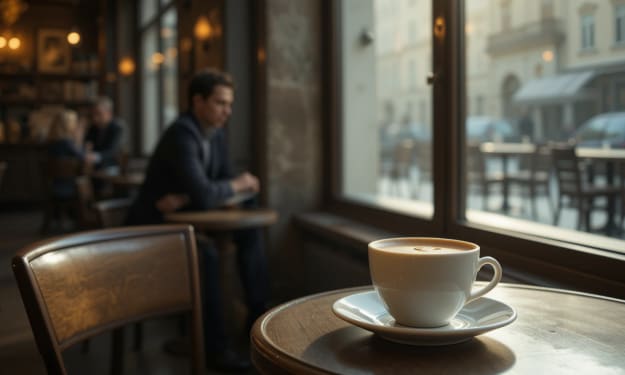
The Ring in Her Coffee Written by Noor Khan Sofia never liked early mornings. But working the 6:30 AM shift at Café Vento in the heart of Florence meant she had no choice. The job wasn’t glamorous—wiping tables, smiling at tourists, and making espressos—but it paid enough to help her cover rent for the tiny attic apartment she shared with her cat, Leo. At 26, Sofia had once imagined herself an art curator or maybe even a travel blogger. But somewhere between her father's heart attack, dropping out of university, and the pandemic that followed, dreams were shelved. Now, every morning, she tied her hair into a messy bun, pulled on the green apron, and served people chasing their own lives. Fridays were her least favorite. Tourists crowded in early, and the regulars didn’t leave tips. On one such Friday morning, her manager shouted from the back, “Special order, table three!” Sofia glanced at the counter. A simple cappuccino, with a cinnamon heart on top. Nothing special. She sighed, picked up the cup, and weaved through the tables. Table three was by the window—the one seat in the café where the sun hit perfectly after 7:15. A man in a navy coat sat there. Clean-shaven, mid-thirties maybe, looking out the window as though waiting for something bigger than coffee. “Here you go,” she said, placing the cup down. He smiled. “Thanks.” She turned to leave when he added, “Do you believe in timing?” She paused. The question was strange. “Like... punctuality?” He chuckled. “No. I mean, life’s timing. Like—things happening exactly when they’re supposed to, even if it doesn’t feel that way?” Sofia gave a polite shrug. “I believe in coffee being on time.” He laughed softly, and she walked back behind the counter, trying not to think about him. ☕ A Week of Coincidences Every day that week, the same man returned. Always table three. Always a cappuccino. And always a question. Monday: “If you could live in any era, which would you choose?” Tuesday: “When was the last time you surprised yourself?” By Thursday, Sofia began to look forward to him. She even made sure his cup had extra foam. He noticed. “Have we met before?” he asked that day. “No,” she said, though part of her wondered too. “You seem familiar,” he added. “Like a page from a book I’ve read.” 🌧️ The Friday Surprise The next Friday, it rained. Florence looked like a watercolor painting smudged at the edges. Fewer tourists, quieter tables. Sofia served two cappuccinos before she saw him again. But something was different. He looked nervous. Fidgeting with his coat buttons. Table three seemed too small for his energy. When she brought his drink, he didn’t ask a question. “You okay?” she asked. He nodded, then pulled something from his pocket. A small black box. Before she could react, he opened it. Inside sat a delicate gold ring with a tiny sapphire, shaped like a teardrop. “Wait—” she began, stepping back. “I know this is crazy,” he said. “But I’ve come here every day for a reason.” “I’m not sure—” “You remind me of someone I used to know. Her name was Elisa. We were supposed to get engaged here in Florence—at this exact café, table three. But she died in a car accident two weeks before the trip.” Sofia’s hand reached instinctively to her apron. “I wasn’t going to come,” he said. “But something kept pulling me. And then you... you look like her. Not exactly, but enough to make me believe again.” “I’m not her,” Sofia said, softly. “I know,” he replied, closing the box. “But you made me feel something I haven’t felt in years—hope.” 📖 The Ending That Wasn't Sofia thought about him all weekend. His story. The ring. The sadness behind his smile. And how—somehow—she’d become part of someone else’s healing. On Monday, he didn’t come. Nor Tuesday. By Thursday, table three felt like a ghost. That Friday, her manager handed her a small envelope left at the counter. It had her name on it. Inside was a handwritten note. > “Dear Sofia, Thank you for reminding me that the world still spins even after the heart breaks. I’m going back home. Starting fresh. I’m not asking you to remember me, but I’ll always remember you. P.S. I left something behind—table three.” She walked to the table. On the seat lay the ring box—open. And under it, a note. > “Give this to someone who makes you believe again
By Moonlit Lettersabout a year ago in Fiction
When the Sirens Stopped
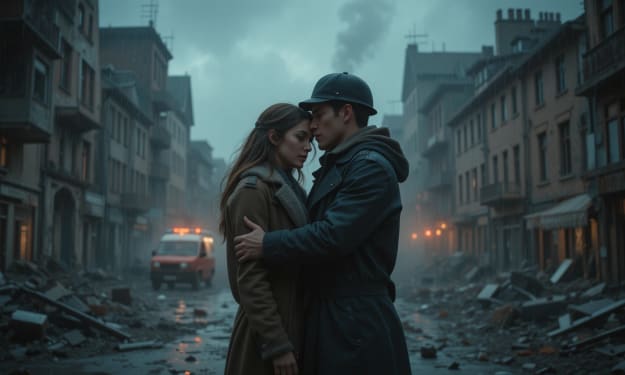
When the Sirens Stopped Written by Noor Khan The air smelled like smoke, and the sky never turned blue anymore. In a shattered corner of Eastern Ukraine, just miles from the frontlines, 22-year-old Lena clutched her backpack tighter and glanced over at Amir. Dust clung to his eyelashes, and his hands trembled as he checked the half-broken radio for updates. The sirens had stopped two days ago, but no one knew whether that meant safety — or silence before the storm. Lena had grown up in Luhansk. She was a university student when the war escalated again, studying literature and dreaming of teaching. Amir was a foreign volunteer medic, half-Ukrainian, half-Turkish, who had arrived to help civilians. Their paths crossed during an airstrike at the local hospital. Amid chaos, their eyes met. She was bleeding from her arm; he wrapped it with a torn shirt and whispered, “You’ll be okay.” She wasn’t. Nothing was. But she followed him anyway. They had been hiding together for eleven days in a collapsed train station basement with no heating, little food, and one flickering flashlight. The city above them was rubble — bones of what once was home. But in that underground darkness, something quietly bloomed. “Do you still think we’ll make it out?” Lena asked one night, her voice barely a whisper. Amir looked at her and smiled faintly. “I don’t think. I believe.” That was Amir. A man of belief. Belief in survival, belief in hope, belief in her. Every few hours, they took turns peeking through a shattered concrete crack above the stairs. Drones still buzzed in the sky. Gunfire echoed like thunder. They scribbled poetry on the back of ration wrappers just to feel human. Then came the twelfth night. They heard footsteps. Loud. Unhurried. Foreign. Amir held his breath and slowly turned off the flashlight. Lena pressed her back to the cold wall, her heartbeat louder than any bomb. The footsteps passed. Then returned. “Russian patrol?” Amir whispered. She nodded silently. They had no weapons. No way to run. Just each other. Suddenly, the footsteps stopped. A voice called out in broken Ukrainian, “We know someone is here. Come out.” Amir grabbed Lena’s hand. “No,” she whispered. “They’ll shoot.” “We can’t stay. We’re out of food. If they find us here, it’s worse.” “But…” “If anything happens—remember your name. And that I love you.” She wanted to scream. Instead, she kissed his forehead, and they stood up together. But fate is strange. As they reached the top of the stairs, a sudden blast rocked the building. Dust rained from the ceiling. The patrol scattered. A nearby apartment tower had been hit — not them. Using the confusion, Amir pulled Lena through a broken side tunnel he had spotted days ago but never dared to use. They ran. Through collapsed corridors. Through narrow alleys lined with burnt-out cars. Through snow dusted with ash. That night, they reached an abandoned Red Cross outpost. It had no doors, no staff, and no medicine. But it had maps. And a working radio. Amir managed to call an NGO in Poland using an old frequency. “Two survivors. One injured. Near checkpoint Bravo 9. Need extraction.” They waited 48 hours in the broken building, feeding on crackers and hope. Finally, a drone hovered above, dropping a flare. Minutes later, a black van appeared from the west — silent, fast, foreign-plated. They were rescued. 💬 Why This Story Matters Lena and Amir now live in Warsaw. She teaches Ukrainian refugee children; he volunteers at a trauma clinic. They still write poems on the backs of receipts. They say war took everything — except what mattered most. Love in a dangerous place is not romance. It's survival. It's staying when everything says to run. It's sharing silence in a room full of fear. It’s believing in life when death is outside your door. Their story never made headlines. But somewhere, in a city still broken, a wall stands with faded graffiti: “The sirens stopped — but we didn’t.”
By Moonlit Lettersabout a year ago in Fiction
The one I couldn't forget. AI-Generated.
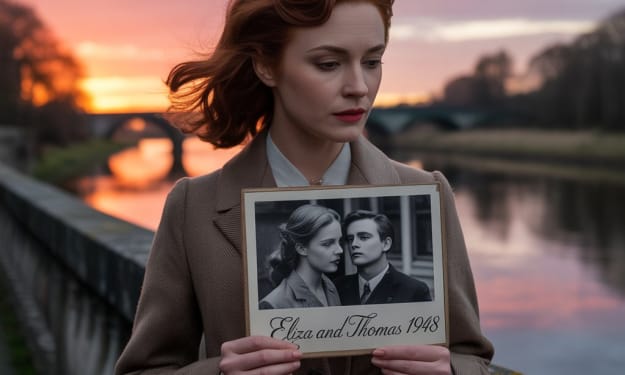
I met Ayaan when I was seventeen. He was sitting alone on the school bench during lunch, reading a book no one cared about. He wore a black hoodie, headphones around his neck, and had a calm, quiet smile that never left his face. Nobody really talked to him. He was that kind of boy — always distant, always somewhere else. But I was curious. One day, I sat beside him and asked, “What are you reading?” He looked at me, a little surprised, and replied, “It’s a story about a boy who travels the world to find what he already has.” I laughed. “That sounds confusing.” He smiled. “Sometimes, life is confusing too.” That was the start of something beautiful. We became friends. Slowly, but surely. Ayaan wasn’t like the other boys. He never made fun of people. He didn’t talk loudly or show off. He listened. Really listened. And when he spoke, his words felt like they came from a deeper place. I started sharing things with him I never told anyone. About my dreams, my fears, and the songs I loved. He told me about the stars, his favorite writers, and how he believed people meet for a reason. He always said, “Everything happens when it’s meant to.” A year passed. Then another. By the time we finished school, we were inseparable. Everyone said we looked good together, but we never said anything about love. It was there, unspoken, floating between our words and smiles. Then came college. We went to different cities. I cried the night before he left. He held my hand and said, “We’ll meet again. This isn’t the end. Just a pause.” We texted every day at first. Then once a week. Then… silence. I don’t know what happened. Life happened, maybe. New people, new places, new dreams. I sent him a message once: “Do you still remember me?” He never replied. I waited. One month. Two months. A year. Still, nothing. It broke me in ways I didn’t understand. How could someone who knew me so well forget me so easily? But life moves on. And so did I. Five years passed. I graduated. Got a job. Made new friends. Smiled in photos. Laughed at jokes. But at night, when everything was quiet, I thought of him. Every bridge I crossed. Every song I heard. Every time it rained. He was there. Like a ghost I never wanted to forget. Then one day, out of nowhere, I got a letter. A real letter, not a message. Just an envelope with my name on it. I opened it with shaking hands. It was from Ayaan. > Dear Zara, I don’t know if this will reach you. I don’t even know if you still live at this address. But I had to try. I’m sorry. For the silence. For disappearing. For making you feel forgotten. You were never forgotten. Life got hard. I lost someone in my family. I couldn’t talk about it, not even to you. I didn’t know how. So I shut the world out. Including you. That was my biggest mistake. I came back to our old school last week. Sat on the same bench. I remembered your laughter. Your questions. Your dreams. You’re the one person I still carry in my heart. I don’t expect anything. I just hope… maybe we could meet again. Even just for a walk. Like old times. If you ever feel the same, I’ll be at the bridge — the one near the lake — this Sunday at 5 PM. If you don’t come, I’ll understand. But I’ll still wait. Yours, always, — Ayaan I read the letter a hundred times. My heart felt heavy and light at the same time. Sunday came. I stood in front of my mirror for an hour. Should I go? Would he really be there? Or was it just another goodbye? I took a deep breath and left. The sun was setting when I reached the bridge. The same colors painted the sky — orange, pink, gold. I walked slowly, my hands shaking. And there he was. Leaning against the railing. Looking at the water. Just like before. He turned. His eyes met mine. And suddenly, nothing had changed. We didn’t speak at first. Just stood there, the silence saying more than words ever could. Then he whispered, “I didn’t think you’d come.” I smiled, my eyes full. “I didn’t think you’d wait.” He pulled something from his pocket — an old photo of us sitting on that school bench. “I carry this everywhere.” Tears ran down my cheeks. “I never forgot you,” I said. “I never stopped loving you,” he replied. We talked for hours. About everything. About nothing. We laughed. We cried. We remembered. That night, as the stars appeared one by one, I realized something: Some people come into your life for a moment. Some stay for a season. But a few — just a few — are meant to stay forever. Even if they leave, even if time passes, their place in your heart never fades. They are the ones you can never forget.
By Asad Ullah khan about a year ago in Fiction
The Librarian's Apprentice
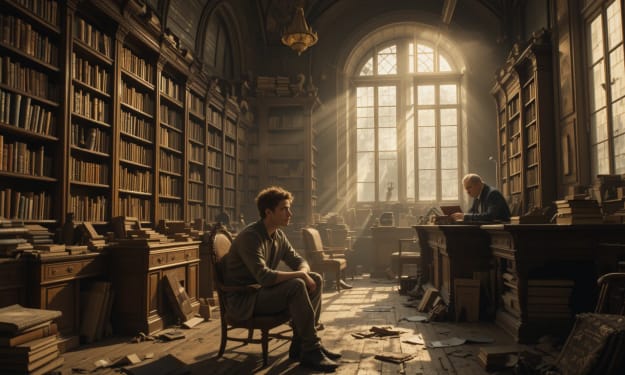
The Librarian's Apprentice Written by Noor Muhammad In a quiet seaside town in Portugal, far from Lisbon’s buzz and the glamour of tourist trails, lived a boy named Luca. He was the son of a fisherman who rarely returned home dry and a mother who worked at a local diner, wiping tables and dreams at the same time.
By Moonlit Lettersabout a year ago in Fiction
The Light Beneath the Streetlamp. AI-Generated.
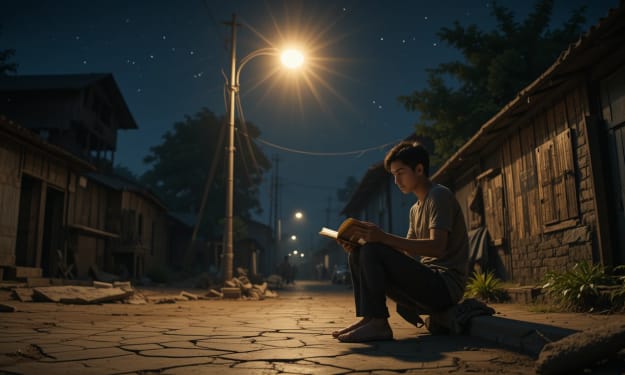
The Light Beneath the Streetlamp Written by Noor Muhammad In the heart of a crowded Pakistani city, where honking rickshaws and endless duststorms ruled the day, lived a boy named Ahsan — a name that meant "perfection" in Arabic, though life had rarely been perfect for him. Ahsan was 17, tall for his age, and had eyes that always seemed to be searching for something beyond the narrow streets he walked every day. He lived in a one-room house with his widowed mother and younger sister. His father had passed away when he was only nine — a construction accident, and just like that, their world broke into pieces no one knew how to fix. There was no inheritance. No savings. Only his mother’s willpower and a tiny job stitching women's clothes for barely 300 rupees a day. But Ahsan had dreams — not the kind that sparkle in movies — the kind made of necessity. He wanted to earn enough to send his sister to school, to buy his mother new glasses, to maybe one day own a home with two rooms and a working ceiling fan. 🌙 Streetlamp Classroom By day, Ahsan sold boiled eggs outside a college gate. Most students ignored him. Some felt sorry. A few bought from him out of kindness. But at night, after he cleaned the small cart and washed hiThes hands with water from a leaking pipe, he sat under the only working streetlamp near his house — his makeshift classroom. An old man once left a torn English grammar book at the tea stall nearby. Ahsan asked if he could keep it. That book became his treasure. Each night, he read the same chapters again and again. He copied words into a notebook made of scrap papers stapled together. Some nights, stray dogs circled him. Other nights, drunk men shouted nearby. But Ahsan kept reading. One day, a college professor who had noticed the egg-seller before, saw him studying under the streetlamp. Curious, the professor approached and asked, “Why are you reading this?” Ahsan stood up respectfully and said, “Because I want to change my life, sir.” The professor was quiet for a moment, then said, “Meet me tomorrow morning. I’ll bring you something better.” 📘 A Push from Fate The next day, the professor handed Ahsan a used smartphone and said, “It’s old, but it has internet. Learn whatever you can.” That phone changed everything. Through free Wi-Fi from the college gates, Ahsan started watching YouTube videos on grammar, freelancing, and even coding. He didn’t understand everything at first. But he tried. And retried. Eventually, he discovered a freelancing platform for writing product descriptions. His English wasn’t perfect, but his work ethic was unmatched. He’d take hours to write what others did in minutes — but clients noticed his dedication. His first payment: $5. Enough to buy a new notebook, a full meal, and a spark of belief. 🌟 Ahsan, The Mentor By the time he turned 20, Ahsan had stopped selling eggs. He was now making over $200 a month — not a fortune, but a lifeline for his family. His sister was in school. His mother no longer stitched at night. And the ceiling fan? It finally worked. But Ahsan didn’t stop there. He started a small WhatsApp group for local boys who had dropped out of school — teaching them freelancing basics, sharing free courses, and encouraging them to read under the same streetlamp that once taught him. One of them got a $20 gig in two weeks. Word spread. Now, every Friday evening, under that very streetlamp, a group of young dreamers gather — notebooks in hand, eyes full of purpose. They call it “The Lamp School.” 💬 Why His Story Matters Ahsan didn’t win a medal. He wasn’t a viral sensation. He had no fancy degrees or foreign sponsors. But he changed lives — quietly, persistently, with nothing but a cracked phone, a streetlamp, and unshakable hope. One of his students once asked him, “Bhai, what if we fail?” He smiled and replied, “Even if we fail, we’ll fail forward.” And that’s the story of Ahsan — the boy who studied in the dark so others could learn to shine.
By Moonlit Lettersabout a year ago in Fiction
The Window Without Glass. AI-Generated.
The Window Without Glass By Noor Muhammad In the dusty corner of a crowded street in Lahore stood a crumbling house with no proper gate, faded paint, and a window that hadn’t seen glass in years. Behind that window lived a boy named Haris. Haris wasn’t the kind of boy people remembered. He wasn’t loud. He wasn’t especially bright in school. He wasn’t athletic or funny. What made Haris different was that he noticed things—quiet things, like the way his mother sighed after folding laundry or how his father’s hands trembled every evening after pushing a fruit cart all day. Their house was small—two rooms, a leaking roof, and a kitchen that barely functioned. The broken window in Haris’s room faced a school playground across the street. Every day, he watched kids in clean uniforms play, laugh, and run freely. He watched them while tying the same worn laces of his school shoes for the third year in a row. But Haris never complained. He had learned early on that complaints didn’t change anything. What changed things was belief. 📻 The Day the Radio Broke One evening, while helping his father repair the old fruit cart, Haris heard something from a nearby shop—an English news broadcast on the radio. He didn’t understand all the words, but he caught some: “global... effort... innovation... future.” Those words stuck in his mind like a song. The next day, he went back to that shop and stood outside until the shopkeeper waved him in. “You like the news, boy?” he asked. Haris nodded. “You understand English?” “Not all. But I want to.” That’s how it started. Every day after school, Haris would stop by the shop and listen for ten minutes. The shopkeeper, amused at first, grew fond of the boy’s curiosity. He gave Haris an old grammar book. “Try learning from this.” And so, Haris did. He practiced verbs and tenses under candlelight. He repeated English sentences in front of the broken window, imagining he was talking to someone on the other side of the world. 💻 An Accidental Discovery At 15, Haris was given a gift by his cousin—an old, barely-working smartphone with a cracked screen and no SIM. But it connected to Wi-Fi. Haris didn’t waste time. He found a free online English course. He watched motivational videos. He discovered Google Translate. He typed slowly, one thumb at a time, and wrote small paragraphs about his life just to see how they sounded in English. Then one night, while browsing YouTube, he found a video titled: “How to earn money online through writing.” His heart skipped a beat. He clicked. That video changed his life. ✍️ His First Story He spent three days writing his first story—about a boy who wanted to fix his broken window and see the world clearly. It was fictional, but it was also him. He submitted it to a small writing website. Days passed. Then came an email: “Your story has been accepted.” They didn’t pay him. But they published it. And that was enough. He wrote another, and another. People left comments: “This moved me.” “You have a gift.” “Keep writing.” He cried the night someone messaged him from Canada saying, “Your story reminded me of my childhood.” 💡 When Hope Became Purpose Haris saved enough from online gigs—rewriting blogs, editing captions, translating Urdu essays—to buy a better phone. He started a blog. He posted quotes and small fictional stories in English and Urdu. His followers grew. At 18, he applied for a remote internship with a digital magazine. The editor wrote back: “We don’t usually hire people your age... but your writing feels real.” He got the job. 🌍 The View Now Today, Haris still lives in the same house. The window is still there, still without glass. But now, he sees more than just the playground. He sees messages from readers in Indonesia, Pakistan, even Germany. He sees story ideas. He sees freedom. He teaches writing to younger kids in his neighborhood. He tells them, “Your words are more powerful than your wallet. Never forget that.” One evening, while watching the sunset through that same old window, his little brother asked, “Will we ever live in a better house?” Haris smiled. “We already do. It's not the walls that matter. It's what lives inside them.”
By Moonlit Lettersabout a year ago in Fiction
The Tides of Rome
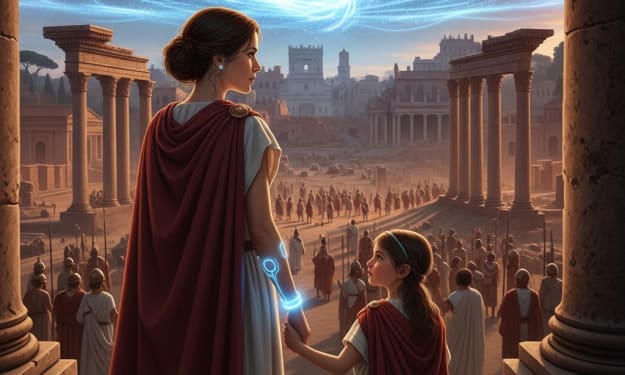
Title: The Tides of Rome In the year 2493, history was no longer confined to books and digital archives. Thanks to the invention of the Temporal Corridor, time travel had become possible—but only for a carefully chosen few. These were not tourists or adventurers, but highly trained specialists whose mission was to preserve, observe, and never interfere.
By Malik BILALabout a year ago in Fiction