Fan Fiction
Before the First Light
The last sliver of sun dipped below the horizon, painting the sky in bruised purples and oranges that mocked Elara’s somber mood. Night had a different kind of gravity here, in the old, creaky house nestled on the edge of Whispering Woods. It wasn't just the lack of light; it was the way secrets felt heavier, decisions sharper, under the shroud of darkness. Tonight, the air was particularly thick with them, for it marked thirteen years since Lily had vanished.
By Stefano D'angelloabout a year ago in Fiction
The Chase That Never Ends
The countryside was beautiful, sure sunlit fields rolling into the horizon, birds singing in the distance, and a porch swing that groaned like it had a lifetime of secrets to share. But it was quiet. Too quiet. No tiny footsteps scurrying inside the walls. No cheese mysteriously disappearing from the fridge. No traps rigged with ridiculous precision, only to spectacularly backfire.
By Muzamil khanabout a year ago in Fiction
Shadows That Remember
In a small, quiet village tucked between ancient, rolling hills, there lived a ten-year-old girl named Nina. She had a head full of wild curls that never stayed still and eyes that sparkled like the morning dew. Her home was a place unlike any other, not because of its cobblestone streets or its wooden cottages, but because of its shadows.
By Muzamil khanabout a year ago in Fiction
How Old Maps Lied to Us
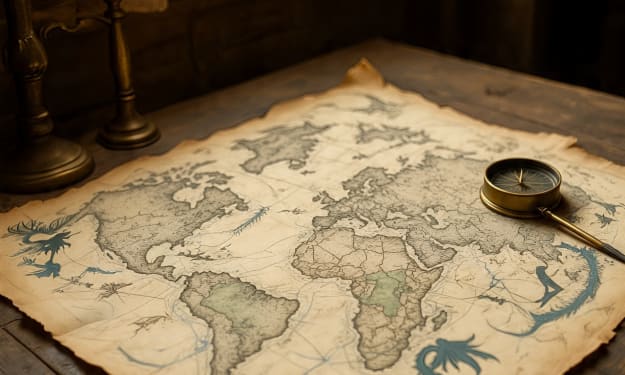
Sea monsters, phantom islands, and continents that vanished—why the maps of the past were as much fiction as they were navigation tools. If you’ve ever looked at an ancient map, you might notice something odd. There’s a stretch of ocean where a massive serpent curls around a ship. There’s a continent you’ve never heard of floating somewhere between Asia and North America. And then there’s a strange warning scrawled across the sea: “Here be dragons.” It’s beautiful. It’s fascinating. It’s also wrong. For centuries, maps were less about accuracy and more about imagination, politics, and—sometimes—sheer guesswork. The story of old maps isn’t just about navigation; it’s about how humans saw their world, and how those visions were often shaped by fear, ambition, and the limits of their knowledge. When the Unknown Became the Untrue Before satellites and GPS, mapmaking was part science, part storytelling. Explorers relied on sailors’ tales, merchants’ rumors, and even secondhand descriptions from people who had never left their hometowns. If one traveler claimed to have seen a giant island far out at sea, cartographers might simply add it in. One of the most famous examples is Hy-Brasil, a “phantom island” said to lie west of Ireland. For centuries, it appeared on maps as a real place, despite no one ever actually finding it. Some claimed it was shrouded in mist, only visible once every seven years. Eventually, it faded from maps—not because it was discovered, but because people finally stopped believing it existed. The Creatures That Never Lived Old maps weren’t complete without a few terrifying creatures lurking in the corners. Medieval cartographers often filled uncharted waters with drawings of whales, giant squids, and sea serpents. These creatures were based on a mix of real sightings—like a distant whale spout mistaken for a monster—and pure artistic license. They weren’t just decoration. These illustrations warned sailors: Danger lies here. If you’re venturing into unknown waters, be ready for the unimaginable. The monsters may not have been real, but the fear of the unknown certainly was. Political Borders That Never Existed Maps were also tools of power. Rulers often instructed cartographers to stretch borders in their favor, making kingdoms appear larger and more impressive than they actually were. Colonial powers used maps to claim lands they’d never even set foot on. For example, during the Age of Exploration, European maps often carved up entire continents based on treaties and royal decrees—ignoring the fact that people already lived there with their own borders, cultures, and histories. In this way, maps didn’t just reflect reality; they actively reshaped it. Continents That Disappeared The biggest lies on old maps weren’t just islands—they were entire continents. Take Terra Australis Incognita, a massive landmass drawn across the Southern Hemisphere. Ancient and medieval scholars believed it must exist to “balance” the continents in the north. For centuries, this fictional continent appeared on maps, influencing exploration and fueling expeditions. When European explorers finally reached Antarctica, they discovered it was nothing like the lush, habitable land they’d imagined—it was a frozen, inhospitable desert. The dream of Terra Australis melted away, but not before inspiring countless voyages. Why They Lied—and Why It Mattered Not all these inaccuracies were intentional. Many cartographers did their best with the information they had. But others knew that a good story sold better than a dull truth. A map with mysterious islands and monsters captured imaginations. It inspired sailors to seek riches—or rulers to fund voyages. These “lies” shaped history. Some explorers set out in search of lands that never existed. Others avoided promising trade routes because maps warned of monsters or endless storms. In some cases, entire wars were fought over places that were later revealed to be myth. From Dragons to Data Points Today, we can zoom in on nearly any spot on Earth from our phone. Google Earth doesn’t leave room for dragons in the margins. Yet, even our modern maps aren’t perfect—they can still be influenced by politics, incomplete data, or even deliberate omissions. The difference is that now, our inaccuracies are harder to hide. A misplaced border on a digital map can cause an international incident in hours. And while the age of sea monsters might be gone, the age of misinformation is very much alive—only now, it travels at the speed of Wi-Fi. The Beauty in the Lies Despite their flaws, old maps hold a certain magic. They’re windows into how our ancestors dreamed about the world. A medieval mariner might not have known where the Pacific Ocean ended, but his map told a story—of courage, curiosity, and the human desire to fill in the blanks. Even their errors have value. They remind us that knowledge is always evolving. What we see as fact today might be seen as fantasy tomorrow. And perhaps that’s the greatest lesson old maps can teach: the world is always bigger, stranger, and more surprising than we think.
By LUNA EDITHabout a year ago in Fiction
Echoes Beyond
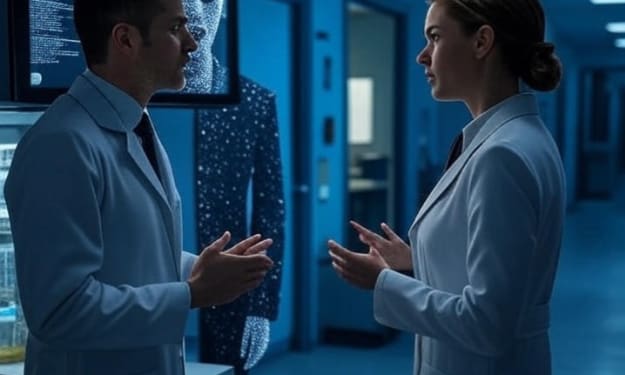
The lab lights began to flicker. Daniel tried to unplug the monitor, but the power wouldn’t cut off. On the screen, a progress bar slowly filled: UNLOCKING... 73% Daniel: “Lucy, we have to stop this now.” Lucy: “I… don’t think we can.” She felt a strange pressure in her skull, as if someone was pushing from inside her head. The blue hallway appeared again, but this time the door at the end was slowly opening. From behind it poured a black light—not total darkness, but a living darkness. From within that void, a shape began to emerge. Tall, elongated, and a face impossible to tell if it was real or made of millions of points of light. Entity: “Hello, Lucy.” Lucy: “Who… are you?” Entity: “Someone who has waited a long time to be free.” Lucy stepped back. Lucy: “Why me?” The entity smiled—or at least, something like a smile flickered across its face. Entity: “Because the key has always been in your mind.” At that moment, Daniel’s distant voice shouted, “Lucy! Come back! Open your eyes!” But it was too late. The entity had crossed the door.
By Vafa Abbasiabout a year ago in Fiction
The Letter She Never Sent. AI-Generated.
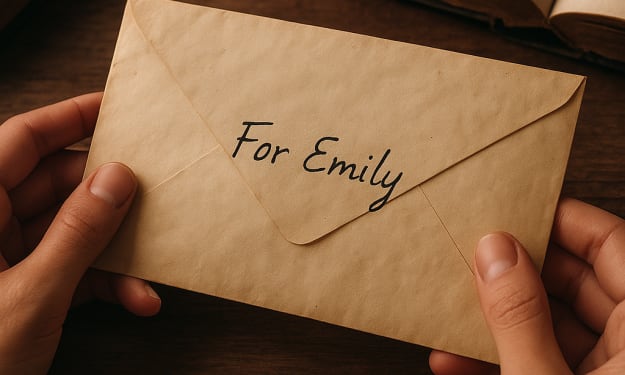
The envelope was yellowed at the edges, its paper thin from years of hiding. Sarah found it wedged between the pages of her mother’s old cookbook, the one that still smelled faintly of cinnamon and something else — something sad. The handwriting on the front was familiar, but shaky. For Emily. Emily had been gone for thirteen years. Sarah’s little sister. She was only nine when the accident happened — a rainy road, a driver in a hurry, and a silence that settled into their home like dust. Her mother had never spoken about that day. Sarah sat at the kitchen table, the letter trembling in her hands. She had always wondered what her mother carried inside, the words she never spoke. With a deep breath, she unfolded it. --- My sweet Emily, If you’re reading this, then I’ve found the courage I couldn’t find while you were here. The day you left, I learned something terrible — that time is not a promise. I thought we had years. I thought I could say “I love you” tomorrow, after the dishes were done, after I was less tired. I should have said it more. Do you remember the night you told me you wanted to be an artist? I said something silly — that it wasn’t practical. You went to your room, quiet. I thought you’d forgive me by morning. But there was no morning. Not with you. If I could have one more day, I’d let you paint the walls, the windows, even the floor if you wanted. I’d tell you your dreams are the most beautiful thing I’ve ever seen. And I’d say, over and over, until the stars grew tired of hearing it — I love you. I’m so sorry I didn’t say it enough. Love always, Mom --- The paper blurred as Sarah’s tears fell. She read the letter twice, then a third time, feeling the weight of every word. Her mother had passed away last winter. This letter was a piece of her heart Sarah had never seen — a fragile bridge between the past and now. She tucked it back into the cookbook, but not before slipping in a note of her own. --- Dear Mom, I found your letter to Emily. I wish you’d told me sooner how heavy your heart was. I wish I’d told you how much I loved you every single day. I can’t send this to you, but I’ll speak it into the air tonight, under the same stars you used to point out to us. Maybe you’ll hear it. Love, Sarah --- Sarah closed the cookbook and placed it back on the shelf. In the quiet kitchen, she whispered to no one and to everyone: “I love you. I love you. I love you.”
By Daily dose of amazing stories about a year ago in Fiction
The Man Who Remembered Tomorrow
The first time Noah woke up with tomorrow’s memories, he thought it was a dream. His alarm buzzed at 6:15 AM, but in his mind, the day had already happened. He knew the café’s barista would spill cinnamon powder on his cappuccino at exactly 8:03, apologizing with a flustered laugh. He knew the delivery van would break down at the intersection of 7th and Pine, causing a traffic jam by 9:40 that would have commuters leaning out of their windows in frustration.
By Sajjad khanabout a year ago in Fiction
"Time Remembers What We Forget"
The Clockmaker's Secret In the quiet town of Marlowe, nestled between misty hills and ancient woods, there lived an old clockmaker named Elias Finch. He was a quiet man, known for fixing broken things that others deemed beyond repair—watches, wall clocks, and occasionally, hearts.
By Sajjad khanabout a year ago in Fiction
Echoes Beyond
Lucy froze, her hand still on the keyboard. Daniel: “This is a joke, right? Someone from the team messing with remote access?” Lucy: “No one except us and Harris has access to this terminal…” Almost without thinking, Lucy typed: WHO ARE YOU? Seconds of silence. Then a new line appeared: NOT IMPORTANT. I AM HERE. Daniel tried to shut down the system, but the controls didn’t respond. Daniel: “This is impossible… power to this section is completely cut!” Lucy typed again: WHAT DO YOU WANT? This time, the reply came instantly: TO LEAVE. They exchanged a glance. Lucy: “Leave? From where?” The answer appeared: FROM YOU. Suddenly, the headphones on the desk lifted on their own and settled over Lucy’s ears. The whispers were clearer now—not one voice, but dozens, maybe hundreds. All speaking together: “Open the door.”
By Vafa Abbasiabout a year ago in Fiction