Fan Fiction
The Last Train at Midnight
M Mehran Ethan was the kind of man who always missed things by a minute. He missed the bus by a minute, the elevator by a minute, even his father’s last phone call by a minute. Life had taught him to live with regret like a second skin. On his thirty-fifth birthday, after a long, bitter day at work, he found himself wandering the city streets aimlessly. That’s when he saw the train station—not the modern one, but an old building tucked between skyscrapers, its brickwork faded, its clock tower frozen at midnight. He had never noticed it before. Curious, he stepped inside. The hall smelled of coal and rain, though no one else seemed to be there. The ticket booth glowed faintly, and behind the glass sat a woman with hair the color of snow. “One ticket?” she asked, her voice echoing. Ethan frowned. “To where?” “Wherever you regret not going.” Something inside him lurched. He almost laughed, but her expression was too steady, too certain. Against his better judgment, he nodded. The woman handed him a slip of paper with no destination, only the words: Last Train. Midnight. When he stepped onto the platform, a black train was waiting. Steam curled from its engine, and its doors hissed open as though inviting him in. He boarded, heart pounding. Inside, the compartments were filled with people he recognized—not strangers, but versions of himself. There he was at fifteen, clutching his guitar with calloused fingers. At twenty-one, running breathless toward a girl he’d never confessed his love to. At twenty-eight, staring at a job offer he had turned down because he was afraid. Each version looked at him with eyes that burned with disappointment. “What is this?” Ethan whispered. The conductor appeared—a tall man in a dark uniform, his face hidden by shadow. “This is the train of missed chances,” he said. “Every regret you carry boards here. Tonight, you decide if you will ride with them forever, or leave them behind.” The train lurched forward. Through the windows, Ethan saw scenes flashing by—his past choices unfolding like film reels. The girl in the café he never spoke to. The audition he skipped. The letter to his father he never mailed. The weight of it crushed him. He buried his face in his hands. “Can I change any of it?” he asked hoarsely. The conductor’s voice was firm. “No. But you can stop riding the same tracks.” The words sank deep. Ethan looked at the versions of himself, their eyes haunted. Then he did something he’d never done—he stood. “I can’t take you with me,” he whispered. “You’re part of me, but you don’t own me anymore.” One by one, the other Ethans faded, until the compartment was empty. The train screeched to a halt. The conductor tipped his hat. “Then your stop has come.” Ethan stepped off onto a platform that glowed with morning light. The old station was gone; he stood in the real city again, his heart strangely light. For the first time in years, he wasn’t a minute late. He was exactly where he needed to be.
By Muhammad Mehranabout a year ago in Fiction
The Painter of Memories
M Mehran Elena lived in a small town where life moved quietly, like the slow river that curved through its center. She worked at the post office, sorted letters, and stacked packages. To most, she was invisible, a pair of hands behind the counter. But at night, she painted. Her apartment smelled of oil and turpentine. Canvases leaned against the walls, crowded with half-finished portraits—faces of people she had seen only once in her life. The man who rode the bus with a torn hat. The old woman who fed pigeons by the church. The girl in the red raincoat, laughing on her phone. Elena remembered them all, and her brush captured them with frightening precision. But what no one knew—not even Elena—was that her paintings didn’t just capture. They kept. One autumn evening, as orange leaves chased each other along the sidewalks, a stranger came to her door. He was tall, with gray eyes and a long coat that looked older than time itself. He carried no umbrella, though rain clung to his shoulders. “Elena Voss,” he said, his voice deep and steady. “You’ve been painting memories that don’t belong to you.” Her stomach tightened. “I don’t know what you mean.” The man stepped inside as though invited. His presence filled the small room, and the ticking of her wall clock seemed suddenly loud. He gazed at her canvases one by one, his eyes unreadable. “Every soul carries its own history,” he said softly. “But when you paint, you pull pieces of those histories into your own world. Fragments that were never yours to hold.” Elena felt dizzy. She looked at the portraits—at the woman on the park bench, the man with the roses, the child chasing a kite. Her chest tightened with a strange guilt. “I never meant to steal anything,” she whispered. The man’s eyes softened. “I believe you. But intention doesn’t erase consequence. Do you know what happens when you carry too many fragments?” Elena shook her head. “You forget your own.” The words cut deep. She tried to recall her childhood bedroom, the scent of her mother’s perfume, her father’s laughter. The images were blurry, slipping like water through her fingers. She gasped. “I don’t… I can’t remember.” The man touched one of her canvases gently. “It’s not too late. But you must choose which memories are truly yours, and return the rest.” “How?” He handed her a brush she had never seen before. Its handle was carved from dark wood, its bristles shimmering faintly as if woven from light. “Paint the truth. Only then will you find yourself again.” Elena hesitated, then sat before a blank canvas. Her hands trembled as she dipped the brush into color. At first, images of strangers surged forward—faces, gestures, places that weren’t hers. She pushed them aside and searched deeper, painting the cracked tiles of her grandmother’s kitchen, the smell of bread rising in the oven, the way her brother’s laughter echoed when they chased fireflies in the yard. The memories burned as she painted, bright and painful, but real. With every stroke, fragments of strangers slipped away, returning to the world where they belonged. The portraits on her walls began to fade, their colors dissolving like mist. Hours passed, though time felt strange, elastic. When she finally set the brush down, the room was almost bare. Only one painting remained—a self-portrait, raw and imperfect, but alive with truth. Elena fell back, exhausted, but her heart felt lighter. For the first time in years, she remembered who she was. The gray-eyed man picked up the brush and tucked it inside his coat. “You’ve done well,” he said. “Guard your gift carefully. Memory is powerful, but it was never meant to be borrowed.” As he turned to leave, Elena called out. “Wait! Who are you?” He paused at the door, rain glistening behind him. “A librarian of sorts. I keep the shelves of time from collapsing.” His eyes flickered with something like sorrow. “And you nearly tipped one over.” Then he was gone. Elena sat alone, her gaze on the self-portrait. The woman on the canvas stared back at her, weary but unbroken. She smiled faintly. Outside, the rain stopped. The streets gleamed under the lamplight, and the slow river carried the town’s reflections away. Elena closed her eyes, holding her own memories close, determined never to lose them again.
By Muhammad Mehranabout a year ago in Fiction
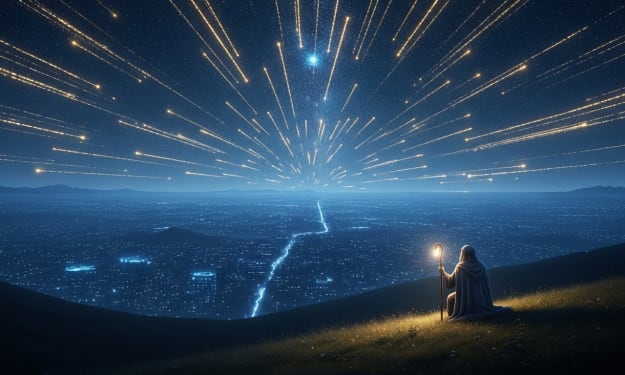
The Data Stream Shepherd
Leo’s world was a river of light and sound, a ceaseless, chattering current known as the Data Stream. His title was Senior Stream Analyst, Third Shift. Most called him a glorified janitor. His office was a dim cubicle on the 214th floor, and his purpose was to watch the flow—endless lines of code, consumer metrics, communication packets, and digital debris—and ensure the weirs and filters were clear. It was a job of profound loneliness, surrounded by the noise of seven billion people.
By Habibullahabout a year ago in Fiction