family
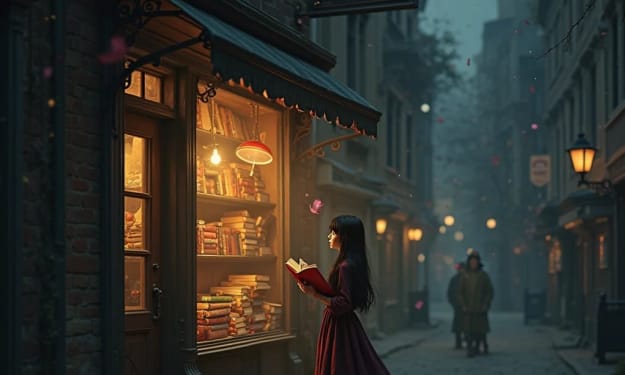
Whispers in the Bookshop: chapter 6
That night, Mara couldn’t sleep. The journal lay on her nightstand, closed but humming in her mind like a song she couldn’t forget. Her grandmother’s words clung to her chest. Each entry had revealed a different shade of Evie—a woman who had hidden longing beneath wit, who had fallen deeply and quietly in love.
By Muhammad Sabeelabout a year ago in Fiction
Love at First Sight
had never believed in love at first sight. To me, love was a slow-burning fire, built over time and familiarity. I’d scoffed at rom-coms, rolled my eyes at sappy novels. Love, I thought, was forged through trials, not lightning strikes. But everything I knew shattered the moment I saw her. It was a rainy Thursday afternoon in late October. I was running late to my best friend’s gallery opening downtown, rushing across puddled sidewalks and dodging umbrellas. The gallery was tucked between a forgotten bookstore and an abandoned laundromat—one of those hidden gems only true artists knew existed. I stepped inside, shaking off the cold, when I caught sight of her. She wasn’t even looking at me. She stood alone in front of a painting—one of those abstract swirls of color and chaos that usually made no sense to me. But the way she stood there, head tilted slightly, hands tucked into the sleeves of her oversized coat—it was as if she and the painting shared a secret. Something in my chest shifted. She turned, and for a moment—just a moment—our eyes locked. Green. Bright, curious, alive. Her lips curled into the faintest smile, as if she recognized me from a dream we hadn’t had yet. I felt like I’d walked straight into a song, one I’d never heard but somehow knew by heart. I should’ve said something. I should’ve walked right up and introduced myself. But I froze. She moved on, disappearing into a crowd of half-drunk art lovers and the clinking of cheap wine glasses. I lost her. I spent the next thirty minutes pretending to admire paintings while scanning the room for her. But she was gone. Disappointed, I stepped outside again, the rain now gentle, as if the sky, too, had softened. I stood under the awning, trying to shake off the strange ache in my chest. That’s when I heard the voice. “You didn’t like the paintings, did you?” I turned, and there she was—coat zipped up, hair damp, a knowing smirk on her lips. I laughed, caught off guard. “They weren’t exactly... my thing.” She grinned. “Same. I just come for the free wine and weird conversations.” “Did we have one yet?” “Not yet,” she said, extending her hand. “I’m Ava.” I took it, still stunned. “Liam.” We walked. No destination, just streetlights and soggy sidewalks. We talked about everything—books we hadn’t read, places we hadn’t visited, childhood dreams that never quite died. She told me she wanted to open a plant shop, even though she couldn’t keep a cactus alive. I told her I used to write poetry but was too afraid to share it. It didn’t feel like we’d just met. It felt like we were continuing a conversation that had begun long before we were born. Weeks passed. Then months. And the more I got to know her, the more surreal that first moment felt—like the universe had paused just long enough for our paths to cross. And when I finally kissed her, under the same gallery awning where we’d re-met, the world stilled again. Just like the first time. People still ask me if I believe in love at first sight. I smile every time. Not because I believe in fairy tales, but because I lived one. And maybe it wasn't magic in the traditional sense. Maybe it was timing. Maybe fate. Or maybe just two people seeing something in each other that the world had hidden until then. But I know this much: The moment I saw her, something in me whispered, There you are. And I’ve been listening ever since. In a world of noise and chance, love found its voice in a glance—and never stopped speaking since.
By Dr Gabriel about a year ago in Fiction
The Firefly That Never Dies
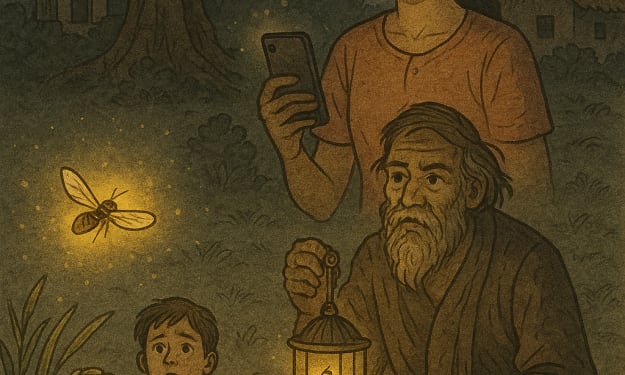
Every summer, the people of Durgapur spoke of the never-dying firefly. Even in the heaviest downpours, it danced just above the paddy fields and glowed brighter than the moon. It was thought to be the spirit of a long-dead saint who looked after the land, blessed the crops, and punished those who broke the rules.
By Ahmed Rayhanabout a year ago in Fiction
The Library Under the Stairs
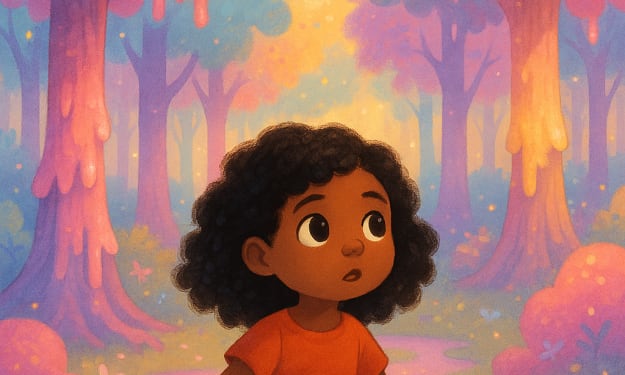
The rain hadn’t stopped in three days. Thick grey clouds hung over the village like an old woolen blanket, heavy and unmoving. Noor sat on the window sill of her grandmother's house, staring out into the garden that now looked like a swamp. The move had been sudden—her father said it was for a fresh start after her grandmother passed. But the house smelled like old wood, mothballs, and silence.
By Mian Nazir Shahabout a year ago in Fiction
The Weight of Ambition
In the glittering halls of Sydney’s most prestigious convention center on June 3, 2025, motivational speaker Victor Kane delivers his signature seminar, Unleash Your Limitless Potential, to a rapt audience of 2,000. His mantra—“Push beyond fear, break every boundary, claim your empire”—has made him a global icon, his books topping bestseller lists. But beneath the charisma lies a dark truth: Victor’s methods, rooted in relentless pressure and psychological manipulation, have driven followers to madness. When a former student, now broken and vengeful, emerges to confront him, Victor must face the devastating consequences of his own teachings. This story weaves the allure of ambition, the psychology of influence, and the haunting beauty of a reckoning into a gripping tale.
By Shohel Ranaabout a year ago in Fiction
The Waterpark
‘Dad! Dad!’ Ben cried as he and Billy ran across the park, ‘can we go on the Crush ’n Gusher?’ Jim was hating life ‘On you go’ his wife Rosie chuckled, ‘you take the boys and I’ll hold down the fort with Stacy.’ Ben and Billy dragged Jim across Typhoon Lagoon to stand in line for an age just to spend thirty-seconds going breakneck speed down a plastic pipe into something that resembled water.
By Alan Walkerabout a year ago in Fiction
She Was Everything I Thought the Lady in Red Could Be
I consider myself a pretty logical person most of the time, I trust reason, facts, and the kind of clarity that can only come from stepping back and assessing a situation from every angle. But recently, I found myself in a position where logic could ruin something… something beautiful. And that’s a terrifying thought. Because logic, for all its comfort and certainty, can’t always see the bigger picture.
By Ruth Girma about a year ago in Fiction
A Woman’s Journey of Love, Laughter, and Advocacy
In the bustling streets of Sydney, where the hum of ambulances often blends with the city’s heartbeat, Amara Jenkins found her purpose—and her love—through an unexpected blend of goofiness and grit. At 34, Amara, a paramedic with a quick smile and a quicker wit, had spent years racing against time to save lives. But when a tragic loss shook her world, she channeled her grief into a fight for change, advocating for Steve’s Law, a proposed legislation to protect first responders from abuse in Australia. Along the way, she discovered that love, with all its quirky, playful moments, could be the pulse that keeps us going, even in the face of heartbreak. This is Amara’s story—a journey of laughter, love, and the courage to stand up for those who run toward danger.
By Shohel Ranaabout a year ago in Fiction
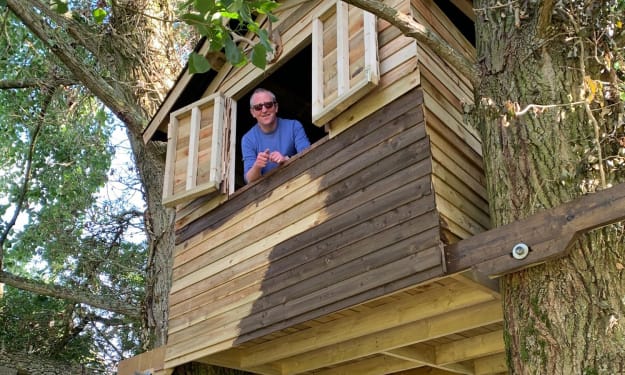
"We grew up, but the treehouse waited."
We grew up, but the treehouse waited. It stood at the edge of Grandpa’s orchard—an old wooden shelter nestled in the gnarled arms of a sycamore tree. The steps had once been planks nailed unevenly along the trunk, and its roof was patched with mismatched shingles that Dad and Uncle Ray had salvaged from the barn. To anyone else, it looked like a crooked shed stuck in a tree. But to us, it was everything. We built that treehouse when I was eight and Lily was six. Every summer, we’d climb into it with peanut butter sandwiches, comic books, and wild imaginations. Some days it was a pirate ship; others, a castle under siege. The treehouse was never just wood and nails—it was our world. It held secrets, laughter, and sometimes even tears we didn’t want adults to see. But childhood doesn’t stay forever. Time doesn’t knock—it just takes. After Dad passed away when I was fifteen, we stopped going to the orchard. The treehouse began to blur into the background like an old dream. I moved away for college, then for work. Lily stayed in town for a while, took care of Mom, then eventually left too. Life moved on—new homes, new relationships, new responsibilities. The orchard was sold after Grandpa passed. I didn’t think I’d ever see the treehouse again. Until last month. Mom’s health had started to fade, and I flew back to say goodbye. Lily and I found ourselves driving through the old roads after the funeral, barely speaking. Everything felt heavy—like grief had woven itself into our silence. Then she turned down a familiar path. I didn’t question it. We knew where we were going. The orchard gate was rusted shut, but we climbed over it like we used to when we were little and trying to sneak cookies from the kitchen. The grass was taller, the trees wilder, but the sycamore stood there just as we’d left it—bending slightly under age and time. And there, impossibly, the treehouse. The paint had peeled, the door hung crooked, and ivy had begun to crawl up its legs. But it was still there. Waiting. We stared at it for a long time. Finally, Lily whispered, “Do you think it remembers us?” I smiled sadly. “Maybe. We left enough of ourselves in it.” We climbed up—carefully, like old friends greeting each other after years apart. Inside, the floor creaked beneath our weight, and dust danced in the sunlight coming through the gaps. But on one of the walls, still faintly visible, was the drawing of our initials inside a lopsided heart. Beneath it: “Forever Pirates.” I felt something crack inside me—a memory, maybe, or a piece of my heart I hadn’t known was missing. “I thought we lost all this,” Lily said, her voice trembling. “We didn’t,” I said. “We just stopped looking.” We sat there for hours. Talking. Laughing. Crying. Not just about Mom or Dad, but about everything. About how fast life pulls you away from the people and places that made you. Before we left, I looked back one more time. The treehouse stood quiet, its wood weathered but strong. And I realized—it hadn’t been waiting to be remembered. It had been remembering us all along.
By Dr Gabriel about a year ago in Fiction