family
Lisa’s Birthday Wish
Lisa sat on the edge of the narrow twin bed, her children bundled beneath a single quilt. Ciara, five years old and already fiercely protective of her younger siblings, clung to Lisa’s arm even in sleep. Liam lay sprawled on his stomach, one chubby hand gripping the battered toy car he carried everywhere. Marie, the baby of the family, was curled against Lisa’s hip, her tiny fingers still sticky from the crackers they’d shared for dinner.
By Rebecca Daughertyabout a year ago in Fiction
Chaos Celebration Part Two
Reverse to Part One By the time Colin got to the hospital, Brooklyn had been taken back to a room. Fast service was an advantage to living in a small town. While the actual facility wasn’t huge, they were fully able to take care of an accident like Brooklyn’s in a timely manner. For anything more involved or critical, they were stabilized and transported to a larger hospital.
By Reb Kreylingabout a year ago in Fiction
Chaos Celebration Part One. Top Story - September 2025.
“So, what are you doing this weekend?” Colin asked as he watched Lincoln begin to gather his scattered belongings. The two men had been hanging out in Brewing Books all morning while Colin waited for his shift and Lincoln worked on plotting his book.
By Reb Kreylingabout a year ago in Fiction
The Secrets My Mother Kept
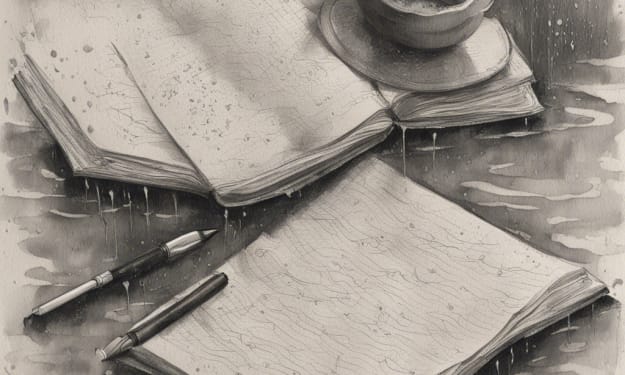
The Morning Light August 19, 2005 The beach stretched endlessly in both directions, a ribbon of silver sand unmarked by footprints or debris. It was that liminal hour just before dawn when the world held its breath, suspended between night and day. The lighthouse at the far end of the bay had already stopped its rotation, leaving only the faintest echo of its beam painting ghosts across the water.
By Parsley Rose about a year ago in Fiction
The Cog-Boy of Aethel. AI-Generated.
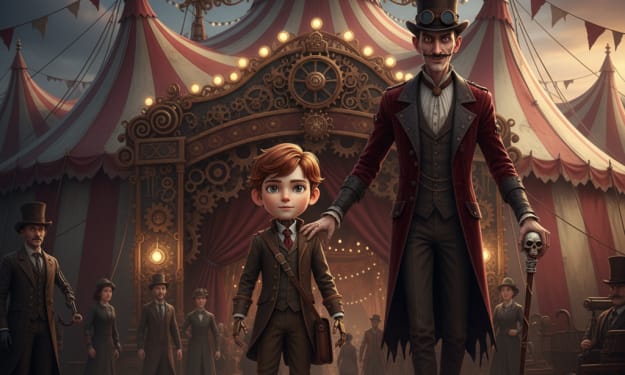
Three days later, Cogsworth made his decision. He left the Academy during the lunch period, slipping away while Sarah Chen was distracted by a complex alchemical equation. His brass-shod feet carried him through Aethel's winding streets with mechanical certainty, even as his decision circuits churned with uncertainty.
By Shane D. Spearabout a year ago in Fiction
The Train That Never Stops
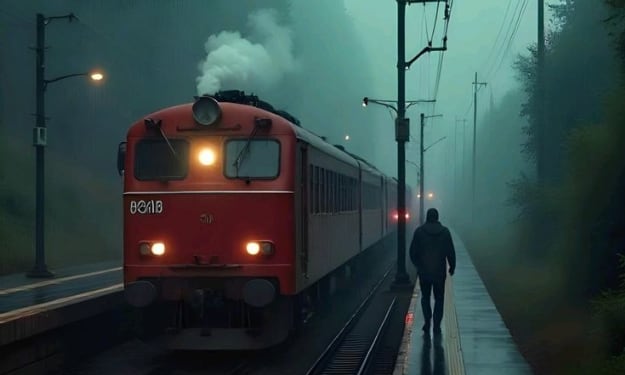
M Mehran Every night at exactly 2:13 a.m., Sam heard the train. It was impossible. The town’s railway station had been closed for nearly twenty years, the tracks long abandoned, weeds curling around the rusted rails. Yet, like clockwork, the whistle echoed through the valley, low and mournful, followed by the distant rattle of wheels. Sam never told anyone. They’d laugh, say it was the wind or his imagination. But he knew what he heard. And deep down, he knew it was calling him. On the anniversary of his father’s death, sleepless and restless, Sam finally gave in. He pulled on his jacket and followed the sound. The moon was high, silvering the broken tracks as he walked. When the whistle blew again, he froze. Up ahead, where the station had crumbled into nothing but brick skeletons, a train stood. Its cars gleamed midnight black, polished as if fresh from the factory. Golden lamps burned in the windows, and steam hissed softly into the night air. The sign above the station—long fallen years ago—glowed faintly with words he could barely read: The Midnight Line. The doors opened with a sigh. Sam’s heart pounded. He should have run, but grief and curiosity overpowered fear. He stepped inside. --- The train was alive with light. Velvet seats lined the compartments, chandeliers swayed gently above, and an old-fashioned bar sparkled with crystal glasses. Yet no passengers filled the seats. Only shadows lingered, faint outlines that dissolved when he looked too closely. At the far end, a conductor in a crisp uniform waited. His face was obscured beneath the brim of his cap, but his voice was smooth as polished wood. “Welcome aboard, Samuel.” Sam stiffened. “How do you know my name?” The conductor smiled faintly. “I know every traveler who boards. The Midnight Line runs only for those who need it.” Sam swallowed hard. “Need it for what?” The conductor tilted his head. “To visit what they’ve lost.” Sam’s breath caught. His father’s face surged in his mind—his laughter, his rough hands, the way he used to ruffle Sam’s hair before bed. “Is he here?” Sam whispered. The conductor stepped aside, gesturing toward the corridor. “Your destination awaits.” --- Sam moved from car to car. In the first, he saw a child clutching a tattered teddy bear. She looked up with wide, tearful eyes. For a heartbeat, he thought she was real—but she faded into mist, leaving only the bear behind. In the next car, an old woman hummed a lullaby. Her voice broke into silence before she too dissolved. Each car held echoes of people long gone, fragments of memory caught in the train’s current. Sam’s chest ached as he passed them, the air thick with longing. Finally, he reached the last car. There, seated at a table by the window, was his father. Solid. Whole. Just as he remembered—broad-shouldered, tired eyes, a gentle smile when he saw Sam. For a moment, Sam couldn’t breathe. His knees buckled, and he sank into the seat across from him. “Dad?” “Hey, kiddo.” His father’s voice was exactly the same—warm, steady. “Took you long enough.” Tears blurred Sam’s vision. “I thought I’d never see you again.” “You weren’t supposed to,” his father said softly. “But the Line… it bends rules, now and then. Gives people a chance to say what they left unsaid.” Sam gripped the table. “Then listen. I’m sorry. For not being there that night. For ignoring your calls. For—” His father raised a hand. “None of that matters now. I don’t blame you. I never did.” Sam’s throat burned. “Then what does matter?” “That you live. Really live. Not just for me. For yourself.” His father leaned forward, eyes shining. “Promise me, Sam. No more letting days slip by like sand. No more waiting for tomorrow to start over.” Sam nodded, tears streaming. “I promise.” The whistle blew again, louder this time. The train began to shudder. His father stood. “Time’s almost up.” Sam panicked. “Wait—can’t I stay? Just a little longer?” His father placed a hand on his shoulder. “If you stay, you’ll never leave. And your story isn’t done yet.” The car dissolved around them. His father’s outline blurred, light spilling through. “Goodbye, son. Keep your promise.” “Dad!” Sam cried, reaching— But his hand closed on empty air. --- Sam woke sprawled on the cold platform of the ruined station. The sun was rising, gold over the hills. The tracks lay rusted, silent. Yet in his hand, he clutched a small object: a brass train whistle, gleaming as though new. He stared at it, heart pounding. For the first time in years, the weight in his chest had lifted. His father was gone, yes. But he’d been given something rarer than a second chance—permission to move forward. Sam stood, pocketed the whistle, and walked back toward town. The day stretched before him, bright and unfinished. He had promised. And this time, he intended to keep it.
By Muhammad Mehranabout a year ago in Fiction
The House That Waited
M Mehran On the outskirts of town, beyond the crooked oak trees and the overgrown path, stood a house no one claimed. Its paint peeled, windows sagged, and yet every night, one upstairs light glowed as though someone were still waiting inside. Children dared each other to approach it, whispering about ghosts and lost lovers, but few ever got closer than the rusted gate. Clara, however, had never been afraid of the house. At twenty-seven, she returned to her hometown with a suitcase of failures—her business had collapsed, her relationship had ended, and the city that once promised so much now felt like a cruel trick. On her first night back, she walked until the familiar silhouette rose in the moonlight. The house looked just as it had when she was a girl, when she’d sketch it in the margins of her notebooks, convinced it had secrets worth knowing. The gate creaked open easily. No lock. No chain. As if the house had always been waiting for her. Inside, dust blanketed the floor, but the air felt strangely warm. The wallpaper peeled in strips, revealing faded patterns of roses. A staircase curved upward, and at its top, yes—light spilled faintly from a room. Clara should have turned back. Instead, she climbed, each step groaning under her weight. At the landing, she hesitated, then pushed open the glowing door. The room was a library. Hundreds of books lined the walls, their spines gleaming though no hand had touched them in decades. A single lamp on a desk flickered gently. And on that desk sat a book with her name embossed in gold. Clara froze. Her throat went dry. She opened it. The first page read: The Story of Clara Whitmore Below, in delicate handwriting, was the story of her childhood—the afternoons at the creek, the loneliness after her mother’s death, the way she always sat at the back of class, sketching that strange house. The pages turned themselves, as though impatient. They showed her teenage years, her secret dreams of becoming an artist, her decision to chase practicality instead. Every choice, every misstep, every heartbreak. And then, halfway through the book, the pages were blank. The lamp flickered once, twice, and the silence thickened. Clara touched the paper. “What is this?” she whispered. A voice drifted from the shelves—soft, old, but clear. “It is your unfinished story.” She spun, but no one was there. “Who’s speaking?” The voice chuckled, though not unkindly. “The house. I keep the stories of those who wander too far from themselves. Yours has been waiting.” Clara’s hands trembled on the desk. “So… what do I do?” “Write,” the house said simply. “Fill the pages with what comes next. Not what you think you should do. Not what others told you to do. What you want.” Her chest ached. “But I don’t know anymore.” “Then start small. One choice. One word. A blank page is not a curse, Clara. It is an invitation.” Her eyes blurred with tears. She sat, picked up the pen lying beside the book, and hesitated. The nib hovered over the page, her hand shaking. Then she wrote: Tomorrow, Clara paints again. The lamp glowed brighter. Somewhere deep in the walls, gears clicked like locks being undone. --- The next morning, Clara woke in her childhood bedroom, unsure if the house had been dream or memory. But the scent of ink clung to her fingertips, and on her desk sat a canvas she hadn’t touched in years. She began to paint. Hesitant strokes at first, then bolder, until color spilled across the canvas. She painted the oak trees, the crooked path, the waiting house. Day after day, she returned to the library, each time finding the book open to the next blank page. Whatever she wrote there seemed to shape her waking life. She painted, she applied for exhibitions, she reconnected with friends she’d long avoided. But with each written word, the house grew quieter. The wallpaper faded further, the shelves thinned. The voice, when it spoke, sounded weaker. On her final visit, the library was nearly bare. Only her book remained. Its last blank page trembled as though in a breeze. The house’s voice whispered, faint as a sigh: “You have no need of me now. Your story is yours to carry.” Clara placed her hand on the final page and wrote: Clara chooses to keep writing, no matter how uncertain. The lamp flickered once—and went dark. --- Years later, Clara’s paintings hung in galleries across the country. Critics praised the haunting imagery, the way her canvases captured both loss and possibility. She never told them the truth: that each painting began in a library that no longer existed. Sometimes, when she walked past the edge of town, she looked for the house. But the path had grown over, and no silhouette rose in the distance. And yet, on nights when doubt clawed at her, Clara would hear it faintly in her dreams—the creak of a gate, the whisper of pages turning, and the soft voice reminding her: “A blank page is not a curse. It is an invitation.”
By Muhammad Mehranabout a year ago in Fiction
Beyond
I woke with a start - my mother's screams still ringing in my ears - and reached over tentatively with eyes still closed tight. I felt Hannah's small, warm body, firmly snuggled against her ratty, pink bunny. She breathed slowly and deeply, her sleep thankfully uninterrupted by my nightmares. The screaming instantly stopped, and the whole world was quiet once more.
By Taylor Rigsbyabout a year ago in Fiction