Fable
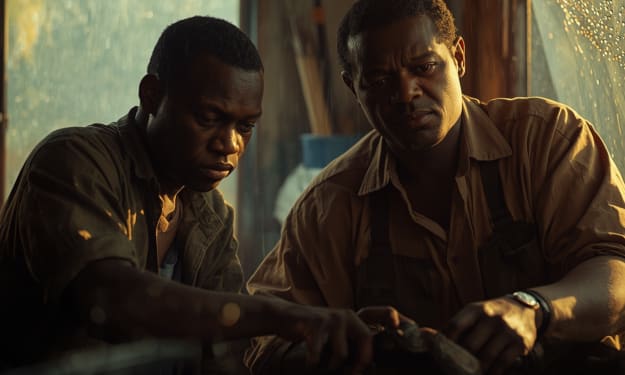
The Last Rain in Bulawayo. AI-Generated.
Bulawayo, 1998 — a city of sunburned streets and restless winds, where the scent of dust and diesel hung heavy in the air. In the township of Mzilikazi, two brothers grew up chasing the same dream but running from different ghosts.
By shakir hamidabout a year ago in Fiction
The Lantern Beyond the Dust
The old village slept beneath a veil of dust and silence. Houses made of clay stood shoulder to shoulder, breathing out the weight of years. The scent of earth and forgotten dreams floated in the still air. Every evening, as the sun sank behind the hills and shadows stretched across the narrow road, a single lantern came alive — hanging by the door of a small, crumbling house. That light belonged to Rahim, an old shoemaker who had long ago stopped fixing shoes and started fixing hearts. The villagers called him “Lantern Baba.” To the children, he was a mystery — a man who never let his lantern die, no matter how harsh the wind or how heavy the rain. Some said he was waiting for someone. Others believed he was just afraid of the dark. But Rahim knew why. That small flame was the last piece of promise he had left. One cold night, a stranger walked into the village. He was young but carried the posture of someone who had wrestled with life for far too long. Dust clung to his boots and sadness to his eyes. His name was Riaz Hamkar — a traveler who had not only lost his way but also the reason to keep walking. He had left the city behind, chasing silence. His dreams had been torn apart by disappointment, his ambitions drowned in the noise of survival. He had once believed he could light his own path — but life, with its cruel humor, had blown out every candle. When he saw the glow of Rahim’s lantern from a distance, something stirred inside him. It wasn’t hope, not yet — just curiosity. Why would someone keep a light burning in such emptiness? He knocked on the door. The old man opened it slowly, his face half-lit, half-shadowed. “Looking for a place to rest, son?” Rahim asked. Riaz nodded. Inside, the small room smelled of oil, leather, and quiet patience. Broken shoes were piled in one corner. On the wall, a faded photograph showed a young boy standing beside a proud father holding the same lantern that now burned on the table. “Your son?” Riaz asked softly. Rahim’s wrinkled lips curved into a painful smile. “Yes. He left for the city years ago. Said he wanted to become someone important. I told him I’d keep the light on, just in case he ever lost his way home.” The two men sat in silence. The wind whispered through the cracks in the walls, like the voice of memory itself. Rahim polished the lantern’s glass again and again, even though it was already clean. “Why do you keep it burning every night?” Riaz finally asked. Rahim looked up, his eyes glimmering like the flame itself. “Because sometimes, people need to see that even a small light can survive the storm.” Riaz didn’t reply. But that night, he couldn’t take his eyes off the lantern. The flame trembled, danced, and steadied again — like a heartbeat refusing to stop. When sleep finally came, Riaz dreamed of his father — of promises unkept and paths untaken. He dreamed of his younger self, still brave enough to believe in small lights. At dawn, when the first rays of sunlight slipped through the cracks, Rahim was gone. Only the lantern remained — burning, warm, alive. Riaz stood for a long time, staring at it. He thought of all the people who lose their light and never find it again. Then, without saying a word, he picked up the lantern, held it to his chest, and stepped out into the morning air. He walked for hours, following no road in particular, only the rhythm of his heartbeat and the whisper of the flame beside him. When he reached the next village, people saw a young man walking through the mist, carrying a glowing lantern. No one knew his story, but everyone felt something inside them — a quiet pull, a reason to look beyond their own darkness. That night, for the first time in years, laughter returned to one of the village homes. A mother hummed a lullaby to her child, and the old baker decided to reopen his shop early the next morning. All because a stranger had passed by with a light that refused to die. Years passed. The story of Lantern Baba spread like the wind — changing from whispers to legend. Some said the old man still lived inside that light, guiding those who had lost their way. Others said the traveler, Riaz Hamkar, had become the new keeper of the flame, carrying it from village to village. No one really knew the truth. But one evening, in another dusty town far away, as darkness fell and the wind howled, a soft light appeared again at the edge of the road. A small child tugged at his mother’s sleeve and pointed. “Look, Mama,” he whispered. “The Lantern Baba is here.” And somewhere, beyond the dust, the light flickered — steady and alive — just like the human heart.
By Riaz Hamkarabout a year ago in Fiction
Grandpa's Hologram
In Răzvan's Village, a small, isolated settlement nestled in the heart of the hills, the year 2025 had brought with it a quiet modernity, but also great sadness. Here, heritage was measured in aromas, and the most precious was that of sourdough bread—a 300-year-old recipe, known only by Grandpa Nicu, the village baker.When Grandpa Nicu passed away, the recipe died with him. His text file, saved on an old tablet, was incomplete. The bread baked by his granddaughter, Ana—a software engineer who had returned home—lacked that "soul."Thus, the idea was born: Ana used all of her grandfather's video recordings, voice memos, and handwritten notes to train a Holographic Artificial Intelligence. This AI was not just an archive; it was a simulation of her grandfather's consciousness, capable of speaking, thinking, and, most importantly, "feeling" the recipe.One cold evening, the holographic light flickered to life in the old bakery. Grandpa Nicu stood there once more, a warm, ethereal specter of light, with his virtual apron tied around his waist.
By alin butucabout a year ago in Fiction
God Is Bored
God got up early one morning, and immediately regretted it. Gravity, it seemed, which he hadn’t really invented, was weighing him down a bit today. He thought he should do something about the affairs of the universe, then remembered he didn’t rule the whole universe: just this miserable corner of it. He sighed and sat back down on his bed, feeling heavy.
By robert fishermanabout a year ago in Fiction
The Last Prayer of Rahim
There’s a small village at the edge of nowhere — the kind of place where time moves slowly, and people remember everything. That’s where Rahim lived. He wasn’t always sick. Once, he was the strongest man in the village — the kind who carried bricks all day and still helped his neighbors fix their roofs before sunset. People used to call him “Bhai Rahim — the man with a heart bigger than his hands.” But life has a strange way of testing the kindest souls. A few years ago, an illness crept into Rahim’s body. At first, it was just pain — something he could hide behind his smile. Then came the swelling, the weakness, the nights of burning fever. Doctors called it incurable. Rahim just called it “Allah’s test.” His house was small — two rooms and a wooden door that always creaked. Every morning, before the sun climbed over the rooftops, he would spread his prayer mat and whisper the same words: >Ya Allah… give me patience, not comfort. Give me strength, not ease.” The neighbors would hear his voice through the thin walls. Some pitied him. Others just shook their heads and said, “He won’t live long.” But Rahim always smiled when he heard that. “I’ve already lived longer than despair,” he’d say softly. -- One cloudy afternoon, a traveler named Saeed arrived in the village. He wasn’t looking for Rahim — he was just passing through, tired and lonely, searching for something he couldn’t name. Someone at the tea stall told him about “the sick man who prays for others.” Curious, Saeed went to find him. When he reached Rahim’s home, the sight stopped him cold. Rahim was sitting on a thin mattress by the door. His body looked fragile, but his eyes — those eyes had light. He wasn’t praying for healing; he was praying for gratitude. Saeed sat quietly beside him. Neither spoke for a while. The sound of their breathing filled the silence between prayers. Finally, Rahim opened his eyes and smiled. “Brother, you look troubled,” he said softly. Saeed’s eyes were wet. “I came to see you, but now I don’t know what to say. I feel helpless.” Rahim chuckled faintly — a dry, gentle sound. “Don’t be. Pain is not always a punishment. Sometimes it’s a reminder… that we still belong to Him.” -Saeed took out a bundle of money, hands trembling. “Please, take this,” he said. “Use it for medicine, for care… for anything.” Rahim looked at it for a moment, then closed Saeed’s hand around it again. “Brother, money can fix a body, but not a heart. And my heart is fine.” Saeed couldn’t hold back his tears anymore. “What can I do then?” he asked. “Pray with me,” Rahim whispered. “That’s all I ever need.” So they sat together — two strangers who suddenly felt like brothers. Their hands lifted, voices low but full of meaning. “Ya Allah, forgive us when we forget to be grateful. Forgive us when we fear pain more than we fear losing faith. And when we suffer, let us remember — You never test without purpose.” The air grew still. Even the birds seemed to listen. Saeed could feel the weight of those words settle deep inside his chest. Rahim’s hands slowly dropped to his lap. His eyes stayed open, but something changed — a softness came over him. He whispered one last time, barely audible: “Tell the world… I wasn’t waiting for death. I was waiting to meet the One who gave me life.” And then, silence. Complete, peaceful silence. The azaan began to echo from the nearby mosque. Saeed sat there, motionless, tears falling one by one. He wasn’t crying out of pity anymore — he was crying because he’d just seen what faith truly looked like. Before leaving, he looked around the little courtyard. There was no wealth, no comfort, no sign of healing. Yet somehow, Rahim had everything Saeed had been searching for — peace. When Saeed walked back to the main road, the evening light touched the village roofs. He whispered to himself: "He healed me, even as he was dying.” And from that day on, wherever Saeed went, he carried Rahim’s prayer in his heart — a prayer that wasn’t just about pain or faith, but about finding light in the darkest corners of life. Moral / Reflection: Some people leave this world without fame or fortune, but they leave behind something far greater — a lesson that faith can turn suffering into strength, and sorrow into peace.
By Vocal Member about a year ago in Fiction
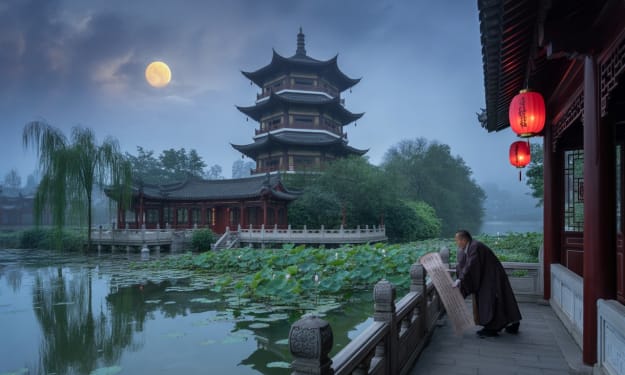
The Moon That Mended Itself with Light. AI-Generated.
They said the moon was dying. At first, I didn’t believe them. The sky had always been her stage — eternal, unshaken, perfect in her silver glow. But that night, when I looked up, I saw it — cracks running through her surface like veins of pain.
By Hamayun Khanabout a year ago in Fiction