Classical
Between Our Cups of Tea
She placed the teacup in front of me, just like she always did — handle turned exactly to the right, the way I liked it. No sugar. No milk. Just like our mornings now. Bland. Quiet. Ritualistic. “Thanks,” I said, my voice low but audible. She didn’t answer. She never really did these days. She took her seat across from me, the chair creaking slightly under her, and lifted her own cup without a glance. The steam rose between us like a ghost — thin, silent, vanishing quickly. We sipped. Two strangers in a house we once called home. --- There was a time when mornings meant laughter. When she’d lean over the table, teasing me about my uncombed hair. When I’d kiss her forehead while the kettle boiled. When we’d talk — really talk — about dreams, books, movies, and silly ideas that only mattered to us. Now, we sip in silence. --- “What time are you heading out?” she finally asked, eyes still on her tea. “Around ten,” I replied. “You?” “Maybe earlier. I have to stop by the pharmacy.” I nodded. Another ordinary exchange. Another moment with nothing in it. --- It wasn't always like this. We used to touch each other without thinking — fingers brushing while reaching for the same spoon. We used to giggle like teenagers, even after five years of marriage. We used to sit on the floor instead of the couch, just because it felt cozier. We used to say “I love you” before falling asleep — even when tired, even when angry. I can't remember the last time we said that. I can't remember the last time I looked at her and saw her — the girl I fell in love with. Now, I just see a quiet woman in a bathrobe, pouring tea. And maybe she sees just a man behind a newspaper — not the boy who once chased her in the rain. --- “I’ve been thinking,” she said, suddenly. I looked up. “About?” She hesitated, then shook her head. “It’s nothing.” Say it, I wanted to tell her. Scream it if you have to. Tell me you’re unhappy. Tell me you miss me. Tell me you want to leave. Anything. Just don’t sip tea and pretend this is normal. --- I remember the night I first met her. She was at a bookstore, reading the back cover of a poetry collection. She had no makeup on. Just jeans, a plain blue shirt, and hair tied in a messy bun. She looked up, caught me staring, and smiled like I was already forgiven. We spoke for two hours that night. We didn’t even buy the book. Now, the same woman won’t speak to me for more than two minutes unless it’s about bills or groceries. --- I reached across the table and touched her hand. She didn’t pull away. But she didn’t hold it either. Just let it sit there — like my touch was something to tolerate, not treasure. “I miss us,” I said. She blinked. Once. Twice. And then quietly replied, “I know.” --- Silence again. Not heavy. Not angry. Just... empty. --- She stood, collected her cup, rinsed it in the sink. I watched her movements. Precise. Mechanical. Distant. I wanted to say so many things. Like how I still remember the way she laughed with her eyes. Like how I still sleep on the edge of the bed because that’s how she likes it. Like how I don’t want to lose her but don’t know how to keep her. But I said nothing. Because we both had gotten used to saying nothing. --- As she dried her hands on a towel, I asked: “Do you think we’ll ever be okay again?” She didn’t turn around. After a pause, she said: > “I think... we’ve been trying not to break. But maybe we already did. Quietly. Without noticing.” --- I stood up. Walked to the door. Picked up my coat. “I’m going for a walk,” I said. She only nodded. No “be careful.” No “come back soon.” Just a nod — like I was a neighbor borrowing sugar, not her husband. --- Outside, the air was colder than I expected. I shoved my hands into my pockets, thinking about how two people can share a house, a bed, a life — and still feel miles apart. --- When I returned an hour later, she was gone. But on the table, next to my empty teacup, was a note. > I made you a fresh cup. I don’t know if it changes anything, but… it still matters to me that you drink it warm. —M ---
By Muhammad Usamaabout a year ago in Fiction
The Generous King
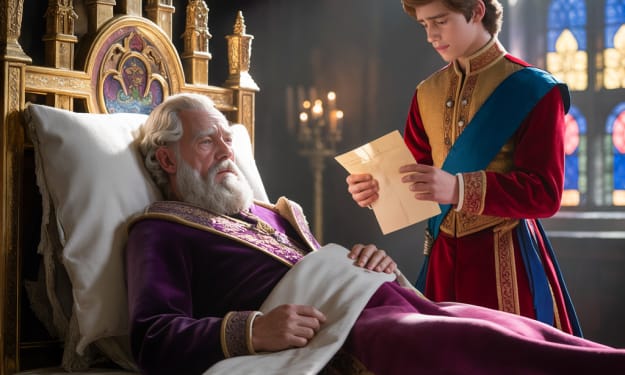
In the kingdom of Nahazar, there lived a king unlike any other. He was called King Rayan the Generous — not because of titles, but because of the way people whispered his name with gratitude. He had no hunger for gold, no thirst for war. He believed true power came from kindness. And so, he gave. He gave to the poor until the streets no longer knew hunger. He gave to the farmers when the rains were late and the crops failed. He gave to the widows, the orphans, the broken — and none left his court empty-handed. His palace gates were never closed. His treasury, always open. The people called him a king touched by heaven. But not everyone in the kingdom felt so blessed. --- The Forgotten Face in the Palace In a room just behind the throne, a young boy used to wait. His name was Zayan — the king’s only son. While his father ruled a kingdom, Zayan ruled nothing but silence. His mother had died when he was five. His father, always surrounded by ministers and the needs of the nation, had forgotten the boy who used to wait outside his chamber door — just to walk beside him. Every evening, Zayan would peek through the carved doors of the court, hoping his father would look up. He rarely did. --- “The People Need Me” When Zayan turned ten, he built a wooden horse by himself. He ran into the court to show his father. But the king was kneeling before a crying widow, handing her his own gold ring. “Not now, my son,” he said, without looking. Zayan nodded, stepped back, and never showed him anything again. The king gave everything… except time. --- A Kingdom Celebrates The years passed, and the king’s legend grew. He built hospitals, opened schools, forgave debts. On his 50th birthday, the entire city threw a festival. Thousands came to bless him. The streets lit up in his honor. But Zayan, now 21, did not attend. He sat in the palace garden, watching the fireworks alone, whispering to himself: > “You gave them all your gold, father. But you never gave me a moment.” --- Illness Comes Quietly One winter, the king fell ill. The royal doctors called it exhaustion. His body had served the people endlessly — now it was fading. The king summoned Zayan to his bedside. “You must be king now,” he said, weakly. “I taught you all I knew.” Zayan looked at him — this man loved by millions, unknown by one. “You taught the kingdom how to love,” he said, “but not your own son.” The king looked away, and for the first time, tears fell from his eyes. --- The Last Gift The king died two nights later. Thousands marched with his casket. The skies rained. The people wept. But Zayan remained in the palace. Only after the funeral did he enter his father’s private chamber. On the desk, untouched for years, was a sealed letter. It was addressed to him. --- The Letter > My son, If you are reading this, I am gone. I was a king to many — but I fear I was a stranger to you. Forgive me. They came to me with empty bowls, torn clothes, broken hearts. I gave them everything because I saw your mother in every crying face. When she died, a part of me froze. Giving to others was my way of keeping her alive. But in doing so… I left you alone. You are the only treasure I never learned to hold. Rule better than me. Love louder than I did. And know this — I was proud of you, even from afar. Always. Your Father. --- Now Years have passed. Zayan rules Nahazar now — a king like his father in generosity, but greater in presence. He still feeds the poor. Still opens the palace gates. But each evening, he walks through the garden where his father never came, holding his daughter’s hand. When she tugs at his robe and says, “Look, Baba,” he stops — every time — and looks. Because he learned the greatest truth too late: > A kingdom can be rebuilt. A treasury can be filled again. But a child who feels unseen… may never forget.
By Muhammad Usamaabout a year ago in Fiction
"What Happens After We Block Someone? A Digital Ghost Story Told by Algorithms"
I used to think that blocking someone was the end. A digital wall. A simple act of control in a chaotic, hyperconnected world. But what if I told you that’s not true? That when we block someone — or get blocked — it doesn’t delete the bond. It just buries it.
By Hamad Haiderabout a year ago in Fiction
The Brave Cub Who Walked Into the Storm
art of the African savanna, where golden grass whispers stories of survival and legacy, a lion cub named Leo was born. But unlike his siblings, who roared with instinct and leapt with promise, Leo was different. He was smaller. Quieter. Often overlooked. While the others played fiercely beneath the tall acacia trees, Leo watched from a distance—his eyes not on the games, but on the horizon. His paws were too small to race, his roar too soft to intimidate, and his legs trembled in the company of boldness. Yet there was something else inside him. A spark that didn’t show on the surface. A curiosity. A question. “Why don’t you join them?” his mother would ask gently, her golden eyes filled with worry. Leo would lift his head, ever so slightly. “Because I want to learn,” he would whisper. “I want to see the world before I try to conquer it.” Others in the jungle didn’t understand. They dismissed him. “Too small to matter,” scoffed the zebras. “Too quiet to be brave,” mocked the monkeys from their high, swinging homes. But Leo didn’t argue. He didn’t need to. Somewhere deep inside him, a voice far older than his own murmured: “Your time will come. And when it does, the world will know.” he Storm That Changed Everything It came without warning. The sky, once a blue canvas, darkened into a violent grey. Thunder cracked through the heavens, and the jungle trembled. The rain poured like arrows from the clouds, and the wind howled like forgotten spirits. Leo’s family, like many others, found refuge in a rocky cave near the cliffs. They huddled close, seeking warmth and safety as the world outside unravelled. Then came the sound that pierced the storm. A cry. Fragile and distant. Milo. The baby elephant from the neighboring herd. Lost. Alone. The lion king, Leo’s father, growled with authority. “No one moves. The storm is not kind to wanderers.” But Leo couldn’t sit still. His ears twitched at the sound. His heart raced—not with fear, but with purpose. “He’s out there,” Leo said, more to himself than anyone else. “He’s afraid.” “You’re just a cub,” his father barked. “Don’t be foolish.” But Leo had already stepped forward. His mother tried to stop him. But courage moves faster than doubt. And sometimes, a lion’s heart knows exactly when to roar—even if no one else can hear it.
By Arshad khanabout a year ago in Fiction
At The Edge Of Avalon
“… is that… you Sir…” “… Johston,” Felix the Thief lied with as much gusto as Sir Johston boasted to last night’s packed inn. He wasn’t proud of the impersonation, but if the knight was true this Lord’s quest came with a hefty sum of gold attached.
By Matthew J. Frommabout a year ago in Fiction
Borrowed Time: The Cost of Living Forever
They told me it was a miracle. The pill was called ChronoSil—a revolutionary biotech marvel that stopped aging at the cellular level. One dose, and your biological clock froze forever. Skin, bones, memory, organs—all locked in pristine condition. It wasn’t for the rich only. It wasn’t hidden from the public. It was free. That should’ve been the first warning. Nothing that powerful comes without a cost. --- I took the pill at 31. Fit, sharp, healthy. I wanted to stay that way. We all did. Within five years, two-thirds of the population had stopped aging. Birthrates dropped. Deaths plummeted. Earth got crowded. At first, it was beautiful. No funerals. No cancer. No wheelchairs. No nursing homes. But then the cracks began to show. --- 1. The Rise of the Forgotten Jobs vanished. Why retire when you never grow old? But why hire when the current workforce never leaves? Young people had nowhere to go. No promotions. No opportunities. Suicides rose. The world became a mansion filled with locked doors. --- 2. Love Lost Its Timing Marriage changed. If no one ages, why settle? Partners drifted. Families fractured. Children became rare, then undesirable. Raising a kid who would age while you didn’t? Tragic. The species began to split. Some of us were immortal. Others weren’t. --- 3. The 200-Year Lie ChronoSil wasn’t permanent. What they never told us: at the 200-year mark, your cells begin to collapse. Fast. You don’t grow old. You unravel. Nervous systems glitch. Organs liquify. Consciousness fades before death arrives. No cure. No fix. No warning. Just the final bill. And it’s non-refundable. --- 4. Time Taxes Governments caught on. Every year you lived beyond 80, you paid a "Time Tax." Not in money—in labor. Enforced volunteering. Emotional extraction for memory-harvesting. Surveillance implants. Loyalty pledges. The older you got, the more of your freedom you gave up. Immortality was freedom—until it wasn’t. --- 5. The Silent Ones Some people couldn’t handle it. The weight of endlessness. They began to vanish. Not by choice. Whispers of secret facilities—places where immortals who cracked were taken. "Recycled," they called it. To make room. --- I’m 143 now. I still look 31. But I feel like a museum piece. A relic from a world that no longer exists. Everyone I loved either aged normally and died—or took the pill and eventually lost themselves. You start to forget. Not memories. Meaning. A sunset becomes just another orange sky. A kiss, just another press of lips. Time, when infinite, becomes empty. --- 6. Memory Overload Our brains aren’t meant to carry centuries. ChronoSil keeps your body young, but not your sanity. People started forgetting how to feel. Not from trauma—from accumulation. Too many heartbreaks. Too many goodbyes. Too many hellos that led nowhere. Eventually, emotion becomes noise. And the silence that follows is unbearable. --- 7. The Copycats Illegal versions of ChronoSil popped up. Cheap. Unregulated. Dangerous. Some worked. Most didn’t. They caused time loops in your perception—where you’d relive one moment forever until your brain melted from the repetition. They called them Time Cages. Whole cities were quarantined. --- 8. The Returners Some people begged to grow old again. Black market clinics emerged offering “decay therapy.” A chance to age—to rejoin the natural cycle. But reversing ChronoSil has a cost too. It doesn’t restore aging. It catches you up. A 150-year-old body, untouched by time, suddenly rushes forward into its true age. No one survives the full crash. But some think it’s worth it. --- 9. Earth's Expiration Date The planet wasn’t built for 40 billion eternal humans. Resources vanished. Skies blackened. Oceans rose. Still, people clung to life. Crying children begged their forever-young parents to let them be born. But there was no space. No permission. No future. --- 10. Me? I Regret It. I wanted more time. But I didn’t know time wanted something back. The pill gave me years, but stole my soul one second at a time. You ask: was it worth it? Let me ask you: > What’s a life that never ends, but never begins again? --- Eternity is a prison with no walls. And once you take the key… You never stop paying rent. --- 🕰️ Written by James World Where time bends, consequences burn, and forever might be the worst curse of all.
By James World about a year ago in Fiction
Jinn Behind Bars: A Prison Guard’s Story of the Unseen Inmates
Jinn Behind Bars: A Prison Guard’s Story of the Unseen Inmates My name is Umar Farooq. I’ve served as a prison officer in three different facilities across Pakistan. I’ve seen drug lords cry, murderers plead, and innocent men rot behind bars.
By Noman Afridiabout a year ago in Fiction
The Unfurling of Agnes
With the faint, nearly undetectable rustle of old paper, Agnes Periwinkle went about her day. The Municipal Archive, a vast maze of lost histories, dust motes dancing in the few shafts of sunlight, and the reassuring smell of lignin and ageing parchment were the quiet, climate-controlled hallways where her days unfolded. Agnes had been its silent keeper for thirty-seven years, a human catalogue among the millions of old maps, old papers, and old photos.
By Momin Shahabout a year ago in Fiction