Classical
The Sky and the Fang
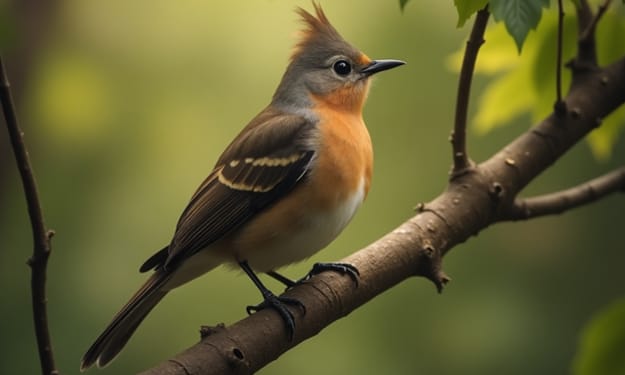
In the heart of a dense, untamed valley surrounded by cliffs and whispering winds, lived an eagle known as Rael. With feathers the color of burnished gold and eyes that could pierce through fog, Rael was not just any eagle—he was the silent ruler of the skies, feared and revered by creatures across the mountains. Far below, slithering through shadows and beneath sun-warmed rocks, lived Sereth, a massive serpent whose skin shimmered like oil and whose venom could kill in minutes. Unlike Rael, Sereth ruled the underworld of the wild—not through flight, but through fear. For years, the eagle and the snake lived separate lives. One ruled above, the other below. They never crossed paths. Nature had drawn invisible lines between them—until the day a drought fell upon the valley. Water became scarce. Ponds dried into cracked mud, and prey became rare. The eagle soared farther each day, and the snake slithered longer through the brittle grass in search of food. Desperation pushed both predators closer to the riverbed that remained as the valley's last source of life. One morning, Rael circled the riverbed, his shadow gliding across the dry stones. His sharp eyes caught sight of a small hare drinking near the water. Just as he tucked his wings and dived, something else moved. Fast. Silent. Deadly. Sereth had also found the hare. As Rael extended his talons, Sereth struck upward from the underbrush, fangs flashing. Their bodies collided mid-attack, the hare escaping in a blur of fur. For a moment, time stood still. Talons met scales. Wings beat against coils. The wild held its breath. Rael managed to break free, rising high with the snake’s venom barely grazing his feathers. But the encounter had ignited something deeper: a rivalry, a war between sky and soil. Over the next few weeks, the eagle and the snake clashed more than once. Rael attacked from the sky, swift and silent. But Sereth had learned to read the shadows. He would flatten himself against the stones, wait patiently, then strike with terrifying precision. It became more than survival. It became pride. Rael, the eagle, began training differently. He practiced mid-air stops, sharper dives, more agile maneuvers. In the wind tunnels near the cliffs, he honed his wings like a warrior polishing his sword. Sereth adapted as well. He began using tree roots for cover, learning to anticipate the eagle's patterns. He would leave decoy movements to mislead his aerial rival. The valley turned into a war zone. Smaller animals avoided the riverbed, afraid to be caught between the two. Even the wind seemed to whisper their names—Rael and Sereth—like ancient spirits caught in an eternal duel. Then came the final day. The sun hung low and red like a blood moon. The riverbed shimmered faintly, reflecting the tension in the air. Rael flew above, scanning the terrain. Below, Sereth lay coiled near a boulder, motionless. Rael dove with unmatched speed, faster than ever before. Sereth did not move. Not an inch. Just as Rael stretched his talons, Sereth uncoiled in a blur, his mouth open, fangs ready. But this time, Rael had learned. At the last second, he twisted mid-air, dodging the strike, grabbing Sereth not from above, but from behind—talons locking onto the serpent's midsection. The snake twisted violently, wrapping around Rael’s legs. The eagle screamed, wings thrashing, trying to rise. The two wrestled mid-air—a knot of feathers and scales—until, with all his might, Rael flung himself higher. The struggle rose above the treetops. Snakes are not meant for the sky. As altitude increased, Sereth’s grip weakened. Air thinned. The eagle climbed with pure defiance, dragging his foe higher. Finally, above the highest peak, with clouds brushing their bodies, Rael let go. Sereth plummeted. The snake twisted, turned, hissed—until he vanished into the canopy below. Rael landed on a cliff edge, exhausted and bleeding. One leg wounded, wings trembling, but alive. Victorious. The valley returned to silence. Weeks passed. The river returned. So did the prey. The drought ended. Rael healed slowly, now limping slightly when he perched, but his wings remained mighty. No one saw Sereth again. But the legend remained. The animals whispered it in their nests and burrows. The eagle who took the sky and the snake who dared challenge it. A story not just of survival, but of adaptation, honor, and knowing when to rise and when to let go. In time, younger eagles would ask Rael why he fought. Was it for food? Territory? Glory? He would simply answer, “Because the sky must always remember what the ground can never understand.” And then he would soar—his wings stretched, the horizon endless—over a valley that once burned with battle, and now breathed peace.
By Muhammad Usamaabout a year ago in Fiction
A Thousand Splendid Suns
There are stories that live inside books, and then there are stories that live inside people. This is one of the latter. I met her in a moment of absolute chaos. The kind of moment where life breaks apart in slow motion—where the world becomes unrecognizable and grief wraps itself around your ribs like wire. We were strangers then. Just two women standing in the rubble of what used to be our homes.
By Muhammad Saleemabout a year ago in Fiction
The Last Light
The Last Light – A Story of “Luminous” There was once a village wrapped in quiet hills and thick, whispering woods. It was a place time had mostly forgotten. The world beyond it rushed ahead with noise and invention, but the people of Velden lived slowly, holding onto rhythms older than clocks.
By Terence Lisherabout a year ago in Fiction
The Man Who Forgot Time
oPart I: The Disappearance When Dr. Elias Monroe stepped out of the elevator on the 102nd floor of the Orion Institute, his wristwatch stopped ticking. At first, he thought little of it—just a mechanical failure. But when he returned to the lobby thirty minutes later, everyone stared at him like he was a ghost.
By noor ul aminabout a year ago in Fiction
She Woke Up Someone Else
She Woke Up Someone Else The first time it happened, Alina thought it was a dream. by Yahya Asim She awoke in silk sheets she didn’t recognize, sunlight pouring through tall windows she had never seen before. A strange man was humming in the shower. Her phone, face down on a marble nightstand, lit up with notifications addressed to Dr. Alina Razak, Head of Neurological Research, something she had never studied a day in her life.
By Yahya Asimabout a year ago in Fiction
Mother's Promise
In the parched expanse of the Kolara Hills, where the earth bled gold like molten tears and the air tasted of dust and despair, the year was 1982. Life here was a relentless grind, a cruel tapestry woven from glittering mines and squalid shanties. The hills echoed with the clatter of pickaxes and the whispered prayers of the broken. Above all, Kolara was ruled by Dheeraj—a warlord whose wealth was built on the broken backs of his workers, a man whose shadow stretched like a plague over the land. Among the many was Vikram, a boy of eleven, his small hands already calloused from hauling ore alongside his mother, Lakshmi. Lakshmi was a woman of quiet fire—her hands rough as the rocks she mined, her eyes a well of unspoken dreams. In the flickering light of their cramped hut, she often traced the lines of Vik’s dirt-streaked face, imagining a life beyond the mines. But a wasting sickness gnawed at her from within, stealing her strength day by day. One stormy night, thunder rolling like the drums of fate, Lakshmi lay on a tattered mat, her breath shallow and ragged. Clutching Vik’s small, dirt-stained hands, she whispered, her voice trembling but fierce: “Promise me, my son... promise me you’ll break these chains. Free Kolara from Dheeraj’s grip. Make it a place where no mother weeps for her child’s hunger.” Her eyes, dim but burning with resolve, locked onto his. Vik’s tears carved clean streaks down his grimy face as he nodded, swallowing the lump in his throat. “I promise, Amma. I will.” That promise became the heartbeat of his existence. Fifteen years passed. Vikram, now twenty-six, was a man forged in the crucible of hardship. His lean frame bore the scars of the mines, but his spirit blazed with his mother’s dream. Known among the workers as “Vik the Unbroken,” he was a beacon of hope in a land suffocating under Dheeraj’s iron fist. Kolara remained a prison. Dheeraj’s fortress, carved into the hills like a black wound, loomed over the shanties. Mercenaries patrolled its walls, their guns gleaming coldly in the sun. Spies lurked in every shadow, ready to snuff out rebellion before it could breathe. But Vik was no ordinary man. Over the years, he had quietly built trust—sharing stolen scraps of food, mending torn clothes, and planting seeds of hope in weary hearts. At night, in the shadows of crumbling huts, he spoke of a Kolara where children laughed and families thrived. His words were dangerous, but they spread like wildfire. Among his closest allies was Tara, a fierce healer with eyes sharp as flint and a spirit unyielding as the hills themselves. She reminded Vik of Lakshmi—her courage, her quiet strength. Then there was old man Ravi, the gentle soul who had taught Vik to read from tattered books salvaged from the mines. And young Leela, a bright-eyed girl who dreamed of becoming a teacher, her laughter a rare light in the darkness. Their rebellion began with small, calculated strikes. Sabotaging machinery, redirecting supply carts, smuggling gold to fund their cause—each act a spark in the tinderbox of Kolara. The people, long broken, began to whisper the name “Vik the Fearless.” Dheeraj’s wrath was swift and brutal. Enforcers burned shanties, beat the innocent, and strung up suspected rebels as grim warnings. The breaking point came when Tara was captured—dragged into the fortress, her defiant glare a challenge even in chains. Vik’s heart shattered. The time for subtlety was over. He rallied every able soul—men hardened by labor, women who had buried too many children, youths who dreamed of freedom. In secret, they trained in the dry riverbeds, wielding pickaxes, slingshots, and crude spears fashioned from mining tools. Vik taught them to fight not just with strength but with strategy, turning desperation into a weapon. The night of the assault arrived under a moonless sky. A sandstorm howled, cloaking their movements as they marched toward the fortress. The air was thick with dust and tension. The battle was chaos—a maelstrom of blood and fury. Vik led the charge, his mother’s promise roaring in his veins. He swung a heavy hammer, forged from stolen steel, shattering the gates as his people poured in. Bullets tore through the night. Old man Ravi fell, clutching his chest with a whispered prayer. Leela, brave and bright, was struck down as she shielded a child. Each loss was a knife to Vik’s heart, but he pressed on, driven by the vision of a free Kolara. The fortress’s inner sanctum was a maze of torchlit corridors. There, Vik faced Dheeraj. The warlord was a towering figure, his eyes cold as the gold he hoarded. “You’re a fool, boy,” Dheeraj sneered, drawing a curved blade. “A peasant dreaming of my throne?” Their duel was a brutal dance of steel and fury. Vik’s hammer clashed against Dheeraj’s sword, sparks flying in the dim light. Dheeraj was skilled, his strikes precise, and he landed a deep gash across Vik’s arm. Blood soaked the stone floor. Pain seared through Vik’s body, but Lakshmi’s face flashed before him—her voice echoing in his mind. With a roar, Vik dodged Dheeraj’s next blow and drove his hammer into the warlord’s chest. Dheeraj crumpled, his reign ended in a single, shattering moment. As dawn broke over the Kolara Hills, Vik emerged from the fortress, bloodied but alive. The people, freed from their chains, gathered below, their cheers a thunder louder than any storm. Tara, released from her cell, ran to him, her embrace a balm to his wounds. “You kept her promise,” she said, her voice thick with pride. Vik looked out at the crowd—the faces of those who dared to hope. The mines, once a symbol of suffering, would now be theirs to rebuild. Schools would rise where shackles once stood. But Vik knew the fight wasn’t over. Dheeraj’s allies still lingered in distant cities, and Kolara’s wounds would take years to heal. Standing atop the hill, Vik felt the weight of Lakshmi’s sacrifice and her unyielding love. He had fulfilled her promise—but it was only the beginning. With Tara by his side and the people of Kolara behind him, he vowed to make their land a beacon of hope, where no child would ever again carry the weight of a mother’s dying wish.
By Nauman Hassan Khanabout a year ago in Fiction
The Echo Room
The house hadn’t changed. The same creeping ivy clung to the bricks, the porch light still flickered with a stubborn hum, and the oak tree in the front yard stood sentinel, gnarled and wise. Loreen Breen, dressed in an elegant navy coat and polished shoes, looked completely out of place—like a photograph taped onto an old postcard. But here she was, back again, not as a daughter, but as the executor of Lucy Brampton's will.
By Ahmad shahabout a year ago in Fiction
A Rooftop Tradition. AI-Generated.
In a small village surrounded by gentle hills, summers were always hot. The sun burned bright all day, and the walls of the houses held the heat like stones from a fire. People tried to stay cool by sitting under trees, drinking cold water from clay pots, and fanning themselves with palm leaves.
By Bilal Mohammadiabout a year ago in Fiction
Mr. Nightingale
I was only 3 years old when Mr. Nightingale came into my life. To me, he was a friend, everything but imaginary. He stood 7 feet tall, dark red skin, black shirt and pants, and a white trench coat that was always clean regardless of what we did together. He also had a black walking stick with a bird on top.
By David E. Perryabout a year ago in Fiction