Classical
Do You Know Love?
Enjoying brunch at their favorite café, Sensi and Kora’s eyes aimed at Clara in silence as they enjoyed their meal of French toast, bacon, and eggs while sipping mocha. After completing their meal and waiting for the waitress to bring their check, silence still held on to the moment.
By Annelise Lords 2 years ago in Fiction
The Plot
Plot Gone Wrong In the quaint little town of Maplewood, nestled between rolling hills and dense forests, life flowed slowly, like the gentle stream that wound its way through the center of the town. People knew each other by name, and secrets were scarce—until the night of the annual Harvest Festival, when everything changed.
By FRANCIS IKEGBUNAM2 years ago in Fiction
The Oasis of Hope
In the ancient city of Zahran, nestled between the majestic dunes of the Arabian Desert, Khalid Al-Rashid's strong features and piercing brown eyes seemed chiseled from the same sandstone as the city's iconic architecture. At 25, Khalid's dark hair was already flecked with threads of silver, a testament to his dedication to his craft.
By Tales by J.J.2 years ago in Fiction
The Monarchy Is So Important Isn’t It?. AI-Generated.
The British monarchy, with its rich history spanning over a millennium, stands as a vital symbol of continuity and tradition in the United Kingdom. From the iconic coronation of Queen Elizabeth II to the current reign of King Charles III, the monarchy continues to serve as an anchor in a rapidly changing world. But seriously, who doesn’t love a good royal story? As one of the oldest institutions globally, it has played a significant role in shaping the nation’s identity, values, and cultural heritage. Whether through royal weddings, jubilees, or the ongoing public fascination with the personal lives of the royal family, the monarchy remains a constant presence in the UK’s cultural landscape. But does anyone really think we can’t live without it?
By Marwa Jawad2 years ago in Fiction
Swirling vortex of Bombay monsoon
In the swirling vortex of Mumbai's monsoon season, Nicholas "Nick" D'Souza's world contracted to a single, rain-soaked street. The once-thriving financial district of Nariman Point now seemed a barren landscape, devoid of promise. Nick's coveted job offer from a prestigious investment firm had vanished, a casualty of the imploding economy.
By Tales by J.J.2 years ago in Fiction
Power of navigation
As she stepped off the train and onto the bustling streets of New York City, 25-year-old Sophia Patel felt invincible. Her freshly minted MBA from Columbia University gleamed on her resume, and a coveted job offer from a top financial firm awaited her. The world was hers for the taking.
By Tales by J.J.2 years ago in Fiction
The Unseen Thread
The sun had barely risen over the small town of Oakdale, Illinois, when the devastating call came. Twenty-two-year-old Amir's world crumbled as he listened to the panicked voice on the other end. His father, a devoted husband and loving parent, had been killed in a tragic accident at the local steel mill.
By Tales by J.J.2 years ago in Fiction
A Mother's Gift of Life
Rukmini's days blended together in a haze of exhaustion. Weighing 90 kilograms, her 5'4" frame struggled to keep up with the demands of her 9-to-5 job and caring for her 25-year-old son, Rohan. His chronic kidney disease had progressed, and the doctor's words echoed in her mind: "Rukmini, Rohan needs a kidney transplant. And you're the best match."
By Tales by J.J.2 years ago in Fiction
311: The Day After, Just Without Zombies (or, Is It?)
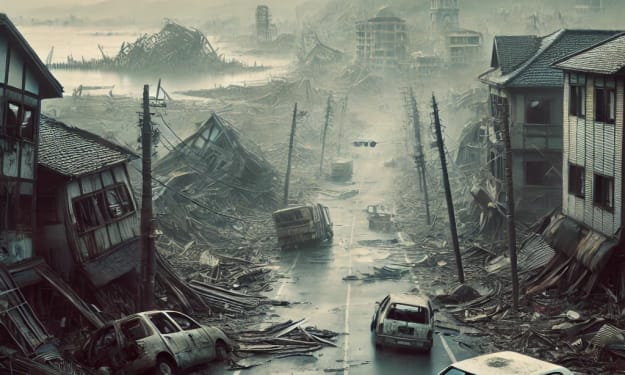
Disasters leave scars, both physical and psychological, on a nation and its people. Some are so powerful that they forever alter the way society perceives safety, risk, and resilience. One such event occurred on March 11, 2011, in Japan, a day that has become known simply as "3/11." This day brought not just a natural disaster, but a cascading series of crises that had Japan and the world on edge. While there were no zombies involved, the catastrophe felt apocalyptic to those who experienced it. This was a real-world horror, testing humanity's endurance, adaptability, and collective strength. What Happened on 3/11? At 2:46 p.m. JST on March 11, 2011, a 9.0-magnitude earthquake—the strongest in Japan's recorded history—struck off the northeastern coast of Honshu, Japan's main island. The seismic activity unleashed a massive tsunami with waves over 130 feet (40 meters) high that devastated coastal towns and cities. Buildings, cars, and boats were tossed about like toys in a tub. Entire neighborhoods were wiped off the map, leaving only debris and rubble in the wake. If the earthquake and tsunami weren't enough, the situation escalated further. The Fukushima Daiichi Nuclear Power Plant, located near the epicenter, sustained significant damage, leading to a partial meltdown in three of its reactors. This nuclear disaster released dangerous levels of radiation, forcing thousands to evacuate, some never to return to their homes. This triple disaster—earthquake, tsunami, and nuclear meltdown—created a profound sense of dread that was likened to the zombie apocalypse of popular fiction. For Japan, and indeed for much of the world, this felt like a waking nightmare. The Human Impact The 3/11 disaster claimed nearly 20,000 lives, left thousands missing, and displaced over 470,000 people. The nuclear disaster also rendered large areas uninhabitable due to radiation, adding a haunting quality to the devastated towns. Survivors faced not only the loss of loved ones but also the destruction of their communities, homes, and ways of life. Rescue teams and volunteers came from around the world to assist, but the task was daunting. For many, the situation felt surreal; the ruins of once-bustling cities looked like scenes from post-apocalyptic movies or games, with debris-strewn streets, destroyed buildings, and a haunting silence in formerly lively neighborhoods. People who lived through the events of 3/11 often describe the psychological toll as almost unbearable. They had to endure aftershocks for weeks, the constant fear of radiation exposure, and the struggle to find food, water, and shelter. For some, the experience left lifelong emotional scars. Schools, hospitals, and public infrastructure were damaged beyond repair, leading to a long, painful road to recovery. Zombie Apocalypse Comparisons: Why They Made Sense It might sound sensationalist to compare 3/11 to a zombie apocalypse, but there are eerie parallels that capture the existential dread it brought. Just like in zombie movies, there was a sense of isolation and vulnerability as survivors navigated deserted streets filled with debris. The threat of radiation was invisible yet omnipresent, creating an anxiety similar to the unknown dangers associated with zombies. Evacuees from the Fukushima area were treated with caution, sometimes even stigmatized, because others feared radiation "contamination," almost as if they were "infected." The images of abandoned towns, empty schools, and deserted homes lent an eerie, post-apocalyptic aesthetic. These ghost towns were left untouched due to high radiation levels, and residents could only briefly return to gather essential belongings. Additionally, the government issued restrictions and safety guidelines that further contributed to a feeling of containment, much like quarantine zones in fictional zombie outbreaks. The Aftermath and Ongoing Recovery Years have passed since 3/11, but its impact lingers. Recovery has been slow, and full restoration is still a work in progress. Japanese society has demonstrated remarkable resilience, facing the challenges of rebuilding cities, decontaminating radioactive areas, and addressing the psychological impact on survivors. The nuclear incident at Fukushima has also led to significant changes in Japan's energy policy, with a push toward renewable energy sources and stricter nuclear safety regulations. Communities affected by the disaster continue to work toward reconstruction, but not everything can be rebuilt. Some areas are still uninhabitable, and many families have permanently relocated, leaving behind memories and a part of their lives. There’s also the challenge of radioactive waste management, which remains a complex and contentious issue. The Fukushima Daiichi plant has been in a decommissioning process that experts say could take decades, if not longer. Lessons Learned 3/11 serves as a powerful reminder of nature's unpredictability and the vulnerability of human societies. The disaster highlighted the need for better preparedness and robust infrastructure capable of withstanding extreme natural events. Japan, known for its earthquake-resistant buildings and stringent safety codes, has since strengthened its emergency response mechanisms, including early warning systems, evacuation protocols, and nuclear safety measures. Furthermore, the disaster underscored the importance of mental health care for disaster survivors. Support services for trauma and mental health are now integral to Japan’s disaster response framework, ensuring that survivors receive the care they need to process their experiences and begin to heal. Is It Really Over? Even without zombies, 3/11 was a kind of apocalypse for those affected. Lives were permanently altered, and many families still struggle with the trauma. In some ways, Japan has emerged stronger, its people showing a remarkable capacity for resilience. But as nuclear cleanup continues and families try to rebuild lives disrupted by this “zombie-free apocalypse,” 3/11 remains a reminder of human fragility. Much like fictional depictions of the end of the world, 3/11 brought about an awareness that safety and security are not guaranteed. It showed that humanity must be prepared to face nature’s wrath and must work toward a future that considers the lessons of past catastrophes. And while there were no undead roaming the streets, for many who lived through it, 3/11 will always be remembered as a real-life horror, a day after that changed everything.
By Hridoy Hasan2 years ago in Fiction
The Whispering Attic
Lily had always been curious about her great-grandmother’s old house. The family only visited once every few years, but each time they did, her attention drifted to the small, locked attic door at the end of the hallway. It had a rusty keyhole that no one seemed to have a key for, and Lily’s grandmother always warned her not to worry about what was up there. But curiosity gnawed at her.
By Parth Bharatvanshi2 years ago in Fiction
The Family - Page by Page
As I sat beside my father's hospital bed, holding his frail hand, I couldn't help but think about the countless mornings we spent together, poring over the daily newspaper. Those moments, once taken for granted, now seemed precious. His eyes, once bright with curiosity, had grown weary, but his spirit remained unbroken. I realized that the traditions he instilled in me were not just habits, but a legacy.
By Tales by J.J.2 years ago in Fiction