Adventure
MAN IS BUT A FEW DAYS
--- Man Is But a Few Days The old man sat beneath the neem tree as he had every morning for the past forty years. The wooden bench creaked under his weight, though he had grown lighter with age. His skin, darkened and creased like old parchment, glistened faintly in the slanted rays of the early sun. He watched the village road that wound like a tired snake through the golden fields, the dust rising with every passing breeze. His name was Elijah Adebayo, once a teacher, a father, a husband—a man of many words and many wounds. Now, in his 83rd year, he was mostly silent, not because he had nothing left to say, but because he finally understood how few words truly mattered. "Papa Elijah!" a boy called, racing across the dry earth barefoot. "They said you told stories. Tell me one!" Elijah chuckled softly, more breath than sound. “Do they say that still? After all this time?” The boy nodded. His name was Jide, no more than ten, with wide eyes and a gap-toothed grin. He plopped down in the dust beside the bench, panting. “Very well,” Elijah said, gazing into the boy’s curious face. “I will tell you a story—but not a fairy tale. This one is true. And it begins, as all good stories do, with a man.” --- Once, there was a man named Anayo. Born under a restless sky, he came into the world as the thunder growled over the village of Umueke. His mother, Nnenna, swore the lightning danced in his eyes when he cried. He was strong from the beginning—eager, determined, curious. As a child, Anayo questioned everything. “Why does the sun chase the moon?” he asked his grandfather. “Why do people die?” “Why do we suffer?” His elders gave him stories, proverbs, scriptures—but Anayo wanted more than riddles. “You ask too much,” they said. “Man is but a few days. Accept what you are given.” But Anayo could not. He studied, searched, and journeyed beyond his village. He read books in city libraries by flickering kerosene light. He walked through markets teeming with the cries of vendors and prophets. He sat in silent churches and chaotic shrines, seeking meaning in the spaces between words and incense. At twenty-five, he returned to Umueke, older but no wiser. “What did you find?” asked his aging father. Anayo looked to the fields where the yam harvest had begun. “I found that no matter how far you go, time is always ahead of you. And man is always behind it.” His father nodded, unsurprised. “So now what will you do?” “I will build,” Anayo said. And so he did. He married a strong woman, Adaeze, who laughed like river water over stones. They had children—three in all. He taught them to read, to question, to love the land and each other. He built a school, planted mango trees, and led the village council for a decade. But time, as he had feared, did not slow. His first child, Chika, moved to the city and stopped writing letters. His second, a son named Obinna, died from a snakebite while hunting. The third, Amara, grew distant, angry with the village for its smallness. Then Adaeze fell ill. It began with forgetfulness—keys misplaced, names confused. Anayo held her hand as she slipped away, day by day, until even he became a stranger to her. At her funeral, he stood beneath the same neem tree that shaded the bench where Elijah now sat. His hair had turned to salt. His back had bent. A boy, not unlike Jide, once asked him then, “Is this the end of your story?” And Anayo had smiled. “No. It is the middle. For as long as breath remains, the story continues.” --- “Did he ever find what he was looking for?” Jide asked as Elijah paused, watching two doves flutter over the distant rooftops. Elijah closed his eyes briefly, feeling the breeze. “Yes. But not in the way he expected. Do you want to hear the rest?” Jide nodded solemnly. --- Anayo lived alone for many years. The village changed. Electricity came. The road was paved. The school he built became a clinic. Children who had never seen a typewriter now had phones smarter than their parents. But Anayo remained. People asked why he didn’t leave. “To go where?” he replied. “This land is my story. And I have not finished reading it.” One morning, he fell while fetching water. His hip cracked like dry wood. He was bedridden for weeks, staring at the thatch ceiling. Flies buzzed lazily. Old memories replayed like films—Adaeze’s smile, Obinna’s laughter, Chika’s first steps, Amara’s stubborn gaze. One evening, a young doctor named Efe visited him. She had grown up in the village, studied medicine in Abuja, and returned—partly out of duty, partly out of longing. “Do you regret staying?” she asked. Anayo looked at her. “No. I regret only the time I wasted fearing the brevity of life. I thought man’s few days meant we must rush, conquer, prove. But now I see... we must simply live.” Efe tilted her head. “So... what is the meaning, then?” He smiled. “That there is meaning, even when we don’t see it. A mango ripens in its time. A river finds its course. And love, even in sorrow, is never wasted.” --- Elijah’s voice grew quiet, as if the wind carried away the last words. “And what happened to him?” Jide asked. “He died,” Elijah said simply. “One morning, before the cock crowed. Peacefully.” Jide looked disappointed. “That’s it?” Elijah looked into the boy’s eyes, serious now. “That’s it. And it is enough. Anayo’s life was not long, not short. It was full. He planted, he lost, he loved. He was human. And man, Jide, is but a few days. What we do in those days is what makes them eternal.” Jide frowned, chewing on the words. “Do you think I will be like him?” Elijah smiled. “You already are. The fact that you asked means the story is already in you.” He reached into his worn shirt pocket and pulled out a small, smooth stone. It was dark, almost black, but shimmered faintly in the light. “Take this,” Elijah said, handing it over. “It belonged to Anayo. He said it reminded him of the world—hard, beautiful, and full of weight.” Jide took it reverently. “Now go,” Elijah said. “And remember, your few days are yours to shape. Don’t spend them waiting.” --- That night, Elijah did not wake. The village mourned, but not with despair. People brought flowers, stories, and laughter to his home. Old students returned, now doctors, teachers, market women, engineers. They spoke of the man who taught them to think, who reminded them that time was precious not because it was short—but because it was theirs. Jide stood quietly by the neem tree. The stone sat in his pocket, warm from his palm. He did not cry. Instead, he whispered, “Thank you.” --- Years Later Jide became a writer. Not famous. Not wealthy. But his stories were passed from hand to hand like sacred fire. One of them—titled “Man Is But a Few Days”—opened with a boy, a bench, and an old man beneath a tree. And in the final paragraph, he wrote: > “We fear that life is too short. But its brevity is its blessing. For if man lived forever, he might never learn to love. But because man is but a few days, he learns to treasure, to weep, to remember. He learns to live.”
By Sam Happinessabout a year ago in Fiction
The Village That Answered No One
THE VILLAGE THAT ANSWERED NO ONE Written by Haroon Bahramzai Somewhere in the fog-soaked valleys of northern Europe, tucked between two forested hills where GPS signals fade and birds fly cautiously, there once stood a village called Eld hollow.
By Haroon Bahramzaiabout a year ago in Fiction
The Radio That Broadcasts the Dead
The first call came at 2:07 a.m. Mara Lane, the new host of “NightPulse 103.3”, had just settled into her third week behind the mic. It was the dead hour—midnight to 4 a.m.—the time when truckers, insomniacs, and the unhinged called in with conspiracy theories and lonely thoughts. She wasn’t expecting much. She never did.
By Muhammad Sabeelabout a year ago in Fiction
The Mirror Knows What You Did
It started as a prank. When Ash found the old mirror at a yard sale tucked behind a stack of dusty books, she thought it would make a cool party centerpiece. Ornate. Baroque. Heavy as hell. And creepy enough to give her goth roommate Carter the chills.
By Muhammad Sabeelabout a year ago in Fiction
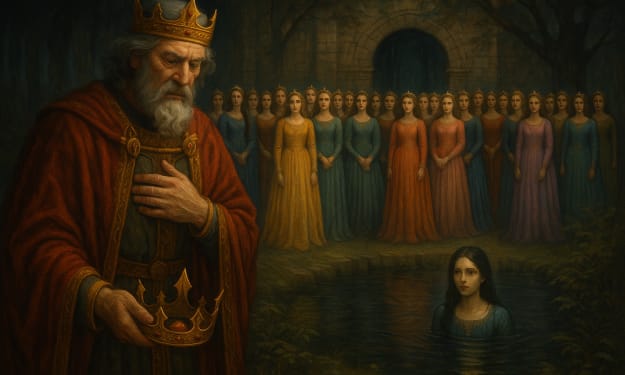
The King’s Garden of Shadows
Once upon a time, in a kingdom surrounded by seven rivers and veiled in the perfume of eternal jasmine, there reigned a King known by the title "Raheem the Wise." His rule was not forged in blood but in books, not sustained by swords but by silence and soul-searching. His palace had no iron gates, only whispering wind-chimes and vines of lilies climbing its golden pillars.
By Muhammad Abdullahabout a year ago in Fiction
The Slave Who Knew the Stars
Once upon a time, in the ancient kingdom of Zaheerabad, nestled between black mountains and golden deserts, lived a Prince named Kamraan, son of the mighty King Ubaid. The Prince was fair in face and feared in sword, taught in the philosophies of men but untouched by the lives of those beneath him. The palace was carved from marble, adorned with silk and mirrors, but behind its glistening curtains brewed storms invisible to the blind.
By Muhammad Abdullahabout a year ago in Fiction
The Garden of Mirrors: A Tale of Two Thrones
Part I: The Echoes of the Orchard In an ancient land where rivers whispered secrets and mountains bore silent witness to time, there existed two mighty kingdoms, separated by a sea of sand and centuries of silence. One was Zahran, a land veiled in mist, where the people believed that dreams were fragments of lost truths. The other was Elburz, whose people trusted only what the eye could see and the hand could hold.
By Muhammad Abdullahabout a year ago in Fiction
Moonlight’s Journey of Courage
The Story of the Chicken In a quiet and distant village surrounded by green hills and winding streams, there lived a little chicken named Moonlight. She was not like any other chicken in the village. Moonlight had a heart full of kindness and a spirit that shone as brightly as her name. Every day, she brought joy to every corner of the village with her gentle nature and willingness to help anyone in need. Whether it was a lost chick or a lonely sparrow, Moonlight was always there with a comforting chirp and a helping wing.
By Muhammad Yarabout a year ago in Fiction
The Lion and the Clever Jackal
I. The Reign of the Mighty In the golden heart of an ancient savannah, beneath skies that burned with the fire of the setting sun, there ruled a lion named King Barafu. His name, whispered through the winds of the tall grasses, struck awe into the hearts of every creature. He was a lion of immense strength, sharp judgment, and an unchallenged legacy. His roars echoed across the plains like thunder, and none dared defy his authority.
By Mahayud Dinabout a year ago in Fiction