Adventure
The Lantern in the Storm
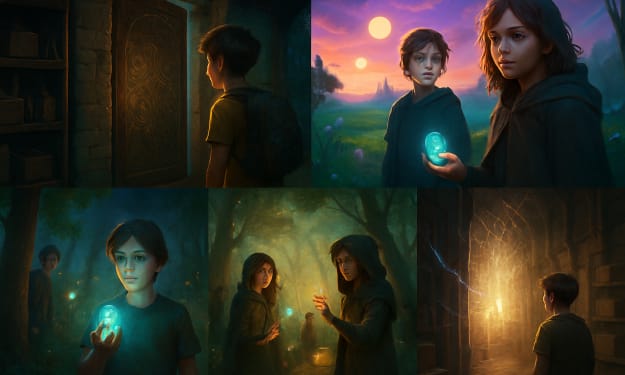
The rain began before sunset. At first, it was gentle — the kind of drizzle that painted the air silver and made the road smell of damp earth. But as night approached, the drizzle turned into a fierce, unrelenting downpour. Trees groaned under the weight of the wind, and the narrow path through the hills seemed to vanish under a curtain of rain. Elias pulled his cloak tighter around his shoulders. He was seventeen, traveling alone for the first time, with a small pack on his back and a letter for his uncle tucked safely inside his coat. His uncle’s farm was three days away, and he had been told to reach it before the harvest ended. But now, with the road slick and the storm growing wilder by the minute, Elias began to doubt he would even make it to the next village. The darkness thickened, and each step felt heavier. The wind seemed to push him back, whispering that he should turn around. But turning back meant admitting defeat, and Elias had never been one to quit. He pressed on until a sudden flash of lightning revealed something ahead — a small, flickering light in the distance. It was the kind of light you could easily mistake for a reflection, but Elias’s heart leapt. He quickened his pace, his boots splashing through puddles, until the light became clearer: a lantern, swinging gently from the porch of a tiny wooden cottage. By the time he reached the door, he was drenched and shivering. He knocked, unsure if anyone would hear him over the roar of the wind. The door creaked open, and an elderly woman stood there, wrapped in a thick shawl. Her eyes, sharp and bright, studied him for a moment before she spoke. “You’re soaked to the bone,” she said, stepping aside. “Come in before the storm takes you.” Elias hesitated — his father had always warned him about trusting strangers — but the warmth spilling from the doorway was too tempting. He stepped inside, grateful for the dry air and the scent of burning wood. The cottage was small but tidy. A fire crackled in the hearth, and a pot of soup simmered on the stove. The woman took his cloak and hung it by the fire, then handed him a towel. “You were lucky to see my lantern,” she said. “Most travelers miss this turn and end up lost in the hills.” Elias thanked her and explained that he was on his way to his uncle’s farm. She nodded, ladling soup into a bowl and placing it in front of him. As he ate, the warmth seeped back into his fingers, and the sound of rain on the roof began to feel almost comforting. They talked for a while. Her name was Maren, and she lived alone since her husband had passed away years earlier. She told him about the storms that often trapped travelers and how she always kept a lantern lit, “just in case someone needs it.” By the time Elias finished his meal, the storm still raged outside. Maren insisted he stay the night. “There’s no sense in walking blind into the wind,” she said firmly. “The hills are unforgiving.” Elias slept in a small room with a quilt that smelled faintly of lavender. He dreamed of warm fires and safe roads, and for the first time since the journey began, he felt completely at ease. --- Morning brought clear skies. Elias thanked Maren for her kindness and prepared to leave. She handed him a small package wrapped in cloth. “Bread and cheese,” she said. “The road ahead is long, and you’ll need your strength.” He accepted it with a smile, promising he would remember her kindness. As he stepped outside, he noticed the lantern still hanging on the porch, glowing faintly in the morning sun. “Do you always keep it lit?” he asked. She nodded. “A light is no use to the person who keeps it to themselves. Someone might be out there tonight, just like you were.” Elias walked away with her words echoing in his mind. --- The following evening, he reached a narrow pass between two cliffs. Clouds were gathering again, and the wind carried the scent of another storm. That’s when he heard it — a faint voice calling out. At first, he thought it was the wind, but then he saw a figure stumbling along the rocks, soaked and shivering. Without thinking, Elias reached into his pack and pulled out the small lantern he always carried. He lit it, waving it high so the stranger could see. The man, no older than Elias himself, stumbled toward the light, eyes wide with relief. “Thank you,” the man gasped. “I thought I’d be stuck out there all night.” Elias helped him to a sheltered spot, sharing the bread and cheese Maren had given him. As they sat there, waiting for the worst of the rain to pass, Elias realized he was doing for someone else exactly what Maren had done for him. --- Years later, Elias would tell the story often — about the storm, the lantern, and the kindness of a woman who had no reason to help a stranger yet did so anyway. And in every place he lived, no matter how far from that little wooden cottage, he made sure to keep a lantern lit outside his door. --- Moral: Kindness is a light that never truly goes out; it passes from hand to hand, heart to heart, until it becomes part of the world’s warmth.
By Hazrat Bilalabout a year ago in Fiction
All to Blame
Day 1 – Saturday Things at my house had gotten tense again—nothing new, just loud voices, long silences, and doors that didn’t close quietly. I called Ali late one night and asked if I could stay for a bit. She said yes without hesitation. I packed a bag the next day.
By Sidney Foxabout a year ago in Fiction
LEU
Simba: An Urban Odyssey Chapter 1: The Asphalt Savannah The city wasn't a savannah, but for Simba, the son of Mufasa, King of the Lion's Valley, it was just as wild. The skyscrapers were mountains, the steel and glass shone like water in a desert river, and the endless traffic was a river of fire and sound. Mufasa, an imposing man with natural charisma, wasn't a king by blood, but by the respect he had earned. He ran an animal protection foundation, a small oasis of hope in a concrete jungle, a place where children learned about compassion and their place in the cycle of life.
By alin butucabout a year ago in Fiction
The Lantern Beyond the Mist
The fog rolled in thick and heavy, swallowing the world in a cold, pale silence. The narrow forest trail that Adeel had been following for hours now looked like a thin thread floating in an endless sea of grey. The air smelled of wet earth and pine, and somewhere far away, water dripped in slow, steady beats. Adeel adjusted the strap of his small satchel. His phone battery had died an hour ago, leaving him with no map, no light, and only the stubborn hope that the path would eventually lead him out. He was a nature photographer—he’d come to this remote valley chasing the legend of a hidden waterfall. But the sun had set faster than he’d expected, and the mist had risen like an uninvited ghost. A sudden flicker caught his eye. Far ahead, just beyond a bend, a faint orange glow trembled in the haze. It looked like a lantern—small, warm, alive in the cold gloom. He hesitated. There were no villages marked on the map he’d studied. Who could be out here at this hour? But the fog pressed in like a living thing, and the idea of walking toward light felt more comforting than staying in darkness. The closer he came, the clearer it became: an old brass lantern, hanging from the crooked branch of a cedar tree. Its flame danced with a strange steadiness, unaffected by the windless air. Beneath the lantern stood an old man. He was wrapped in a long wool coat, a dark scarf wound tightly around his neck. His beard was white, but his eyes—sharp, almost too bright—watched Adeel as if they had been expecting him. “You’re late,” the man said. Adeel stopped short. “Late? For what?” The man tilted his head, studying him. “The mist doesn’t rise for everyone. You were called.” Called. The word rattled in Adeel’s mind, unsettling yet oddly familiar, like a half-forgotten dream. “I think you’ve mistaken me for someone else,” he said, forcing a shaky laugh. “Perhaps,” the man murmured, “or perhaps you’ve mistaken yourself.” Before Adeel could reply, the man took the lantern from the branch and gestured. “Come. The path ahead isn’t safe.” Against his better judgment, Adeel followed. The lantern’s glow revealed details the fog had hidden—roots curling across the path like sleeping snakes, sudden drops where the earth crumbled into black nothingness. As they walked, Adeel tried to start a conversation. “Do you live out here?” “I keep watch,” the man said. “For what?” The old man glanced over his shoulder. “For those who wander too close to the edge.” Something in his tone made Adeel’s skin prickle. “And what’s at the edge?” “Not what,” the man said softly. “When.” Adeel didn’t understand. But the forest seemed to lean closer, listening, so he kept his questions to himself. They walked for what felt like hours. The air grew colder, the fog thicker. Then, without warning, the ground ahead opened into a wide clearing. In its center stood a stone archway, freestanding, leading to nowhere. It was covered in moss, its carvings worn smooth by time. “This is as far as I go,” the old man said, raising the lantern high. Through the archway, the mist swirled differently—denser, but glowing faintly, as though it held its own light. The sight pulled at something deep inside Adeel, a strange yearning he couldn’t name. “What is this?” he whispered. “The place you’ve been walking toward since before you knew you were walking at all,” the man replied. Adeel felt a shiver crawl up his spine. “And if I walk through?” “You won’t return.” He stared at the mist beyond the arch. The thought should have terrified him, yet an odd calm settled over him. “Why me?” The old man smiled faintly. “Because you saw the lantern.” The forest was silent. Even the sound of dripping water had stopped. Adeel took a deep breath. Every part of him wanted answers, but some questions, he realized, could only be asked on the other side. He stepped forward. The moment he crossed the threshold, the air changed—warmth flooded his chest, the fog dissolved into gold, and a vast meadow spread out under a sky streaked with colors he had no words for. Somewhere far ahead, the sound of rushing water called to him. He turned back. The stone arch stood behind him, but the old man was gone. Only the lantern remained, hanging from the arch’s peak, burning steady and bright. Adeel smiled. He didn’t know where he was, but for the first time in years, he felt exactly where he was meant to be.
By Muhammad Bilalabout a year ago in Fiction
Where The Line Ends
The moon hung grimly in the sky as if you could tell it was ready to fall. The thread it clung to, invisible and withering away by the second. The tides of the ocean seemed to follow suit in their mourning, swaying meagerly, full of pity. I sat by myself on the cold sand, digging my nails into the barren land. I watched as the grass swayed with the weak breeze, the blades turning deeper by the minute. It was a soulless world, an unapologetically blank space. A bitter, angry, dejected spot hidden deep inside a bleak galaxy.
By Brittany 🩷about a year ago in Fiction
The Hunt or the Lesson – The Tale of the Monkey, the Horse, and the Lion
It was a hot afternoon in Sierra Leone. The golden sunlight spread across the grassy plains, and the dry air carried the scent of dust. At the edge of the forest, a curious monkey named Maka sat high on a branch, scanning the open field below. Down there, a beautiful brown horse grazed peacefully. The horse belonged to the nearby village farmers, but it often wandered alone into the meadow. A playful thought sparked in Maka’s mind: “What if I ride that horse? I’ve seen humans do it… maybe I can see the world from up there!” Climbing down quietly, Maka crept toward the horse. With a sudden leap, he landed squarely on its back. The horse startled, snorted, and stepped back, but when it realized the small creature wasn’t a threat, it allowed the ride. Maka grinned wide. “Wow! I feel like the king of the jungle now!” But the true king of the jungle — Kano the lion — was at the far end of the grasslands that very moment. Hungry and restless after two days without a proper meal, his sharp eyes caught sight of the horse… and something extra sitting on top. To Kano, it didn’t matter — prey was prey. oving low through the tall grass, Kano approached like a shadow sliding across the earth. The horse’s ears twitched; it sensed danger. Suddenly, its eyes widened and, without warning, it bolted forward at full speed. Maka jolted, nearly losing his grip. Glancing back, his heart froze. The lion was charging after them, his golden mane flowing, eyes locked directly on Maka. “Run! Faster! Go, go, go!” Maka squealed, though the horse hardly needed encouragement. Hooves pounded the ground like war drums. Tufts of grass flew into the air, and a trail of dust swirled behind them. Kano’s heavy paws hit the earth with a deep, rhythmic thud. He was closing the distance. The air was thick with tension, every second stretching like an eternity. aka’s mind raced. “I started this as a game… but now it’s life or death.” Ahead, a small river glimmered under the sun. The horse slowed just a bit, unsure of the depth. The water was fast and murky. Behind them, Kano’s growl rumbled louder, closer. The horse stopped at the bank, stomping nervously. There was no time to think — the lion was nearly upon them. Maka made his choice. Leaping from the horse’s back, he grabbed a dangling vine from an overhanging tree branch and swung himself high into the foliage. The horse neighed loudly, then splashed into the river and scrambled across to the other side. Kano didn’t bother following the horse. His eyes were now fixed on the monkey clinging to the branch above. me down, little snack,” the lion growled, pacing beneath the tree. Maka held his breath, trying not to tremble. He knew lions couldn’t climb trees, but a hungry lion could wait — and wait he did. Hours passed. The sun dipped low, the shadows stretched long. Kano circled the tree, his tail flicking in frustration. As night fell, he finally gave up, slinking back into the darkness in search of an easier meal. Maka waited until he was certain the lion was gone before climbing down. His playful spirit was gone, replaced by a deep sense of humility.next morning, Maka spotted the brown horse grazing again near the edge of the meadow. He approached slowly. The horse noticed him and took a cautious step back. Maka lowered his head and said softly, “Yesterday, you saved my life… and I put yours in danger. I’m sorry.” The horse said nothing, but his calm, steady gaze seemed to speak: “Friendship means responsibility.” al: Life’s adventures and playful risks can be exciting, but dragging others into danger for your own thrill is selfish. A true friend protects you, and a true friendship is one you protect in return. This isn’t just a tale of the jungle — it’s a reminder for anyone who acts without thinking and puts others at risk. Fun, freedom, and daring choices have value, but responsibility and care for those around you matter more.
By Saeed Ullah about a year ago in Fiction
Fighting for Life
"You can have it," the man in front of Ryder said, solemnly, resigned to his fate. "You deserve it." Ryder looked at the man's bloodied nose, steadily streaming red mucus, and his lank hair, hanging down over his face. He was poorly dressed and would be referred to as "unkempt" by his mother. Not quite a hobo but not far off. The man would not look him in the eye which was curious as moments before, he had been glaring at Ryder as he'd gripped his shirtfront, his eyes wide, bulging with fury, as he spat his angry, defensive words into Ryder's face.
By Rachel Deemingabout a year ago in Fiction