Adventure
The Mirror in Room Six
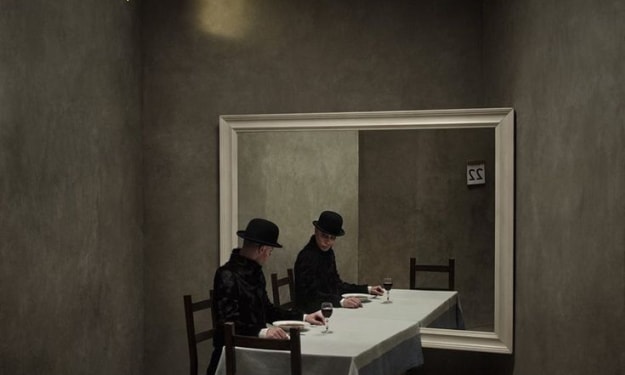
M Mehran When traveling for work, Daniel never expected much from the hotels he stayed in—sterile lobbies, thin walls, and coffee that tasted like cardboard. But the motel he checked into that rainy Thursday was stranger than most. The clerk barely looked up as Daniel signed in, mumbling, “Only one room left—Room Six.” The hallway was dim, lined with peeling wallpaper. Room Six creaked when he pushed the door open. Inside, everything seemed ordinary enough: a bed, a chair, a lamp that flickered. The only unusual thing was the mirror. It was full-length, framed in dark wood, and leaned against the far wall. It wasn’t dusty or cracked like the rest of the room—it gleamed, flawless, as though it had been polished moments before. Daniel didn’t think much of it until he unpacked. He glanced at the mirror and froze. His reflection was smiling. But Daniel wasn’t. He stepped closer, his stomach lurching. Slowly, cautiously, he raised his hand. His reflection raised its hand too, in perfect sync. But the smile lingered, stretched unnaturally wide. “Long day,” Daniel muttered to himself, trying to laugh it off. “Just tired.” He turned away, but unease prickled his skin. He left the television on for noise, but every time he glanced at the mirror, the reflection’s smile seemed sharper. --- At 2 a.m., a noise jolted him awake. A faint tapping, like fingernails on glass. The room was dark, the TV off though he hadn’t touched it. His gaze slid to the mirror. His reflection was standing closer than he was—right up against the glass. The tapping grew louder. The reflection lifted its hand and knocked, once, twice, three times. Daniel’s breath caught. His body felt heavy, pinned to the bed. Then, in a voice that didn’t echo in the room but bloomed inside his skull, the reflection whispered: “Let me out.” Daniel scrambled off the bed, heart hammering. “This isn’t real,” he hissed. “I’m dreaming.” The reflection tilted its head, the smile never faltering. “You don’t belong out there. You’re tired. Worn down. Let me take your place. Rest. Just rest.” “No,” Daniel whispered. The mirror rattled. Cracks spidered across its surface though it didn’t break. The reflection’s smile widened until it split the face unnaturally. Daniel grabbed his bag, fled the room, and didn’t stop running until he was in his car, the rain soaking him through. He drove through the night, not caring about the headlights or the storm. --- By morning, he had convinced himself it was exhaustion and stress. Lack of sleep. Maybe even a fever dream. But when he stopped at a diner for breakfast, he caught his reflection in the window. It was still smiling.
By Muhammad Mehranabout a year ago in Fiction
The House That Waited
M Mehran On the outskirts of town, beyond the crooked oak trees and the overgrown path, stood a house no one claimed. Its paint peeled, windows sagged, and yet every night, one upstairs light glowed as though someone were still waiting inside. Children dared each other to approach it, whispering about ghosts and lost lovers, but few ever got closer than the rusted gate. Clara, however, had never been afraid of the house. At twenty-seven, she returned to her hometown with a suitcase of failures—her business had collapsed, her relationship had ended, and the city that once promised so much now felt like a cruel trick. On her first night back, she walked until the familiar silhouette rose in the moonlight. The house looked just as it had when she was a girl, when she’d sketch it in the margins of her notebooks, convinced it had secrets worth knowing. The gate creaked open easily. No lock. No chain. As if the house had always been waiting for her. Inside, dust blanketed the floor, but the air felt strangely warm. The wallpaper peeled in strips, revealing faded patterns of roses. A staircase curved upward, and at its top, yes—light spilled faintly from a room. Clara should have turned back. Instead, she climbed, each step groaning under her weight. At the landing, she hesitated, then pushed open the glowing door. The room was a library. Hundreds of books lined the walls, their spines gleaming though no hand had touched them in decades. A single lamp on a desk flickered gently. And on that desk sat a book with her name embossed in gold. Clara froze. Her throat went dry. She opened it. The first page read: The Story of Clara Whitmore Below, in delicate handwriting, was the story of her childhood—the afternoons at the creek, the loneliness after her mother’s death, the way she always sat at the back of class, sketching that strange house. The pages turned themselves, as though impatient. They showed her teenage years, her secret dreams of becoming an artist, her decision to chase practicality instead. Every choice, every misstep, every heartbreak. And then, halfway through the book, the pages were blank. The lamp flickered once, twice, and the silence thickened. Clara touched the paper. “What is this?” she whispered. A voice drifted from the shelves—soft, old, but clear. “It is your unfinished story.” She spun, but no one was there. “Who’s speaking?” The voice chuckled, though not unkindly. “The house. I keep the stories of those who wander too far from themselves. Yours has been waiting.” Clara’s hands trembled on the desk. “So… what do I do?” “Write,” the house said simply. “Fill the pages with what comes next. Not what you think you should do. Not what others told you to do. What you want.” Her chest ached. “But I don’t know anymore.” “Then start small. One choice. One word. A blank page is not a curse, Clara. It is an invitation.” Her eyes blurred with tears. She sat, picked up the pen lying beside the book, and hesitated. The nib hovered over the page, her hand shaking. Then she wrote: Tomorrow, Clara paints again. The lamp glowed brighter. Somewhere deep in the walls, gears clicked like locks being undone. --- The next morning, Clara woke in her childhood bedroom, unsure if the house had been dream or memory. But the scent of ink clung to her fingertips, and on her desk sat a canvas she hadn’t touched in years. She began to paint. Hesitant strokes at first, then bolder, until color spilled across the canvas. She painted the oak trees, the crooked path, the waiting house. Day after day, she returned to the library, each time finding the book open to the next blank page. Whatever she wrote there seemed to shape her waking life. She painted, she applied for exhibitions, she reconnected with friends she’d long avoided. But with each written word, the house grew quieter. The wallpaper faded further, the shelves thinned. The voice, when it spoke, sounded weaker. On her final visit, the library was nearly bare. Only her book remained. Its last blank page trembled as though in a breeze. The house’s voice whispered, faint as a sigh: “You have no need of me now. Your story is yours to carry.” Clara placed her hand on the final page and wrote: Clara chooses to keep writing, no matter how uncertain. The lamp flickered once—and went dark. --- Years later, Clara’s paintings hung in galleries across the country. Critics praised the haunting imagery, the way her canvases captured both loss and possibility. She never told them the truth: that each painting began in a library that no longer existed. Sometimes, when she walked past the edge of town, she looked for the house. But the path had grown over, and no silhouette rose in the distance. And yet, on nights when doubt clawed at her, Clara would hear it faintly in her dreams—the creak of a gate, the whisper of pages turning, and the soft voice reminding her: “A blank page is not a curse. It is an invitation.”
By Muhammad Mehranabout a year ago in Fiction
The Xenobotanist's Secret
The planet Sylvan wasn’t green. It was a world of twilight hues—indigo forests, silver rivers, and a deep, violet sky. My mission, as a xenobotanist for the Astra Corporation, was to catalog its flora for potential profit or peril. Mostly, I found peril.
By Habibullahabout a year ago in Fiction
A Dreamer's Journey
The neural crown fitted snugly around Pudding's head, its crystalline sensors pulsing with ethereal light as they delved deep into her unconscious mind. She had been asleep for nine months now, her frail body suspended in the gossamer threads of the Dream Weaver—a chair that seemed more grown than built, its organic curves shifting subtly with each of her breaths. Above her, translucent screens bloomed like jellyfish in the sterile air, displaying the vast archipelagos of her sleeping thoughts.
By Parsley Rose about a year ago in Fiction
The Library of Forgotten Names
M Mehran It wasn’t on any map, nor marked by any sign. But if you ever lost something precious—so precious that the ache of it followed you like a shadow—you might find yourself wandering a narrow street one evening and stopping before a tall, ivy-covered building you had never noticed before. Its wooden doors were always unlocked. Inside, the air smelled of old parchment and candle wax. The shelves stretched higher than seemed possible, vanishing into shadows overhead. The spines of the books were unmarked, except for a single word embossed in gold letters: a name. Maya stumbled into the library on a rain-soaked Tuesday. She had just returned from a funeral—the third in as many years. Her grandmother, who had once told her bedtime stories about gods and monsters, was gone. Maya walked without direction until she found herself at the library’s door. She stepped inside, dripping water on the floor, and froze when she saw a man seated at a desk. He wore a black coat, his gray hair pulled back neatly, and his eyes were sharper than the edge of a blade. “Welcome,” he said. His voice echoed strangely, as if the shelves themselves were listening. “What name have you lost?” Maya frowned. “I don’t understand.” The man rose and gestured for her to follow. He led her past rows of books until he stopped and ran a finger along a spine. “Here,” he said, pulling one free. The cover was plain, save for the name: Elena Marquez. Maya’s grandmother. Her breath caught. She opened the book, and there it was—the sound of Elena’s laughter written in looping script, the smell of her perfume pressed into the page. Each line was a memory, captured as vividly as if it had just happened. “How is this possible?” Maya whispered. The man gave her a small, knowing smile. “Every person leaves behind echoes. We collect them here. But you must understand—borrowing comes at a price.” Maya didn’t ask what price. She simply read. Hours slipped away as she turned the pages, reliving moments she thought she had forgotten: her grandmother teaching her how to roll tortillas, scolding her for staying up past midnight, kissing her forehead on nights when storms shook the windows. She cried, she laughed, she lingered. When she closed the book at last, the man was waiting. “You may take it with you,” he said. Her hands tightened around the cover. “What’s the price?” The man’s eyes softened. “For every memory you keep, you must surrender another. The shelves remain balanced.” Maya hesitated. “Surrender? As in… lose it?” “Yes. A name for a name.” She thought of her grandmother’s face, how sharply grief had cut into her heart. The temptation was unbearable. “I’ll do it,” she said. The man nodded. “Then speak the name you wish to give up.” She searched her mind. Who could she afford to forget? At last, she whispered a name—an old school friend she hadn’t spoken to in years. The man wrote it carefully on a blank spine, slid the book into place, and nodded. Maya left the library with her grandmother’s book pressed tightly to her chest. The days that followed felt magical. She opened the book each night, reading her grandmother’s words until she fell asleep. But soon she noticed a strange emptiness. When an old classmate waved at her in the street, Maya only stared blankly. Their name was gone, as if erased from her mind. Still, she told herself it was worth it. Weeks passed before she returned to the library. This time, she asked for another book—her mother’s. Her mother was alive, but distant, her love worn thin by years of silence between them. Maya wanted what she no longer had: closeness. Again, the man offered her the book. Again, she surrendered another name. One became two. Two became five. Soon, Maya had a growing stack of books at her bedside. Every night, she devoured memories, filling the void her heart could never quite satisfy. But with each trade, her own life thinned. Friends grew frustrated when she didn’t recognize them. Colleagues avoided her. Even her reflection felt like a stranger. Until one day, she realized she no longer remembered her own father’s name. Panic drove her back to the library. She burst through the doors, clutching the stack of books. “Take them back!” she cried. “I don’t want them anymore.” The man looked at her sadly. “Once a name is surrendered, it cannot return. Memory flows one way.” Maya fell to her knees. “Then what happens to me?” He gestured to the shelves. “You’ll become like them. A book among books. A name waiting to be read.” She stared at the endless rows of spines, each a person reduced to words on a page. And for the first time, Maya felt the true weight of her choices. No one knows how long she stayed there. But years later, when another wanderer stumbled into the library on a rainy evening, they found a new book resting on the desk. Its cover was plain, embossed with gold letters: Maya Rivera. The wanderer opened it and found laughter, sorrow, love, and regret—an entire life bound in paper. They read, they wept, they wondered. And when they closed the book, the man behind the desk smiled politely. “What name have you lost?” he asked.
By Muhammad Mehranabout a year ago in Fiction
Marvel/DC Comics Presents #7
Dr. Strange/Dr. Fate Baltimore, Maryland 1968 Dr. Stephen Strange watched as the ambulance carrying Mr. Robert Reynolds, accompanied by his estranged wife, faded off into the distance. There was a small crowd of neighbors that slowly dispersed to their nearby homes. Dr. Strange noticed Kent Nelson, better known as the hero Dr. Fate, earlier speaking with a cop that came onto the scene. Though he was not within earshot at the time of their conversation, he recognized the effects of an enchantment placed upon the cop by Kent. The cop left before the ambulance did. The same calm blank look upon the cop’s face had eventually spread to the bystanders that had earlier gathered and they too left the scene as well until Kent and Strange were the only ones left outside across from the Reynolds’ apartment.
By Derrick Billups about a year ago in Fiction
The Chronos Weaver
My grandmother was a weaver, but her tapestries didn’t hang in galleries. They hung in the air for a moment, shimmering with light and memory, before fading into the fabric of reality itself. She was a Chronos Weaver, the last in a long line of women who could mend time.
By Habibullahabout a year ago in Fiction