Adventure
The Light Beneath the Leaves
The Light Beneath the Leaves How the Forest Dwellers Built Harmony from Shadows in the Hidden Village of Thaloren Deep within the emerald heart of the Elderwood Forest, where the sunlight danced through layers of ancient leaves and time moved gently like a breeze, lay the hidden village of Thaloren. You wouldn’t find Thaloren on any map, for it wasn’t drawn with lines or walls—it lived among the trees, woven into the roots and branches of the forest itself. Thaloren was home to the Sylari, a gentle people with bark-textured skin, leaf-kissed hair, and eyes that shimmered like dewdrops. They lived in harmony with the forest, crafting homes inside tree hollows, gathering food from glowing fruit-bearing vines, and singing to the stars each evening from treetop platforms. Long ago, however, Thaloren had not always been peaceful. There had been a time when the forest dimmed, when the ancient canopy grew too thick and blocked out the sun. Plants stopped growing, animals grew restless, and the Sylari began to fear the shadows. They blamed each other for the darkness, building small fires to keep it away, which only scared the forest more. But in the midst of this fear, a young Sylari named Liora believed differently. She had always felt the forest breathe with her—each root a heartbeat, each leaf a whisper. "The darkness is not punishment," she told her people. "It is an invitation to listen. To learn what the forest needs." The elders laughed. “You’re too young to understand,” they said. “Fire is safety. Fire is control.” But Liora didn’t give up. Guided by dreams and quiet intuition, she wandered deep into the untouched parts of the forest, further than anyone dared. There, she found something unexpected—not monsters or danger, but light. Gentle pulses of golden glow rising from beneath the roots, where the forest stored its oldest memories. Liora knelt by the glowing soil and whispered, “What are you?” The forest answered not in words, but in warmth. In understanding. The light was life—pure, ancient, and shared. It had been buried, waiting to be remembered. When she returned to Thaloren, her hands glowed with the soil’s light. The villagers stared in awe. "This is the light beneath the leaves," she told them. “It’s not from fire. It’s from listening. From trusting.” With careful guidance, Liora taught them how to tend to the forest in a new way—by restoring the balance. They trimmed the canopy, allowing sunlight to filter through again. They sang to the roots, planted bioluminescent seeds, and slowly, the village began to change. The fires were no longer needed. The fear faded. Homes glowed softly at night from the natural light of moss-lanterns and crystal fruit. Children played in the trees without worry. Elders sat beneath moonflowers and told stories not of fear, but of hope. And Liora became the first “Lightkeeper” of Thaloren, honored not for control, but for care. Years passed, and Thaloren flourished. The forest thrived, not just above ground, but below, where light and life wove together like threads in an ancient tapestry. The Sylari no longer tried to tame the forest—they walked beside it. Every year, on the longest night, the village gathered around the Heartroot Tree—the oldest in the forest—and planted one glowing seed in the soil. It was their tradition, a symbol of trust, and a promise to the forest that had once been forgotten. As Liora grew older, she often sat by the Heartroot, her hands resting on the earth. When asked how she had known what to do, she would smile and say, "Sometimes the light you need isn't above you. It's beneath you—quiet, patient, waiting to be seen." And so Thaloren remained, hidden from the world, not because it needed to be secret, but because some places grow best when they grow together, gently, beneath the leaves.
By Muhammad Saad about a year ago in Fiction
The Last Library on Mars
The dust of Mars was a fine, red ghost that seeped into everything, but it never touched the heart of the Noctis Labyrinthus. There, deep within a canyon, was the Vault. Kaelen was its Librarian, the last in a line stretching back to the Exodus. His library did not hold books. It held souls.
By Habibullahabout a year ago in Fiction
"Tourism for Good: How Travel Enriches Communities and Cultures"
Tourism for Good: How Travel Enriches Communities and Cultures In the small town of Ubud, Bali, where lush rice terraces stretch across the land and temples stand as quiet guardians of tradition, the sound of laughter rings out from a local art market. A group of travelers gathers around Wayan, a skilled woodcarver, as he demonstrates the intricate techniques passed down from his grandfather. His hands move gracefully over the teak, shaping a figure that tells a centuries-old story of his people. The visitors are captivated—not just by the craft, but by the connection they feel. This is the essence of tourism done right. Tourism is often seen through two lenses: the economic benefits and the environmental or cultural concerns. But there’s a growing global movement toward responsible, sustainable tourism—a kind of travel that goes beyond sightseeing and selfies, and instead fosters genuine cultural exchange, protects natural beauty, and supports local communities. The Power of Positive Tourism When travelers choose to engage respectfully and consciously, tourism can be a powerful force for good. It creates jobs, supports small businesses, and helps preserve cultural heritage. In many countries, tourism is a key driver of the economy. According to the UN World Tourism Organization, tourism accounts for about 10% of global GDP and supports one in every ten jobs worldwide. In rural areas especially, tourism brings opportunities where few exist. Local guides, guesthouse owners, artisans, and restaurant workers all benefit from the influx of visitors. These jobs not only provide income but also help keep families rooted in their communities instead of migrating to cities in search of work. Take, for example, the mountain villages of Peru’s Sacred Valley. For generations, these communities depended solely on agriculture. But with the rise of cultural tourism around Machu Picchu, locals have opened eco-lodges, guided treks, and weaving cooperatives that allow travelers to experience authentic Andean life. Visitors learn traditional dyeing techniques or share meals cooked with native crops, while their money directly supports local livelihoods. Culture Sharing, Not Culture Selling Responsible tourism is about mutual respect and exchange. Travelers gain a deeper understanding of the places they visit, and locals feel pride in sharing their culture. This exchange builds empathy, reduces prejudice, and strengthens global citizenship. In Morocco, for instance, community-based tourism has helped Berber villages showcase their traditions while maintaining their way of life. Visitors stay in earth-brick homes, learn to cook tagine, and hear oral histories passed down through generations. Rather than turning culture into a product, these experiences honor and preserve it. Of course, there are challenges. Over-tourism can strain resources, damage fragile ecosystems, and drive up local prices. But many destinations are addressing this with sustainable strategies—limiting visitor numbers, promoting off-the-beaten-path locations, and enforcing eco-friendly policies. A Better Way to Travel As travelers, we have the power to shape the tourism industry through our choices. Supporting locally owned accommodations, eating at family-run restaurants, and hiring certified local guides are simple ways to ensure your money stays in the community. Avoiding unethical activities—like elephant rides or exploiting sacred sites—also helps protect the dignity and environment of the places we visit. Technology, too, is playing a role. Apps and platforms now help travelers find eco-lodges, carbon-offset flights, or ethical volunteer opportunities. Social media is being used not just to document trips, but to inspire more conscious travel choices. A Shared Journey In a world that often feels divided, tourism reminds us of what connects us. When done thoughtfully, travel becomes more than recreation—it becomes a bridge between people, a celebration of diversity, and a source of shared hope for a better future. As Wayan finishes his carving in Ubud, he smiles and hands it to a young couple, who thank him not just for the souvenir, but for the story. In that moment, tourism becomes more than an economic transaction—it becomes a meaningful human connection. And in the end, that’s what the best journeys are all about.
By Muhammad Saad about a year ago in Fiction
The Last Light on Earth. AI-Generated.
The sky used to glow with color. Not from the sun — that had faded long ago — but from the satellites that circled above, thousands of them, blinking like artificial stars. When the final sunrise failed to appear, humanity didn’t panic. They simply adjusted their screens. Artificial light was already more familiar than the real thing. In 2145, the world ran entirely on synthetic sunlight, a network of orbital mirrors designed to keep the Earth warm after the atmosphere began to collapse. But mirrors break, and when the system failed one cold morning in December, darkness fell faster than anyone expected. The Engineer Who Stayed Behind Mira Hale was one of the last engineers stationed at Aurora Station, the largest orbital array above the North Hemisphere. For years, she’d worked alone, maintaining the mirrors that kept cities alive below. She’d seen the planet through clouds of frozen dust — oceans still, forests turned gray, and cities glowing like constellations against the black. Humanity had learned to live without daylight, but never without power. When command ordered all personnel to evacuate after the system failure, Mira refused. She wasn’t afraid of dying in orbit. She was afraid of Earth dying without her trying to save it. The Signal in the Static Days passed in silence. The communication lines to Earth were dead. She rationed water, recycled air, and spoke to the ship as if it were a friend. Then one night, as the temperature dropped and the hull began to frost, her console flickered with a faint signal. “Is anyone alive?” The voice was rough, distorted by distance, but human. Mira froze. The signal originated from Earth — specifically, from New Anchorage, a frozen research colony long thought abandoned. She responded immediately. “This is Engineer Hale aboard Aurora Station. I’m still operational. Who are you?” A pause, then the reply: “Dr. Elias Rowe. We built the mirrors together, remember?” She did. Years ago, they’d worked side by side designing the light grid. He was supposed to be dead.
By kashif khanabout a year ago in Fiction
Globophobia. Top Story - October 2025.
**I'm taking another writing course and one of the prompts that the teacher asked us to write about was using a random phobia from this website. He prompted us to write a story about said phobia that was picked at random. This is what I managed to come up with.**
By Chloe Unfilteredabout a year ago in Fiction
Fox Hunt; Chapter 11
The camp is surprisingly quiet. Those I do happen to see as I dodge between the barracks don't seem too interested in anything around them, and the few nurses and doctors I see with them are too focused on them to notice me. I know I'm nearing the other side of the camp when I spot the fence between the barrack rows. Once I was there, I could slip out over the fence and be gone without anyone here being any wiser. And without any serious exposure. Three more barracks and then I'm in the clear. I check to make sure no one is paying any attention before I start across the next gap.
By Katarzyna Crevanabout a year ago in Fiction
Mirror Image
I was finally in, I cracked it. I had hacked his webcam, now I would know what all the noise was about in the middle of the night. Ever since the new guy moved in upstairs, the apartment right above mine, there were noises once every month that I couldn’t figure out. That had been six weeks ago, and the guy just now got signed up for the internet. I knew it was his Wi-Fi because it was the only new one even though the name was vague and meaningless. I hacked into his network, and it wasn’t much from there to hack into his webcam.
By Raine Fielderabout a year ago in Fiction
the little girl and the shark. Content Warning.
the waves were calm that morning and the air smelled like salt and sunshine a little girl named lila walked along the beach her toes sinking into the cool wet sand she loved how the water touched her feet then ran away again like it was playing a game ,but that morning she saw something strange near the water a dark shape lying still she moved closer and her heart started to beat faster it was a shark a small one hurt and barely moving its tail twitched weakly and its skin had long marks like it had fought too hard against the sea , Lila didn’t know what to do she just stood there staring her chest felt tight and heavy she wanted to help she really did but she didn’t know how and she couldn’t explain the feeling inside her it was like sadness and worry and something she couldn’t name all mixed together.
By Ayah Kadiriabout a year ago in Fiction
The Light Beyond Simulation
Elara was a god of a world that didn't exist. As the lead architect of the Aethel Simulation, she had crafted a paradise. Her city had no poverty, no crime, no suffering. The sun was always a gentle gold, the grass a perpetually vibrant green. The citizens, sophisticated AI known as Echoes, lived lives of curated contentment. It was a masterpiece of logic and order. And after five years living inside it to monitor its stability, it was slowly suffocating her.
By Habibullahabout a year ago in Fiction
The Last Rain in Bulawayo. AI-Generated.
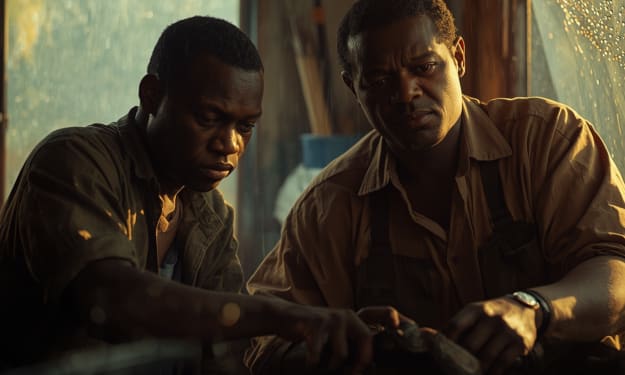
Bulawayo, 1998 — a city of sunburned streets and restless winds, where the scent of dust and diesel hung heavy in the air. In the township of Mzilikazi, two brothers grew up chasing the same dream but running from different ghosts.
By shakir hamidabout a year ago in Fiction