
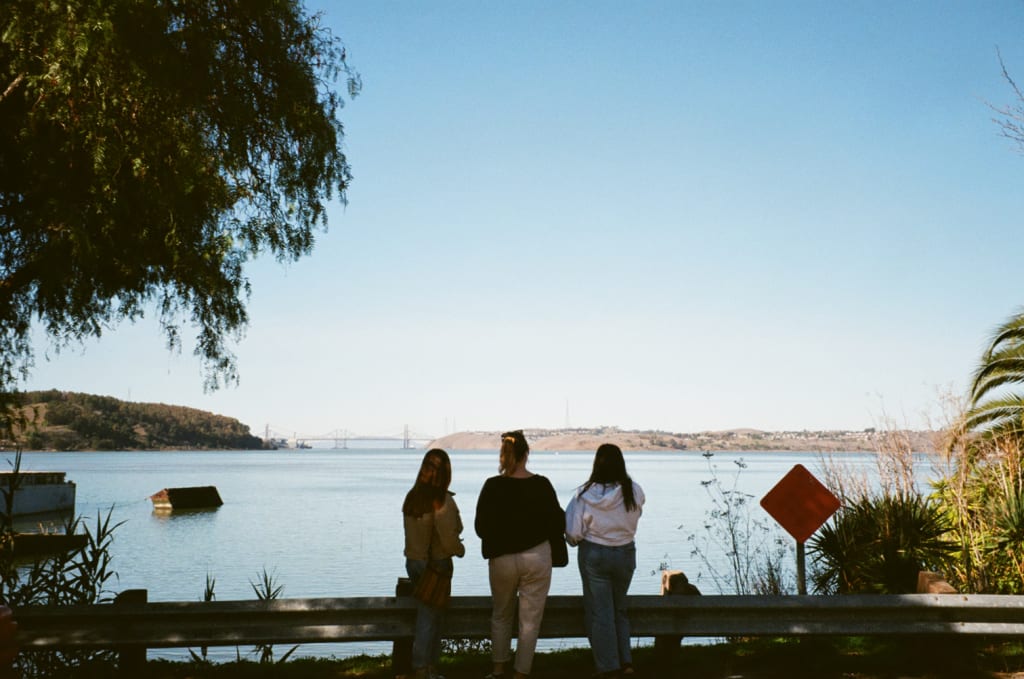
Crockett, CA starts as a hill that bleeds into a smattering of homes off of the bank of the Carquinez Strait and is accessed at the tail end of a highway before it turns into the Carquinez bridge. It is home to John Swett High School, the C&H Sugar factory, a public pool, a library floating like an island in a parking lot. It is home to less than four-thousand people, two bars, a middle school, and a finishing high school named after the slow, low-hanging willow. Groups of houses are positioned at wayward angles on yellow grassed hills facing the water, a small strait that takes water from the San Joaquin and Sacramento rivers and leads into San Pablo Bay, the final leg of the San Francisco Bay. Houses in town face towards the water too, but are mostly blocked from the view by other buildings, all built in the late 19th and early 20th centuries. Most of the buildings in Crockett are residences, crowded along snaking roads like jagged teeth across the hills that make up the town. The ones that aren’t homes line Pomona Street and the smaller avenues grouped together in a gridded womb at Pomona’s base.
Our house was on one of the lower hills, tucked behind years of overgrown trees and grass that Bobbi, our landlord, refused to have cut down. From the living room window you could see the bridge and the land it connected to, a taller and more uniform place. From anywhere in the house you could hear the rushing and whirring of cars driving past, which became as familiar to me as the muffled boom of the ocean, something I could hear from the house I used to live in before this one. From our front porch you could see the Sugar factory, emitting puffs of white smoke, a fixture in the skyline. When they would make brown sugar the scent of molasses would carry itself on the back of gusts of wind that struck at any moment, overtaking the senses of whoever happened to be in its unforgiving path. The only place where it provided bitter relief was by the water, momentarily dulling the scent of raw fish and washed up trash.
Depending on who you asked, this small “Sugar City,” was no city at all and it certainly wasn’t part of the Bay Area. “If you can’t see the bay, it isn’t the Bay,” was the common phrase. It was some in-between town, tucked under a bridge. Drive too fast, and you’d miss it. Pass through, you’d be moving on in ten minutes or less. To others, it was a hidden gem, a tiny paradise, one of the few “hometowns” that seemed to be dying out year after year. It was a small piece of history that many people had personal ties to. If anything, it was the presence of high school football and the small population that made Crockett feel this way. If people had been neighborly I wouldn’t have known. My mother had always lived on the principle of staying out of everyone’s way. My father lived on the principle of politeness, being nice was better than being silent, but know when to distrust someone’s intentions. I landed somewhere in between, avoiding interactions with people I didn’t know but being almost too nice to, and too trusting of, those I called friends. “Being liked” as a person was a concept entirely new to me. What did it mean for someone to “like” another person? “Your dad is nice. I like him,” the girls on my soccer team would say. Nice. Cheerful. Complacent. My mother on the other hand, her threshold for bullshit depleted, had earned a different reputation. My friends, she had assessed, were scared of her. This concept of being liked painted itself like a social law, and my new brain abidingly told her that it couldn’t be true and that every kid is scared of their friends’ parents a little. Through continued complaint I eventually wondered how a woman, almost thirty years older, could care what a bunch of children thought of her. Now, I understand that it doesn’t matter how old someone is, insecurity will claw at all ages looking for the fault-lines in the brain that are split open and waiting to be filled.
***
Crockett had, perhaps due to its population, uncovered land that was spread in gaping patches around town. Nature seemed to be everywhere; the thick trees Bobbi wouldn’t cut down towering over the small patch of grass in our prehistoric front yard, the multilayered backyard with stairs that led to a small gate that opened up to the street above ours, the oil refinery that preceded the last ditch exit before you were on the bridge going somewhere with greener grass and a populace with clearer skin, the Springtime shoots of grass that peppered the roof of our garage where I’d sneak away to sit. The heat, highlighted by the refinery’s drifting sulfur made the air unbearable in the Summer and the only reasonable place to go was the public pool. At five dollars you could go to the pool and stay all day. This was the closest form of entertainment that Crockett had to offer for anyone under twenty-five, besides high school football games, making donuts in the library parking lot, and smoking on the playground at night. For those of us that had no one to drive us to the mall or movie theater the pool was the only place to relieve the false sense of needing to relax and most of us were able to assign the pool with more meaning towards fulfillment. This was not so for Kathy Robinson, the first person my age that acted like a woman. She was level-headed, with a mental agility uncommon in most twelve year olds. She was direct and somehow knew what she wanted. She was also my best friend. “The pool is a boring place. You go, you get wet, and then you just sit in the sun and get burned,” She’d say. And yet, we’d find ourselves there, not for fun but as a necessity to counteract the heat that gripped us in our houses that lacked air conditioning, despite temperatures climbing past eighty on most days. We were bound together as friends much in the same way that our heat-swelled bodies were bound to the neon water of the pool. That aching and awkward twelve year old need for attention, but from anyone other than our own families, drove our friendship. In those first few months, it seemed that there were few things that Kathy didn’t hate. Playing computer games, watching tv, listening to music, baking. We’d spend weekends at the mall, darting in and out of crowds of people like nervous fish, handling clothes we couldn’t afford, saving face by saying we were saving money. When I’d spend nights at her house her dad would play “Cath...” from Death Cab for Cutie’s Narrow Stairs album on his guitar in the other room. We’d fall asleep with the window open, listening to the sound of his guitar floating from the living room window and into the one above our heads.
One morning we helped her neighbor look for her pet chicken that disappeared overnight. It had white and black feathers and was the size, roughly, of a small watermelon. We walked down the road to a small overlook and peered over the edge into a grassy ravine, hoping to see the bloodied carcass of the small chicken who Kathy and I secretly supposed had been stolen by a stray dog or coyote. The ground we stood on was made out of small gray rocks and under a few of them were trapped feathers. I pointed this out to the chicken’s owner whose reddened and tear-plumped face made me think I shouldn’t have. Our search party was cut short by Kathy’s mom who peeled off the side of the road shouting at us from her open minivan window. “Your mom is going to kill me,” She was saying, pointing her white stubby index finger at me. She turned her attention to Kathy who had already resigned herself to whatever her mom was about to say by not responding. She crossed her arms and pushed her sunglasses further up her nose. I could tell she was on edge, but pretended not to notice. We got into the back of the van and they drove me home in silence.
***
When my sister turned three my parents moved her out of what had originally been a breakfast sunroom and into my room, directly above me, so that my mother could use the sunroom as an office. Mia slept on a loft bed, and due to lack of room, my bed was put in the space below. In the morning, she would vault herself from her bed and onto mine, often times landing on me, deepening my distaste for having a sibling at all, annoyed that there was a wrinkle in my denial of her existence. In the sunroom, my mother spent most of her time working on her computer in ways that fulfilled her need for creative expression and also brought in money. She’d let Mia sit in there with her, looking at puzzles or watching television. I’d lay in my usual spot on my bed until forced out by school or weekend activities. My dad, whose brain, still unfamiliar with its old capabilities, could not work anymore. He’d spend his time reading books with titles like, “Your Brain and You,” or “Traumatic Brain Injury: What to Expect” He would take Mia to preschool, cook dinner, drink as soon as was acceptable, sometimes sooner. He would force us out into the woods on hikes, his intense appreciation for nature demanding that his offspring feel the same way. When he wasn’t doing these things, he was taking hours-long naps on our brown L-shaped couch from one of my mother’s favorite furniture stores.
Talking to anyone in my family felt like a chore at this point in my life. I avoided large scale conversation in the same way that I avoided my sister, slamming doors in the face of pervasive questioning. As soon as I’d arrive home from school I’d lay out on the smooth duvet of my bed, letting my cheeks rest on its cool surface. Here is where I’d begin my usual daydreams or recount my day, thinking over any and all interactions. One daydream that I was invested in was one of running away. From “who” changed each time. Sometimes it was from an imagined stranger that had stolen me while sleeping, other times it was from school. Most times it was from my room, out the window into the cool night. That summer I stopped smiling and started saying, “I don’t care,” with genuine dissatisfaction. My cousin was the one that noticed this most when I visited. Annoyed, she told me that I said it too much, that I needed to stop, didn’t I care about some things? This is how I saw the world: I’m looking out at my school’s yard from the small hill on its southeastern edge, feeling as though things couldn’t get any more miserable, that I was meant to approach life with pessimism and a vague feeling with a physicality closest to regret. What was it that I felt? Was it fear? What was I the most scared of? Time passing, my future, my family, my conscious. The years were starting to go by faster, things were starting to get harder; school, family, friendships. I sank deeper into my daydreams, letting myself plan out all the different lives I wanted to have instead of the one I was given, hoping there was some way to change things.
***
Years before the accident, or my sister, or my own self-awareness, we lived in a different house in Crockett. One that slanted on its side from a mudslide and had checkerboard tiles in the kitchen. Sunflowers that my dad had planted lined the fence in our front yard. A small, yellow sunchair with a fragmented, sun-faded Snow White smiling from its back sat on the cement walkway facing the grass. The only life I had known before that is filled with memories of tall fences that looked like two red hands with interlocking fingers and soft grass that stretched on for what I only knew to be eternity. A lone tree that bore no fruit. A blackberry bush that spilled over the fence from the neighbor’s yard. A playhouse made out of old paintings by my mother’s friend who put them together with a nail gun. Lying in the grass between my parents looking for shapes in the clouds, and the lack of knowledge about everything and not knowing to care about how much I didn’t understand. When we lived in that slanted house, I hadn’t known the sadness of Crockett that I would learn to live beside on our return. The lights that blinked C–&–H from the factory once held some novelty for me, but when I would look at them blinking lazily from under the overpass just as the sky eased into darkness, I felt nothing.
***
One year the police chased a man on the freeway until he made the desperate mistake of careening into Crockett in an attempt to avoid the inevitable trap on the other end of the bridge. He would have sped past signs advertising the Boy Scout fish fry, 6pm at “the Hall” fed by the Nantucket, and the pancake fundraiser for the volunteer Fire Department, 11am at the fire house. He wouldn’t know there were only three different roads he could take to get out; behind him, to the right of him, or slowly and eventually through Port Costa, the even smaller town in the valley under Crockett, that would’ve dragged him through a sludging forest road and would’ve dumped him out on Highway 4, further than he’d ever been in the first place. They cornered him behind Toot’s Tavern where an axe, a pistol, and two shotguns were found in the trunk of his car. Waitresses from the pizza parlor and the usuals at Toot’s watched lazily from the sidewalk, shaking their heads and presupposing what he’d done with the items in his trunk. My dad and I watched the local news coverage on tv from our couch. “Why would he turn down that street? If he just kept going straight he could’ve hooked a right and been gone.” My dad said, annoyed with the man’s stupidity. “He shouldn’t have gotten off the freeway at all.” We laugh at the absurdity of this man, wondering what he had done to get there, shoved onto the hood of his own car, his entire being and belongings put into questioning. My mother and I were glad that he had been caught and I marveled at how this town was a literal “dead-end” for this man who thought he won a ticket to freedom by leading the police into our little inward elbow of a town, our sugar styx.
***
It’s hot and I am waiting. I’m sitting on a small hill backed by a small tree that provides a small triangle of shade on the slight slope of the hill’s northern side. My friends and I are on its peak, staring out at the rest of the blacktop as other Carquinez Middle Schoolers trickle in from all sides, like ants swarming their hill. Our hill was on the further end of the long stretch of asphalt-covered yard that divided us from the orange-creamsicle colored block designated as a place of learning. Our place of learning. We were waiting, with tense frigidity, for the warning bell, loud and a few seconds longer than it should have been. This, and only this, would prompt us to make our defeated progression to the back double doors of the orange box. There we would join the swarm, weaving in and out of groups of people to get to our lockers or classes, avoiding each other at all costs. We’d all settle into the usual schedule held together by our teachers who barely ever seemed to have a true hold on anyone and got through each day without incident purely by chance. There was a thick, nervous energy that crowded behind elbows and ears and felt like there was always someone staring. The only moment of peace was on the path leading from the front door of the middle school through a damp tunnel that connected us to the high school’s basement where 7th grade choir was held by the only band teacher in the area, Mr. Pitzulo. Twenty or so of us gathered in the afternoon, around 1:35, in the gray carpeted room with one of those ceilings made of what looked like freckled styrofoam that had been hole punched hundreds of times and always seemed to have one or two tears or pieces missing somehow. Mr. P, as he liked to be known, was of a higher caliber than other teachers we knew. For one, besides our class he taught high school, something he treated so obviously different than middle school. There was a kid in that class that would suck on Jolly Ranchers until his tongue was too numb to practice his scales. One day he let the candy sit for so long in the back of his mouth that it stuck to his molar and when he pulled the candy out the tooth came with it. He said his tongue tasted like watermelon and salt and we all laughed even when blood started to drip onto his shirt. Months later he would be dead by suicide and I would think back to that moment while watching his best friend cry in the library, and again in the gymnasium when the school would have his family sit on stage where we could all see them mourn, and spread the low whispered rumor that his father was the one that made his decision easy.
***
The school down the road behind us was where old dropouts and pregnant teens went to finish their education, the end always in sight, the sooner the better. Finishing fast was better than not finishing at all. The expectation of keeping within the status quo, of having a diploma on the record, was better than wanting to learn. It didn’t matter if all you were going to do was be a teen mom or form an addiction to something, as long as you were educated. I thought about the girls at Willow and how mean they seemed to be, how unconcerned with life they already were. I thought about what they did to get where they were and I let myself feel that base fear of doing the same things and ending up just like them. What all of this really meant I didn’t know. All I knew were what the rumors among four twelve year olds were which were taken as fact, always. None of any of the things that we said were positive and all were said with the superiority only middle schoolers could have, all of our brains seemingly snapping into consciousness at once. Together we would talk about the different things we’d have to do in order to get kicked out of school, placing us at Willow. Skip class, hit a teacher, smoke cigarettes in the bathroom, start a fire, start a fight, have sex, get pregnant. We chattered nervously about what our lives would be like as girls of Willow, the underlying fear being how much lonelier we would be than we were then, sitting on the fringe of school property, indignantly basking in the attention that comes with being removed from a larger group. We thought we knew how people saw us and acted like it too, when in reality we were more like nervous cats scampering around everyone that wasn’t in the group and desperately looking into the mirror that was every other middle schooler. We wanted answers to questions we weren’t even sure how to ask yet, for life to fast forward through what we were living then, thinking we knew better than what our age allowed us, ready to place our blind faith in whatever or whoever came around.
At the end of the school year, us seventh graders were taken to spend the day in the small national park on a plot of land next to the landscaper’s shed where a square blanket of sand had been dumped next to an empty swimming pool that was caked with green things and looked as though it hadn’t been filled with water for decades. The hills were tall, almost mountainous from where the sand was and smelled sweet in the way that dry yellow grass does in the heat, shooting out like needles. The trees ached at jagged angles, causing one’s back to twinge just by witnessing their slow and painful dance. A group of five or six of us left the rest to venture into these dry, sweet smelling hills, running as fast as we could. We hiked through, planning to be back in time to get back on the bus for school. Our exploration ended when the park ranger and a helicopter were called. We were found by one of the rangers on foot. His specialty was tracking footprints. When he found us we were sitting at a forgotten wooden table under the shade of a large thicket of trees. He told us that we had to leave with him and he led us down a steep hill, the fastest way back. We slid down it, hollering the whole time, dust coating our clothes and our hair, the camera we used to take photos with lost in the weeds forever. When we got back to the school we waited in the hallway for our parents, the principal dejectedly telling us we wouldn’t be allowed at the last day of this year, or the first day of the next year. “I’m not coming back here, anyway,” I had said, only half-knowing if this was true. When my father arrived I had to watch him walk down the hallway to where we were being held. He took his time, admiring the different framed photographs on our middle school walls, pausing briefly at a wooden cabinet with its glass doors proudly boasting nearly insignificant pieces of middle school history highlighting, if anything, how much it hadn’t progressed. Finally, he approached us. “Hey, kid,” he said. He was smiling, and he looked as I had expected. Calm. “My dad won’t be upset,” I told my friends, “he won’t care at all.” Looking in his eyes that gleamed with a strange sort of understanding I realized that it wasn’t that he didn’t care, but that he knew it was something I had to do.
***
Leaving Crockett felt as natural as living there. This town had given more than I wanted to accept and had taken more than I was ready to give.
About the Creator
Enjoyed the story? Support the Creator.
Subscribe for free to receive all their stories in your feed.
Comments
There are no comments for this story
Be the first to respond and start the conversation.