

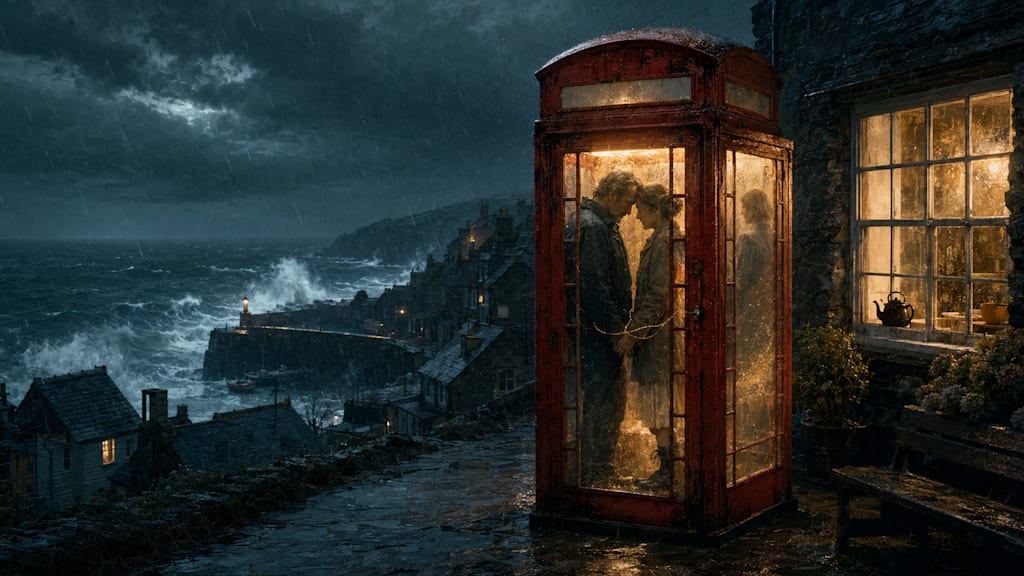
The red phone box outside Ellen's shop hadn't rung in thirty years, and everybody in Porthmara agreed that was rather the point.
Her aunt had started it, dragged the decommissioned box up from the harbour in a borrowed trailer, painted over the BT crest with gold leaf that peeled within a season, and told anyone who asked that it was "for talking to the ones who can't talk back." People laughed. Then people used it. By the time Ellen inherited the shop and the box and the whole absurd, aching legend that came with them, half the village had a name they whispered into that dead receiver at least once.
She didn't mind the box. She minded, a little, that she could see it from the till.
Every morning at ten past six, before she'd so much as flipped the sign on the tearoom door, Jago Trewin walked down from the headland, let himself into the box, and pulled the door shut behind him with the particular care of a man closing a church gate. He never dialled a real number; there wasn't one to dial, just turned the rotary through its slow, clicking circuit and lifted the receiver to his ear as something might answer. Ellen never watched. Not really. She just happened to be filling the kettle at that exact window at that exact hour, six mornings out of seven, for going on three years.
She knew his wife's name was Nessa. Everyone did. Nessa Trewin had died the spring before Ellen's aunt did, which meant grief had arrived in Porthmara in a kind of tandem, and the two of them, the widower and the shopkeeper's niece, had spent three years being very carefully not thrown together by absolutely everyone.
"You'd think," said Mrs Pascoe, dropping four sugars into her tea with the solemnity of a woman performing surgery, "that somebody round here might have the sense to see what's obvious."
"I've no idea what you mean," Ellen said, which was a lie broad enough to see from the lighthouse.
Mrs Pascoe ran the Porthmara Women's Institute the way other people ran small, well-armed nations. She had married off two publicans, a coastguard, and, famously, tragically, her own nephew to a woman he'd known for eleven days. She had not touched Ellen. She had not touched Jago. It wasn't kindness, exactly. It was strategy. You didn't rush a fire that was already laying its own kindling.
Which was how Ellen ended up, on a wet Tuesday in October, holding a ladder for Jago Trewin while he refixed a loose slate on the tearoom roof, a job that technically belonged to Ellen's cousin, who had developed a sudden and suspicious ear infection that morning.
"Tell your cousin," Jago called down, rain running off his collar, "he's not fooling anyone."
"He knows. He said the ear infection was Mrs Pascoe's idea, actually. She rang him a script."
Jago laughed, a real one, surprised out of him, and nearly lost his footing, and Ellen's stomach did something unhelpful and immediate. He came down the ladder wiping his hands on his jeans, close enough that she could see the grey coming in at his temples, close enough to smell rain and woodsmoke and something that was just him, and for one whole second neither of them said anything at all.
"Right," he said eventually. "Well. That's the slate."
"That's the slate," she agreed, and let him go.
It went on like that. A fence needed mending, and somehow it was the two of them. The lifeboat fundraiser needed someone to run the raffle table, and somehow it was the two of them, laughing at Mrs Pascoe's increasingly unsubtle seating arrangements, both of them pretending not to notice that they were, once again, the last two names on every list.
Ellen told herself it was proximity. Small village, small pool. She told herself that every time she caught herself timing her kettle to the phone box, and every time she didn't quite manage to stop.
Then the council sent a letter.
Coastal path improvements, it said, in the flattened, bloodless language councils use for things they know will hurt somebody. The box was structurally redundant, a liability, scheduled for removal in six weeks. There would be a form to fill in if residents objected. There was always a form.
Ellen read it twice at the till and felt something in her chest go tight and stupid, because it wasn't her grief in that box. She had no right to it. But she thought of Jago's careful hand on the door each morning, and she went and got the form.
She didn't tell him. She meant to. She got as far as there's something I ought to three separate times and lost her nerve three separate times, because it wasn't hers to make a fuss about, until the storm came in on a Thursday night hard enough to strip the harbour wall of two boats, and she looked out from her flat above the shop and saw the box lit up gold in the dark, and a shape inside it that hadn't moved in a long while.
She went down in her coat over her nightclothes, boots unlaced, rain going sideways off the sea. The box door stuck; she had to put her shoulder to it. Jago was inside, receiver pressed to his ear, not speaking, water running off him onto the floor he'd probably stood on dry a thousand mornings.
"They're taking it away," he said, without turning round. "Six weeks. I read the notice on the noticeboard an hour ago."
"I know. I filed an objection this afternoon." Her voice came out smaller than she meant it to. "I should've told you."
He was quiet long enough that she thought the wind might have taken the words before they reached him. Then: "I used to tell her everything. Every stupid thing. What I had for lunch. Whether the tide was good." He turned, finally, receiver still loose in his hand, rain and something else on his face. "Lately I've been coming down here and not knowing what to say to her. Because most mornings, what I'm actually thinking about is you. And it felt like, I don't know. Like cheating on a phone call to a dead woman. Which is mad. I know it's mad."
"It's not mad," Ellen said, and found she was crying, which was mad in its own way, in a phone box, in a gale. "It's not mad, Jago."
He set the receiver back in its cradle, gently, the way he always did, a small courtesy to a line that had never once carried a voice back to him, and reached for her hand instead.
They fought the council together. They won, in the end, the way small places sometimes do: a heritage listing, a plaque, a paragraph in the parish newsletter that Mrs Pascoe took a suspicious amount of personal credit for. The box still stands at the top of the lane, red and absurd and slightly rusted at the hinge.
It still doesn't ring. But most mornings now, if you're filling a kettle at the right window at ten past six, you'll see two shapes in it instead of one, fogging up the glass, in no particular hurry to come out.
About the Creator
Diane Foster
I’m a professional writer, proofreader, and all-round online entrepreneur, UK. I’m married to a rock star who had his long-awaited liver transplant in August 2025.
When not working, you’ll find me with a glass of wine, immersed in poetry.
Enjoyed the story? Support the Creator.
Subscribe for free to receive all their stories in your feed. You could also become a paid subscriber, letting them know you appreciate their work.
Comments
There are no comments for this story
Be the first to respond and start the conversation.