
Something Is Playing Down Rutledge Street
He Wants Something Warmer, and He Always Gets It

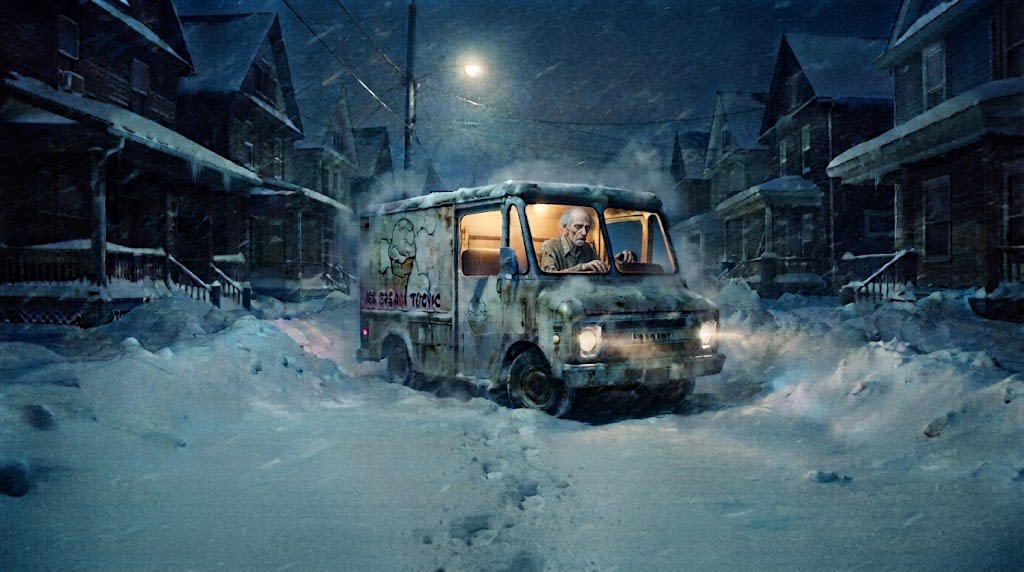
The storm had swallowed the whole town by ten o'clock, and by midnight it had swallowed every sound that dared remain. I sat alone in my grandmother's old house on Rutledge Street, the house she left me when she died, and listened as the walls groaned beneath gusts that seemed bent upon tearing the roof from its timbers. Snow had fallen for two days, piling against the doorway until I could scarcely force it open that morning, while the street outside lay buried beneath drifts tall enough to swallow a wagon whole. It was the coldest January the county had known in decades, a bitter cold that cracked pipes, stopped watches, and settled into the marrow the instant a soul ventured outdoors, and I had resigned myself to a long, sleepless vigil staring into the darkness until some final blast ended the electricity altogether.
At first I believed the sound beneath the wind came from some gap in the boards, some old imperfection through which the storm had found a voice. Then I heard it again, clearer than before, and something within me grew colder than any winter had ever managed by its own cruel strength. It was a melody, thin and tinny, the sort of jangling tune that once drifted down my street on long summer evenings, following a truck while I clutched coins tightly in my small fist. That tune belonged to July, to bare legs and sticky lips and the long golden hour before supper, and hearing it now, in the dead center of a blizzard, felt like watching a long-buried relative rise from the churchyard and stroll calmly into the parlor with a smile upon its face, as though death had been some minor inconvenience easily forgotten.
I tried to convince myself that my mind had conjured the sound from some forgotten corner of childhood, for solitude within an old house can play dreadful tricks upon a man. Yet the melody continued, verse after verse, drawing nearer down Rutledge Street with a slowness that seemed intentional, as though whatever produced it possessed an intimate knowledge of dread and knew precisely how long a human soul could endure before breaking. I rose from my chair, my legs trembling in a manner I despised even as they carried me forward, and pressed my face close to the glass, wiping away the mist with my sleeve. Through the swirling white I saw it at last, a pale truck rolling along the buried road, its lamps casting twin sickly cones through the storm, its side bearing the same faded cartoon of a smiling scoop I remembered from decades before, though the paint had cracked and peeled until the painted face seemed afflicted by some sorrow of its own.
The truck stopped directly across from my porch, and its engine settled into a low, steady growl that seemed to travel upward through the boards beneath me. Steam rose from beneath its frame and curled into the storm, vanishing after only a few inches, as though the cold itself had condemned even warmth to immediate death. I stood there in my socks with my coat forgotten, watching snow gather upon the roof in a manner no honest machine could have endured, while some foolish corner of my soul longed to run outside barefoot and press my palm against that cold metal side, as I had once done when I was a girl who feared nothing beneath the summer sun.
I told myself this was madness, and I knew sensible people remained indoors during blizzards when midnight had swallowed the town and a forgotten summer tune came drifting through the storm. Sensible people barred their doors and waited for morning, trusting daylight to make the dreadful seem foolish. Yet I found my coat and boots, and soon I was crossing the buried yard while the wind screamed past my ears like some living creature enraged by my decision, until I stood beside the driver's side and looked upward into a face illuminated by a soft glow bearing the color of an August evening buried deep within the past.
The driver appeared carved from patience itself, unhurried and composed, with a smile stretched slightly too wide across his features and eyes pale as spoiled milk. He wore a paper cap of summer white, entirely untouched by the storm, while his sleeves were rolled to the elbow as though winter possessed no authority over him. A metal box rested upon the counter between us, its little glass front clouded over, and behind that cloudy pane I could see rows of pale frozen treats stacked in columns so precise that they seemed prepared for some purpose far removed from ordinary commerce. He greeted me warmly, as though we had performed this strange exchange a thousand times before, and told me his shop remained open through every season, every hour, and every storm the world had ever sent against him.
"What will it be tonight?" he said, and his voice carried an odd, rolling cheer beneath it, the sort of cheer a carnival barker might summon long after the carnival itself had rotted away and vanished from memory. I questioned him about the business that had drawn him into such weather, and he answered with a laugh that rattled strangely against the storm, a laugh possessing all the sound of merriment and none of its warmth. He told me the season held no meaning for him, and trade remained steady through every month of the year so long as some soul still possessed something worth spending.
I told him I had brought nothing with me, for my coat pockets were empty when I rushed from the house and contained not a single coin. He tapped the fogged glass with one knuckle and told me his shop dealt in another form of payment, one far dearer than money. He traded in summer memories, the true ones, still warm at their center, those memories people bury deep within themselves and seldom surrender. He told me I would know the correct memory the instant I found it, for it would rise from the depths of my mind whole and sweet and terrible in its perfection.
I laughed then, the nervous laugh a man gives when a stranger says something so absurd that laughter seems easier than fear. The driver merely waited, patient as a grave waiting through centuries of rain, while the tune continued somewhere beyond my sight. I searched my own mind partly to humor him and partly because some reckless creature within me wanted to discover what such a bargain might cost, and soon a memory rose before me with startling clarity. It was the summer I turned nine, when my cousin and I ran barefoot down this very road after being soaked by a sprinkler, laughing until our sides burned and the evening seemed too young ever to end.
The moment I surrendered the memory, silently holding it before my mind, I felt something pull loose behind my eyes, a small and clean sensation like a splinter drawn from beneath the skin. The driver's smile widened with delight, and he reached into the box and produced a treat wrapped in pale paper, lowering it into my waiting grasp with a solemn nod of approval. I took it before thought could intervene, and the instant it touched me, warmth spread through it, absurd and intense, as though the whole of July had been folded into that little parcel and sealed there against the winter.
I turned toward my porch with the treat in my possession, and only then did I understand what I had given away. The memory remained within reach, yet some portion of it had dimmed, as though a veil had been drawn across one precious corner, and when I tried to summon the sprinkler again, the color of the water beneath the evening sun had vanished from my recollection. I could remember my cousin, the running, the laughter, and the burning ache in my sides, yet some essential piece had been taken from the scene, leaving a hollow place where the sweetest part had lived. A dull unease settled within me and grew larger each second, until I turned toward the truck with the intention of reclaiming what I had surrendered.
He had vanished. The truck had vanished as well, along with the tune, the pale glow, and the man in his summer cap, and all of it seemed to have been swallowed by the storm as though the night itself had closed over the place where they had stood. Only my own tracks remained behind me in the snow, accompanied by a second set beside them that was already filling beneath the endless fall. I remained there for a long while, the treat cooling against my palm while my thoughts circled that faded portion of memory like a tongue circling the empty socket left by a lost tooth.
I have told this tale to no living soul, partly because morning brought with it a terrible doubt concerning my own senses, and partly because some ancient instinct within me warns that speaking of the event too freely could summon that tune once more down Rutledge Street before its proper season. Yet every January, when the drifts rise high and the wind claws through every gap in the old boards, I find myself straining to hear that thin, jangling melody, half consumed by terror and half possessed by a shameful longing, for beneath the dread there remains a hunger to trade with him again. I surrendered my ninth summer to that pale and patient driver, and some nights I lie awake beneath the darkness wondering which summer he intends to claim next, and whether my will shall prove strong enough to refuse him when that dreadful tune comes rolling once more down Rutledge Street.
About the Creator
Nolan Reed
I write true stories, including unsolved mysteries and events that actually happened.
Enjoyed the story? Support the Creator.
Subscribe for free to receive all their stories in your feed.
Comments
There are no comments for this story
Be the first to respond and start the conversation.