
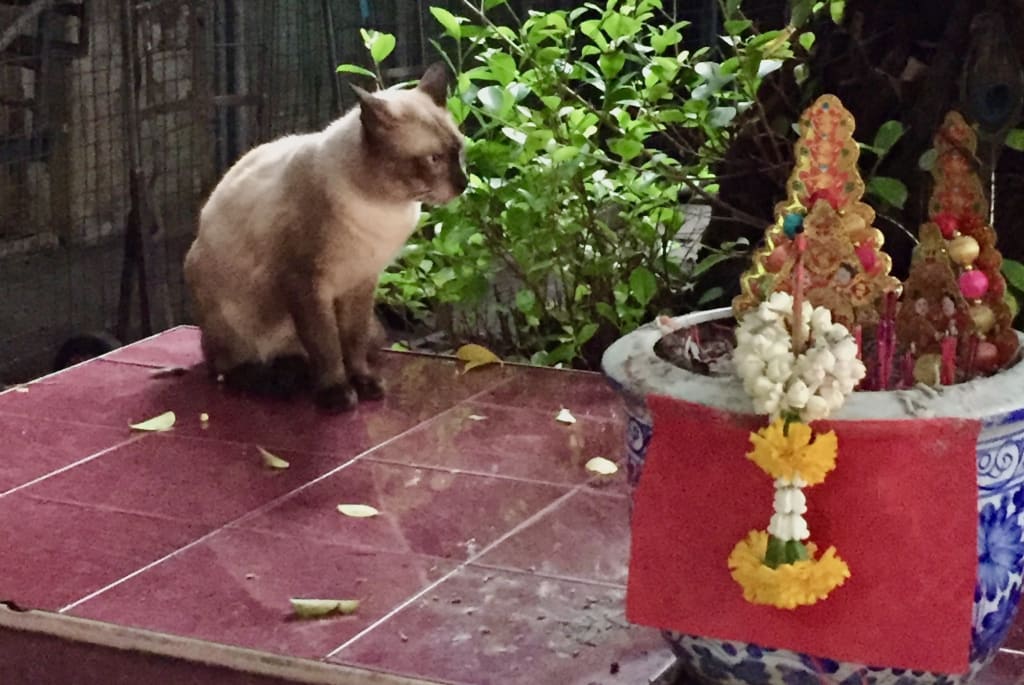
The air is still, hot and humid where the skinny Siamese perches on the concrete rail of the fourth-floor porch, outside the potter’s studio where the wheel hums low. Mika flicks her stubby tail watching schoolchildren pass on the street below, jostling and tripping each other with book bags dangling and high voices. An old woman selling fragrant kabobs cries out, shooing them away from the open flame below the grill, above the gutter, in front of a 7-Eleven where scooters circle and pick up rides. A lizard darts, making for the trailing leaves of a hanging fern.
As evening falls the Bangkok street gets noisy with people filling restaurants and sidewalks, dogs come from alleys to pick up scraps, cars honk and drivers call, and the breeze from the canal smells of trash and danger. Mika descends after the signs lining the street go dark, adventuring silently in deep shadows.
The aftershocks try to take her feet from under her. Racing through streets and yards with the night loud and clogged with smoke, she runs from walls shaking, sirens, screams, people clogging the streets, howling dogs, every block is a terror. On the back side of a half-built hotel, she stops short on the patio of a long green lawn that stretches down to the canal. The air is clearer here, it’s quiet, the ground has stopped trembling. A fire across the water burns the sky orange, the bright night reveals dark shapes moving on the lawn - monitor lizards made restless by the shifting earth. Her back goes up before she crouches, growls, creeps along the patio wall, over the tall chain fence, into a yard of stacked boxes and pallets.
At the steps of a building, she sees a box overturned, flaps open, fabric inviting, she soft steps in and curls up to wait and sleep.
Mika is awake before she opens her eyes, ears flick to noise muffled by her bedding. A voice gets louder and then the box flips onto its bottom, fabric stuffed back in and flaps folded closed before she can protest. The box lifts, stacked with others and rolled down to a long, low boat on the dock, passed to waiting hands and piled at the back. Mika mews but there is no one to hear, then the sound of people talking over an outboard engine, soft rolling vertigo, claws dig into pliant cloth.
The engine stops and the boxes are shuffled onto land. In the new stillness Mika noses at the flaps and a little sunlight appears. She pushes harder, paws clawing, creates a space just large enough to wiggle head, shoulders, lean body and she’s out on a pier lying long on the shoreline, busy with cargo and tourists. She scoots away under a tuk-tuk parked in the shade of a tall statue that welcomes all to the grounds of the temple. The solid old buildings were untouched by the earthquake. People crowd vendors, food stands and gilded doorways, children play at recess behind a high wall.
The temples finished in porcelain and gold face solemn Buddhas and trail off where jungle twining vine tests fences set with colored glass gleaming in the hot green shadow. After all the tourists have left on the long boats the sun sets with bells and low chanting and a young monk walks down to the empty market carrying a full plastic bag worn soft and quiet. Kittens and cats pop out of cracks, bound from rooftops and cloth-covered tables to mew and thread with tails high around his legs. He speaks gently, food clatters into bowls and the cats go silent as they feed.
Mika creeps along the edge of the market until the monk spots her. Bending over he coos and whispers, encouraging her to eat. He puts a soft hand on her back but she flexes away so he leaves her to her meal.
The kittens have never known solitude. They run and play in bouncing, tumbling packs, and sleep in piles surrounded by each other's wiggles and kicks as they squirm in dreams or object to their fleas. From a shady afternoon temple doorway Mika watches a monitor stalk them playing on the grass, launching in twilight to snap up some and scatter the rest.
The older cats are jealous of their spots, they begrudge territory and snarl from trees. But the temple grounds are large, and Mika finds peace under lonely altars in cool stone rooms heavy with incense. She settles in her new routine, stakes out territory for morning sun and afternoon shade. She eats with the other cats in a truce of shared need, retreats avoiding rustling bushes and dark shadows back to the solace of temples. Stubby tail flicking on the rail of a porch, she watches the monks and tourists come and go. At night the cats yowl, fight with each other and stray dogs and Mika’s ears flatten, back bunched. Vigilant day and night until she finds a spot behind a curtain, a cool, still alcove of stacked flat round pillows. It smells unused, dusty and damp. In soft silence she sleeps well at last, secreted away from danger and noise.
Mika sleeps through the sound of tiny feet climbing onto pillows, soft fur brushing against soft fur, breathing and squeaks as warm bodies snuff around her and settle into little commas against her back. She springs up and hisses, batting the faces of kittens who complain and stretch their paws against the attack. Mika growls and hisses again, the kittens flop and yawn. Ears flat, she slinks from the alcove with a low steady murmur in her throat.
The kittens have found her. She chases them off when she’s awake, so they wait until she’s sleeping to invade with snuggling, wiggling, baby mews and bad dream shakes. She moves to another pillow; they find her again. Kittens follow her through the day, crowding at a food bowl, playing under her perches. Some disappear and are replaced by others. They are a ubiquitous annoyance of playbites and needle claws, Mika wanders farther and longer to avoid their company.
On a still morning that feels like rain, Mika prowls in a bamboo thicket near the river, where the slow boats trail long rudders and cargo ships churn loud smoke. When the rain starts, she takes cover in a plastic container near the shore. Rain drops pop on the flat top, until it’s raining hard enough that drops become a steady rumble splashing up at the little round opening where she crouches ears flat and face tight.
Mike jumps up when the container moves, the rising water pushing towards the current pulling from the shore. She tests the opening to jump, hesitates, tests, the container twisting away from land, rain pounding.
She floats down the vast grey river under the low grey sky, attendant to the circling earth while rain falls and after it stops quiet with lapping waves in the hot dim day. Bird feet scramble above her, off-balance, rolling the canister left and right, and fly off when she meows in her durance.
In the glow of early day, the small vessel bumps to rest, snugged up on branches hung with trash on a slip of land not much larger than her temple. Mucky plastic rustles with rats. Mika tests each step and explores slowly, the north end covered with bunched sodden trash giving way to a canopy of bushes and small sandbar to the south, where birds pick for small fish.
On the tiny island she can hear from the south end the rats in their twitchy hungry colonies. A rustle and squeak in low grass by the waterline, she stalks and pounces. City rats were bold and vicious, with fighting screams that had echoed against buildings. The island rats are small and heedless, Mika tortures them in the kill.
The days are quiet, the nights are still. Mika watches slow boats and circling birds with stubby tail flicking on the sand, eyes blinking into naps on her peaceful island. Morning sun, afternoon shade, full belly. The bushes bloom drooping white flowers from spikey stems, thick green ivy climbs on itself over insects chittering in the moss.
As she hunts, the rats get bolder. They don’t come down to the sand but stand on back legs to greet her at the threshold of trash and die quietly with ripped bellies and broken necks. They appear from under bottles and inside plastic bags, watch her from branches and holes with eyes and teeth gleaming, and scramble unafraid around her legs. They reek of their trash, wear smears of slime, flicks of plastic.
If she doesn’t pounce they bounce against her, provoking violence with bites and scratches. She breaks them open; twitching or still, their brothers and sisters eat what she leaves.
On the tiny southern beach at the end of the world fat Mika sleeps well, secreted away from danger and noise. She sleeps through the sound of tiny feet in the sand, soft fur brushing against soft fur, breathing and squeaks as warm bodies snuff around her and settle into little commas against her back.
About the Creator
Enjoyed the story? Support the Creator.
Subscribe for free to receive all their stories in your feed.
Comments
There are no comments for this story
Be the first to respond and start the conversation.