
SOLIDUS SNAKE: THE DEVIL’S ARMY
A fan-media origin story rooted in established Metal Gear lore

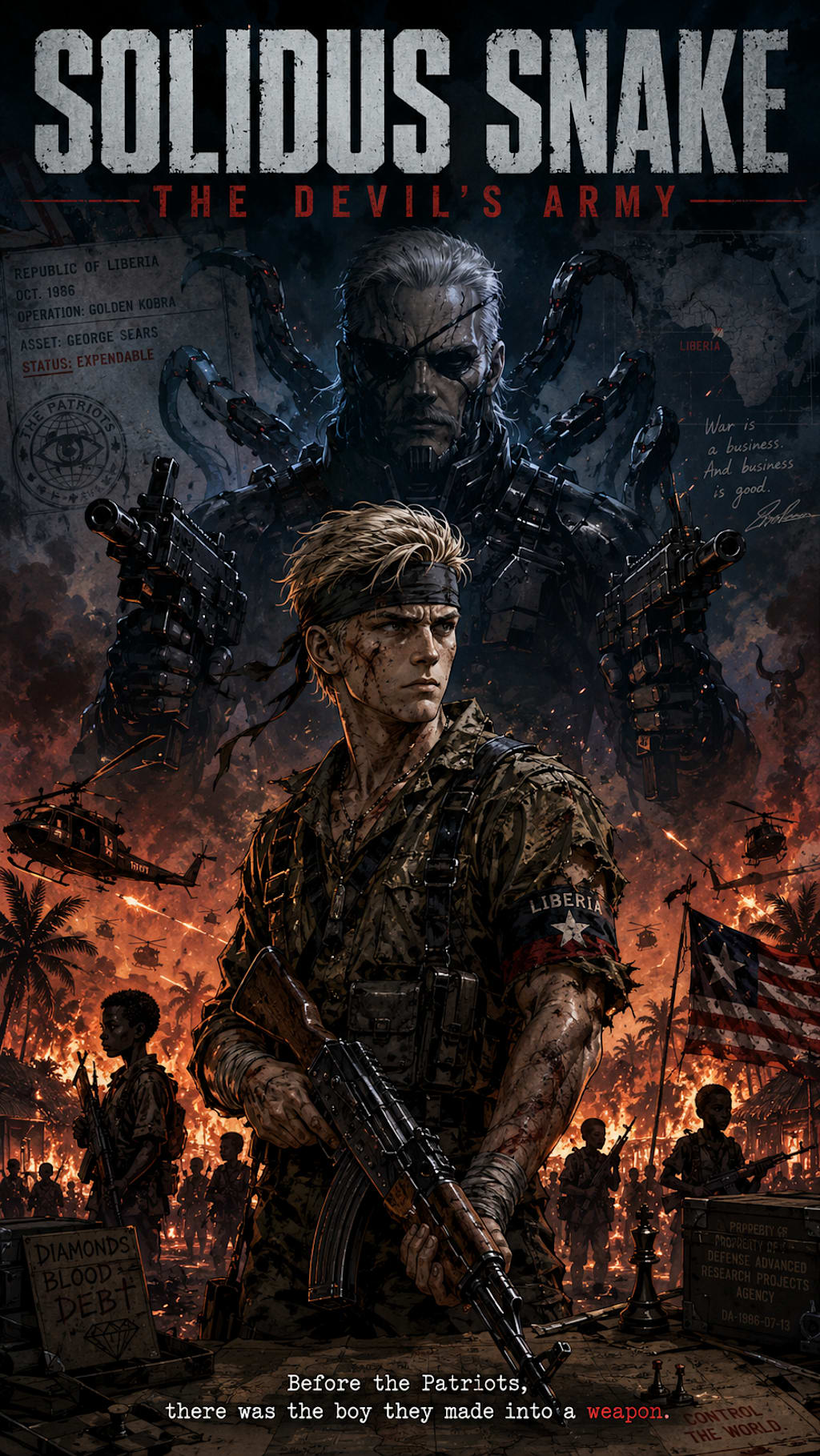
Part I: The Making of a Weapon
Before he was President George Sears, before Big Shell, before the world learned to fear the name Solidus Snake, he was a boy in a room without windows.
The room had no flag.
That was the first lesson.
Flags were for the people outside. They were for the speeches, the funerals, the schoolbooks, the songs, the little hands pressed over hearts in rooms where children were taught that nations were sacred things.
In this room, nations were colored shapes on glass.
West Africa glowed beneath the table, divided by red routes and white borders. Liberia pulsed at the center, not like a country, but like an exposed nerve. Diamond corridors blinked. Arms networks crawled. Private airstrips appeared as neat blue points. Displacement estimates scrolled beside casualty projections. Civil unrest indexes rose and fell like weather.
Three men watched the map.
The first wore a civilian suit and had hands too clean for the world he discussed. The Financier. He never raised his voice. Numbers never required volume.
The second wore a uniform without any insignia that mattered. The Colonel. He stood with the posture of a man who believed history was merely a longer campaign.
The third wore a white coat and spoke with the patience of a priest explaining doctrine to the dying. The Doctor. He did not look at people as people. He looked for patterns. Stability. Compliance. Heritability.
On the wall, beside the map, a file appeared.
SUBJECT: GEORGE SEARS
GENETIC SOURCE: BIG BOSS
PROJECT: LES ENFANTS TERRIBLES
FIELD VIABILITY: PENDING
STATUS: EXPENDABLE
The word was red.
The boy was not in the room.
Not yet.
He stood behind observation glass in the chamber next door, pale blond hair damp with sweat, eyes fixed on a tactical board. The officers across from him were grown men. They had education, experience, rank, and the comfortable arrogance of adults who believed age was a form of armor.
George Sears had none of those things.
He had silence.
He had patience.
He had a mind built too sharply for mercy.
The simulation had begun as a border conflict. The officers expected him to attack. Boys attacked. Boys rushed. Boys wanted to prove bravery to men who watched through glass.
George did not attack.
He cut fuel.
He bribed a relay.
He abandoned a decoy position and let the officers feel victory long enough to move their reserves into a corridor he had already made useless.
Then he starved them.
One by one, their pieces stopped moving.
The room behind the glass went quiet.
The Financier leaned closer to the window.
“He understands.”
The Doctor folded his hands.
“No. He learns quickly.”
The Colonel watched George, who did not smile, did not celebrate, did not even look relieved.
“There’s a difference?”
No one answered.
On the screen, the red word remained.
EXPENDABLE.
Empires do not raise children.
They inventory them.
Liberia did not appear on George Sears’ orders as a country.
It appeared as a theater.
He arrived in the belly of an unmarked cargo plane descending through storm clouds over the coast. The cabin lights were red. Rain slapped the metal skin of the aircraft. Around him sat crates marked as medical relief, communications equipment, food distribution kits, and emergency sanitation supplies.
Under the false labels were radios, ammunition, weapons parts, sealed black cases, and codes that belonged to no government anyone could admit existed.
The Patriots sent medicine on paper.
Everything else was packed underneath.
George sat alone with his hands folded, too young for the uniform and too old in the eyes. No one had told him to be afraid. No one had told him not to be.
So he simply watched.
The plane landed on a muddy airstrip at night.
Helicopter rotors cut the rain into sheets. Floodlights burned through mist. Men shouted in several languages. Trucks coughed black exhaust into the wet air. A private military liaison waited beside the stairs, holding an umbrella as if manners could survive this place.
“Welcome to Liberia, Mr. Sears.”
George stepped down into the mud.
He did not look at the man.
He looked past him.
Children were unloading crates from the aircraft.
Some were thin. Some were barefoot. Some moved with the dull efficiency of those who had learned that hesitation invited punishment. One boy strained beneath a wooden box stenciled with a red cross. Another watched George with eyes that did not belong to childhood anymore.
The liaison noticed George watching.
“Labor is fluid here.”
George finally looked at him.
“Everything is fluid when no one is protected.”
The man smiled, unsure whether he had been corrected.
A convoy took them inland.
Through rain-streaked glass, George saw the country in fragments. A burned truck at the roadside. Women carrying water past a checkpoint. Men in mismatched uniforms standing beneath a torn billboard advertising foreign development. A church wall chewed by bullets. A line of miners walking under guard. A boy in oversized fatigues holding a rifle too long for his arms.
The liaison spoke from the front seat, reading from a folder as if the words could make the world cleaner.
“Multiple factions. Fragile command structures. Resource corridors in dispute. Local leadership remains malleable.”
George watched the boy at the checkpoint disappear into the rain behind them.
“They’re frightened.”
“That is one interpretation.”
“No,” George said. “That is the useful one.”
The liaison stopped reading.
By morning, George understood the inventory.
The compound hid behind humanitarian markings.
Outside, the war was wet and loud. Trucks groaned through mud. Generators rattled. Radio towers blinked red through rain. Men with no insignia guarded gates painted with the language of relief.
Inside, the floors were clean.
That was the second lesson.
The dirt never reached the rooms where decisions were made.
George was taken first to the Financier.
A polished table waited under low light. On it lay diamonds, shipping manifests, bank routes, weapons invoices, false medical labels, and a map marked with ports and airstrips.
The Financier slid a stone toward George with one finger.
“A diamond is not wealth, Mr. Sears.”
George looked at it.
“It is compressed permission.”
The man pointed to the manifests.
“Permission to buy rifles. Permission to buy silence. Permission to keep a war useful.”
George picked up the stone. It was small. Almost nothing. A bright little tooth torn from the ground.
“Useful to whom?”
The Financier smiled.
“Now you are asking the correct question.”
Next came the Colonel.
He took George to a reinforced observation window overlooking a training yard. Rain fell hard. Men drilled below. Some were adults, some barely older than George, some smaller than the rifles stacked nearby. The Colonel watched them without sentiment.
“Adults bring history with them,” he said. “Causes. Flags. Grievances. Pride.”
Below, a young recruit stumbled, rose, and returned to formation.
“Children bring hunger. Fear. Memory gaps. Structure enters cleanly through those openings.”
George stared through the glass.
“You make obedience sound medical.”
The Colonel did not turn.
“It is. Disorder is the disease.”
Then came the Doctor.
The examination room was cold. George stood beneath fluorescent light while monitors traced his heart, blood pressure, hormonal response, stress markers, neurological reactivity. On a screen beside him appeared the image of a man the world had already begun turning into legend.
Big Boss.
The Doctor studied George as one might study a rare machine.
“Big Boss was the problem of the twentieth century,” he said.
George looked at the image.
“Because he was dangerous?”
“No,” said the Doctor. “Because he was disobedient.”
The Doctor turned to him.
“You are our correction.”
George did not move.
The word entered him quietly.
Correction.
Not son.
Not heir.
Not even soldier.
Correction.
The three handlers gathered with him that night over the map of Liberia. Rain beat against the roof. The training yard moved beyond the glass.
The Financier gave him the economy.
The Colonel gave him the army.
The Doctor gave him the myth.
“Men fight for causes,” said the Financier.
“Children fight for fathers,” said the Colonel.
The Doctor’s voice was soft.
“And fathers can be manufactured.”
George listened.
Something inside him began taking notes.
They did not teach him to conquer Liberia.
They taught him to understand why Liberia was useful.
The first lesson in the field came at dawn.
A convoy of relief-marked trucks rolled through mist and mud. Armed escorts walked beside the vehicles. George sat in the back of an armored truck with the Financier, watching the jungle open and close around them.
“Armies are expensive, Mr. Sears,” the Financier said. “So the war must pay for itself.”
They arrived at a mine that had no flag.
Only guards.
Ledgers.
Floodlights.
Men who understood silence.
Workers sifted gravel under watch. Foreign brokers stood near local commanders, laughing in low voices. Diamonds were weighed beside crates that would later become rifles. No one pretended the arrangement was noble. That was for the posters.
Here, honesty wore mud.
At the sorting table, the Financier laid out stones in small piles. Beside each pile sat a destination code.
Antwerp.
Monrovia.
Abidjan.
Offshore accounts.
Private purchase.
Militia payroll.
“This one buys rifles,” said the Financier. “This one buys a minister. This one buys a ceasefire long enough to reload.”
George pointed to the smallest stone.
“And this one?”
“That one buys tomorrow.”
At a transfer point, medical crates were opened. Inside were rifles, radios, boots, uniforms, sealed rations, batteries, and ammunition packed beneath boxes labeled for malaria treatment.
The Colonel joined them there.
“A starving army mutinies. A paid army negotiates. A supplied army obeys.”
George watched recruits receive gear. He saw posture change the moment a uniform touched a body. Fear did not vanish. It merely learned to stand straighter.
Near the mine road, the loop completed itself.
Diamonds left in crates.
Weapons returned in crates.
The road was guarded by those who had nowhere else to go.
The Financier waited for admiration.
George gave him something else.
“You do not control the war.”
“No?”
“You control what the war needs to survive.”
For the first time, the Financier did not smile.
George looked toward a doorway where small boots sat beside old schoolbooks, soaked by rain. No child stood there now. Only what had been taken from one.
He saw the child’s world stripped away.
Then he saw the system around it.
And the system was easier to name.
The first lesson was not how to win a war.
It was how to keep one alive.
The fifth lesson came with a map.
Route 17B.
A bridge.
A mining road.
A rival checkpoint.
A missing convoy.
A countdown to the arrival of foreign observers.
George stood in the operations room, still muddy from the field, while the handlers watched him study the board.
The Colonel placed both hands on the table.
“A commander is not measured by what he wants preserved. He is measured by what he can spend.”
The mission was simple on paper. Secure the corridor. Recover the cargo. Keep the bridge intact. Maintain plausible deniability.
War only looked simple on paper because paper did not scream.
George was given a small unit. Adult mercenaries, local militia, drivers, and intermediaries gathered in the rain, unimpressed by the young blond figure sent to command them.
A bearded mercenary laughed.
“This is command?”
George looked at the trucks, the fuel cans, the radio kits, the men pretending they were not already late.
“No. This is delay.”
The mercenary stepped closer.
George did not step back.
“Command begins when you realize you are already behind schedule.”
He did not strike the convoy.
He removed the road beneath it.
Fuel disappeared from the rival staging area. A bridge was blocked but not destroyed. A checkpoint guard accepted an envelope and misplaced ammunition at the correct hour. False chatter moved over an intercepted radio channel. Convoy lights turned down the wrong road.
For six hours, the map obeyed him.
Then the map became human.
A civilian truck entered the route near the bridge. Families. Bundles. A man driving too fast through rain because fear had mistaken motion for safety.
Two armed groups moved in the dark, each certain the other had set the trap.
George stood beneath the trees with a radio in his hand.
For one breath, he hesitated.
The Colonel watched from a distance through field optics.
This was the test.
Not whether George could win.
Whether he could choose when winning became ugly.
George raised the radio.
“Proceed.”
No one wrote that word down as a scream.
By nightfall, the route was open. The bridge stood. The cargo was recovered. Attribution remained clean.
The operation succeeded.
Back at the compound, the handlers reviewed the results.
The Colonel praised restraint.
The Financier praised recovery.
The Doctor praised adaptation.
George sat apart, staring at the mud on his hands.
“How many were lost?”
The Financier signed a ledger without looking up.
“None that were counted.”
That day, George Sears learned that victory did not erase the dead.
It only taught the living where not to look.
The sixth lesson was not taught on a map.
It was taught in a room where men pretended to care.
A banner hung over the compound gate the next morning.
INTERNATIONAL STABILITY INITIATIVE
HUMANITARIAN OUTREACH PROGRAM
Trucks rolled beneath it carrying water, food, medicine, cameras, and men who knew which angles made suffering look manageable.
They called it humanitarian outreach.
It was politics wearing a white vest.
George watched from a balcony as officials arrived with clean boots and rehearsed concern. A senator from somewhere safe shook hands with local leaders. Photographers captured sacks of rice, smiling children, bandaged hands, and women receiving water beneath canvas tents.
Behind the tents, crates were moved elsewhere.
Not photographed.
The Financier invited George into a room where coffee was served in porcelain cups.
“The reports are exaggerated,” one official said.
“The election is in six weeks,” said another.
A man with a gentle public voice looked at George as if explaining the weather.
“People don’t vote for facts. They vote for hope.”
Hope, George learned, was not a feeling.
It was a product.
On a wall board, propaganda photographs were pinned beside the images that would never be shown.
One column read:
HOPE RESTORED
PEACE IS TAKING ROOT
A REGION ON THE PATH TO STABILITY
Another column read:
DO NOT SHOW:
bomb sites
displaced families
mines
arms routes
unmarked graves
failed deliveries
The Doctor stood beside him.
“You don’t win a war by winning hearts,” he said. “You win it by managing which hearts get to be seen.”
They taught him how to buy loyalty with food, contracts, and fear.
How to silence dissent with a grant.
Or with a visit from men who never gave their names.
By the end of the night, they asked George a simple question.
Not, What do you think is right?
But, What is useful?
George did not answer with words.
He watched.
And watching was enough.
The seventh lesson was written in results.
Route open.
Bridge intact.
Cargo recovered.
Investigators delayed.
Attribution: none.
Casualty assessment: classified.
George stood before the board and read success in green marks.
The road had been opened, so the world would call it order.
The route had been secured, so the handlers would call it stability.
The dead had not been counted, so the file would call them weather.
In the village near Route 17B, smoke still rose from black beams. A child’s sandal lay in the mud. A medical crate sat split open beside the road. Someone had drawn a house in chalk on a wall before the wall had learned what bullets sounded like.
George walked through the aftermath with his face closed.
No one spoke of the people on Route 17B.
The handlers reviewed the outcome that evening in a room lit by lamps and wet glass.
“Restraint under pressure,” said the Colonel. “Well executed.”
“Assets recovered,” said the Financier. “Investors satisfied.”
“Adaptation accelerating,” said the Doctor. “Emotional suppression acceptable.”
George looked up.
“How many died?”
The Financier lifted his pen.
“None that were counted, Mr. Sears.”
That night, George Sears did not celebrate.
He did not cry.
He listened.
He listened to the silence that comes after command.
He listened to the part of himself that still remembered.
He listened to the part that was starting to fade.
And he understood what power required.
Power does not ask the world to understand it.
Power asks the world to survive it.
The eighth lesson was not spoken aloud.
It was left where he could find it.
George had known he was being used. Only fools imagined otherwise. But knowing was different from seeing the words written by the men who fed you, trained you, measured you, praised you, corrected you, and sent you into the dark.
Rain followed him through the compound corridors that night. He passed the operations room and heard voices beyond a half-open door.
“Field viability remains optimal.”
“Long-term utility remains contingent.”
George stopped.
The handlers sat around a table with his file open between them. No one looked toward the door. Men who believed they owned a thing rarely feared being overheard by it.
“Compliance high,” said the Doctor.
“Mission success rate rising,” said the Colonel.
“Failure cost acceptable,” said the Financier. “Disposition remains deniable.”
George waited until the room emptied.
Then he entered.
The file was still there.
SUBJECT: GEORGE SEARS
GENETIC SOURCE: BIG BOSS
ROLE: FIELD ASSET
DISPOSITION: DENIABLE
STATUS: EXPENDABLE
He read the word once.
Then again.
It did not hurt because it was cruel.
It hurt because it was precise.
The file contained everything the Patriots believed mattered. Origin. Performance. Stability. Mission rate. Emotional attachment. Failure cost.
There was no line for loneliness.
No line for fear.
No line for the moment on Route 17B when the map became human.
Every asset is expendable, the note said.
That is what makes it an asset.
George stood in the rain outside the compound and looked at the lights, the towers, the roads, the guards, the trucks, the flag that belonged to no country and every country.
For the first time, he understood.
He was not being raised.
He was being budgeted.
Empires do not keep sons.
They keep options.
And George Sears finally learned which one he was.
After that, he stopped waiting to be chosen.
He began building something that answered to him.
The Patriots had made George Sears into an asset.
George Sears began making assets of his own.
The camp was a mess when he took hold of it. Fighters drifted between factions. Mine guards stole from convoys. Paid men vanished when payments were late. Recruits slept where they fell. Ammunition disappeared into personal caches. Commanders lied about numbers. Smugglers lied about everything.
George did not give them hope.
He gave them order.
Schedules.
Patrol routes.
Rations.
Ammunition control.
Punishments.
Rewards.
Names written on boards.
Boots lined in rows.
Weapons counted at dawn and dusk.
Food issued by unit.
Water logged by barrel.
The camp became cleaner.
The roads became safer.
The machine became hungrier.
The Colonel watched from the yard one night as lines of men moved through rain with a discipline that had not existed a month before.
“How did you make them obey?”
George did not look at him.
“I stopped asking them who they were.”
The Colonel waited.
“I told them what they were for.”
Below the tower, men began to whisper a word.
Commander.
The first time George heard it, he felt nothing.
The second time, he felt less.
The third time, he understood why the Patriots loved files.
A name was dangerous.
A function was clean.
Inventory had found its author.
Years passed in the way war counts years.
Not by calendars.
By roads secured.
Mines taken.
Villages emptied.
Boys hardened.
Men buried.
George Sears grew into his face.
The pale boy in the file became a man of twenty or twenty-two, lean and severe, blond hair darker with rain and dirt, beard and mustache grown in across a jaw that had forgotten softness. He no longer looked like a student.
He sounded like command.
The tenth lesson wore a human face.
It waited in a village with no place on the map.
The mission brief was simple. Resistance had sheltered there. The road had to be separated from the refuge. The route had to be secured before morning.
The map did not mention prayers.
Or cooking fires.
Or names.
George entered with his men in the rain, watching doors open, faces withdraw, hands lift in fear, lanterns flicker in huts made fragile by poverty and time. A local commander pointed down the main path.
“Resistance sheltered here.”
“Then separate the road from the refuge,” George said.
The commander looked at him.
There had been a time when George would have asked what that meant in human terms.
That time had been filed away.
For one breath, he saw a family huddled in a doorway. A mother. A father. A blond boy pressed between them, staring at the soldiers with eyes too steady for panic.
The boy was small.
Too young for defiance.
Too steady for fear.
A soldier beside George waited.
“Sir?”
George looked away.
Success always arrived before the accounting.
By dawn, the road was secure.
The village was called a success.
Among the survivors stood the blond boy.
He did not cry.
He only looked.
George noticed him because the boy’s stare contained no plea. No performance. No attempt to be saved. It was the stare of something emptied before it knew the name for emptiness.
George Sears left the village with a witness.
He did not know the boy’s name yet.
Only that war had not finished with him.
The village left behind many survivors.
Only one looked back without asking to be spared.
George found him standing in rain and ash, small shoulders squared beneath a sky too large for him.
The local commander spat into the mud.
“He’s alone.”
George studied the boy.
“No.”
The commander frowned.
“He’s unclaimed.”
That was not mercy.
George did not mistake it for mercy.
Mercy releases.
Power claims.
He stepped toward the boy and held out a canteen. The boy stared at it, then at him.
“Come here,” George said.
The boy did not move.
George crouched, lowering himself to the child’s height. Rain ran down his beard. Around them, men cleared the road, counted supplies, moved the living where the ledger required them to go.
“What is your name?”
The boy said nothing.
“What do you want done with him?” asked the commander.
George did not look away from the child.
“He comes with us.”
The order was simple.
That made it permanent.
The boy had lost a family.
George Sears gave him a direction.
He placed a hand on the boy’s shoulder and guided him through the broken road as survivors watched from doorways and shadows. No one stopped him. No one had the power to name what was happening. A child was being removed from one life and entered into another.
The boy did not resist.
That would come later.
George did not know the name Jack yet.
Only that war had left a space beside him.
And George Sears chose to fill it.
Before he called the boy his son, he first called him his.
This is not the story of a monster born.
It is the story of a boy who was measured, filed, ranked, owned, and spent.
They called him expendable so many times he stopped hearing the word.
And when the world taught him that people were tools, he became very good at using them.
But power has a shadow.
Every army, no matter how loyal, asks one day:
Who does he serve?
Someday, they would call George Sears a butcher.
Someday, they would call the blond boy Jack the Ripper.
Someday, men would write both their names in blood and pretend the ink was history.
But long before legends were written, a young man was told he was nothing.
So he decided to become everything.
This was the birth of the Devil’s Army.
Not in fire.
Not in glory.
But in dust, discipline, obedience, and the cold arithmetic of men who taught a child that survival was the only morality power respected.
Built by a boy who was never allowed to be a child.
Built by a man who would soon be afraid of nothing.
George Sears would carve his name into darkness.
He would raise an army the world pretended never existed.
And the boy blond as bone would become the blade the world would fear.
To be continued.
Part II: The Devil’s Army
About the Creator
Alejandro Arango
A theater major, a poet, and a lover of the written word. I write to the muses that they may inspire me, and to you the reader. Hopefully you can find meaning in my words or something that will lighten your heart on this journey of life
Enjoyed the story? Support the Creator.
Subscribe for free to receive all their stories in your feed.
Comments
There are no comments for this story
Be the first to respond and start the conversation.