
Solar Storm
What will happen when a solar storm occurs

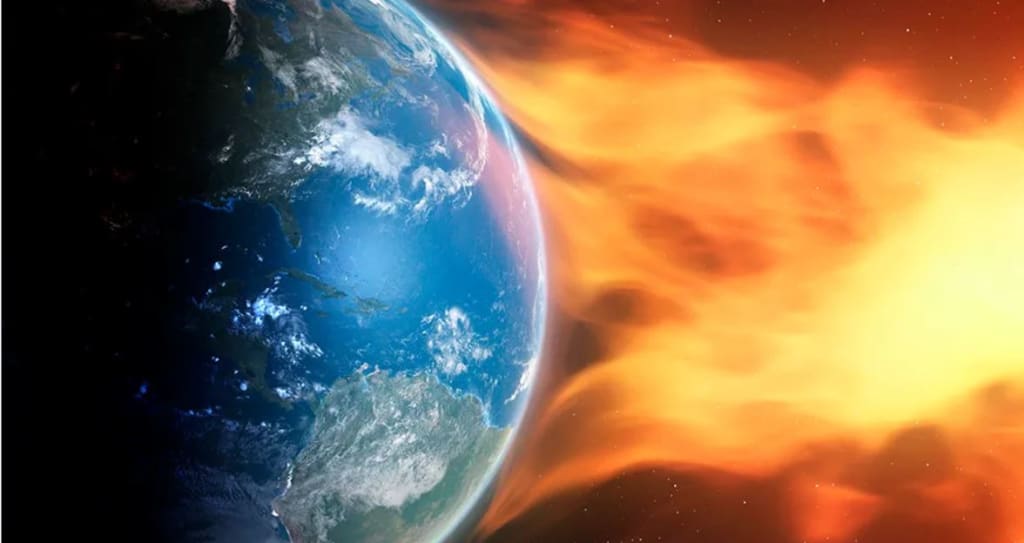
A solar storm could hit Earth in 2024, causing power grid failures and communication disruptions. Solar storms occur due to the sun's solar cycle, with peaks of increased solar activity every 11 years. While solar storms are a threat, climate change poses a more immediate danger to Earth. The Environmental Protection Agency is implementing rules to reduce carbon emissions from power plants and incentivize the switch to cleaner energy sources like wind and solar. Leaders need to prioritize carbon reduction to protect the planet.
Scientists have been tracking sunspots since 1755. The sunspots are predicted to peak in 2024, increasing the chances of a solar storm. Sunspots are cooler, darker areas on the Sun caused by a strong magnetic field. Although sunspots don't create solar flares, flares are common in these areas due to high magnetic activity. Magnetic field lines near sunspots can twist and align, releasing a burst of energy. Solar storms result from this energy release.
During a solar storm, auroras will appear worldwide as charged particles interact with Earth's atmosphere. However, the storm can disrupt technology like satellites, GPS, and radio transmissions. Communication systems would be unreliable. Astronauts in space could face intense solar radiation and communication issues. In a worst-case scenario, a solar storm could be deadly to astronauts. This is just the impact of a single day of a solar storm.
A massive attack from the Sun, known as a coronal mass ejection (CME), could disrupt Earth's magnetic field. This can cause geomagnetic storms that interfere with technology. In 1859, the Carrington event disrupted Telegraph Communications. Today, our reliance on technology is much greater. A solar storm could cause a global blackout and disrupt communication and power grids. This could lead to catastrophic events and loss of life. Recovery could take weeks or months, requiring rebuilding of power grids and communication systems. Despite the potential trauma, humanity would eventually recover. The likelihood of a solar storm hitting Earth is unpredictable. Our technology is built to withstand some interference, but a severe event could still have significant impacts.
NASA is developing technology to predict and warn us about solar flares. To prepare, have an emergency and first aid kit nearby. Surge protectors can help with electronics during a solar storm. Look into off-grid power supplies like generators or solar panels. In 1916, Albert Einstein's theory of general relativity explained gravitational waves. Scientists at LIGO detected gravitational waves in 2015, proving Einstein's theory. Gravitational waves can come from black hole collisions or other cosmic events. These waves can cause distortions in space and time. Fortunately, Earth is far from any orbiting black holes, so we are generally safe. But if closer, gravitational waves could cause catastrophic events like earthquakes and volcanic eruptions.
Just before the collision, the rogue planet would enter Earth's atmosphere. Lightning, hurricanes, flooding, earthquakes, and volcanoes would have already caused devastation. The rocky invader would fill the sky. Atmospheres would merge, glow brightly, and become extremely hot. Everything in its path would vaporize instantly. The ground would be scorching.
The Big Rip will tear apart the universe in a billion years. But what if it happened tomorrow? Dark energy drives the expansion. Phantom energy could lead to the end. Your world would crumble. Galaxies vanish. Stars move away. Earth breaks apart. You'd witness your own destruction. The universe would be gone. We can't predict what comes next. It's a grim end. But don't worry, it won't happen in our lifetime.
About the Creator
Enjoyed the story? Support the Creator.
Subscribe for free to receive all their stories in your feed.
Comments
There are no comments for this story
Be the first to respond and start the conversation.