
She Won the Lottery the Day Her Son Disappeared
The world finally gave her everything after taking the only thing she wanted back

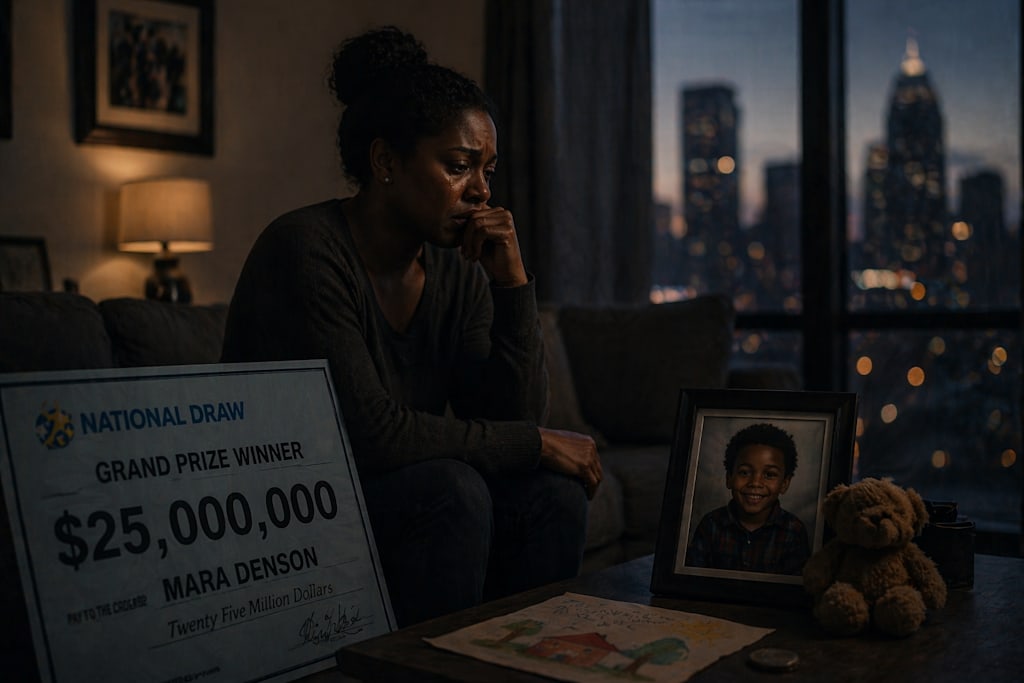
She got the call that changed her life, then another that destroyed it.
Money came but, her son never did.
The call came while Mara was at the local foodstore buying some onions for the evening meal.
She almost ignored it because unknown numbers usually meant debt, scams, or relatives pretending not to need money.
“Hello?”
A woman’s voice, careful and official.
“Is this Mara Denson?”
“Yes.”
“I’m calling from the National Draw Commission. Your ticket has been selected for the grand prize.”
Mara looked at the pile of onions in her basket.
Then at the cashier.
Then at the rain streaking the shop window.
“I think you have the wrong person.”
“No, ma’am. Ticket number 4-1-7-3-9. Purchased Tuesday at West Market.”
She remembered buying it only because the vendor had insisted.
Try your luck, sister. Maybe God is walking around today.
She nearly laughed now.
Luck did not know her address.
Still, the woman continued speaking in numbers so large they became meaningless.
Taxes.
Verification.
Collection process.
Security advice.
Mara heard none of it clearly because at that exact moment another call began vibrating on the screen.
It was her son’s school.
She declined it.
The lottery woman was asking if she was alone.
The school called again.
Then again.
Mara’s stomach tightened.
“Please hold,” she said, and switched over.
A man answered immediately.
“Ms. Denson? This is Vice Principal Hale. We can’t find Jonah.”
The world did not shatter.
That is something stories get wrong.
It narrowed.
The shop.
The onions.
The fluorescent light buzzing overhead.
Everything else moved far away.
“What do you mean you can’t find him?”
“He didn’t return after lunch break. We’ve searched the grounds.”
Jonah was nine.
He hated loud hand dryers, loved maps, and still slept with one foot outside the blanket no matter the weather.
He had never missed pickup.
He had never crossed a street alone.
Mara left the basket where it was and ran into the rain.
The lottery woman was still on hold.
By evening, everyone knew two things.
Mara Denson had become a millionaire.
Mara Denson’s son was missing.
The town cared deeply about one of them.
News vans parked outside her building before police finished taking the first report. Reporters smiled with practiced sympathy and asked how she planned to “balance this emotional day.”
Balance.
As if fortune and terror were weights on the same scale.
Her landlord knocked at 8 p.m. to congratulate her and gently mention overdue rent.
A cousin she had not seen in seven years sent a heart emoji and her bank details.
A church woman said perhaps the money was “God making room for testimony.”
Mara closed the door in her face.
Detectives searched parks, bus stops, drainage tunnels, abandoned lots.
They asked about Jonah’s father.
Absent.
They asked if Jonah had enemies.
He collected beetles.
They asked if he ever ran away.
From what?
At midnight, they found his backpack behind the gym fence.
Lunchbox inside.
Shoes beside it.
No Jonah.
The next morning, Mara stood in front of cameras because police advised public visibility.
“Please,” she said, voice breaking in places that no longer mattered. “If anyone has seen my son…”
The reporters asked about the prize money before they asked about Jonah.
Would she move?
Would she invest?
Would she donate?
One man shouted, “Do you think the publicity helps find him?”
She walked off set.
By noon, social media had turned her life into debate.
If I won millions, I’d hire private security.
Maybe the kidnapping was planned.
Why buy onions when you’re rich?
Fake tears.
Strangers studied screenshots of her grief like weather patterns.
The police advised hiring private investigators.
She hired three.
The money made things happen quickly.
Drones over forest edges.
Canvassers in neighboring cities.
Data analysts tracing cameras.
Psychics.
She did not believe in psychics, but grief lowers standards faster than hunger.
They all wanted deposits.
Everyone did.
The florist downstairs doubled prices after seeing her on television.
A taxi driver refused change because “you can afford it.”
An old friend asked for a loan while hugging her.
A woman at the bakery whispered loudly, “At least something good happened.”
Mara bought six loaves she did not need just to leave.
Jonah’s room remained untouched.
Planet stickers on the ceiling.
One sock under the desk.
A library book due Friday.
She slept there because the shape of his absence was easier to bear in a smaller bed.
At 3 a.m., she replayed the last ordinary morning.
“Eat your eggs.”
“I don’t like eggs when they look at me.”
“They have no eyes.”
“They know.”
She had laughed.
She had tied his tie badly.
He had fixed it himself with solemn little fingers.
At the door he turned back.
“You forgot my lucky coin.”
She handed it to him from the shelf.
A silver coin with a hole through the center.
His treasure.
The last thing she gave him.
The first thing police asked if he had with him.
Weeks passed.
The story changed categories.
From Breaking News.
To Ongoing Mystery.
To Human Interest.
To Old Story.
The cameras left.
The calls slowed.
The volunteers returned to their own lives.
Only bills remained consistent.
Security upgrades.
Consultants.
Search teams.
Reward fund.
She increased the reward until even greed felt exhausted.
No one came.
The lottery commission sent cheerful reminders to complete public appearances required by contract.
She ignored them.
They threatened breach penalties.
Her lawyer suggested cooperation.
“Your image matters.”
“My son matters.”
“Yes,” he said gently, “but one of those is billable.”
Three months later, they found the coin.
It was turned in by a pawnshop owner two towns away.
A silver coin with a hole through the center.
Jonah’s initials scratched on the back.
The man who sold it was already dead.
Overdose.
No known address.
No useful friends.
The trail ended where so many poor trails do: in someone else’s disposable life.
Mara held the coin in an evidence bag and felt something new enter grief.
Hatred.
Not at a person.
At randomness.
At the universe’s refusal to provide a villain sturdy enough to carry what had happened.
She collected the prize in private.
No giant check.
No smile.
No confetti.
Just signatures in a quiet office and a transfer so large it made bankers stand straighter.
The advisor congratulated her.
She asked if money could reverse decomposition, time, or silence.
He did not laugh.
She moved to a larger house because the old apartment had become a museum no one should live inside.
The new place had gates, cameras, a pool she never used, and rooms so empty footsteps echoed like questions.
People envied her online.
She read comments while eating cereal over the sink.
Dream life.
Manifesting this energy.
She deserves it after all she went through.
Deserves.
What an ugly word.
A year after Jonah vanished, police declared the case inactive pending new evidence.
Not closed.
Just professionally abandoned.
They returned his backpack.
Mud-stained straps.
A missing zipper tooth.
Inside the front pocket was a folded worksheet.
Draw your future home.
Jonah had drawn a small house, a tree, and two figures holding hands.
One tall.
One small.
Above them, in careful block letters:
ME AND MOM WHEN I’M TEN
He never turned ten.
People still recognize Mara sometimes.
At airports.
In restaurants.
At charity galas she attends because wealth requires public rituals.
They whisper as she passes.
That’s the woman who won all that money.
No one says:
That’s the woman who lost everything first.
She funds search programs now.
Missing children databases.
Emergency grants for parents.
Hotline staff training.
She has saved strangers she will never meet.
It does not feel noble.
It feels like bargaining with a universe that does not negotiate.
Every birthday, she buys Jonah a gift and leaves it unopened in the attic.
Age ten.
Age eleven.
Age twelve.
The boxes line up neatly under the rafters.
A childhood continuing in cardboard.
This year she bought a telescope.
He would have loved Saturn.
Tonight she sits alone in a house worth more than everyone on her childhood street combined.
The city glows beyond the windows.
Her accounts grow while nothing else does.
On the table beside her lies a silver coin with a hole through the center.
She rubs it between finger and thumb the way prayer beads are meant to be used.
Somewhere, people are still buying tickets, whispering prayers, hoping luck will find them.
Mara used to believe in that too.
Now she knows better.
Some things arrive with a price you don’t get to refuse.
And some losses don’t end, they just keep being lived.
(image was created using nano banana in Google Gemini)
About the Creator
Ajan Lori A.
My mind screams, I write!
(Author exploring education, identity, human behavior, life between cultures, business and entrepreneurship)
Find my writing on Medium: https://medium.com/@loriaa
My books on amazon: amazon.com/author/loriaa
Enjoyed the story? Support the Creator.
Subscribe for free to receive all their stories in your feed.
Comments
There are no comments for this story
Be the first to respond and start the conversation.