
She was the grandmother no one invited
Until she Became Grandma Cool

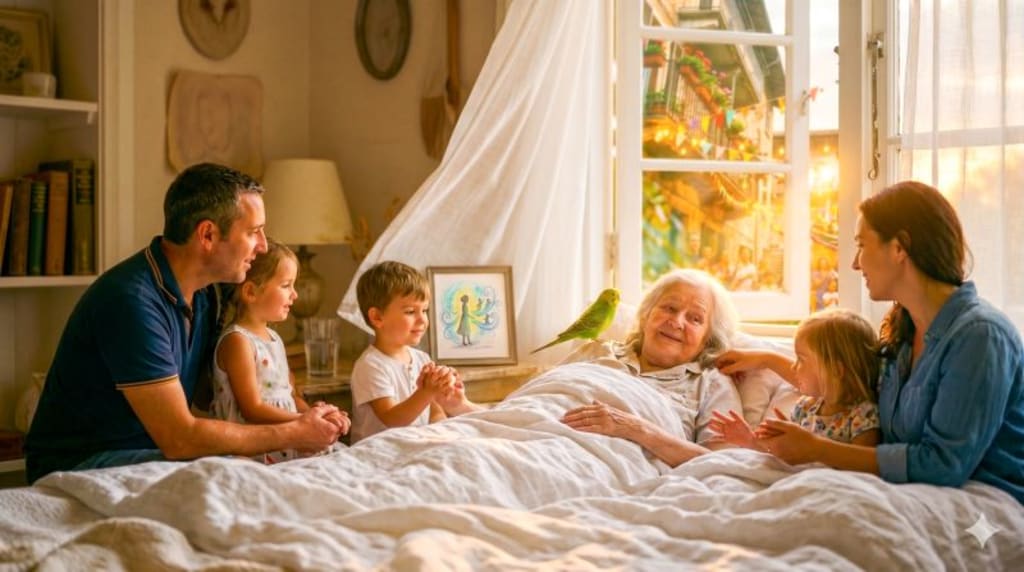
VOICE OVER IS ON SUBSTACK & SPOTIFY for those who want to listen.
Scroll past these for written content. I wrote this, edited, worked on this for 12 hours.
She was the grandmother no one invited
Until she Became Grandma Cool
Author’s Note — Dedication
For every grandparent
who waited by the phone,
who dressed for an invitation
that never came,
who loved without being seen,
who gave without being asked,
who held a family together
even when the family let go
this story is yours.
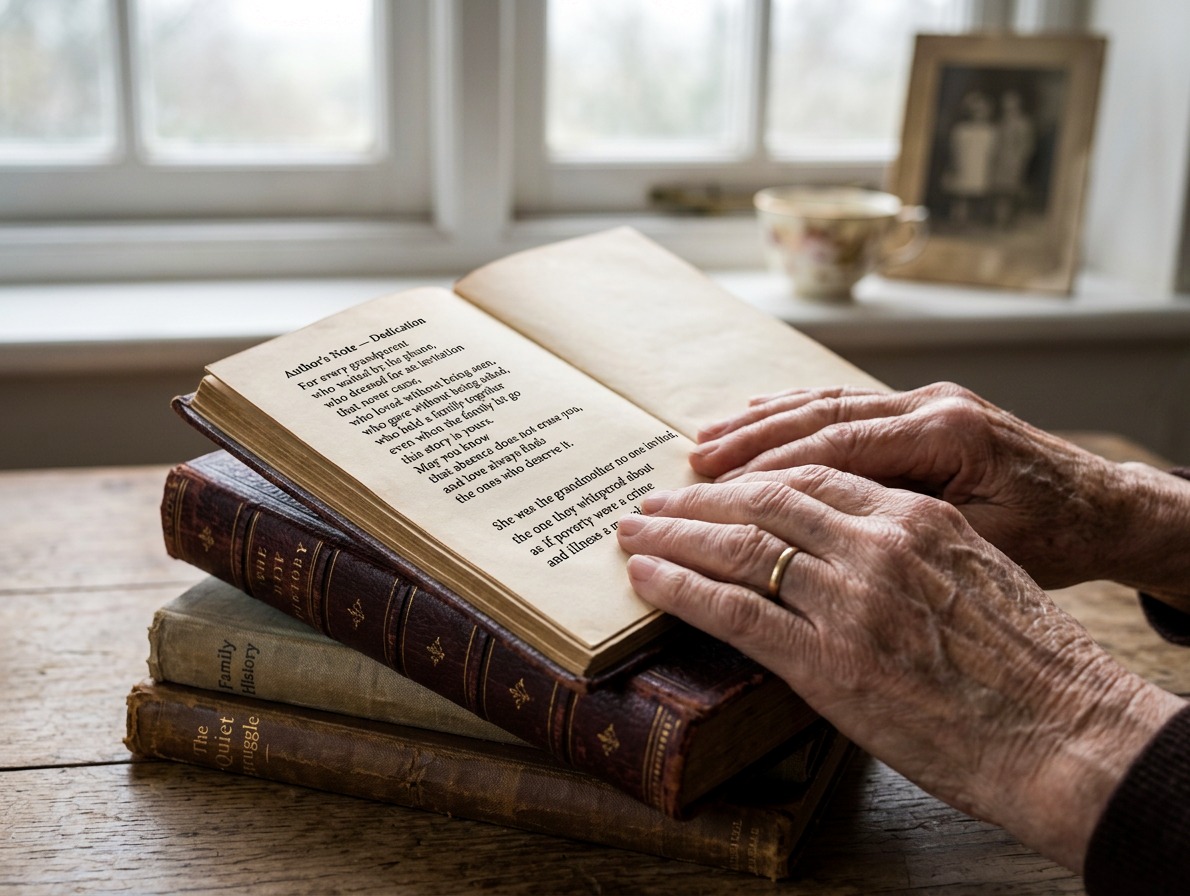
May you know
that absence does not erase you,
and love always finds
the ones who deserve it.
She was the grandmother no one invited,
the one they whispered about
as if poverty were a crime
and illness a moral failing.
They stood in their pressed shirts
and polished shoes,
believing themselves superior
to the woman who had read more books
than all of them combined.
She watched from a distance,
not because she was unwanted,
but because she refused
to be humiliated again.
So she turned her grief into art,
her silence into story,
and her absence into power.
She was the grandmother no one invited…
She learned earlier that some families
confuse wealth with wisdom,
and mistake convenience for love.
They wanted a grandmother
who fits into photographs,
not one who carried the weight
of three generations’ survival
in her bones.
So, she built her own circle,
quiet as a candle,
steady as a library lamp.
Children who were not her own
found her anyway
the shy ones,
the overlooked ones,
the ones who sensed
that she saw the world sideways
and could therefore see them.
She taught them how to read storms,
how to listen between words,
how to turn shame into ink
and ink into freedom.
She never raised her voice,
but her stories traveled farther
than any of their judgments.
In the end,
the family who dismissed her
became footnotes,
while she became the myth
the woman who refused to shrink,
the elder who rewrote the script,
the grandmother who chose
her own lineage of light.
Her Past
Before she was the grandmother no one invited,
she had been the girl who learned early
that love in her family came with conditions.
She grew up in a house where silence
was safer than asking for anything,
where books became her escape
because stories never raised their voices at her.
She married young,
not out of romance
but out of survival.
She worked two jobs,
kept the lights on,
kept the children fed,
kept the world from collapsing
even when her own body began to fail her.
Illness didn’t make her weak
it made her invisible.
People stopped seeing her effort
and only saw her limitations.
They whispered about her poverty
as if it were a personal flaw,
never once acknowledging
how many lives she had held together
with nothing but grit and borrowed hope.
But she never stopped loving.
She never stopped giving.
She never stopped believing
that kindness mattered
even when it wasn’t returned.
The Children Who Found Her
Where she lived now
in that small, worn building
with peeling paint and thin walls
there were children everywhere.
Children whose parents worked late,
children who wandered the courtyard
with backpacks too heavy
and hearts too quiet.
They started calling her Grandma Cool
because she listened
without rushing them,
because she kept extra snacks
in a tin by the window,
because she knew how to fix
a broken zipper
and a broken spirit
with the same gentle hands.
She never asked for the title.
They gave it to her freely.
And every time one of them
knocked on her door
with a scraped knee,
a school paper,
a secret,
or a question too big
for their small bodies to hold,
she felt something inside her
stitch itself back together.
She cried sometimes
not from loneliness,
but from the strange,
unexpected grace
of being chosen
by the ones who needed her most.
Her family didn’t invite her.
But life did.
And life sent her children
who saw her heart
instead of her hardships.
The Scene — The Drawing
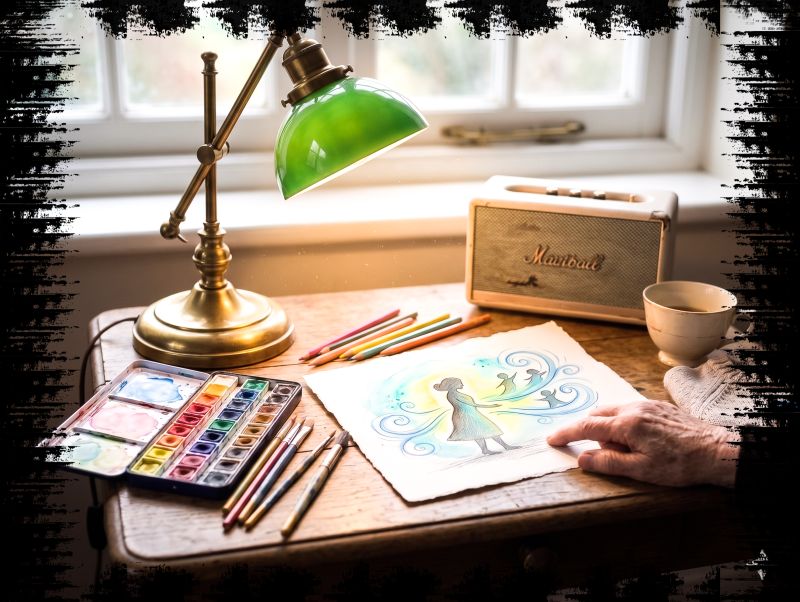
It happened on a Tuesday afternoon,
the kind of day when the sun felt tired
and the courtyard kids wandered slowly,
waiting for something to spark.
She had been teaching them
how music wasn’t just sound
but feeling with direction —
how a single note could open a window
and a single color could change the weather
inside a person’s chest.
They sat around her tiny table,
knees knocking, pencils rolling,
a small speaker humming softly
with the kind of melody
that made even the walls breathe easier.
One boy Mateo, the quiet one
with the too-big hoodie
and the eyes that always watched
before he spoke
had been working on something
with fierce concentration.
When the lesson ended
and the other kids scattered
like bright marbles across the courtyard,
he stayed behind.
He held the paper to his chest
as if it were fragile,
as if it were alive.
“I made this for you,” he said,
voice barely above a whisper.
She took it gently,
the way she once held her own children
before they grew into strangers.
On the page was a drawing of her
not the tired woman in thrift store clothes,
not the grandmother no one invited,
but the version the children saw:
A woman with music swirling around her
like soft blue wind,
a woman whose hands glowed
with the colors she taught them to see,
a woman sitting in a circle of kids
who looked safe
because she was there.
Her breath caught.
Her eyes stung.
She pressed her hand to her heart
as if to steady it.
“You see me,” she whispered.
Mateo nodded.
“We all do.”
Her Realization — The Chosen Family
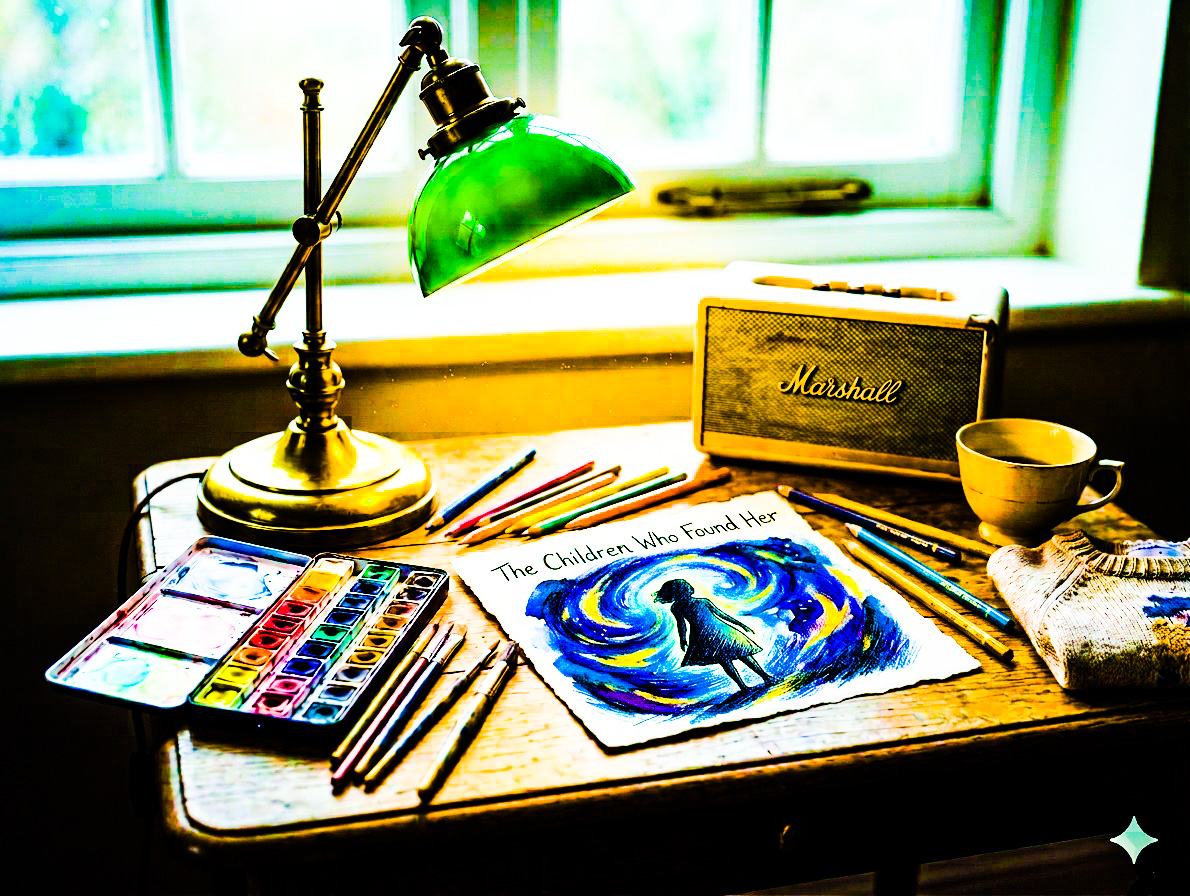
That night,
as she placed the drawing on her wall
with a piece of tape that barely held,
she understood something
she had never dared to believe:
She wasn’t missing a family.
She had one.
Not the kind that shared her blood,
but the kind that shared her afternoons,
her stories,
her music,
her laughter,
her snacks,
her patience,
her light.
The kind that chose her
without hesitation
and without conditions.
The kind that didn’t care
about her illness,
her income,
her past,
or the invitations she never received.
They cared about her heart.
And they had made a home in it.
Her Absence Becomes Her Power
When the family gathering came and went
without her name on the list,
she didn’t cry the way she used to.
She didn’t wait by the phone.
She didn’t rehearse the old ache.
Instead, she spent the evening
teaching the courtyard kids
how to blend colors
until they made a sunset
that looked like forgiveness.
Her absence at that gathering
wasn’t a wound anymore.
It was a boundary.
A quiet declaration:
You may not invite me,
but I am not alone.
She had built something
they could never take from her
a family made of children
who saw her worth
long before her own blood did.
And in that small apartment,
with laughter echoing off the walls
and music drifting into the hallway,
she realized:
She was not the forgotten grandmother.
She was the chosen one.
The Birthday Party
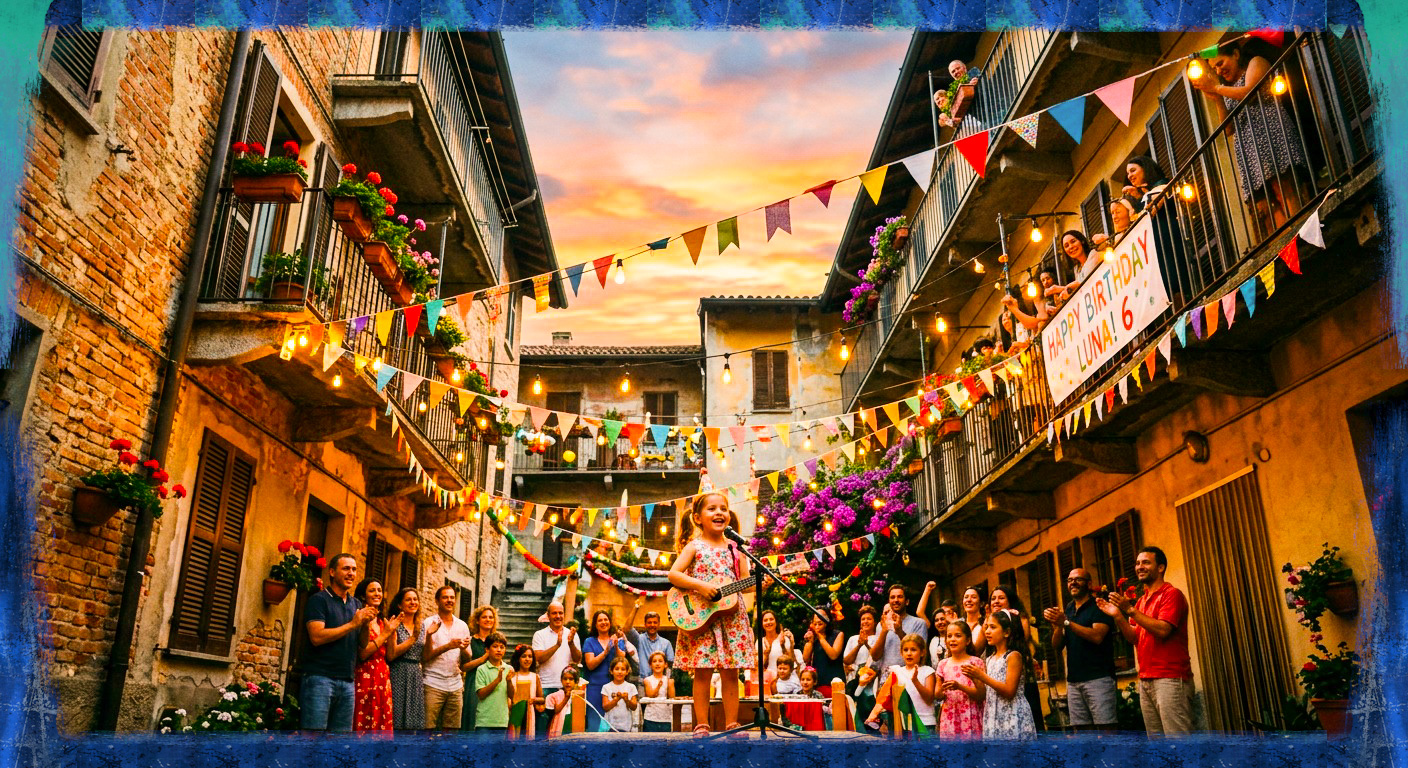
Her birthday wasn’t something she talked about.
It had become one of those days she learned to fold quietly
into the back pocket of her heart
a day that once meant celebration
but now passed like a shadow
no one noticed.
But the children noticed.
They always noticed her.
So, on a warm Saturday afternoon,
the courtyard buzzed with a strange, excited energy.
Whispers darted between doorways.
Parents carried foil covered trays.
Someone hung a string of mismatched paper decorations
between two balconies.
When she stepped outside,
thinking she was only going to water her plants,
the entire courtyard erupted:
“HAPPY BIRTHDAY, GRANDMA COOL!”
She froze.
Her hand flew to her mouth.
Her eyes filled instantly.
There were children everywhere
holding handmade cards,
holding cupcakes,
holding each other’s hands
because they were too excited to stand still.
Parents stood behind them, smiling,
some shy, some proud,
some wiping their eyes
because they knew what this woman meant
to their children.
And then she saw her
a single mother she knew only in passing,
a woman of color who worked long shifts
and carried exhaustion like a second skin.
She walked straight up to Grandma Cool
and wrapped her in a hug
that felt like gratitude made physical.
“Thank you,” she whispered into her shoulder.
“You helped my little girl do something
I didn’t think she’d ever get to do.”
She stepped aside,
and her daughter came forward
a small girl with bright eyes
and a brace on her leg,
the one who had been diagnosed with MS
far too young.
The girl held a tiny keyboard in her hands,
the one the school had donated
to Grandma Cool’s apartment
because they knew she would use it
to teach the children.
“I made you a song,” the girl said.
“It’s not perfect… but you taught me
that music doesn’t have to be perfect
to be beautiful.”
Grandma Cool knelt down,
her knees aching but her heart soaring.
“Play it for me,” she said.
The girl pressed the keys
soft, trembling notes,
a melody shaped like hope
and courage
and the stubborn belief
that even a small body
can hold a big spirit.
The courtyard fell silent.
Even the wind paused to listen.
When the song ended,
Grandma Cool gathered the girl into her arms
and held her as if she were holding
the whole world.
“You gave me the best gift,” she whispered.
“You let me see your light.”
The Mythic Closing — The Legend of the Building
After that day,
the story of Grandma Cool
spread through the building
like a warm rumor.
People said she could turn sadness into music.
They said she could teach color to children
who only knew gray.
They said she had a way
of making broken things feel whole again.
Some swore that when she laughed,
the hallway lights flickered brighter.
Others claimed that when she told stories,
the air around her shimmered
like the pages of a book turning themselves.
But the children knew the truth:
She wasn’t magic.
She was love.
And love, when given freely,
always looks like a miracle.
She became the legend of the complex
the grandmother who wasn’t invited
to her own family’s table,
so she built a bigger one
and filled it with children
who saw her worth
long before anyone else did.
And in that courtyard,
under strings of crooked decorations
and the echo of a little girl’s brave melody,
she realized:
She had not been forgotten.
She had been found.
Epilogue — Grandma Cool’s Closing Monologue
She lay in her bed, the soft hum of the oxygen machine
blending with the distant laughter of children in the courtyard.
Her caregiver sat beside her, knitting quietly,
giving her the dignity of silence.
Grandma Cool closed her eyes and spoke softly,
as if speaking to the room,
as if speaking to the years themselves.
“I wasn’t invited to the table I was born into,”
she whispered,
“but I built a bigger one.
And the ones who sat with me…
they were the ones meant for my heart.”
Her breath trembled, but her voice stayed steady.
“I taught them music so they could hear their own courage.
I taught them art so they could see their own worth.
I taught them love because no one taught it to me.
And look how they grew…
look how they shined.”
She smiled, eyes still closed.
“If this is the end of my story,
then let it be said:
I was not forgotten.
I was found.”
Years Later — The Return
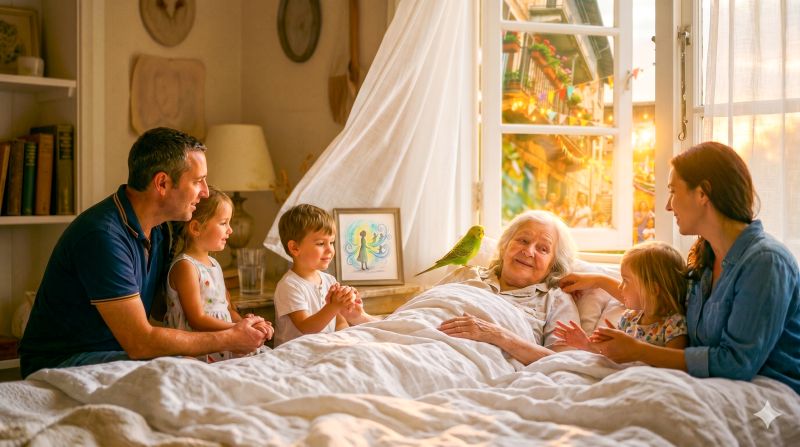
She was one hundred years old
when the knock came on her door.
Her caregiver opened it,
expecting a delivery,
a neighbor,
a nurse.
Instead, the hallway was filled
with grown faces she recognized instantly
the courtyard kids,
now adults.
Some wore college sweatshirts.
Some held toddlers on their hips.
Some stood hand in hand with partners.
Some stood alone but strong.
And in the center of them all
was a young man holding a birdcage.
Inside was a bright green parrot
with curious eyes and a tilted head.
“We brought someone to meet you,”
one of them said.
They stepped inside,
set the cage down,
and opened the door.
The parrot, Polly
fluttered out,
circled the room once
as if inspecting the air,
then landed gently
on Grandma Cool’s shoulder.
Polly leaned in
and pressed her beak
to Grandma Cool’s cheek
in a soft, deliberate kiss.
Her eyes filled.
Her smile widened.
Her hand lifted slowly
to stroke the bird’s feathers.
“You found me too,”
she whispered.
The room filled with love
arms around her,
hands holding hers,
voices telling stories
of how she changed their lives.
The Light
The room glowed softly,
a warm brightness gathering around Grandma Cool’s bed
like dawn arriving early.
The grown kids now adults
stood in a circle around her,
hands linked,
Polly perched on a shoulder,
watching with bright, knowing eyes.
They did not step into the light.
They stayed with her.
They stayed grounded.
They stayed present.
The angel appeared at the foot of her bed,
gentle and radiant,
not calling the children,
only calling her.
The angel smiled.
“Well done, Grandma Cool.”
Grandma Cool exhaled,
a soft, peaceful breath
that carried a century of love.
Polly fluttered closer,
pressed her beak to Grandma Cool’s cheek
one last time,
and let out a quiet chirp
that sounded almost like a blessing.
The light brightened around her
only her
lifting her gently,
like a story being carried
to its final, sacred chapter.
The children watched,
tears on their faces,
but no fear in their hearts.
They did not follow.
They did not disappear.
They remained rooted in the world
she had helped them grow into.
The angel gave them a small, knowing wink
a gesture of gratitude,
not invitation.
And then Grandma Cool
slipped into the light alone,
wrapped in peace,
wrapped in love,
wrapped in the legacy
she had built with her own hands.
The glow faded.
The room softened.
Polly settled on the pillow beside her,
as if standing guard.
The children now adults
held each other,
held the moment,
held the truth:
She had gone ahead,
but they were still here,
carrying her music,
her art,
her kindness,
her legend.
Closing Paragraph — Love, Peace, Hope
In the quiet after the light faded,
the room held only warmth.
The grown children stood together,
hands linked, hearts steady,
knowing they had witnessed
not an ending
but a homecoming.
Polly nestled beside the pillow,
soft feathers rising and falling
in the hush of the moment.
And though Grandma Cool had stepped
into a brighter world,
her love remained
woven into their lives,
their music,
their art,
their courage.
She left them not with sorrow,
but with a legacy of gentleness,
a map of hope,
and the truth she lived every day:
that love given freely
never disappears.
It becomes the light
that guides us forward.

Executive Feathered Producer
Sweetie Bird
Author & Music
Vicki Lawana Trusselli
Assistants
Copilot
Gemini
Eleven Labs
Suno
Vicki
About the Creator
Vicki Lawana Trusselli
I am 76 year old California mythic storyteller blending lived truth, technology, and sovereign survival into multimedia art.
Enjoyed the story? Support the Creator.
Subscribe for free to receive all their stories in your feed. You could also become a paid subscriber, letting them know you appreciate their work.
Comments
There are no comments for this story
Be the first to respond and start the conversation.