
Shared Scars
What breaks inside a family rarely stays with one person.

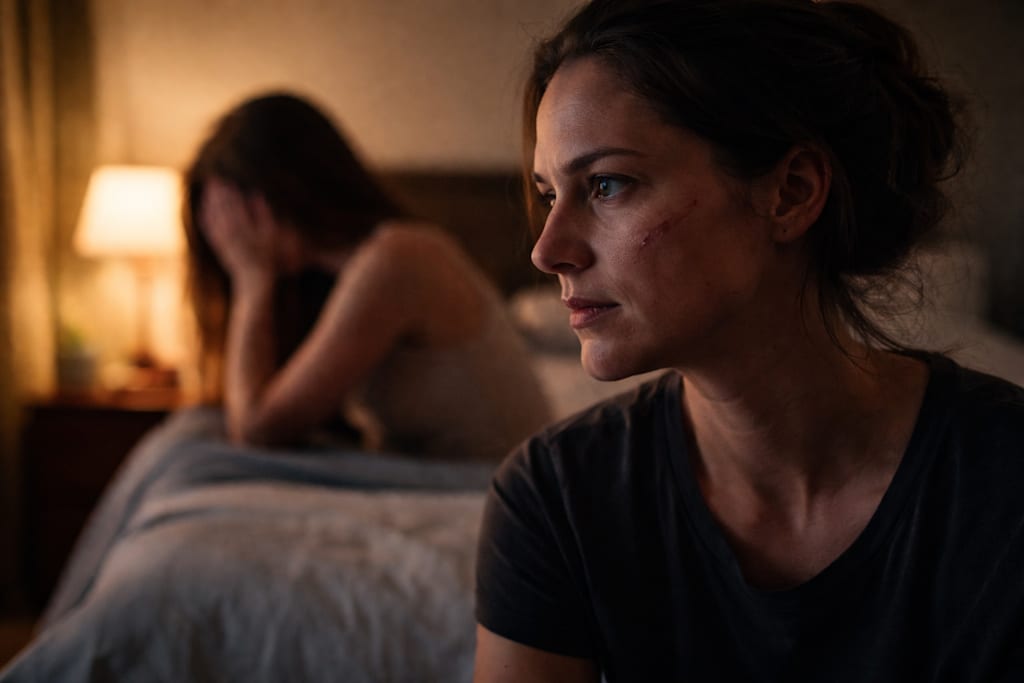
By the time my sister asked him to walk her down the aisle, the scar on my cheek had faded into the color of old paper.
It began near my temple and pulled slightly whenever I smiled too hard, a pale line disappearing into my hairline. Children used to stare at it in supermarkets. Adults pretended not to. Men I dated kissed around it before they kissed me, as if pain should be approached gently.
In our family, nobody mentioned the scar unless they were drunk, angry, or both.
“It was an accident,” my mother always said too quickly, as if speed could turn a lie into truth.
Because I was fifteen when it happened, and because my sister Ada was nine and still believed every terrible thing in the world could be explained softly, I let that version survive.
Until the wedding.
Ada called me on a Thursday evening while I was grading papers at my kitchen table.
I teach literature in a secondary school two towns away from where we grew up. My life is small by design. just books, rent and silence. I had some plants on a balcony that mostly survive me. This is the kind of life you build when peace matters more than excitement.
“I finalized the seating chart,” she said.
“Congratulations.”
“You sound thrilled.”
“I sound tired.”
She laughed. Then came the pause she always took before stepping onto dangerous ground.
“I want to ask you something,” she said. “And I need you not to make it a thing.”
“That usually means it’s already a thing.”
Another pause.
“Daddy is going to walk me down the aisle.”
I looked at the papers in front of me. One of my students had underlined a sentence twice in blue ink:
The body remembers what the mind tries to misplace.
“I see,” I said.
“You promised not to make it a thing.”
“I said I see.”
“He’s old now, Naya.”
“So?”
“So people change.”
I let the silence answer for me.
“He comes to church now,” she added. “He calls every Sunday. He asks about you.”
“Does he.”
“He cries sometimes.”
That almost made me laugh.
People never tell you this about men like my father: age does not make them gentle. It only makes them look breakable. And people are always eager to mistake fragility for goodness.
“I’m not asking you to forgive him,” Ada said. “I’m asking you not to ruin my wedding.”
There it was.
No "please come" or warmer words like; "I want my sister there."
Only a warning wrapped in lace.
“I wasn’t planning to,” I said.
“Good.”
When we hung up, I sat in the dark kitchen long after the room had gone quiet.
Then I touched the scar on my cheek the way some people touch prayer beads.
Not for comfort.
For counting.
My father gave me the scar with a whiskey bottle.
That is the clean version.
The dirtier version is that it was never meant for me.
He had thrown it at my mother because the soup was cold. Because she answered too slowly. Because men like him are never looking for reasons, only opportunities.
Ada stood beside her in a yellow nightdress, one sock on and one sock off, crying because she thought the shouting was her fault.
I stepped between them.
That part everyone remembers.
What they forget is that after the bottle shattered against the wall and glass opened my face, the first thing my father said was not my name.
It was:
“Look what you made me do.”
My mother spent years repeating that sentence in softer forms.
He was stressed.
He had been drinking.
You know how your father gets.
Families go through things.
No need to carry the past forever.
Think of your sister.
I did think of my sister.
That is why I left home at eighteen without telling anyone where I was going.
That is why I mailed birthday gifts with no return address.
That is why I answered Ada’s calls even when hearing our mother’s voice in the background made my hands go cold.
That is why I never told her everything.
She had already seen enough.
Or so I told myself.
I arrived the week before the wedding because Ada insisted there was too much to do, and because some disloyal part of me still wanted to be useful to her.
My mother opened the door with tears in her eyes, the same way she greeted every crisis: as if emotion itself were proof of innocence.
“Naya,” she whispered. “Look at you.”
I had heard that sentence all my life.
It never meant anything good.
The house smelled the same: fried onions, furniture polish, something damp trapped in the walls. The curtains had changed. The fear had not.
It lived there like mold.
My father was in the sitting room wearing spectacles and a cardigan the color of dust. Age had softened his outline, but not his eyes.
Those were untouched.
Small. Watchful. Annoyed by other people’s existence.
He stood when he saw me.
“Naya.”
I nodded once.
“It’s been a long time,” he said.
“Yes.”
“I’m glad you came.”
I met his eyes.
“I didn’t come for you.”
My mother made a wounded sound.
Ada appeared from the kitchen carrying ribbon samples and froze when she felt the room tighten.
“Can we not do this?” she asked.
No one answered.
Then my mother clapped her hands lightly.
“Who wants tea?”
The child’s name was Lila.
Ada’s future stepdaughter. Seven years old. Quiet, narrow-shouldered, with the habit of standing close to doorframes as if prepared to disappear behind them.
Ada was marrying a widower named Daniel, a decent man with tired eyes and gentle hands. He loved her in the practical way some people do, less poetry than shelter.
I liked him for that.
I liked him more for the way he knelt whenever he spoke to Lila, as though children deserved to be met at eye level.
On my second night, I found Lila sitting on the back steps picking at a loose thread on her dress.
“You’re hiding,” I said.
She glanced up. “No.”
“Good. I’d hate to interrupt.”
A small smile flickered.
I sat beside her. Crickets sang in the yard. Inside, the adults argued softly about flowers and guest lists.
After a while, she said, “Your face doesn’t look scary.”
“Thank you,” I said. “I think.”
“Aunty Ada said you got hurt a long time ago.”
“I did.”
“Did it hurt?”
“Yes.”
She thought about that.
“Did you cry?”
“Afterward.”
She nodded, satisfied by the honesty.
Then she asked, in the same tone children use for weather and missing crayons:
“Do grown-ups still hit when they’re sorry after?”
Everything inside me went still.
“Who hits?” I asked.
She shrugged.
“Just when people are angry. Or joking angry.”
“Who is people?”
Another shrug.
“Sometimes Granddad taps too hard.”
Granddad.
There was only one in that house.
My father had taken to Lila instantly. Everyone called it sweet. He pinched her cheeks. Sat her on his knee. Taught her card games. Asked for kisses on the forehead before bed.
The room had applauded tenderness every time.
I kept my voice steady.
“Where does he tap too hard?”
“On my leg. Or my arm.”
She hesitated.
“One time my mouth because I answered rude.”
The night around us changed shape.
“Did you tell your dad?”
Her fingers stopped moving.
“Granddad said not to. It would upset wedding things.”
Not again, I thought.
Not in front of me.
I told Ada first.
I made that choice out of love, loyalty, or stupidity. The three often borrow each other’s faces.
We stood in her bedroom surrounded by makeup brushes, garment bags, and the white architecture of her dress hanging from the wardrobe.
“She’s seven,” I said. “She has no reason to invent this.”
Ada was at the mirror brushing powder across her collarbone. I watched the color leave her face and return as anger.
“Lila is sensitive.”
“She said he slapped her mouth.”
“She said tap.”
I laughed once.
“Is that where we are? Debating vocabulary?”
Ada turned sharply.
“You don’t get to come back here after all these years and poison everything.”
“Poison?”
“Yes. You. This.” She gestured wildly between us. “Whenever he’s involved, you become this person who only knows how to drag blood into the room.”
“Blood was always in the room.”
She flinched.
Then steadied.
“I was a child too,” she said. “Do you understand that? I lived in the same house. I survived the same father. I am tired of being told my memories are wrong because yours are louder.”
The words struck harder because part of me feared they were true.
I stepped back.
“Ada—”
“No.” Her eyes filled. “You left. I stayed. I had to make a life out of what was here. I had to keep loving people you were allowed to hate from a distance.”
Then she said the thing that ended any chance of mercy.
“Maybe if you had stopped turning that scar into a personality—”
I slapped her.
The sound split the room.
We both froze.
I had never touched my sister in anger before.
A red mark bloomed across her cheek.
Her hand rose to it slowly.
There it was.
The inheritance made visible.
I understood, in one sickening instant, why some people collapse after becoming what they despise. Because disgust is too small a word for seeing an old monster wear your face.
Ada whispered, “Get out.”
I did.
No explanation.
No apology large enough to survive what had happened.
The consequence had already arrived.
Daniel believed Lila.
That was something.
When I told him, his face did not fill with denial or offense. It simply emptied. Then hardened.
He went into the house and came back carrying Lila. Ada followed behind him, pale and frantic.
My father denied everything.
My mother cried and called it confusion.
Ada begged Daniel not to “do this now,” as if timing were the true obscenity.
Daniel said, very calmly, that he and Lila would stay elsewhere until after the wedding.
Then he looked at Ada.
He was giving her one final place to stand.
She looked at our father.
That was all.
Just one glance.
But it told the whole story.
Not who she loved more.
Who she still needed to remain innocent.
Daniel left before midnight.
The wedding was canceled by morning.
By afternoon, relatives knew some ugly version of events. By evening, my mother had already told three people I returned home unstable and full of old resentment.
My father sat in the living room watching the news.
Composed as a judge.
Ada locked herself in her room.
I knocked once.
Twice.
Three times.
On the fourth, she said through the door:
“You ruined everything.”
I almost said, No. He did.
But some truths, however correct, are only another form of self-defense.
So I stood there with my forehead against the wood and said nothing.
I left before sunrise.
My mother did not come out.
My father did.
He stood on the porch in his cardigan, holding a mug with both hands, looking almost gentle in the weak light.
“You always were dramatic,” he said.
I put my suitcase into the taxi.
He smiled slightly.
The kind of smile a man wears when he believes he has survived consequence.
“Families survive worse than this,” he said.
I looked at him for a long time.
“No,” I said. “They just rename it.”
Then I got into the car.
Three months later, Daniel sent me a message.
Lila’s in therapy. We’re divorcing. She still asks for Ada sometimes.
Nothing else.
Ada never called.
She ignored mine.
A cousin told me she had moved back into our parents’ house “for a while.”
As if adulthood could be set down and picked up later.
As if houses like that ever let people leave unchanged.
I heard she now tells people I hit her during wedding stress and invented lies because I could not bear to see anyone forgive our father.
It was almost clever.
It used the only undeniable truth against me.
I had hit her.
I had.
Some endings do not need villains.
Only one unforgivable motion at exactly the wrong time.
Winter passed and spring came along.
Some mornings, I touch the scar on my face and think about how easily people love wounds once they become visible, finite, healed into something they can point at.
A line.
A story.
A before and after.
The injuries that destroy families are rarely so clean.
They travel.
They wait.
They learn new hands.
Sometimes I dream of Ada as a child in her yellow nightdress, one sock on and one sock off, looking at me as if I can still step in front of everything sharp.
In the dream, I do.
In the dream, it works.
In life, Daniel is gone. Lila is learning what fear feels like in the body. My sister lives with the man who taught us both how silence is made. And somewhere in that house, my mother is still saying It was an accident in whatever language the day requires.
I tell myself I did the right thing.
I tell myself truth matters even when it detonates.
I tell myself scars mean survival.
Then I remember Ada’s face after I slapped her; shock first, then recognition and now, I understand something I did not when I was younger:
Every scar tells a story.
Some of us learned to tell it without trembling.
Some of us learned it so well, we passed it on.
-------
(Image was created using nano banana in google Gemini)
About the Creator
Ajan Lori A.
My mind screams, I write!
(Author exploring education, identity, human behavior, life between cultures, business and entrepreneurship)
Find my writing on Medium: https://medium.com/@loriaa
My books on amazon: amazon.com/author/loriaa
Enjoyed the story? Support the Creator.
Subscribe for free to receive all their stories in your feed. You could also become a paid subscriber, letting them know you appreciate their work.
Comments
There are no comments for this story
Be the first to respond and start the conversation.