
Second Chance
A Man Revisits His True Calling
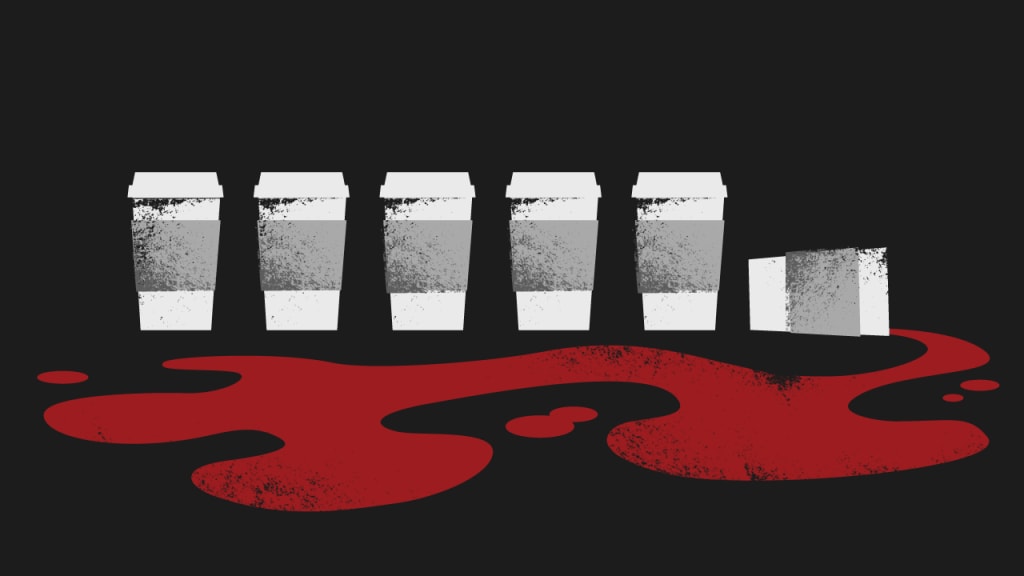
Bill Fielding stood six feet up on the rickety old scaffolding, peering in through the big window on the west side of Ebner Plains Community Church. Inside, the Sisters of Strength Women's Bible Study was in session. They were a handsome council of middle-aged ladies, all dolled up in their Thursday best and chattering around a table brimming with splayed-open bibles, journals, and notepads, every visible page electrified with neon highlighting and peppered with stray doughnut crumbs.
Bill could hardly tell one Sister from the next. He was certain they must all frequent the same barber. Most all of them shared the same hairdo: short, choppy, longer in the front than the back, dyed in similar unnatural colors and spray-sculpted into similar unnatural shapes. (Not very flattering, in Bill's opinion, but who was he to judge?) They took notes with brightly colored pens or clacked their fake nails against tablet screens. No hand was without manicure or lacked a steaming coffee from the adjacent Higher Grounds® coffee shop.
And then there was Bill, outside.
He also held a coffee from the adjacent Higher Grounds® coffee shop. Working for the church entitled him to one complimentary beverage per shift. Being a man of simple pleasures, he only ever ordered a plain black coffee (a Father, Son, and Holy Roast on the Higher Grounds® menu, apparently a blend of three beans), and he had done so every day now for the last three years.
Today, Bill was washing windows. Which was, of course, the only reason he was at the big window peering in on the Sisters' bible study. Washing the big window required him to look at and survey its pane, which of course, being made of glass, was transparent, which, of course, meant his peering through it was a totally normal byproduct of his work.
Besides, he'd been out since six o'clock, lugging the scaffolding from window to window. It was purely coincidence that it was now 8:45 on Thursday, which also happened to be when the Sisters held their study, and that they also happened to hold it in the room with the big window.
He had always found an oblique sense of satisfaction washing windows when there were people inside. Watching their faces blur through the murky lather and then refocus as he pulled his squeegee over the glass. He liked to imagine he was an artist refining the details of his work, faces and objects forming under his hand, nothings becoming somethings.
In the case of the Sisters at their table, he felt the scene redolent of da Vinci's Last Supper. The composition wasn't much different, really. Disciples huddled around a rectangular table, a smattering of food and drink filling in the empty spaces. The subjects were women as opposed to men, and the meal was coffee and doughnuts as opposed to bread and wine, but the likeness was still striking.
Today, notably, Gladys Pridgeon was missing from the head of the table. Gladys was the hallowed and revered matron saint/queen bitch of the pious sorority, who, Bill now thought, would have most certainly positioned herself in the middle of the table (à la Christ) rather than at its head, had she been juxtaposing the scene against da Vinci the way Bill was.
Gladys had started the group, come up with its name, and ruled over the other ladies with an iron fist. She possessed exactly enough sanctimonious egotism to fill such a position. She served on the church board, taught Sunday school, and, at least by Bill's assessment, possessed a personal calling to make him look like a schmuck.
An outside observer might think that it had all started the time Bill accidentally knocked her Higher Grounds® White as Snow Mocha off the table while vacuuming. Or the time he had accidentally broken her laptop after tripping on its charger while vacuuming. Or the general fact that he spent so much time vacuuming while she was trying to speak. But in truth, Gladys Pridgeon had loathed him from the first day he came to Ebner Plains. She was a bitter old hag, jealous of those above her and judgmental of those below.
And that was exactly how she viewed Bill. He was below her. He was a loser. She treated him with the same charitable superiority that she did the poor slobs who stayed at the Second Chance Sober Living housing that Ebner Plains sponsored. The ex-cons and substance abusers. Addicts, drunks, felons. The real schmucks. The real losers.
Had Gladys ever given him the time of day, she would know that he was nothing like them. He'd never been to prison or jail, had lived a life entirely unmolested by the law. He'd never abused any substances, never done any drugs, had drunk only two times in his whole life. All in all, Bill considered himself a pretty stand-up guy.
His marriage hadn't worked out, no. But neither had hers. Not the first one. And oh ho, wouldn't he like to remind her of that. Fill her in on his little secret that he was aware of her little secret. To Bill's knowledge, no one, not even her current "first" husband, was aware of her real first husband. Her children certainly weren't. And neither, Bill assumed, were Pastor Mike or the board. But Bill knew. It was amazing what dirt you could find on a person if you really wanted to. But that was the thing, most people didn't care enough—
Once, after coming back from visiting his sister, Bill had overheard Gladys saying that she wouldn't mind if he moved away to live with her, that she wouldn't mind if the church found a new maintenance guy. Well, Bill thought, he wouldn't mind if he found a brick somewhere and used it to bash her skull in.
He didn't mean that. That was just hyperbole spurred on by frustration. He would never hurt anyone. He wouldn't even—
It didn't matter. Why let Gladys Pridgeon ruin his day—again, like all the other times she had ruined his day—when she wasn't even at the table? And, gee. Man. Wow. Just look who was.
Nancy Walker, that's who. There she was. Right there. If there was an antonym for Gladys Pridgeon listed in the dictionary, it was Nancy Walker. She was kind and generous and caring, nothing like Gladys. Nothing like anyone.
Nancy found the best in everyone. Found goodness in everyone. She was the one who had founded Second Chance, and she spent six days a week there helping those who couldn't help themselves. Was there anything more selfless than that?
And maybe that's why Bill liked her so much. He thought that if he could just get close to her, maybe she could help him, too.
Today, she was wearing a grey dress with white polka dots. Her long brown hair spilled over her shoulders in silky waves. Her eyes glinted and sparkled each time she looked up from her notes. She was breathtaking.
Once, Bill heard a couple of the youth group boys call her a milf, which he, for one, found extremely disrespectful. She was beautiful and wholesome and good, and she would never do any milfing with anyone.
As he scrubbed and squeegeed the window, Bill could see her talking but couldn't tell what she was saying. He imagined that she was talking to him.
She might say, Oh, hello Bill. How is your day going?
Or maybe, Bill, thank you so much for all you do around the church!
Or maybe, Bill, how have you been doing since Mother passed? Hanging in there?
It was nice of her to care. No one else did.
Bill? she said, with a slight pout now. Would you mind stopping by tonight? Don is at another conference, and I just get so lonely and nervous by myself, and, well—
Of course, Bill said. It's no bother. I can stop by.
Thank you, Bill. I would appreciate it very much.
Oh, Nancy. Her gratitude was so genuine, so humbling. And Bill was grateful to her, too.
She didn't know it, but Nancy was the reason Bill had started coming to Ebner Plains (and, by extension, the reason he was employed) in the first place. He had seen her one day while getting Mother a Coke from the gas station on Fifth and Summerdale. He watched from inside as she filled her car at the pump, and he knew right then that she was special.
He ran into her again in the park the next day and at the grocery store the day after that. He ran into her dropping her daughter off at school and picking her up. He ran into her at the doctor and at the dentist and at the credit union. When he started running into her every Sunday and Thursday, he decided that if this woman frequented Ebner Plains Community Church, well, then he wanted to do the same.
It wasn't easy at first. He'd never cared much for religion. It put a bad taste in his mouth. Mother had seen to that.
In truth, he'd never felt at home there. Not as an employee or as a member of the congregation. It was no different than anywhere else. But Nancy made it OK. She made it worth being around other people. She made it worth the glares and the whispers and the feeling that he was something much less than welcome.
So here he was, three years later. Still longing after this goddess of a woman. But still no closer to her than he had been that day at the gas station—still separated by a pane of glass, just as they were separated by age and by class and by her marriage.
Bill sighed and continued his work.
He had already spent too much time at the big window. He didn't need someone noticing his loitering. He wasn't sure how long he'd just been standing there, holding the dripping squeegee erect in both hands, or how much water had spilled from it onto the planking underfoot. As he turned to reach for the scrubber, he slipped and fell off the scaffolding.
♦♦♦
He wasn't sure if he had, in fact, been unconscious, but he had a distinct feeling of coming to.
And when he did, he came to to the whole flock of Sisters, plus half the Amazing Grays Senior Bible study and a handful of church staff, encircling his fallen body like a wake of judgmental vultures.
They had all seen him fall.
He knew what they were thinking.
Bill Fielding, the idiot.
Bill Fielding, the loser.
Bill Fielding, the schmuck.
He didn't know what to say or do or how he could possibly remove himself from the situation without further inspiring their judgment or further deepening his embarrassment.
His eyes flicked from face to face, sweat beading on his brow, pain muddling in his leg. What the hell did they want from him, anyway? Couldn't they just leave him alone? Was it any of their business that he had fallen off the scaffolding? Weren't they—
Christ. Why did his leg feel like that?
And there was Nancy, staring down at him like the rest of them. Of all the times he had gone unnoticed to her, of all the times she had passed him without even a glance in his direction, why couldn't this be one of those times?
"Geez, Bill. Are you alright?"
Sympathy? Is that what he heard in her voice? He looked around at the others. Could sympathy be in their eyes, too?
It was the last thing he was expecting, yet here it was. He closed his eyes. For a moment, he felt like it was going to be OK. Like he could absorb their pity and their consolation and know that for a little while, for once, it was acceptable to just lay there and hurt.
And then came the voice.
"Bill Fielding," it shrieked. The worst his name had ever sounded. "What are you doing? Get up."
Gladys Pridgeon.
What was she doing here? Wasn't she gone today? Why was she here? Why now?
She parted the small crowd and pushed herself into view, the disgust on her face matching the withering scorn in her voice. She looked at him the way a person might look at a smear of roadkill twitching against pavement. He repulsed her.
"Oh lord," she said. "Did the man wet himself?"
Bill was unsure of her meaning until he shifted his gaze to the part of him most likely to be accused of wetting. Then he saw it. A dark, moist circle right between his legs.
He had no idea what it could have been. It was cold, not warm the way he assumed fresh piss would be. And it wasn't soapy enough to be the window cleaner.
He looked around for a possible culprit. To his left, he saw his empty Higher Grounds® cup rolling lightly in the breeze. That was it. His coffee must have spilled on the way down, splashed his overalls, left the spot where it definitely should not have been.
Bill looked back up to his accusers, most eyes now shying away in embarrassment. They really thought he had soiled himself?
Well, he had not soiled himself. How could they not see that the dark spot, damning as its placement may have been, was clearly from his Father, Son, and Holy Roast? They really chose to believe Gladys over the clear logic of the situation?
Apparently, yes, they did.
So, there was Bill, his mangled body lying on the tarmac, being judged for sins he hadn't committed.
How typical.
His blood boiled.
What a day this had been. He could already envision how it would end: with him crawling into his lonesome twin bed, pulling the covers over his head, still feeling their eyes on his body, still feeling the shame and humiliation and rage of what had happened.
But he would not cry. No, not Bill Fielding.
Not Bill Fielding, who drank his coffee black and drove a (small, but no less rugged) pickup truck and worked with his hands day in and day out. Bill Fielding hadn't cried since the time Mother had caught him playing with his sister's doll and scolded him and told him to act like a man. Bill Fielding hadn't cried since the time Mother's boyfriend had boxed his ears for not hearing what he had said because his ears were still half-deaf from the last boxing. Bill Fielding hadn't cried since—
"BILL," came Gladys' voice again. "GET UP!"
But he couldn't get up. Nor, he would find out, would he be crawling into his bed.
His leg throbbed.
♦♦♦
Gladys drove him to the hospital after it was decided that his leg was almost certainly broken. There was no hospital in Fairview, so they had to drive all the way to Bradford City. It was the worst forty-five minutes of Bill's life.
She didn't have much to say to him, nor he to her, so he was alone with his thoughts for most of the drive.
He chuckled at the idea of giving the steering wheel a little jerk, sending the car careening into oncoming traffic or a ditch.
At the hospital, his leg was set and cast and Bill was surprised at how long Gladys stuck around and how much he liked oxycodone.
He was also surprised when Gladys came back that evening, after some indeterminable number of hours had passed, to take him home. On the drive back he pretended to sleep until actual sleep overcame him.
He awoke to the sound of scoria crunching beneath tires. They rolled to a stop in front of his shabby old trailer, and he wondered through what means Gladys had procured his address. The payroll system? The church directory?
Gladys opened the door and helped him out of the car. The rock paving beneath his wheelchair was more forgiving than Bill expected, and he was relieved that its wheels didn't get stuck. When he gave Gladys the key to open his door, he felt a pang of disquietude at the thought of her seeing the inside of his meager home, but he was equally relieved when she made no flippant remarks.
Inside, Gladys slid Bill's corduroy recliner to the no man's land between the dining and living rooms to make room for his wheelchair in front of the TV. It was odd to see her put so much effort into helping another person.
Gladys refused to leave until Bill had phoned his sister to confirm that she would be on the next flight to Bradford City. After hanging up the phone and recording her number on a greasy scrap of napkin, Gladys opened the door and said, "Take care, Bill. Call if you need anything." It was a voice that sounded like it must belong to someone else. A more caring, more gracious someone.
"Pridgeon?" Bill called after her. In his head, this was followed by things like Thank you or I appreciate your help today, or Maybe you aren't such a bitch after all, but what came out was: "I didn't wet myself. It was—"
"It's okay, Bill," she said in the same kind voice. As she left, she stopped in the doorway. "Oh," she said, "I almost forgot. Nancy Walker will be by later with some dinner for you. She makes a mean lasagna!"
And then she was gone.
♦♦♦
As with most days, Bill ended this one with a mental review, assessing the day to determine how many unforgivable things he had let himself say or do.
What was strange about this day's review, marred as it may have been with misery and woe, was how little botheration it seemed to bring him.
He thought not of the embarrassing fall viewed by an audience, the public urination, or the busted leg. Not even the ninety minutes trapped in a car with Gladys. Nor, he was proud to say, did Bill Fielding cry that night.
On that night, Bill Fielding's mental review consisted of only one thing: Gladys Pridgeon's prognostication that Nancy Walker would, that very night, be bringing him dinner.
Had he heard her right? Had she really said that? Would Nancy come to his home tonight?
He had seen Nancy's house a few times. Driven by, never been inside. Well, other than the time the Walkers had been on vacation last summer and he had stopped by to check up on the house and sort of accidentally let himself in while attempting to verify that the door was locked. He hadn't stayed long, just long enough to check all the doors and windows and bedrooms. And then he'd fallen asleep in Nancy and Don's bed, but only for twenty minutes or so. And besides—
It was a strange feeling, legitimate anticipation. He hadn't felt it in a long while. When Bill came back to Fairview, he promised himself he wouldn't get trapped. He was only back to take care of Mother, not to stay. Yet here he was, nearly a decade later, Mother dead and buried, still living in her house.
He thought about his time back in Cali. What was going to be the start of his new life, the best years of it. In the end, what had it amounted to? No more than a few hundred weeks living out of shithole hotel rooms.
He thought about the girl he had met there, the night they had spent together.
She had become a sort of timepiece to him, a static point against which he measured the rest of his life. There was the great gaping void that came before her, now so inconsequential and meaningless that it may as well have never happened at all. And then there was every moment since. Every breath and sigh and tremble drawn out to ten times its natural length in her absence.
He hadn't known anything about her, not even her name. He promised himself he wouldn't make the same mistake the next time.
But there hadn't been a next time. Only other Nancys—beauties gazed on through glass and across streets and from shadows. And all of a sudden he was old and pitiful and alone, and—
He had read her name in the paper the next day, heard it on the news. He repeated it in his head often. But even now, he wouldn't allow himself to say it aloud. It didn’t belong to him.
He had wanted to attend her funeral, but he was too scared to go in. Instead, he sat in his old Buick and stared at the passenger seat where she had sat next to him just a week before. He left when he saw her family go. He knew he could never share in their grief.
In the days that followed her murder, he marveled at the way the magazines and newscasters referenced him but had no name for him. He was to them what she had been to him: innominate, nameless, a stranger. All these years later, they still didn't know him.
When he found others, he had tried so much harder, tired harder to know them, but he never, not even once had another chance to—
That's all he needed—a second chance.
The waiting felt like hours, the anticipation was torture. He drifted in and out of sleep and welcomed the pain in his leg each time it woke him up. It felt like it was a thing detached from his body, stiff and useless in its cast, like his mind inside his skull.
It was 8:38 when Bill heard a vehicle in his driveway. He reached to the window and pulled the dingy curtain back just enough to see out.
Peering through a window, as always.
Despite the darkness, Bill knew the car pulling into his driveway. His heart raced as he watched the driver exit her vehicle. As she walked up the four creaking steps to his door, he considered the possible outcomes of the evening. He knew his own strength, leg be damned.
He wondered if he deserved her. He wondered if he was worthy of her. He told himself that he wasn't.
But then he understood. She was a gift. A reward for all his good deeds, for his faithfulness. He had been doing the Lord's work, hadn't he?
She was a reward for washing the windows of God's house. For trimming his hedging and plowing his parking lot. For unclogging his toilets and fixing his leaks. Most of all, Bill knew now, she was his reward for tolerating Gladys Pridgeon. She had been a test, and her new kindness to him was God saying, Good work, son. Your tribulation has ended.
Abstinence. That was his best deed of all. Half a lifetime without acting on his impulses. Without being himself. He could have killed Gladys. He wanted to. But, harp as she did, was she not, too, doing the Lord's work?
Then came the knock. Bill opened the door.
There she was on his doorstep, a steaming, foil-covered dish in hand. There she was, doing good as always.
He said her name aloud. He savored the taste of it, wrapped his tongue around it, suckled it like a babe at its mother's breast.
Nancy had changed out of the dress she was wearing that morning, had probably gone to work as soon as she left bible study. She smiled as she greeted him, and Bill smiled back when he read the logo on her wrinkled T-shirt: Second Chance.
About the Creator
Enjoyed the story? Support the Creator.
Subscribe for free to receive all their stories in your feed.
Comments
There are no comments for this story
Be the first to respond and start the conversation.