
Rising From the Hashes
How We Won the War With the Technocracy

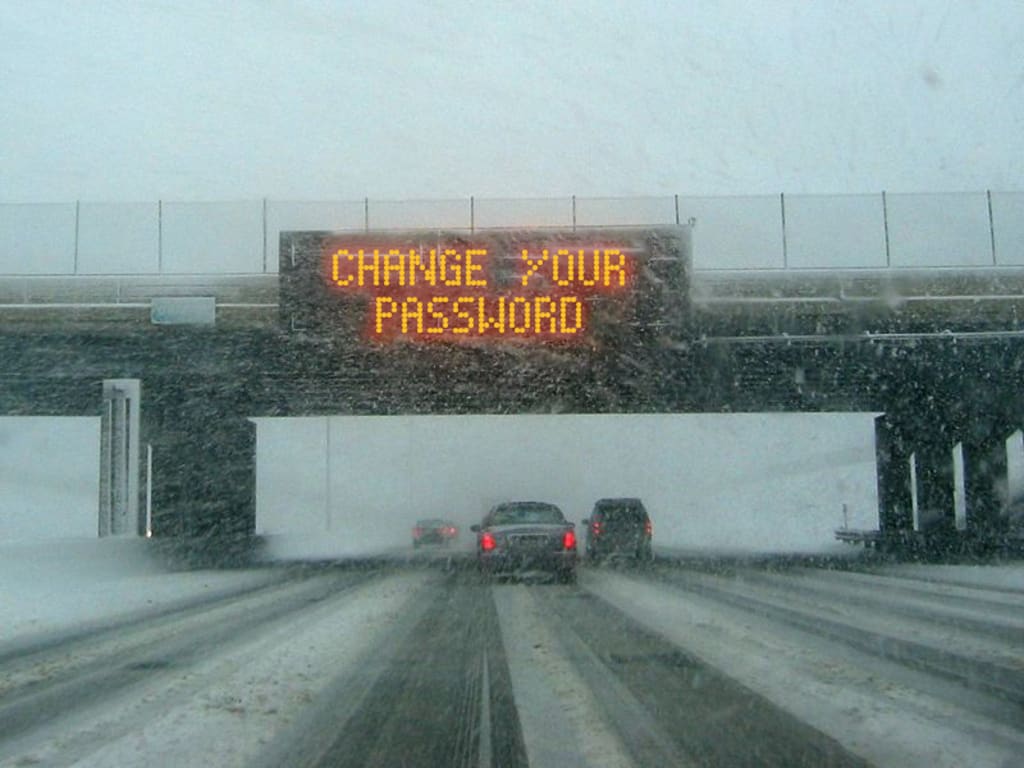
In those long three minutes, time itself had become timeless. Beyond her hot, heaving breath, her still frame reanimated to the blaring of a thousand horns. With every hair raised, she slowly regained some semblance of awareness and squinted into the steamy horizon, hazed by a cloud of funk and exhaust from the customary rite of five o'clock traffic. She had been here before — first in a dream, then in a constant call to do something bigger with her obscure and withered life. Yet here she stood, smack dab in the middle of the Interstate, somehow stupefied at the scene now unfolding before her in physical form. Dwarfing her obsessions to avert this real-life dystopian nightmare, the giant yellow bulbs on the road sign before her flashed against a massive black backdrop, uniting with the words: RESET YOUR PASSWORD.
Even the car horns had an echo in this place — so loud she could feel the vibrations in her hand. It was another notification. The Emergency Alert System (EAS) jarred across a heavenly symphony of mobile devices in a synchronized stamina fit for a nuclear meltdown — all with the same message: RESET YOUR PASSWORD.
Brenna had run through this scenario a hundred times before but never imagined it would go down like this. She had presented to the appropriate alphabet agencies and symposiums, authored painstakingly-sourced scholarly articles for high-impact journals, and even made memes, appealing high and low, to expose the problem of network centralization. She finally wrote a fiction piece, hoping to appeal to anyone with the right mind to hear.
Fiction is precisely where this trope belonged: an unbelievable story of a hidden world war ravaging cyberspace with censorship, sophisticated propaganda armed with tactical algorithmic precision, complete with manufactured bioweapons, and institutional corruption that permeated every industry. It was so far-fetched that even those who suspected foul play fell victim to more elaborate narratives constructed to distract and damage their credibility. They would try to warn their closest loved ones, but the sly smiles of fancy talking heads in suits drowned their pleas and pitted them into pointless squabbles about the shape of the earth.
Borrowing straight from the Nazi playbook, six corporations managed to control 90% of the media, and the capacity for abject harm had grown more robust and laser-focused than ever. With digital eyes and ears wired into nearly every living room, pocket, purse, and nightstand, this sprawling digital leviathan had a virtually unlimited tap into the hearts, minds, and wallets of the people they held sway over. Yet, unwittingly, denizens of the earth continued to feed this machine exabytes of personal data, which it fully digested to exact its hypnotic delivery and silencing with fantastic contextual accuracy.
Grappling with the gravity of this story and still coming to, horns from every direction assaulted her, reminiscent of the late morning work alarms that always came too early after years of sleepless nights tossing around every human problem curable through hashing. She had discovered that locally-hashed user signatures — an alphanumeric string computed from a passphrase — would effectively secure online accounts, provide transparency and privacy in aggregate data and provide a vehicle for cross-platform networking, effectively splintering the grip of this technocratic monster.
Securing the future of communications was her steadfast focus in the face of an unprecedentedly rich news cycle of seemingly unrelated current events upending every facet of American life as she knew it. She knew this cycle well, having returned to her roots in the virtual newsroom for the virtue of access, grimacing every time she collated the budgeted syndicated attack pieces for publication. Her only refuge amid a quiet whistleblowing drop was filtering out the apparent stories marred by the more obvious sensationalism and libel, which didn't appear to bother anyone else.
Despite her best efforts, the turning point in this war would belong to some rogue grey hat with access to a quantum computer who had cracked the RSA encryption for multi-state Departments of Transportation and the national alert system. Brenna hesitated to celebrate, knowing that no good problem ever goes to waste. Undoubtedly, the sounds abound would yield some fix for the rot that had become the new normal. Instead, she stood frozen on the asphalt, horrified at what the final solution might bring. She imagined this was what death must be like — a rapid-fire cinematic review comprising an eternity full of synchronicities signaling this moment. Finally, a familiar voice that transversed these centuries broke through the blaring noise, pulling her back to the present, "Babe! Get in! It's time to move."
About the Creator
Crystal S.
A journalist who learned to code.
Enjoyed the story? Support the Creator.
Subscribe for free to receive all their stories in your feed.
Comments
There are no comments for this story
Be the first to respond and start the conversation.