
Redeemer of the Valley
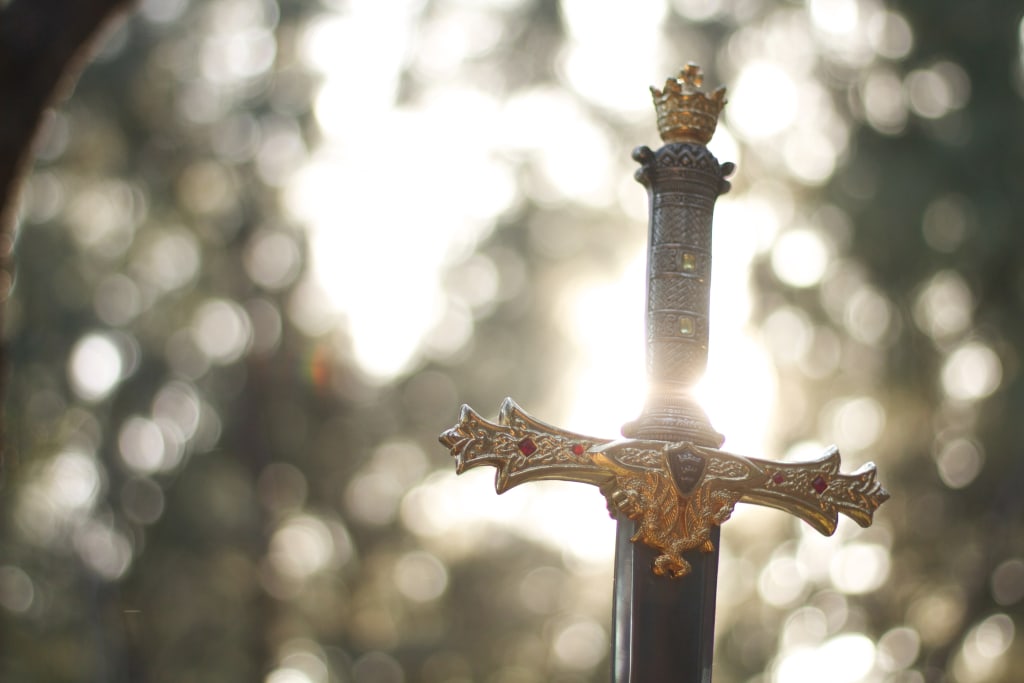
The great sword, Hirionaeth
There weren’t always dragons in the valley. They came back slowly as news of wickedness and corruption and the weakening of the bonds that had held the clans together spread North, carried by the messengers of such things - the bitterest of crows, the snakes who had been banished and the men who had turned their service to the fell creatures who sought nothing but destruction.
The dragons took their time as they moved South, vengefully laying waste to forests and farmlands and the scattered villages. In the time of the Great Allegiance, the Great Worms had been driven to the farthest, coldest reaches of the North against their will. The battle flags of the Allegiance had whipped and glittered brightly in the sun, the hosts of horsemen and archers holding the flanks as the sword carriers and shield bearers in the centre strode forth to challenge the flying terror. No dragon had left that field unscathed, wings ripped by blazing arrows and limbs ripped from their bodies by the mounted axemen who rode through great floods of flame. The kings and princes then bore in with the only blades that could cleave at the fire-breathing throats and end the terror of centuries.
The victorious armies had galloped North, hunting out the dragons’ treasure hoards, freeing the terrified prisoners the dragons kept and bred for food. In their final act of triumph, the armies had found their way into the deepest of the Fire-Worms’ burrows and smashed their precious eggs.
For countless years, all that the scaly survivors of this massacre could do was kindle fires to keep themselves from freezing and wait. Behind the glitter of those dragon eyes was a cunning understanding of human nature. The naive belief that dragonkind had been defeated for good and all would weaken the two-legged fools and they would no longer guard the Northern border. As the dragons curled around their fires, they fed their hate. They would take back their gold and burn the mightiest mead halls to the ground. The wait had been longer than even the wisest Worm had expected, but now the time had come for them to uncoil their bodies, stretch out their great leathern wings and roar hell against their enemies sitting comfortably in the warm, soft South.
The first to feel the returning fury were the Northmen of Langlundir. They had been fierce in the defence of their land and treasure, fought long and hard against the great Worms of Fire but even their strongest axemen had been forced to flee in the end. Scattered bands of refugees, once proud landowners, were seen more often with each passing month, moving along the ridge-lines away from the settlements to avoid the shame of being pitied. It was said that they would gather again on the plains of Rothgillid to make their final stand if the dragons dared to follow them that far.
When rumours flew far ahead of the dragons, many of the smaller clans packed up and left without a fight. Though none of them had ever seen a dragon’s shadow on their hills, the memory lived on in stories of flame and suffering and there was no defence against that fear.
Beyond the Trentperryth Mountains, where the River Harlwent had its source, the people of the Lysmenian Folds would not be driven out. They still had faith in Kings and the High Stewards, the Princes and their Earls, their castles and the shelters dug of old. In some corners of Lysmenian, men and women toiled again to make the shelters strong. There they could survive. To win back their safety and drive the Worms into oblivion, the ancient weapons kept safe for generations would have to be in the hands of warriors who had the stomach for a fight and the knowledge of how the Dragons had been crushed before. While all across the Folds men sharpened blades and burnished helmets, there spread a poison more dangerous than the Fireworms’ fangs. The threat of invasion had lit up rivalries and ignited old feuds and blood was flowing long before a Dragon had been seen. As the best of the clan leaders called the warriors to unite, narrow-eyed envy turned men to murder. All the while, the dragons bided their time, waiting for warmer weather.
* * * * * * * *
A biting wind howled through the leafless branches of the forest. Wood creaked against wood, making the boy look up before wrapping the white coat more tightly around his thin frame. As he walked over the brow of a small hill, Lachlan stopped in his tracks. The shapes were unmistakable: even under the blanket of snow, the outlines of the horses were visible, lying where he had seen them fall the day before under the terrible storm of arrows.
Looking around carefully, knowing that anyone nearby would be able to follow his tracks through the fresh snowfall, he had to gather every ounce of his courage to go closer. The wind dropped away as suddenly as it had come up, and now the snow dampened every sound, as if the whole world was in hiding, waiting, hushed by fear. Alert to any movement, he stood motionless, his body hunched forward to present as small a target for the spotters on the mountains to the West. All Lachlan heard now was the sound of his own breathing.
He forced his legs forward, heaving his thighs high as he ploughed ahead through the deep drifts of snow. He would have to be quick before they came. And if they came, he would have to move even faster to find a place to hide.
The cold had deadened the bitter smells of battle, but even so he knew that he was walking across a field that hid the bodies of brave men. He placed his feet carefully out of a mixture of respect and deep fear. Everywhere under that covering of white were the blades of axes, broken spearheads and the faces of the men and boys who had been his friends. He moved painfully slowly, not heading directly to where he thought the treasure he was seeking lay but circling around it to confuse any who would hunt him down. With each step, he delicately kicked the snow aside in such a way that a man on horseback trying to track him would not be sure which direction he was travelling. He skirted the battlefield in this way, edging nearer to where he had seen the Earl’s horse crash to the ground beneath him.
The warning came quietly at first, the hoofbeats muffled across the white-dazzled landscape, the rhythm steady as the wall of noise grew and climbed the hill beyond the fringe of trees. Burying himself in the soft snow behind the rotting remnants of a fallen tree, camouflaged as he was by his white coat, none of the sixty horsemen who crested the hill and drew in their reins saw Lachlan where he lay. They stopped at the crest, their horses wheeling this way and that, while the men searched the trees with suspicious eyes. They had seen what concealed archers could do just the day before and were intent on robbing the bodies of the men who had fallen, not joining them in the grave. The horses blew clouds of steam out of their nostrils as they smelt the air, their ears cocked forward, tense, straining for any sign of danger. Some of the horsemen kept watch while more than half of the party dismounted, unstrapping shovels, axes and long-handled knives from their saddles. They would dig up every body and strip them all of precious armour and any treasures the men had carried with them.
Lachlan could only lie where he was, as motionless as the corpses around him. He felt the cold grip his fingers and toes as he took shallow breaths so that steam from his mouth would not give him away.
Barely a spear’s throw from where he lay, the men hacked with their shovels trying to crack away the ice that held the bodies they were intent on stripping. Lachlan heard a shovel hit flesh and bone and one of the men swore in disgust.
“Can’t hurt him now. Get on with it – and keep your voice down. Sound travels. Now, find it!”
Lachlan could barely stop himself from crying out. They had come for the self-same treasure he now sought and he was powerless to stop them. The cold had seeped into his bones and he forced himself not to shiver, imagining himself warm beside his master’s hearth. But he could never go back there until he had retrieved what had been lost.
One body after the other was dug out and searched. The horsemen on the hill had turned away and now their horses stirred, stamped. Suddenly, there was a blast on a great horn, blown with the force of anger. The horsemen on the hill waved, frantically, and the robbers fled, abandoning their shovels as they hauled the heavy armour up the hill.
“Leave it! Run!!”
Lachlan heard the horn blast again and felt the rumble of what must have been hundreds of horses charging across the valley on the far side of the hill. The party of sixty grave-robbers would be no match for them and the fear in the men was clear even at a distance. The last of the men disappeared over the hill, digging their heels hard into their horses’ flanks, and Lachlan jumped up, heading for the last great untouched mound of snow in the centre of the battlefield.
He grabbed one of the discarded shovels as he ran, took the final few strides, drew in his breath and began to dig. And there it was, beside the body of the horse, the hilt of the famous sword, Hirionaeth, ‘Redeemer of the Valley’, protruding now from the snow just where he had seen it dropped. The pommel end of the sword, decorated with the apple symbol of the Royal house, was carved from ebony, the iron-dense, dark wood threaded through with intricate patterns of gold that caught the weak rays of the sun and flashed yellow against the whiteness all around him. Lachlan reached out and hauled at the sword’s grip, expecting it to slide easily, but ice had formed along the edges of the blade and he had to lean every ounce of his weight against the sword to crack the hold the snowdrift had taken on that famous sword. Back and forwards, he threw himself over and over again, before finally he could draw it clear. Light played on the embossed images of saints and dragons that had been crafted, beaten and carved into the blade. The razor-sharp edges were unmarked from battle because its owner had fallen so quickly under the torrent of arrows. The blood he saw on the hilt must, then, have belonged to the Earl himself whose lifeless body had been carried away by his servants, the same servants who were now in the dungeons for failing to rescue this priceless weapon.
And then Lachlan heard the horns again, distant now, blowing the command to cease the charge. He knew he had to move quickly and yet hide his tracks. There would be time, he thought, until he heard that horn blown again, and this time the sound was coming in his direction…
About the Creator
Enjoyed the story? Support the Creator.
Subscribe for free to receive all their stories in your feed.
Comments
There are no comments for this story
Be the first to respond and start the conversation.