
Rafy's Jibaro
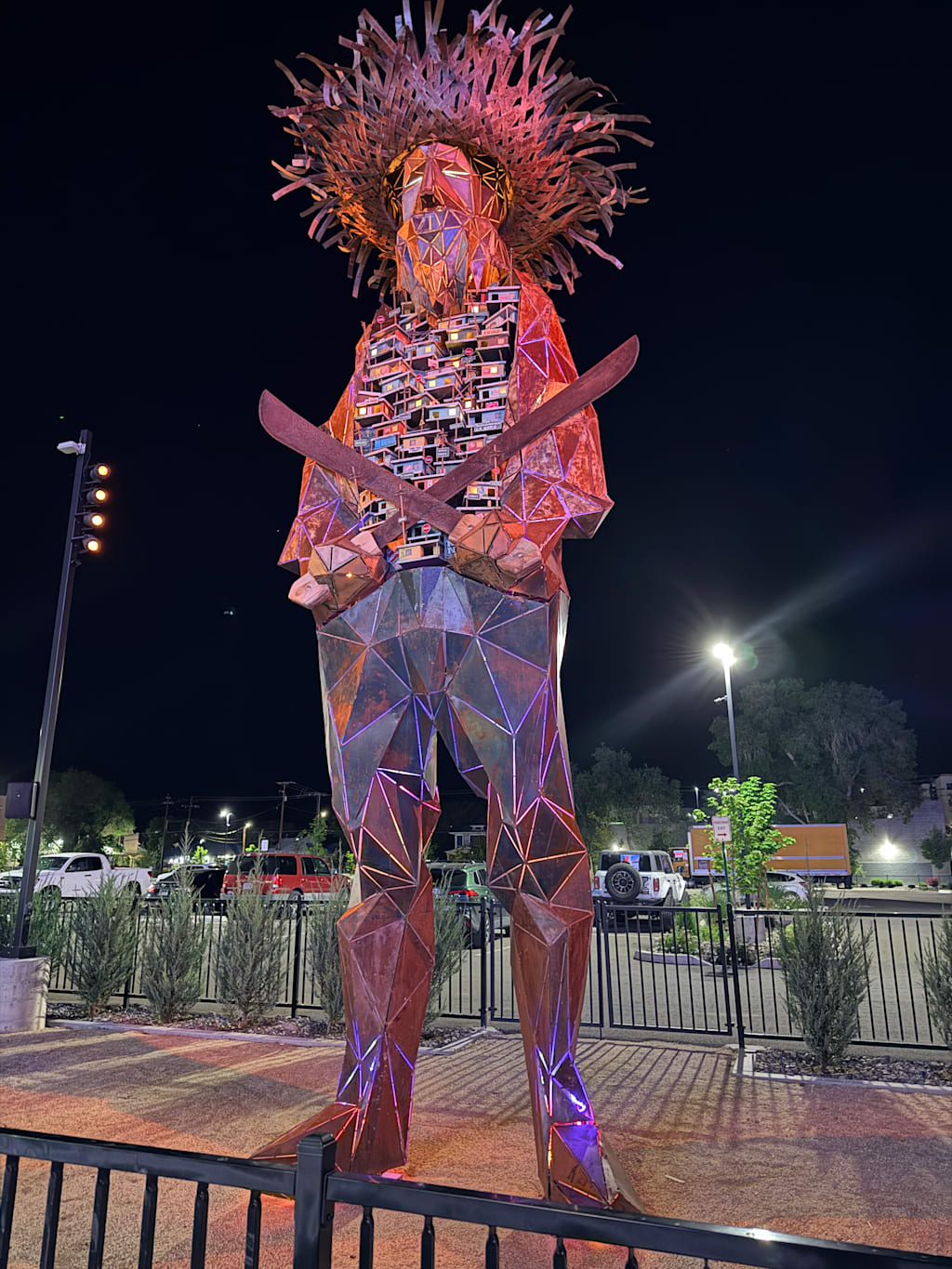
A Metal Artist's Story, Reimagined in Fiction - inspired by a photo taken of the Jibaro sculpture in Reno, Nevada, which depicts dignity, anti-colonialism, and freedom
He rolled into my isolated, dusty town, far from urban sprawl and gentrification, coming from somewhere in the Mexican desert. You don’t need to know his former GPS coordinates, just that he came here and stayed awhile.
He rode an Indian motorcycle past me as I wondered where he got the beautiful machine and who he was.
The truth is, I was not alone in wondering who the hell he thought he was, riding into our God-forsaken, poorly educated, impoverished town, dressed like a gaucho on an expensive bike.
A gray beret sat askew on his head, and his poncho of red and black threads was flung carelessly over his shoulders. Long ebony curls, touched with gold, streamed down his back, and his handlebar mustache matched only the ebony strands of his hair.
He parked and strode toward me, slightly bowlegged, with broad shoulders like an eagle's wings, his eyes scanning the town. My brothers, Daniel, Peter, and Adam, were on him before he took three steps, forming a wall between him and the rest of us.
“Hola.” He smiled, but my brothers didn’t return the smile.
“Where are you from?” Daniel, my eldest brother, asked, looming over him.
“Mexico,” he said, his voice like a razor, daring them to continue interrogating him.
I’d studied people all my life in this one-trick tumbleweed town. Parents, grandparents, the boys chasing cattle and each other. I could read hunger, pride, depression, and sadness, as well as the promise of a storm. But this man, Rafy, was a puzzle piece from a box not sold in our town, too profoundly enriched to touch our domain.
Adam, the fighter, bristled. “Where in Mexico?”
“Adam,” I warned. Adam's an Aries, my fire-sign brother, always picking fights. Rock, paper, scissors. He always chooses rock, for smashing.
“Western Mexico. Baja. I’m an artist. Mostly sculptures.”
Trey circled him, slowly like a sleek cougar. “Your name?”
“Just call me Rafy.” His brilliant smile flashed, as if in a toothpaste commercial, and my heart leaped.
My brothers stood firm, but I stepped forward. “I’m Ariella,” I said. “You look about twenty-four?”
“Good guess. Twenty-two.” He watched me, curious. He was studying my brothers and me, sizing us up. Daniel kicked the dirt to take the stranger’s attention off me.
Rafy was hard to read and didn’t fit into any of the types I knew well. Intrigued, I studied him as my brothers glared and scowled, blocking his path.
“I’m looking for a place to work on my metal art. Do you know of a place I could rent?”
My brothers all huffed, “NO!” at the same time. I pushed forward, past my threatening siblings.
“Come with me; I know a place.” I led him away, glancing back at the 3 ruffians as if to say: I’ve got this. They watched, all frowning.
As we passed my home, I told him that my brothers shared the bunkhouse on our property, and that I still lived in the house with our parents. My mother’s older sister had a loft in the barn, which she occasionally rented out.
“My Aunt Bettye has a loft in the barn, and sometimes she rents it to men passing through,” I looked around cautiously to see who was watching us. Walking with a stranger in a tiny town brought lots of eyes peeking through blinds, or watching from porches.
“Thank you, Ariella.” I love how he rolls the r’s in my name. Realizing I’m holding my breath and staring at him, I take a gulp of air.
“Where’s your art supplies?” Aunt Bettye looked him up and down, wiping her calloused, toast-brown hands on a stained apron. Her sapphire eyes shone beneath shaggy brows on her weathered face.
“I left my trailer about forty miles back at that Sinclair station. To start, though, I’d like to buy some sheet metal; I’m sure there’s a scrap metal place here.” He waited, and she nodded curtly. Inside the barn, she showed him where he could sleep and pointed to the staff farthest from the cattle.
“I’ll give you blankets and a pillow to sleep with. Only use that stall, and don’t upset the cows, you hear?” He smiled and nodded. “$110 per night, and you get breakfast and dinner. You’re on your own for lunch. I go to bed early, and so do most around here, so you can’t make a lot of noise after sunset.”
When Auntie went to get the blanket, I asked Rafy why he made sculptures instead of working.
“I was a farmer in Mexico for a while, but I decided making art is more important.”
“Art! No one here would understand a man who thinks art is more important than farming, which grows food for people. You can’t eat art.”
“No, you cannot eat art, my little Ariella. But it makes your soul sing and your eyes sparkle. It fills your heart.” I sighed at his words. He is right, but not here, in a town no one ever leaves or tries to improve. They just keep it the same, comfortable, for the generations that grew up here.
“Show me something you made.” He pulled out photos of metal sculptures, some enormous, others tiny. Birds, children, flowers. A magazine spread about him. I skimmed it and learned that some famous people had commissioned him and that cities wanted his art on their streets. Cities I would never visit. “How can you be famous at only 22?”
He shrugged, smiling.
A few days later, I ran into Rafy at the grocery store . We had a brief chat, but Robby, an old school chum of mine, interrupted.
“Don’t you talk to her, Gaucho.”
“Fuck off, Robby. He’s my friend,” I snapped. Robby glared at us, then left.
“Can I see what you are working on?” He nodded, and I followed him.
“Whoa, what is that?”
“It will take a few weeks. I’ll need help with the electrical work…”
Aunt Bettye suddenly appeared. “Listen here. I told you there should be no noise after sundown. I heard saws and clanging.”
Rafy sheepishly replied, “I’m sorry, Miss Bettye. I was just touching up a piece and knew I wouldn’t be able to sleep if I stopped. It's a piece for you.” He trotted over to a work bench and returned with a sculpture of the milk cows and two red and brown chickens. The cows had a metal fringe of hair on their foreheads and the chickens were exact replicas of ones in the barnyard.
Bettye’s mouth fell open, and I must say, that is unusual. Rafy had surprised my aunt, who rarely could be.
“Why, I…thank you, young man. These are simply exquisite, exactly like my farm girls. You have talent, Rafy!” He returned her smile with a gleaming grin, displaying dimples I had yet to notice. He’s so handsome. Calm, kind.
Turning to Rafy, I said, “Adam is an electrician. I’ll ask him if he will help.”
At dinner, I explained what Rafy was doing and that he needed an electrician. Adam said, “Hell no, I don’t want nuthin’ to do with your Mexican stranger.”
I let it go, but decided to butter him up a bit and then ask again.
“Did ya hear what happened to your artist friend?” My best friend Monica and I worked at the only café in town. “He was beaten up at the bar last night.”
“Who did that?” I asked. She stayed silent, and I knew instantly. I threw my apron on the counter and stormed home.
I found Adam and Daniel in the backyard, eating a sandwich. I walked up and punched Adam's shoulder.
“What did you do that for?” An unwritten house rule: boys didn’t hit girls, even if a girl hit first.
“You beat him up?” I glared. He laughed. Then it turned into an all-out brawl. I grabbed his hair and pulled, my fist tightly clenched. As he tried to lift me, I kneed him in the groin. I screamed in rage until Pa told him to let me go. “Pa, he beat up the artist.” I turned to Adam. “Why do you have to be so mean all the time? Being a bully might seem cool to you, but it’s not. Grow up!” My parents watched silently as I told Adam off and stormed away.
That night, I overheard Mom telling Adam to stop taunting his little sister. He denied that the beating was meant to taunt me. He just didn’t like Rafy and didn’t want him in the bar with his friends.
On Tuesday, a three-foot metal replica of a roadrunner, bright-colored and shining in the sun, was in front of the café. On Wednesday, it was gone.
The following week, on Friday, a female dancer with castanets, her dress made of colored metal ribbons, appeared before the city hall. On Saturday morning, she lay on her side. I watched from the café as Rafy stood her upright. He left, then returned to place a large red heart next to her, one that people could sit on. As the day wore on, I saw people resting on the red heart, gazing at the dancer sculpture. Every week, a new metal sculpture appeared. If one was vandalized, Rafy fixed it and brought a second.
Toward the end of the second month, Rafy left on his Indian, wearing a backpack. At sunset, I heard the motorcycle again and ran to Betty’s. His bike was pulling a trailer loaded with supplies for his sculptures. He took my hand, and my stomach flipped at the touch. The stall farthest from the cows held a large sculpture.
“That is Jibaro,” he whispered into my hair, sending butterflies through me. “Now he’s ready for the electrical wiring if you can convince your brother.”
I took Rafy by the hand and led him up the porch steps of my house. We entered, and Papa and Mama still sat at the dining table.
Mom gasped, and Papa scowled. “Who is this, Ariella? We don’t have…” I cut Papa off. “Rafy, these are my parents. Papa and Mama, please meet Rafy, the artist. I need help convincing Adam to help with the electrical component of his sculpture of a Jibaro. It is dedicated to his father from Puerto Rico.”
“You said you were Mexican!” my father snapped.
“Puerto Rican and Mexican, yes.” He met my father’s gaze. They agreed to walk to Aunty Bettye’s to see the twelve-foot metal statue of a farmer wearing a metal-fringed sombrero and carrying his Daga machetes.
I whispered loudly:
Barrio Jibaro stands tall,
a symbol of them all,
sugar cane and other crops chopped
using his Daga machetes
“Papa, Rafy comes from a Puerto Rican family of subsistence farmers. Those farmers kept going without assistance, harvesting sugarcane and other crops. Now, look at Jibaro’s chest. It is a replica of the barrio and their homes; the homes fill his chest like tiny mobile park homes. We need Adam to help light up the statue and make the homes sparkle with dancing lights.”
Adam refused our request.
Days later, at night, Rafy placed a metal sculpture of our parents next to the front door, and they awoke to find its many colors shimmering in the dawn light. My parents' faces were exact replicas of theirs.
I learned that Rafy stopped at the electrical company in town. He told them he would pay handsomely. All the men looked away. He rode to the next town and returned with a Nigerian electrician who taught math at the community college. The Nigerian looked at Jibaro and said it was complicated, but he would help. Every Saturday morning, I saw him drive up in a blue Honda Fit, unfold his lanky legs, and take his tools into the barn. He was not a licensed master American electrician, but he tried. I took photos of his wiring and brought them up at dinner. I also shared some articles I had found online about Rafy. I laid the color printouts of the articles and photos of partially lit-up Jibaro in front of them.
Curiosity got the better of bullheaded Adam as he studied them.
“Come!” he ordered, and we drove to the barn, where we found Rafy working on Jibaro. “Move over, Mex, let me see.” I hit him on the shoulder and hissed at him not to be rude.
After 2 hours, Jibaro lit up like a town, and we all stood there, grinning. The lights twinkled from building to building across his chest; store names blinked on and off.
“Where do you plan to put this thing?” Adam asked.
“Wherever you think it would look best,” Rafy replied.
“I know a place, but we need approval and permission. I’ll get back to you.”
Adam and Rafy installed Jibaro on a stone platform next to the “Welcome to Cinderstone” sign.
Robby was watching, jeering, calling Rafy names and ridiculing Adam for helping him. Once the statue was securely set in the spot the city had approved, Adam shook Rafy’s hand.
Then he walked over to Robby and slapped him upside the head.
“Ow!” Robby yelled, his face crimson.
“Listen, you little shit, no more defacing or knocking over Rafy’s sculptures. I know it was you. Don’t even think about. I’ll come for you.” Robby’s eyes were like saucers, and he looked down as my brother let him have it. “Understand?” Robby nodded.
**
The outsider’s art welcomed everyone to town. In fact, it helped make the town a featured stop on road trips.
And Rafy? His art continued to be featured in large tourist towns like New York and Las Vegas. Art curators begged him for shows.
His and Ariella’s grandchildren run the art studio he founded in Laguna Beach, California, and many of his works have appeared in top-grossing movies.
**
Author note: I originally was creating a poem from the headliner photo that I took. It became difficult - could I rhyme it? Should I do free verse? How can I lay out the information about this sculpture? It morphed from a poem to this story. I hope you like it. ❤️✍️
Copyright © 6/3/2026 by Andrea O. Corwin Thanks for stopping by! 😃 If you like ♡ my scribbles, hit the subscribe button. Please consider leaving a comment. ✍️❤️
About the Creator
Andrea Corwin
🐘Wildlife 🧘♀️ 🖋️🈷️ 3rd°🥋 See nature through my eyes and photos.
Poetry, haiku, fiction, horror, life experiences. Written without A.I. © Andrea O. Corwin
bigcats4ever.bsky.social
Threads/ Instagram @andicorwin
Enjoyed the story? Support the Creator.
Subscribe for free to receive all their stories in your feed. You could also become a paid subscriber, letting them know you appreciate their work.
Comments
There are no comments for this story
Be the first to respond and start the conversation.