
Quantum Fingerprints of Light: Exploring Unique Photon Signature in Laser Technology
A New Frontier in Laser Physics: Harnessing Photon Signatures for Innovation

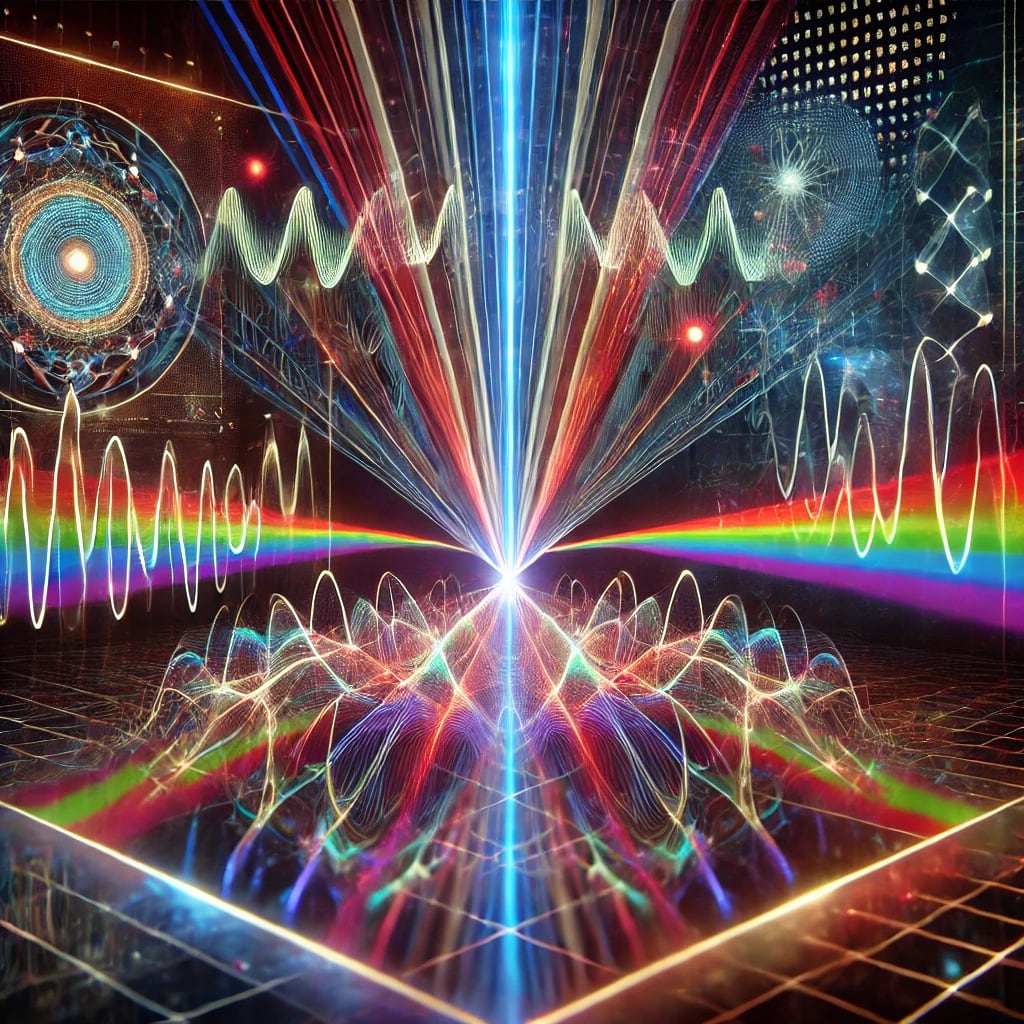
Introduction
Lasers have revolutionized modern technology, finding applications in everything from medical surgery and industrial cutting to data transmission and holography. At the heart of laser technology lies the manipulation of photons—the fundamental particles of light—in highly controlled ways. While much has been explored about laser coherence and monochromaticity, a novel concept is emerging that delves deeper: quantum fingerprints of light. This idea explores how the unique properties of photons in a laser beam can form distinct, identifiable signatures, paving the way for groundbreaking applications in security, data storage, and laser diagnostics.
Quantum Fingerprints
Every laser beam is composed of photons characterized by various properties:
Wavelength: Determines the color or energy of the photons.
Phase: The relative position of the peaks and troughs in the photon’s wave.
Polarization: The orientation of the electric field associated with the photon.
Intensity: The number of photons per unit area or the brightness of the laser.
These properties, when combined in a specific arrangement, create a unique quantum "fingerprint" for each laser beam. Unlike classical light sources, lasers operate with extreme precision, allowing these fingerprints to be stable and repeatable. The configuration of these quantum characteristics in a beam can be thought of as an optical identity—a signature that distinguishes one laser source from another.
Photon Interference and Signature Patterns
Quantum interference is a phenomenon where photons interact with each other, producing patterns that depend on their phase relationship. By examining the interference pattern produced by a laser beam, one can decode its unique quantum fingerprint.
This pattern reflects:
- The coherence length of the photons.
- The spatial and temporal phase distribution.
- The polarization dynamics.
These patterns can be captured using specialized optical sensors and analyzed with quantum-optical computing algorithms. Each laser beam’s signature, once identified, can be stored as a reference for future comparison or authentication.
Applications of Photon Fingerprinting in Laser Physics
1. Security and Cryptography
In the age of cyber threats, quantum-based security systems are becoming increasingly important. Photon fingerprints can be used to develop secure communication channels where the unique laser signature authenticates the data transmission. If the fingerprint is altered, the system would detect tampering immediately.
2. Advanced Data Encoding
Traditional data storage systems rely on binary encoding. Quantum fingerprints offer the possibility of storing information within the subtle variations of a laser’s photon properties. This would significantly increase data density, enabling compact, high-capacity quantum storage devices.
3. Laser Diagnostics and Quality Control
Photon fingerprinting can be employed to monitor and analyze laser performance. By continuously measuring a laser’s signature, manufacturers could detect deviations that indicate wear or faults in the system. This technique would ensure high precision and reliability in applications requiring consistent laser output.
The Future of Quantum Laser Fingerprinting
The concept of quantum fingerprints is still in its infancy but holds vast potential for reshaping optics and photonics. Future developments could include:
Photon Signature Manipulation: Technologies that intentionally alter laser fingerprints for adaptive optics and reconfigurable laser systems.
Quantum Fingerprint Databases: Massive repositories of laser signatures for use in security checks and device identification.
Quantum Computing Interfaces: Photon fingerprints could serve as inputs for next-generation optical quantum computers, enabling highly efficient data processing.
Despite the promise, several challenges remain. Reading and manipulating quantum fingerprints require extremely sensitive detectors and sophisticated algorithms to interpret the data without introducing errors. Researchers must also address issues related to fingerprint stability in varying environmental conditions.
Conclusion
The exploration of quantum fingerprints in laser physics offers a new frontier for scientific discovery and technological innovation. By unlocking the potential of unique photon signatures, industries ranging from cybersecurity to advanced manufacturing could benefit from more precise, secure, and efficient laser-based systems. The future of laser technology, driven by quantum insights, promises to be as illuminating as the light itself.
About the Creator
PhysicsWave
"Discover the world of physics with Physicswave.com. Learn about the fundamental principles of physics and access user-friendly tools to make calculations and problem solving easy. Explore the exciting world of physics today."
Enjoyed the story? Support the Creator.
Subscribe for free to receive all their stories in your feed.
Comments
There are no comments for this story
Be the first to respond and start the conversation.