
Purpose of Visit
Forty-one days after retirement, the badge still opens the door. That's the problem.

The badge still works.
You didn't think it would. You sat in the parking lot for eleven minutes with the engine off, watching the sodium lights buzz over two empty spaces stenciled RESERVED — CG and RESERVED — CSM, and you told yourself the system would have caught it by now. Forty-one days. Somebody in the S-1 shop would have clicked a box. Some contractor in a building you've never seen would have run a script, and your name would have gone gray in a database the way names do.
But you hold the card to the reader beside the staff door, the one you've used two thousand times, and the little light blinks green. The lock gives its soft mechanical cough. You are inside before you've decided to be.
It's 0214. You know without looking. Your body has kept military time for thirty years, and nobody has told it to stop.
The hallway smells like floor wax and burnt coffee and the sweet chemical ghost of the carpet shampoo they ran through the conference room after the holiday party. Fluorescent tubes on night setting, every third one lit. You know which tile squeaks — fourth from the water fountain, left side — and you step over it without thinking, the way you used to when you came in at this hour to see what the staff duty NCO was really doing with his night.
You are not here to check on anybody.
You tell yourself that twice, and you notice you have to.
You're wearing jeans and a gray fleece your wife bought you the week after the ceremony, because, she said, you need clothes that aren't green. Your hands don't know where to go. For three decades they went behind your back, or to a soldier's shoulder, or to the brim of a patrol cap. Now they hang. You put them in your pockets and that feels worse, like slouching in church, so you take them out.
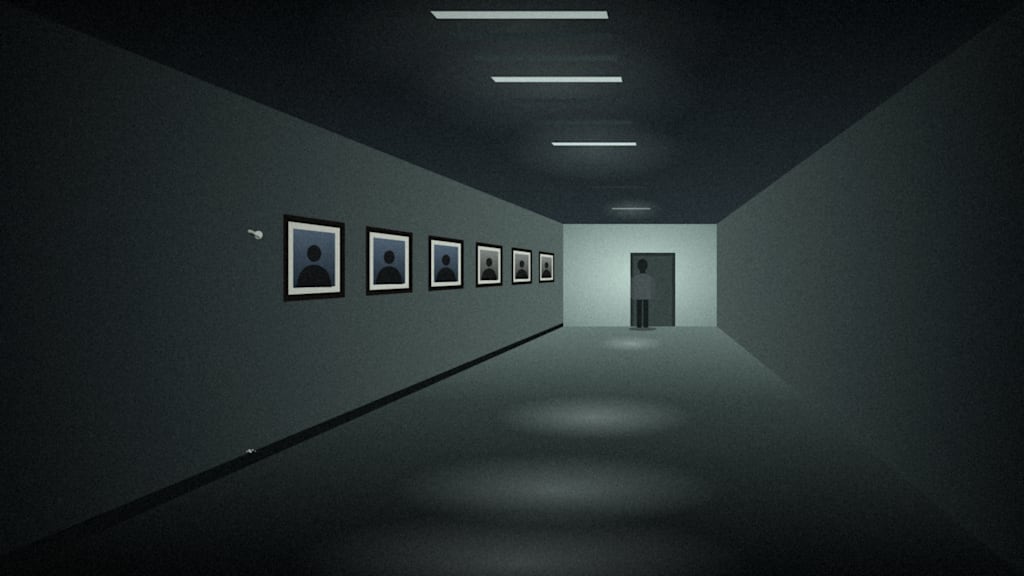
Down the main corridor is the wall.
Every division has one: the command sergeants major, framed in a single long row, oldest at the far end in black and white, the faces getting younger and the photographs sharper as you walk toward the present. Men who are mostly dead now. Men whose names you learned as a private because a drill sergeant told you that you would. You walked this row every morning on the way to the commanding general's office and stopped seeing it within a month, the way you stop seeing a clock.
You see it now.
The last frame is you.
They hang it while you're still in the job — tradition, a way of reminding you that you are temporary — and you passed it every day for two years without once looking yourself in the eye. The man in the photograph has a jaw you don't have anymore. Rows of ribbons, the combat patch, the tab, the wings, all of it squared away to the sixteenth of an inch by a staff sergeant from protocol who measured twice and was terrified of you. The man in the photograph looks like he knows exactly where he's supposed to be.
To the right of your frame, there's a nail.
Fresh. Driven at a slight angle into the drywall, waiting. On the baseboard beneath it, a crumb of white dust nobody has swept. You stand there longer than you mean to, and you think about the man who'll hang on that nail — you know his name, you sent him a note the day the list came out — and you are glad it's him, you really are, and you still feel something close in your chest like a fist around a sling swivel.
You keep walking. It's what you know how to do.
Your office is at the end of the command suite, past the chief of staff's door and the aides' bullpen with its two desks pushed together like kids sharing a lunch table. The suite door takes the badge. Green light. Cough. You are further in now, and you know it, and some careful part of you — the part that once relieved a first sergeant for propping open exactly this kind of door — stands off to the side with its arms crossed and watches what you'll do.
Your office takes a key. You turned the key in. The hand receipt cleared, and the supply sergeant shook your hand and said, Sergeant Major, it's been an honor, and meant it. So you can't open it. But there's a narrow strip of wired glass beside the door, and the hall light falls through it at an angle, and you lean in.
It's not your office.
The desk is the same desk. The flags in the corner are the same flags, the national colors and the division colors with their battle streamers hanging like dry vines. But there's a different coffee mug by the keyboard — some university, a team you never followed. A pair of running shoes tucked under the credenza with the laces stuffed inside. A picture frame on the desk, turned toward the chair, so you can't see who's in it. Somebody's wife. Somebody's kids. Somebody's whole life angled toward the person who belongs in that chair, and away from you.
On the wall, the whiteboard.
You read it. Of course you read it. Your eyes go to it like water goes downhill. The training calendar for the quarter in four colors of marker. Range dates. A gunnery window. The rotation date with three exclamation points. And in the lower right corner, a sergeant's last name with a box drawn around it and a question mark beside the box.
You know that box. You've drawn that box. That box means a soldier in trouble, or a soldier who's going to be trouble, or a soldier someone above you wants to throw away and you haven't decided yet whether to let them. You want to know what's in that box. You want to know what he did, and who his first sergeant is, and whether anybody's talked to his wife, and whether the question mark is a hope or a doubt.
And it lands on you, standing in a dark hallway with your forehead almost touching the glass: you have become a man who wants to know things he has no right to know.
That's the line. You crossed it somewhere between the parking lot and this window, and you never felt it go by.
“Can I help you?”
The voice comes from the end of the suite. It's young, and it's doing a very good job of not shaking.
You turn around slowly with your hands where she can see them. Nobody in this building is armed at two in the morning. But your hands know the drill even if the rest of you has forgotten it.
She's a specialist. Twenty, maybe twenty-one. Staff duty runner — reflective belt, a clipboard held against her chest like a shield. Her name tape says REYES. She has the look of a soldier who heard a door on her rounds and spent thirty seconds arguing with herself about whether to come look.
She came to look. Good.
“Sir, this floor's restricted after duty hours,” she says. “I'm going to need to see some identification.”
Sir.
Nobody has called you sir in thirty years except by mistake, and every time it happened you corrected it — don't call me sir, I work for a living — because that was the joke, the whole culture, the line between the ones who signed commissions and the ones who did the work. And here it is in a dark hallway, delivered in a voice trying so hard to be correct, and it is correct. That's the thing. To her you're a civilian. A man in a fleece. Sir is what you call a man in a fleece.
You hand her the badge.
She looks at it under the hall light. She looks at you. She looks at the badge again, and you watch the math happen behind her eyes: the photo, the rank printed on the card, the man in front of her with the same face, only softer. The long wall of frames she walked past to get here.
“Sergeant Major?” she says.
Not a greeting. A question.
“I'm sorry, Sergeant Major. I just got here in August. I've only seen the picture.”
There it is. You're a picture. You're a frame a specialist walks past on her rounds.
“You're fine,” you tell her. “You did it right.”
She doesn't know what to do with that. You can see her trying to fit you into a box, and none of the boxes fit. You're not the chain of command. You're not a visitor, because visitors come with escorts and in daylight. You're not an intruder, because intruders don't have badges that work.
“Were you checking on us, Sergeant Major? Should I wake up the staff duty NCO?”
And you realize you could tell her anything.
You could tell her to go back to her desk and forget this. You could tell her to get the key — the staff duty desk has a key box, third hook, red tag — and unlock that office, and she would probably do it. Not because it's right, but because the voice still works the way the badge still works. Both should have been deactivated. Neither was. That isn't her failure. It's yours, for using them.
“No,” you say. “Don't wake him. And no. I'm not checking on anybody.”
She opens her mouth and closes it, because a specialist doesn't ask a command sergeant major why he's standing in the dark at two in the morning. Even a retired one. Even one in a fleece.
You wouldn't have an answer anyway.
“You'll need to log me,” you say.
Relief crosses her face like weather. Here is something with a procedure. She leads you back down the corridor — past the aides' desks, past your frame, past the nail — to the staff duty desk at the main entrance, where a radio murmurs on a low channel and a sergeant sleeps sitting up against the wall, arms folded, chin on his chest. A year ago you'd have stood in front of him without a word until the silence woke him up.
You step around the squeaky tile so you won't.
The visitor log is a green government ledger with a ballpoint pen tied to its spine with parachute cord. NAME. TIME IN. PURPOSE OF VISIT. ESCORT. TIME OUT. Reyes turns it toward you and steps back, the way you'd step back from someone writing a check.
You write your name. You get as far as the comma and stop, because you've written your rank after your name every day of your adult life and you don't know what it is now. You write RET, small, and it looks like a typo.
TIME IN: 0214.
PURPOSE OF VISIT.
The pen stays on the paper. A little blue dot spreads in the fibers.
Reyes waits. She's good at waiting. You notice that and you file it away out of habit — good at waiting, challenges strangers, admits what she doesn't know — and then you remember you have nowhere to file it. There's no counseling form. No evaluation you'll sign. You will never know if she makes sergeant, and you have no say in it, and that is exactly how it's supposed to be.
“Sergeant Major,” she says carefully, “can I ask you something? My contract's up in fourteen months. Everybody's telling me something different. Reenlist, get out, go to school.” She glances toward the long wall. “You did it the whole way. Was it worth it?”
And there it is. The conversation. You've had it a thousand times — in motor pools, on the back ramp of a Chinook, on a cot at a combat outpost in a valley where the sun came up late and went down early, with soldiers who were nineteen and couldn't see the end of anything. You know the shape of this talk the way you know the shape of a rifle in the dark. You know what to ask her first. You know when to be quiet. You know how to make her answer her own question so the answer is hers.
And it isn't yours to have.
In a few hours, the man whose running shoes are under your old credenza will walk past this desk. He's the one who should hear this. He's the one who'll be accountable for whatever happens to her next. If you answer her tonight — at two in the morning, in a fleece, with a badge that should be dead — you are standing between a soldier and her own chain of command. You spent thirty years teaching young sergeants not to do exactly that.
“Ask your sergeant major,” you say.
She blinks.
“I mean it. Go through your first sergeant and ask for his time. He'll make it. That's the job.” You set the pen down. “Whatever he tells you will be worth more than what I'd tell you, because he's going to be here to see how it turns out.”
She nods slowly. She doesn't understand yet. Maybe she will in twenty years, in some other hallway.
You look down at the ledger. PURPOSE OF VISIT, still empty, the blue dot like a period at the end of nothing.
The badge is in your hand. You don't remember her giving it back. You set it on the ledger, face up, on top of the empty column — the younger man, the rank, the green light that used to open every door in the building.
“Turn that in to S-1 when they open,” you tell her. “Tell them it still works. Tell them it shouldn't.”
“Roger, Sergeant Major.” Then, uncertain: “What do I put down? For purpose?”
You think about the nail. The box with the question mark. The photograph on the desk turned away from you. You think about the fact that the building ran fine tonight without you — that a specialist two months on station challenged a stranger in the dark and did every single thing right — and that this is the only proof that counts that you did your job. You built it so it wouldn't need you.
It doesn't.
“Put down: returned government property,” you say.
She writes it in neat block capitals. She checks her watch and fills in TIME OUT: 0231. Seventeen minutes. It felt longer. It felt like thirty years.
You don't salute. You nod. She nods back. The sergeant against the wall snores once and doesn't wake.
You walk to the staff door and put your hand on the bar. Behind you is the hallway and the wax and the wall of faces and the nail waiting for the next one, and you don't turn around, because if you turn around you'll find a reason to stay another minute, and then another.
You push the door open. The night is cold and smells like cut grass and jet fuel from the airfield down the road.
The door swings shut behind you. The lock gives its soft mechanical cough, and you couldn't open it now if you wanted to.
It's the right sound.
About the Creator
Charles V Sasser Jr
Retired U.S. Army CSM, SOFREP defense analyst, and author of the thriller Led by Love of Country. I translate military doctrine into strategic insights on global conflicts, defense technology, and executive leadership.
Enjoyed the story? Support the Creator.
Subscribe for free to receive all their stories in your feed. You could also become a paid subscriber, letting them know you appreciate their work.
Comments
There are no comments for this story
Be the first to respond and start the conversation.