
Play This Only After You Forgive Yourself
Revised Edition

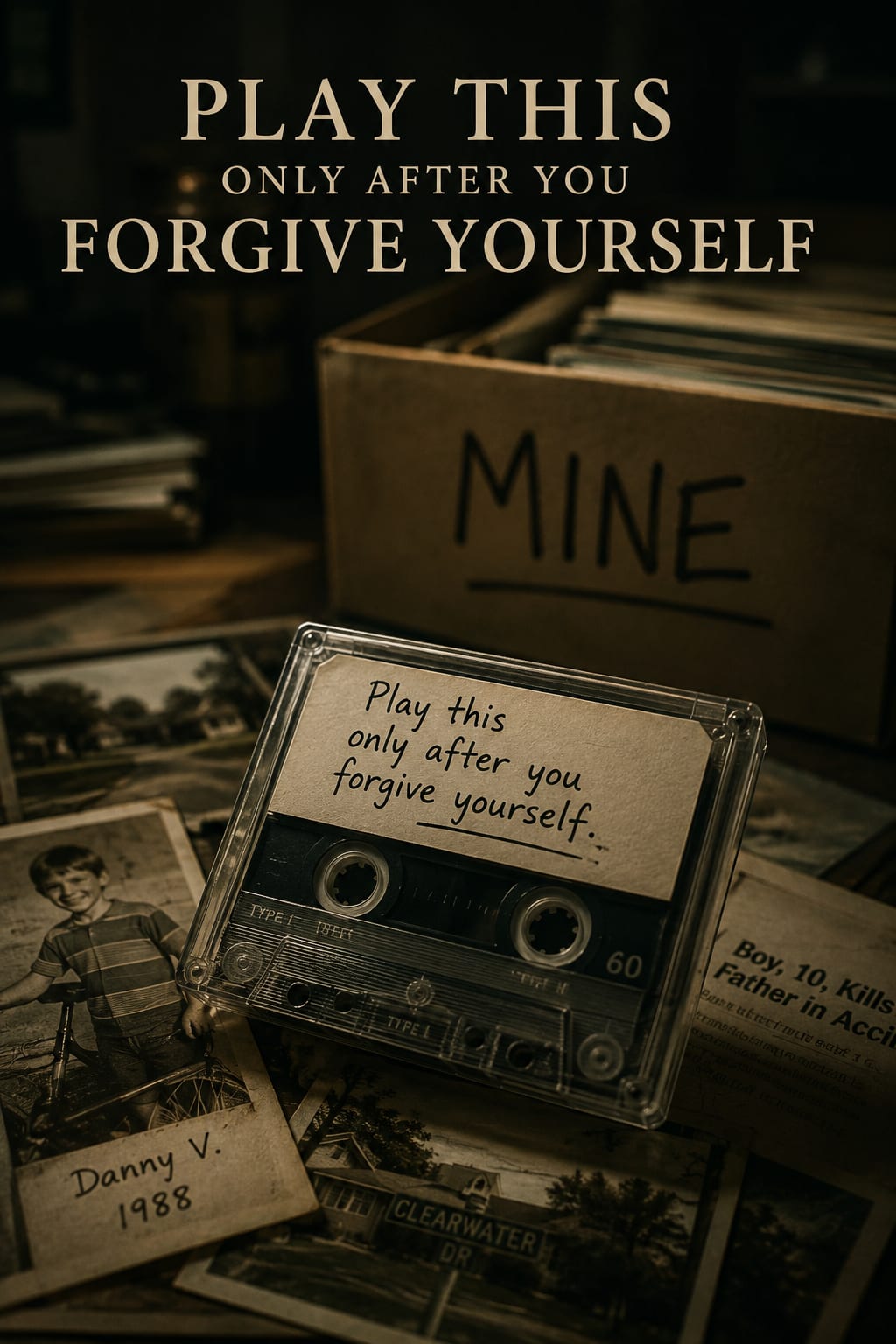
The cassette tape was sitting on top of a box labeled MINE, and my first thought was that it was a strange thing to write on a box.
My second thought was that I should put it back, get in my car, and drive home to Denver without touching anything else.
I didn't do that.
I never do the right thing when it counts.
The lawyer's name was Solis. She called on a Thursday, the kind of flat gray Thursday you don't remember afterward, and told me a man named Gerald Morrow had died and left me everything he owned.
"I think you have the wrong number," I said.
"Are you Daniel Voss? Date of birth, March—"
"Who is Gerald Morrow?"
A pause. Papers shifting. "That's something we'd hoped you could tell us."
I couldn't.
I was certain of that.
I am less certain now.
Gerald Morrow had a storage unit in Tempe, a PO box, and $340 in a checking account untouched for eleven years. No house. No car. No family. The unit had been paid through the end of the decade — a cash lump sum dropped at the facility office in 2013, no name left on the receipt.
"You're not legally obligated to take possession," Solis said. "You can disclaim. Walk away."
"Did he leave any explanation? Any note?"
"Just your name, your contact information, and a request." Another pause. "He asked that you come in person. Alone."
The word alone sat wrong in my chest.
I almost said no.
I almost did.
I drove from Denver to Tempe in two days, which gave me too much windshield time and not enough answers. I searched Gerald Morrow at every red light, every gas station, every Albuquerque motel where I lay on top of the covers unable to sleep.
Nothing. No obituary, no social media, no court records, no LinkedIn ghost.
A man who had existed entirely off the grid, for reasons I couldn't know, had decided that I should inherit his silence.
The drive gave me one other thing: the low, persistent feeling that I had forgotten something important. Not misplaced — forgotten. The kind of forgetting that lives in the body before it lives in the mind.
I've had that feeling most of my life.
I'd learned not to pull on it.
The storage facility was called Desert Keep.
The manager, a sun-cured man named Phil, handed me the key without asking a single question about why I'd driven six hundred miles for a dead man's boxes. In my experience, people who work around other people's stored lives learn quickly not to ask.
Unit 114. Long corridor. The smell of hot plastic and time.
The padlock opened first try.
Twelve boxes, labeled in careful block letters, uniform as a library. A folding chair. A reading lamp still plugged in — which meant Phil had been paying the electric, and I filed that away as a question for later.
And on top of the box labeled MINE:
A cassette tape in a clear case.
Play this only after you forgive yourself.
I stood there reading it long enough that the fluorescent light above me buzzed twice, like a question.
I didn't pick it up.
I opened the box first. Because I needed to understand the room before I let it speak.
Photographs.
Hundreds of them, in manila envelopes sorted by year, going back to 1987. A neighborhood I didn't recognize: ranch houses, chain-link fences, a cul-de-sac with a basketball hoop missing its net. Kids in a yard. A woman on a porch, hand shading her eyes, smiling at whoever held the camera.
I flipped it over.
Clearwater Drive, July 4th. The summer before everything.
I pulled out another. A boy, maybe nine, standing next to a bike too big for him. Gap-toothed. Grinning with the specific confidence of a kid who hasn't learned yet that things end.
On the back:
Danny V., 1988.
My name.
My name, in a dead stranger's handwriting, on the back of a photograph of a child I had never seen.
I sat down in the folding chair.
I sat down and I looked at that boy for a long time.
And the thing that frightened me wasn't that I didn't recognize him.
It was the faint, awful feeling that I did.
I was not a happy child, but that's geography, not self-pity. My mother worked nights. My father left when I was four. I grew up in a rotation of Southwest apartments, trailing whatever job or man my mother needed next. No cul-de-sacs. No neighborhood Fourth of Julys. No bikes.
What I have instead are gaps.
My therapist years ago called it dissociative response to childhood instability — the brain's way of smoothing the rough parts, filling the ditches with fog. She said it like it was a mercy.
I believed her.
I sat in that folding chair and looked at a photograph of a boy who shared my name and I thought: What if the fog isn't mercy? What if the fog is a door — locked from the outside — and someone else has the key?
I picked up the cassette tape.
I didn't forgive myself first.
I didn't know yet what I was supposed to have done.
Phil had a boombox in the office. Classic rock, he said. Sometimes you need the real thing.
He didn't ask about the tape. I will always be grateful for that.
I sat at the corner table and pressed play.
Static. Long enough to make me think it had degraded, taken its secrets to wherever magnetic memory dissolves. Then a voice.
Low. Careful. The voice of a man who'd rehearsed this.
Daniel. I'm going to assume you didn't forgive yourself first. That's okay. I never managed it either.
Phil turned a page he wasn't reading.
My name is Gerald Morrow. I'm your father's brother. Your uncle. I know your father told you I didn't exist, and I know you believed him, because children believe the things that help them survive. I don't blame you for not knowing me. I blame myself for letting him tell that story unopposed for thirty years.
A breath on the tape. Or wind. Or the sound of a man choosing his next words with great care.
I need you to open the box marked OCTOBER.
There were two boxes marked OCTOBER.
The first held newspaper clippings from three states, all from the same autumn: 1991. I didn't read the headlines fully. I scanned them the way you scan a room when you know something is wrong but not yet where.
The second box held a single manila envelope, the tape sealing it dried to the color of old teeth.
Open when you're ready. Not before.
I was not ready.
I opened it.
A police report. October 14, 1991. House fire, Clearwater Drive, Mesa, Arizona. Two adults deceased. One child, male, aged eight, recovered from a rear bedroom.
Child's name: Daniel Voss.
I knew this part. I'd always known this part — the fire, the before-everything, the original fact my entire childhood had been built on top of. My parents died when I was eight. I was told. I was raised by an aunt in Phoenix. I had the death certificates, the documents, the fog.
What I hadn't been told was the line at the bottom of the report.
Fire ruled suspicious. Accelerant traces identified in living room. Origin point inconsistent with cited electrical malfunction.
And below that, a handwritten notation added when the case was closed two months later:
Child witness unable to provide reliable account. No other witnesses. Unresolved.
Child witness.
I had been there.
I had told someone something.
And I remembered none of it.
I went back to the folding chair and didn't move for a long time.
When I pressed play again, Gerald's voice returned like it had been waiting.
I know what you found. I know what you're asking yourself. I asked it too, for a long time. The answer is in the box with the red lid. Tape marked CLEARWATER. But Daniel—
He paused. Something shifted in the recording — a breath, or a catch, or the sound a man makes when he's been carrying something heavy for so many years that setting it down hurts worse than holding it.
Whatever you hear on that tape. I never believed it was your fault. Not for a single day.
I hadn't noticed the red box. It was behind the others, flush against the back wall, placed there to be found last.
Inside: one cassette tape. And a handwritten note.
This is the voice of an eight-year-old boy. Play it only if you can hear it without running. It took me twenty years to be able to listen. I'll be gone before you get here. I'm sorry about that. I'm sorry about a lot of things.
I drove back to the motel.
I sat on the edge of the bed with the tape on my knee and I thought about what my therapist said about sealed things. That sometimes the breaking is healing. Sometimes it's just damage. She'd said it about something small — a relationship I'd ended without explanation, a person I'd hurt by disappearing. I'd thought it applied to nothing larger.
I sat there until 4 AM.
Then I drove back to Desert Keep, knocked on Phil's window, and he let me in without a word.
The voice on the CLEARWATER tape was small.
Caught — that was the word. A voice that had run out of places to go.
A detective was asking questions. The gentle, trained kind, the ones designed to sound like ordinary conversation so a child doesn't know he's being mapped.
Can you tell me what happened that night, Danny?
There was yelling. They were fighting again.
Who was fighting?
Mom and Dad. Mom said she was going to leave. Dad said she couldn't take me.
And then?
A silence long enough to fill with anything.
I remember the kitchen. Dad was at the stove. And then I don't know. I don't remember the after-part. I woke up outside with the lights.
Fire truck lights?
Yeah.
Do you remember anything else? Before the lights?
A pause.
I remember it got hot really fast.
The tape ended.
I sat in Phil's office and understood — in the specific way you understand things your body knew before your mind did — that my father had killed my mother. That I had been standing in that kitchen at eight years old, and my mind had looked at what it saw and decided, with surgical mercy, to take it away.
Then I understood something else.
I rewound the tape. Played it again. Listened past the content to the texture of it. The way a detective's questions shaped a child's answers the way a current shapes water.
Do you remember anything else? Before the lights?
I remember it got hot really fast.
Between those two moments: a gap.
Not static.
Not silence.
A gap. Clean-edged. The kind that happens when someone presses pause, waits, then presses record.
Someone had edited this tape.
And then left it for me to find.
I called Solis from the parking lot.
"Gerald's copy of the police interview," I said. "The tape. Was there anything in his files about how he obtained it?"
Rustling. "He filed a FOIA request in 2004. Received a copy of the full case file."
"The full case file."
"That's what it says."
"I need you to get me the original recording. The unedited one."
A pause. Different from her usual pauses — this one had texture. "Is something wrong with the copy?"
I looked at the storage unit door. Thought about twelve boxes arranged with the care of a man who knew he was building something someone else would have to live inside.
I never once believed it was your fault.
Not for a single day.
Fault. An interesting word to use when you could have used responsible. Or involved. Or nothing at all.
"Someone cut eight minutes out of it," I said. "I want to know what's in them."
The original file arrived three days later.
I listened to it in my Denver apartment with the blinds down and the dishes unwashed and the photograph of Danny V. on the kitchen table facing the wall, because I couldn't look at him and do this at the same time.
The detective's questions continued past the cut point. Eight more minutes. And eight-year-old me — exhausted, stripped of everything adults use to construct a self — said the rest.
He was scared too. My dad. When it started. He was trying to put it out. He kept yelling my name.
He was trying to put the fire out?
He couldn't. It went too fast.
Where was your dad when you last saw him?
By the stove. Trying to stop it. Mama was already — Mama was already on the floor.
How did your mama get on the floor, Danny?
A silence.
She fell. When the cabinet came down.
The cabinet.
Not my father.
A kitchen cabinet loaded with years of accumulated weight, coming down in the middle of a fight, and my mother going with it, and my father at the stove while something caught, and the fire going faster than anyone expected, and my father dying with my name in his mouth.
The case had been marked suspicious because of the accelerant patterns — cooking oil, the investigators would eventually note in a supplemental file I tracked down a week later, which behaved like accelerant under certain temperatures and wasn't distinguished from it in 1991 with the equipment Mesa PD carried.
They'd closed it because an eight-year-old couldn't give them what they needed.
Because Gerald Morrow — my uncle, the ghost, the man who drove past my apartments at night and convinced himself that staying away was kindness — had received the FOIA file in 2004, listened to eight minutes of a child's testimony, and decided that I didn't need to hear it.
Had decided a murderous father was easier to carry than a helpless one.
Had shaped the story he handed me, then died before I could demand a different one.
The fog lifted then.
All at once, the way weather changes in the desert — no warning, no transition, just suddenly a different sky. And what replaced it wasn't grief or anger but something older and less nameable: the sensation of a weight you'd been carrying so long it felt like bone, and someone had just tried to remove it, and you felt the absence the way you feel a phantom limb — the presence of the thing in the exact shape of its gone-ness.
My father was not a murderer.
My father was a man who died calling my name.
Gerald Morrow — who had loved me from a distance for thirty years, who had organized every fragment of my history into labeled boxes, who had driven past my window in the dark to make sure I was still there — had heard a child describe an accident and chosen to hear a crime.
Maybe because the accident was too terrible to accept.
Maybe because he and my father had been estranged for six years before the fire, for reasons he refused to name in his letter, and carrying a six-year grudge into a dead man's interrogation tape is the kind of thing people do when they've run out of other ways to hold their anger.
Maybe both.
Maybe neither.
Nobody is entirely innocent.
Nobody is entirely anything.
There was one more thing in the box labeled MINE.
I'd gone through the photographs. I'd thought I'd found everything. But taped to the cardboard bottom, underneath the last envelope:
A letter. Two sides of one page. Same block letters.
Daniel,
If you found the original recording, you know what I did. I've been trying for twenty years to explain it to myself in a way that doesn't make me the villain, and I haven't found the explanation. What I found instead is this: I heard what I wanted to hear. I cut what I couldn't forgive. I told myself it was mercy and said it enough times that I believed it.
Your father and I didn't speak for six years before the fire. What he did — I won't name it. It belongs to the dead. But I carried it into a room where a frightened child was describing an accident and I listened with a full thirty years of hate and I heard a different story. And then I kept that story, because it was easier than the one that was actually true. An accident has no one to blame. I needed someone to blame.
I am not asking you to forgive me. The tape is labeled the way it is because I never managed to forgive myself and I spent my whole life waiting to — and the waiting was its own kind of dying. I didn't want that for you. Whatever you're forgiving yourself for — and I suspect you know — I wanted you to have room for it. More room than I gave myself.
I watched you grow up into someone your parents would have loved.
Both of them.
That's the only thing I know for certain that doesn't cost me something to say.
— Gerald
I drove back to Clearwater Drive.
The GPS didn't know the street had been renamed. I found it the old way, by feel — which shouldn't have been possible, since I had no conscious memories of it. But my hands knew the turns. My body remembered what my mind had locked away.
The cul-de-sac was the same shape, different surfaces. Chain-link replaced with wood. New paint on the houses. And in front of what had been the Voss place: a mesquite tree, large enough that someone must have planted it years ago, its branches going silver in the late afternoon.
A woman came out of the house next door. Sixties, cautious, watching me the way people watch strangers who stand still too long.
"Can I help you?"
"I used to live here," I said. "A long time ago."
She looked at the house, then back at me, and something in her face rearranged.
"The Voss place," she said. Not a question.
"Yeah."
A pause. "The boy who got out."
My throat closed over whatever I was about to say.
"My mother was here when it happened. She talked about you." She looked at the tree, not at me. "Said the firefighters found you in the backyard. That you'd gone out the window."
Thirty-three years. Nobody had ever told me that.
"She always wondered if you were okay," the woman said.
I thought about an eight-year-old boy going out a window. I thought about a voice calling his name through the smoke. I thought about all the things that mind sealed up to get that boy from the backyard to adulthood in one piece — every gap, every fog, every blank space where a memory should have been — and for the first time I thought: thank you. For keeping him alive long enough to come back.
"I'm getting there," I said.
She nodded, slow and certain, like that was the answer she'd been holding a place for.
Maybe it was.
I drove home with twelve boxes in my trunk.
The cassette tape is in my glove compartment. I haven't played it again. I don't know if I will.
Here's what I know:
An eight-year-old boy went out a window and forgot. The forgetting was the only way he survived. And he grew up carrying a fog he thought was weakness and was actually the most sophisticated thing his mind ever did — a lock on a door he wasn't ready to open, held shut until someone left him a key in a storage unit in Tempe, Arizona, with a label that told him exactly what the price of admission was.
The tape says: play this only after you forgive yourself.
I used to think that meant arrive cleansed. Come prepared. Earn the right to know.
Now I think Gerald had it backwards.
I think you play the tape first.
You let it break you open — the whole terrible, accidental truth of it — and the forgiveness comes after. Not as a condition but as a consequence. You don't forgive yourself and then face the hard thing. You face the hard thing and discover, on the other side of it, that there was never anything to forgive. Just a child in a burning kitchen, and a father calling his name, and a window low enough to climb through.
You go out the window.
You survive.
And then someday — if you're brave enough, or broken enough, which is usually the same — you come back to the place that made you and you stand outside it and you let yourself remember not just the fire.
But the voice inside it.
The one that was saying your name.
The one that, all this time, was trying to find you.
About the Creator
Alpha Cortex
As Alpha Cortex, I live for the rhythm of language and the magic of story. I chase tales that linger long after the last line, from raw emotion to boundless imagination. Let's get lost in stories worth remembering.
Enjoyed the story? Support the Creator.
Subscribe for free to receive all their stories in your feed.
Comments
There are no comments for this story
Be the first to respond and start the conversation.