
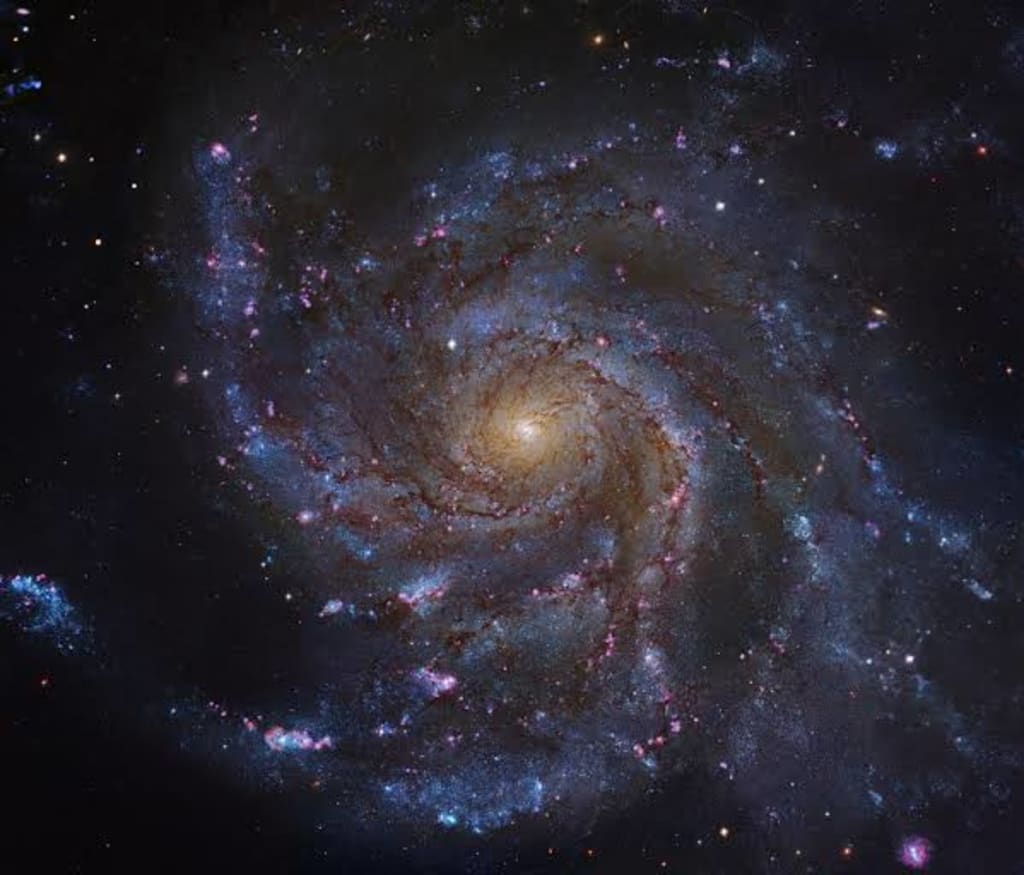
The Pinwheel Galaxy, also known as Messier 101 (M101), is a stunning spiral galaxy located in the constellation Ursa Major. With its intricate structure and remarkable features, it has captivated astronomers and stargazers alike. Here are numerous facts about the Pinwheel Galaxy to delve deeper into its characteristics and significance:
1. Classification and Location:
- The Pinwheel Galaxy is classified as a spiral galaxy of type Sc. This classification indicates that it has loosely-wound, intermediate-arm spirals.
- It is situated approximately 21 million light-years away from Earth, making it relatively close in cosmic terms.
- The galaxy resides within the M101 Group, a galaxy group that includes several other galaxies interacting gravitationally with each other.
2. Apparent Magnitude and Visibility:
- The Pinwheel Galaxy is one of the brightest galaxies visible from Earth. It has an apparent magnitude of 7.86, making it observable to the naked eye under dark sky conditions.
- While it is visible without the aid of telescopes, binoculars or small telescopes enhance the viewing experience and reveal more intricate details.
3. Size and Scale:
- The Pinwheel Galaxy has a substantial size, boasting a diameter of approximately 170,000 light-years.
- To put this into perspective, it is slightly larger than our own Milky Way galaxy, which has an estimated diameter of around 150,000 light-years.
4. Distinctive Spiral Structure:
- One of the most prominent features of the Pinwheel Galaxy is its striking spiral structure, consisting of grand design spiral arms.
- These arms wind out from the central bulge in a manner that resembles a pinwheel or whirlpool, hence its common name.
- The spiral arms are composed of stars, gas, and dust, and they exhibit a sweeping, graceful curvature.
5. Active Star Formation:
- The Pinwheel Galaxy is a hub of active star formation, hosting numerous young, blue stars within its spiral arms.
- These young stars illuminate the galaxy and contribute to its vibrant appearance.
- The Pinwheel Galaxy's regions of active star formation are characterized by H II regions, which are nebulous clouds of ionized hydrogen gas that surround hot, young stars.
- H II regions serve as stellar nurseries, giving birth to new generations of stars.
6. Stellar Population:
- The Pinwheel Galaxy, like many other spiral galaxies, has a diverse stellar population.
- It contains stars of various ages, from young, hot stars in the spiral arms to older, cooler stars in the central bulge.
- The distribution of stellar ages throughout the galaxy provides insights into its evolutionary history.
7. Supernovae Production:
- The Pinwheel Galaxy has been a prolific producer of supernovae, which are massive explosions that occur during the final stages of a star's life.
- At least seven supernovae have been observed within the Pinwheel Galaxy, including SN 1909A, SN 1951H, SN 1956A, SN 1961I, SN 1970G, SN 2011fe, and SN 2014J.
- These cataclysmic events release an immense amount of energy and can briefly outshine entire galaxies.
8. Distance Determination:
- Accurately determining the distance to astronomical objects is crucial for understanding the scale of the universe.
- The distance to the Pinwheel Galaxy was precisely measured using Cepheid variable stars.
- Cepheids are pulsating stars with a known relationship between their period of pulsation and their intrinsic brightness.
- By observing and analyzing the pulsations of Cepheid variables within the Pinwheel Galaxy, astronomers were able to
About the Creator
Enjoyed the story? Support the Creator.
Subscribe for free to receive all their stories in your feed.
Comments
There are no comments for this story
Be the first to respond and start the conversation.