
Physics and the Nature of Reality
Understanding How Nature Works at Its Core
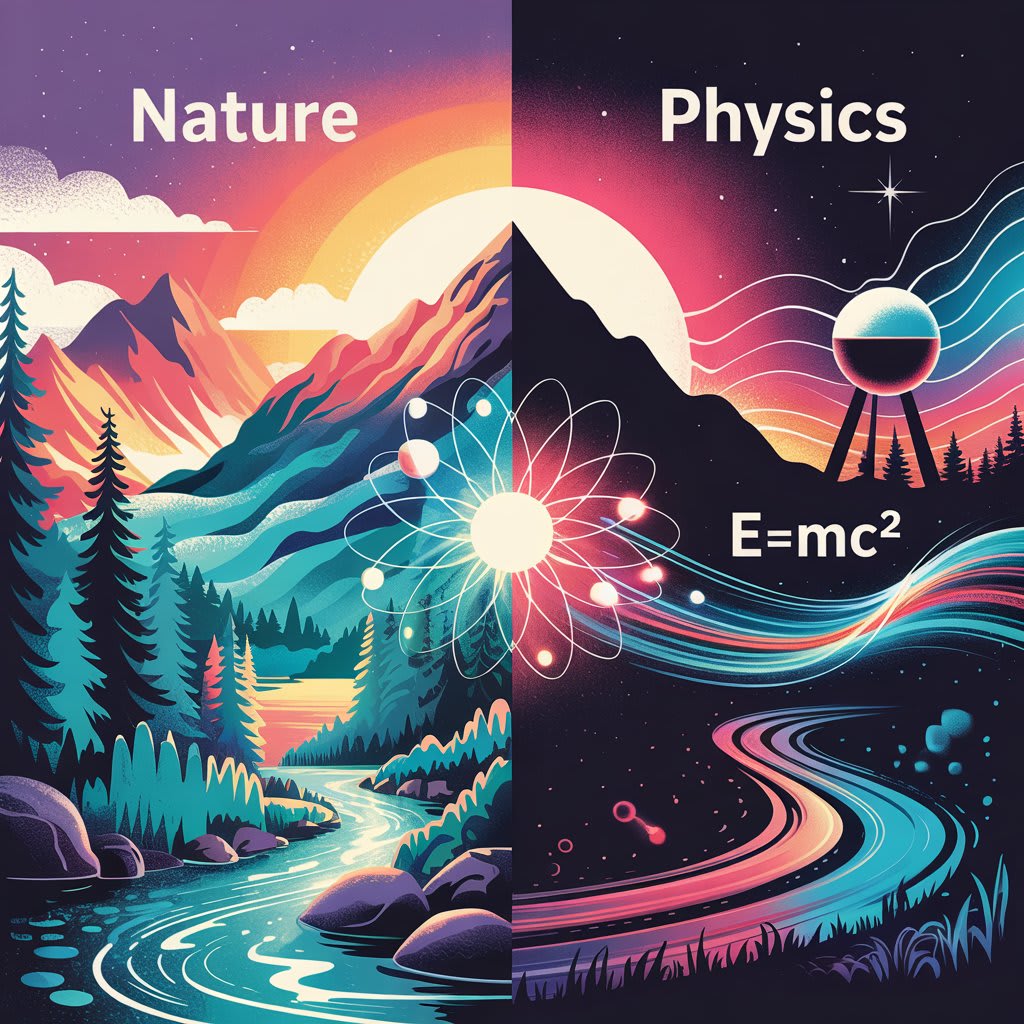
In a quiet mountain village nestled between towering peaks and ancient forests, there lived a boy named Aarav. From a young age, Aarav was captivated by the world around him. He spent hours lying on his back in the fields, watching the clouds shift, wondering what made them move, and why the stars blinked only at night. To the villagers, he was simply a curious child with too many questions, but to Aarav, every question was a doorway to understanding the language of the universe.
One summer evening, as twilight melted into night and the first stars appeared, Aarav sat beside his grandfather, an old man with a mind like a library and a heart full of stories.
“Dada,” Aarav asked, “Why do things fall down and not up? Why does the river always flow down from the mountain?”
His grandfather smiled, stroking his white beard. “You’re asking about the nature of physics, my boy. The rules that the universe follows — silently, invisibly, but always faithfully.”
“Is it like magic?”
“No,” his grandfather chuckled. “It’s more beautiful than magic — it’s truth.”
That night, Aarav couldn’t sleep. His grandfather's words echoed in his mind. The nature of physics... the rules of the universe... He stared at the stars through his tiny window and made a promise to himself — he would uncover those rules. He would read the book that nature had written.
Years passed. Aarav’s questions multiplied, and so did his hunger for answers. He left his village for the city, where he found a world of libraries, laboratories, and minds that pulsed with knowledge. Physics became not just a subject, but a compass that guided his every thought.
In college, Aarav sat through lectures on Newton’s laws, the strange behavior of light, the mysteries of time and space, and the invisible forces that stitched the universe together. He marveled at how a simple equation could describe the arc of a falling apple and also the orbit of the moon. He realized that behind the chaos of nature — the crashing of waves, the flight of birds, the crackle of thunder — there was structure. Logic. Beauty.
But Aarav wasn’t content with learning old discoveries. He wanted to see beyond — to find the questions that had not yet been asked.
One winter, during his final year, he traveled back to his village for the holidays. The air was crisp, and the stars burned brighter than ever. One evening, while walking near the forest, he stumbled upon a cave he had never noticed before. It was half-hidden behind ivy and snow.
Curiosity tugged at him.
Inside, the cave was dark and narrow at first, but it opened up into a wide cavern lit by a shaft of moonlight through a crack above. In the center lay something strange — a smooth, metallic sphere, humming softly. It didn’t belong. It looked... alien.
As he reached out to touch it, the sphere glowed, and suddenly, the cave shimmered away. Aarav found himself floating — not in space, not on Earth — but in a dimension that pulsed with light and motion. Around him, he saw equations dancing like fireflies. Spirals of galaxies, waves of particles, the bending of time. It was as if the universe itself was unveiling its secrets to him.
A calm voice echoed in his mind:
“You seek the laws of the universe. Then witness how they are born.”
He was shown the moment before the Big Bang — pure silence, followed by an explosion of light and energy. He saw particles forming, forces separating, time ticking into existence. He saw gravity pulling stars into galaxies, quantum fields shaping the tiniest sparks of matter, and black holes warping the very fabric of space.
But most of all, he saw something else — the elegance. The patterns. The way everything obeyed a set of principles, no matter how vast or how small. The laws of physics were not written in stone, but in relationships. Motion, force, energy, entropy — all in perfect balance.
When Aarav awoke, he was back in the cave, the sphere now dim. Had it all been a dream? A vision? He couldn’t say. But something inside him had changed.
He returned to the city with renewed purpose. His research became more focused, more daring. He explored ideas that bridged classical physics and quantum theory, searching for a unified understanding. His papers drew attention. His ideas stirred minds. But he never claimed to know all the answers.
He often returned to his village, sitting with young children under the stars, just as he once had.
One child asked, “Why does the moon follow us when we walk?”
Aarav smiled, the same smile his grandfather had given him years ago.
“Because the universe is always walking with you,” he said. “And if you listen closely, it will tell you its secrets.”
Moral:
The nature of physics is not just about formulas or laboratories. It’s the story of existence — told through motion, energy, and time. Those who seek to understand it must learn to see the universe not just with their eyes, but with wonder.
About the Creator
Enjoyed the story? Support the Creator.
Subscribe for free to receive all their stories in your feed.
Comments
There are no comments for this story
Be the first to respond and start the conversation.