

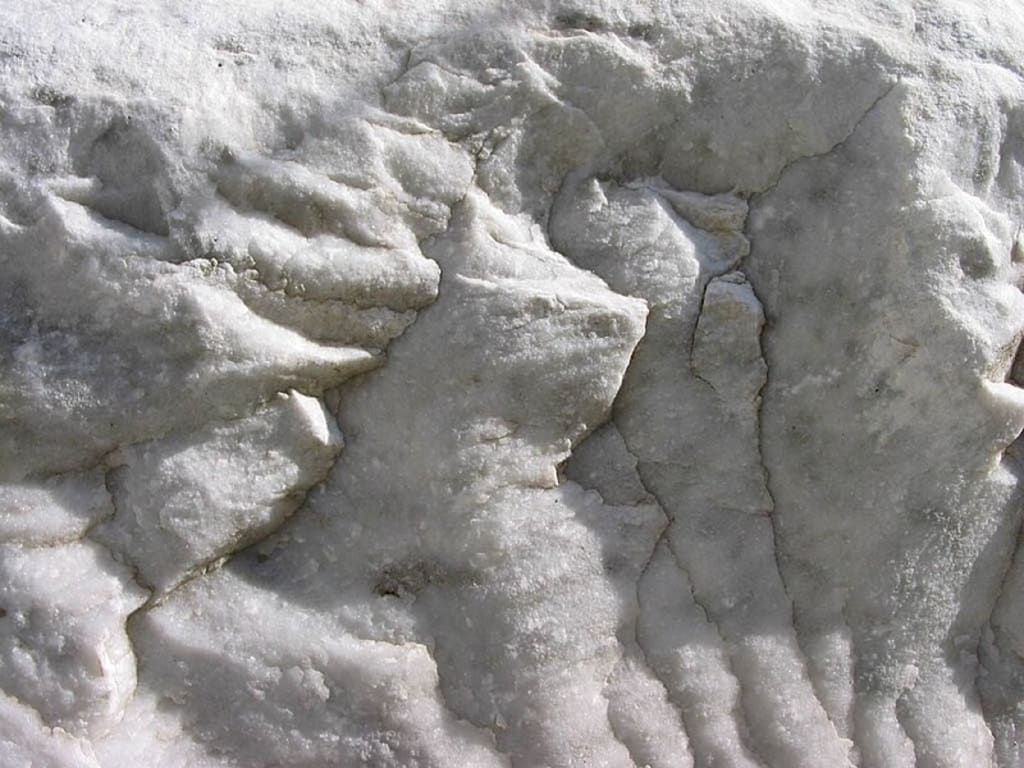
On a pale rock, far, far away from any semblance of civilization, the last being of an age wept tears of blood.
While it stood tall, and awestruck, as it gazed upon the glinting sun which bathed its domain in soft rays of illumination, within the being was turmoil. Only a short time ago it had what could be roughly translated to “a father,” “a mother,” “a wife,” and “a child.” Only a short time ago its world had made relative sense, and was whole—not the last fragment of an imploded ball of ashen stone drifting ever onward into void-like darkness. The being knew it should consider itself lucky, and relish in its deliverance from the destruction of all it had ever known, but it thought only of one thing.
From the amalgamated nothing of schema some thoughts are birthed with the rare mutation of persistence. These thoughts are an infection, one that spreads like boils and scars plump grey matter in a wicked rash. It ricochets within the mind, against walls of fleshy neuronal membrane, until it has spread succinctly and totally. As the being wept, and its infection spread, the thought gained clarity. It was like a word, a phrase, carved for eons by the erosion of water; an ocean's wrath chiseled and sculpted out the infection of hopelessness. The infection of a single ask uttered to the empty night air in a guttural whimper of guilt.
“Why am I here?”
The being received no answer on its lonely, pale rock. Driven by the force of a world caved in, by its earthy matter rippling and flinging continents asunder, the being only drifted ever onward. It drifted long beyond tears, which stained its grey, insectoid face in a sickly discoloring. It drifted towards the light of the sun, which allowed no spec of the being’s solitary island to go unbathed in its spotlight; to it, the blazing fire was a watchful eye ever aware of the being’s unworthiness to continue, and ever judgeful.
As the being coasted its rock, its last semblance of home beyond the scorched clothes on its back and spoilt memories, started to crumble. The force of travel ground against the pale rock like fine sandpaper. Slowly, over the decades, and the centuries of lasting, dreamlike shock, it was reduced to a small column scarcely wider than the being’s own body, and no taller than a small dwelling. On this column the being curled into itself, unable to see the simplest shadows before its eyes, for amidst the stars it had grown older and a glossy haze had long since set in.
The being was tired. Tired of a banishment among the stars; tired of weightlessness, and the pull of the void; and tired of holding on to what could not even be its grave. For longer than it could rightly say the being had held on to its pale rock, had dug its jagged hind legs and palms deep into the grainy mixture of dwelling substance, grime, and debris, and it had started to ask why—why did it persist? Why did it continue in a galaxy absent of anything it could ever know or that could know it back? The being thought on this for so long it might have been considered an obsession were there anything else to do, but there wasn’t. Its mind, while broken, had maintained its cognitive abilities far better than the rest of its dying body had retained their functions over the centuries.
It started with the simplest of explanations: that it persisted because it could not bring itself to do otherwise.
Long lives were the standard of the beings' race. Whatever their near-extinction might have suggested this was a biological fact. More primitive ancestors were studied to have wasted away for decades, and the improvements of life that come with any growing society, alongside the gift of technology and genetic modulation, resulted in this rate growing to untested limits. None could remember the last to be burnt and released to the ocean for none had died in centuries. There were those who were weak, and frail, like a crumbling cocoon that might turn to dust under the slightest pressure, but even they continued in some capacity.
The fact of their long existence had developed an old precedent of slowness. Time was in abundance, as was resources, and so more often than not the being would go slow rather than fast; would stumble on rather than briskly run; and would rather spend seven decades on what is essentially a meaningless hobby rather than venture beyond their front door. This was normal, and it was okay, because there had always been time.
As the being dug even further into the pale rock, and it asked itself why it could not bring itself to die, it reflected on its memories of the world it once knew—it reflected, specifically, on itself. It could not name a single act, or even the slightest moment, of which in its long and slow life the being had contributed anything more than the most idle effect on those it had known. It had done nothing, it had been no one, and it was to die alone. Such a conflict of inaction is one many face and resolve with marked determination, but how could the being do such a thing adrift among only the stars?
So it persisted, it held out, and even swathed in hopelessness it begged for a chance to be more than it had been. It clung to its lonely column out of the slightest chance that it would careen into something and become something itself. That was at least one theory that the being had conjured up. For many ages it had reflected and it had scrutinized, to the point that its spinal spikes had begun to crack, yet it was unsatisfied. Unsatisfied not out of the glaring truth of the life it had not lived, but because that answer, if anything, only demanded that the being should let go and loft without direction—yet the being did not. It held out through pain and exhaustion to the pale rock.
It started upon a more complex explanation only briefly before the column had found itself so far from known planetary fragments that it drifted, at a gradually slower pace, into the kuiper belt. There the swirling, crystalline balls pin-pricked and fractured the column in orbiting swaths of astronomical hail. Already grinded away the column found itself peppered—pulverized to a whittled obelisk the likes of which the being could scarcely kneel upon.
When it had breached the comet field the being continued, ignorant to the pull of celestial bodies that, by some miracle, failed to draw the being into their gassy domain. This theory was much the opposite of the last in an attempt to overcome the pitfalls of the being’s previous attempt in reconciliation. It had begun to wonder if it persisted not because it could not bring itself to do otherwise, but because it was morally wrong to do so. It wondered if there was a nature of justice, and right, woven into the fabric of an atoms swirling—and if in suicide it would violate that justice.
While the beings' race had not suffered ones passing for millennia they were not against death in principle, only in timing. Swaths of the billions who had built cities of crystalline tungsten to fuel their endeavors in lucious tranquility were pruned from existence in under a single day. Those who had once known they—and all those around them—would witness the rising of stars were forced to find words of sorrow, explanation, and love in the final instances before fire overtook them; the being, too, had been forced into this desperation as it raced for its “family” in failure. Yet unlike all the others, unlike the orbiting corpses many millions of miles away, the being had survived. It still had time.
Through fate it suffered a cruel twist of luck. No matter how lonely, how tired, or how old it would be unjust to turn on this luck. It would be wrong to openly accept death prematurely when all others had it thrust upon them through agony. To forsake the pale rock would be to forsake it's inconceivable survival and the gift of perseverance. The being may have aged beyond the function of mobility, and sensory information, but it was far from dead. It might have been testing the limits of biotechnological alterations, genetic modulation, and pristine perfection in bipedal form, but it could likely go ever onward for many more hundreds of years. Even if all that was left was a few neurons firing, grasping at glimpses of wakeful thought, the being would go on. It would do so in place of those who had that choice stolen away.
It stopped caring about itself, and about being something. The being needed to hold on for a far more important reason—to preserve the memories of all those who never got the chance: and it would do just that.
***
As the pale rock and its rider persevered through the cosmos, and both flaked away, they gradually swung from orbit to orbit before becoming a new satellite of a glowing Earth—the year, from a human perspective, was 2087. The being had retreated so far into its own mind its dreams were all that remained. It survived through the faintest of impulses, which relished in a single memory. The memory was of its “wife,” the instance they first ever saw each other, and when all else grew still. Were the being still able to contain other cognitive functions atop its pale rock it would have included the disaster, the fire, the ash, and the poison as a warning to whoever or whatever could crack the cold of its mind and decipher a biological time capsule.
It could not, and so it left for the future its love.
About the Creator
Caleb M Stevens
Hi
My names Caleb, I'm interested in math and virology, and hoping to further develop my writing abilities on Vocal in-between big projects. If you like anything I've written feel free to check out my Ko-Fi below
https://ko-fi.com/cstevens
Enjoyed the story? Support the Creator.
Subscribe for free to receive all their stories in your feed.
Comments
There are no comments for this story
Be the first to respond and start the conversation.