
Berlin, 2025
The air smelled of ozone and snow when Klaus Reinhardt left the black marble building where the Thule Society had its headquarters. The mass rose above the Plaza of Order, with cyclopean columns and golden eagles. At twenty-six, Klaus was one of the youngest initiates in decades: son of an impeccable lineage that traced back to the original founders. A surname that opened doors, no words required.
He walked gloved, his mind drifting far from the symbols that surrounded him. And amid all that cold perfection, he found himself thinking of Maria.
Around him, the city unfolded like a monument to triumph. Skyscrapers shimmered beneath an icy moon; magnetic trains streaked the sky. Screens broadcast the Reich’s news: colonies on Mars, the rise of fusion, celebrations for the eightieth anniversary of the Final Victory.
He passed uniformed workers and children playing beneath the bronze Führer — with his arm forever extended, an eternal salute. In the distance, the Victory Flame burned atop the Volkshalle, visible from every corner of the city, eternal and cold. Ordinary life in the world that had won history’s greatest war.
He found Maria at her usual café beside the Tiergarten. Inside, steam fogged the windows. Maria Hoffmann sat by the glass, fingers around a cup. When she looked up, she barely smiled.
— Hello — Klaus said, leaning in to kiss her.
The touch was fleeting, cold.
— Hello — she replied.
The silence stretched.
— What’s wrong?
— Nothing. Just… problems with my studies.
Maria studied History at the Imperial University, but he’d never seen her so pale.
— You don’t seem worried about an exam.
She smiled, a smile that hurt to see.
— It’s not that.
— Then tell me.
Maria lowered her gaze. Finally she sighed.
— It’s my father. He’s been working on a translation for years, but he’s reached a dead end. He needs an artifact… a metallic disc called Orbis Aeternum.
The phrase floated between them like crystal about to shatter.
Klaus remained motionless. He knew exactly what she was talking about. He’d seen that object that morning in the lower vaults: a blackened disc, engraved with symbols no linguist had managed to decipher. It was said they’d found it in Tibet, in 1938.
— And why does he need it?
— He believes he can understand the symbols.
Klaus didn’t know whether to laugh or worry. She looked at him, and in her green eyes something shone between sadness and fear.
— And you? Do you believe he’s managed to decipher it?
Maria held his gaze a second too long.
— I don’t know. If my father believes he has, I have to support him.
— Tell him to leave it alone — Klaus said — . That object is dangerous.
— Too late. He’s worked on this for over forty years.
Klaus forced a smile.
— Well, accessing the Orbis is impossible. No one accesses the vaults without permission.
— I imagined as much — she murmured, biting her lip.
He observed her in silence. There was tension in her hands. And something in him — a mixture of pride and desire — pushed him to speak before thinking.
— Don’t worry. I can get it.
She raised her head, incredulous.
— Really?
— I can bring it. One night.
— Klaus, that’s madness.
— Trust me.
— I don’t think it’s a good idea. You could get into serious trouble.
— I won’t.
Maria looked at him.
— Why would you take such a big risk?
He smiled.
— Because that’s what people do when they love someone.
Maria’s eyes glistened; Klaus could swear he glimpsed a flicker of tenderness and sorrow before it vanished with a blink.
Klaus took a small box from his coat. Inside, a simple silver ring.
— Not the formal proposal — he said — . That will be with your father. But I wanted you to have it.
Maria looked at the ring. For an instant, Klaus thought she would cry. Then she took it.
— Thank you — she whispered.
When they left the café, snow fell in silence. Klaus took her hand. Maria held it for an instant, then gently withdrew it.
The Thule Society headquarters never slept. In the lower vaults, where artifacts from ancient expeditions were kept, the air smelled of stone and electricity.
Klaus descended by the service elevator. Two guards greeted him with the rigidity of those who know a surname weighs more than an order.
— Quiet night, Herr Reinhardt.
— As always.
The artifact he sought was classified as TB-17. Vault 03.
He slid his card through the reader. The lock emitted a metallic click.
Inside, beneath pale light, rested the Orbis Aeternum.
A blackened metal disc, the size of an open hand. The symbols appeared to shift and ripple if stared at too long.
Klaus approached. The air seemed denser. He extended his hand. It was heavier than he remembered. And warm, as if it breathed.
A chill ran through him. He placed it in his briefcase.
The system automatically registered the exit: Reinhardt, K. — Artifact TB-17 — Purpose: personal research.
No one stopped him. He was a Reinhardt. That was enough.
He drove toward the outskirts. On the radio, a female voice recited:
Eighty years of peace. Eighty years of purity and progress under the New Order.
Klaus turned off the radio.
The journey to Wannsee took less than half an hour. The Hoffmann house appeared among the trees: white stone, sloped roofs, snow-covered gardens.
A maid received him.
— The young lady is outside, by the dock.
He crossed the garden.
Maria sat at the edge of the pier, looking at the frozen lake. Her dark silhouette against the whiteness. She trembled.
— Maria — he called — . What are you doing out here in this cold?
She didn’t turn immediately. When she finally did, her eyes were red.
— I was going to think a bit.
Klaus sat beside her. He wanted to embrace her, but she remained rigid.
— You don’t have to worry — he said, showing the briefcase — . I have it.
She didn’t smile.
— You really did it?
— Yes. No one will know. Tomorrow, I return it.
She nodded.
— Maria! Klaus! — Heinrich Hoffmann’s voice called from the house — . Come in, please. It’s too cold.
The man’s figure stood out in the illuminated doorway: tall, thin, gold-rimmed glasses.
They dined amid courteous phrases and measured silences. Heinrich spoke with irony.
— I’ve read your essay on the symbolism of the Black Sun. Promising for someone so young.
— Thank you, Herr Hoffmann.
— I suppose you believe in those things. Initiates usually do.
— Believing is not understanding — Klaus replied.
Heinrich smiled.
— You should go into politics.
They moved to the library after dinner. High ceilings, dark oak shelves, ancient maps. Fire cast shadows on the walls. It smelled of leather and wood smoke.
Klaus set the briefcase on the desk.
Heinrich opened it with reverent care. His fingers touched the disc.
— Extraordinary — he murmured — . Forty years searching for it. And now it’s here.
Klaus felt a chill.
— What does it say?
Heinrich didn’t respond. He took the disc and carried it toward the light. The symbols seemed to glow under the fire. His hands trembled slightly.
— The opportunity to correct mistakes — he said at last.
— I don’t understand — Klaus replied.
— You don’t have to understand.
Maria appeared in the doorway with a tray. Two glasses of wine.
— To celebrate — she said with a tense voice.
Klaus took his. Heinrich raised his in a silent toast.
— To the future — he said.
Klaus drank. The wine had a bitter, metallic taste.
The world began to spin. The glass fell and broke. The last thing he saw was Maria, standing by the window, crying.
Wolfsschanze — July, 1944
Heinrich Hoffmann walked down the wooden corridor, immaculate and solemn, unaware he was playing with the slow machinery of time. Sweat ran down his neck; the Orbis in his pocket throbbed.
Beyond the door, Hitler spoke of victory. The clock struck twelve thirty-five. Heinrich drew his pistol and thought of his grandfather’s failure — Claus von Stauffenberg. Life for life, he thought.
— For him — he whispered — . For all of us.
The barrel rose, the shot shattered the air. The tyrant fell across the papers, dead, before his guards opened fire.
His last thought was Maria’s face… and the grandson he would never know.
Berlin, 2025
Klaus awoke with stabbing pain in his temples. The library was in shadow.
— Wake up… please…
Maria knelt beside him, face soaked in tears.
— I’m sorry…
Klaus tried to sit up. Dizziness threw him back.
— What happened?
She looked away.
— I had to do it.
Klaus searched for the briefcase.
The artifact wasn’t there.
— Where is the Orbis? — he roared — . Where is your father?
Maria sobbed without answering.
Klaus grabbed her shoulders.
— Tell me! I have to recover that disc! If it’s missing, they’ll execute me for treason!
Maria looked at him with pure sadness.
— I understand.
Klaus stepped back, incredulous.
— Then why?
Her voice was barely a whisper:
— My father needs to avenge his grandfather Claus.
The silence that followed had the weight of a gunshot.
— Claus…?
— Claus von Stauffenberg — Maria added.
The name struck him like a forbidden echo. Von Stauffenberg. The traitor. The man who tried to kill the Führer.
— That’s impossible. He was executed. The attack failed. The Führer survived.
— That’s right — she whispered — . And that’s why we’re here.
Klaus felt the vertigo of an abyss opening beneath his feet.
— What are you saying?
— That my father discovered how to change that day. How to go there.
— Go…? Time travel? — The laugh came out bitter — . That’s madness!
Maria nodded slowly.
— Maybe. But he did it.
— How long was I unconscious?
— Hours.
Maria looked toward the windows. The reflection of the moon on the lake rippled, tremulous.
— He went to 1944 — she said with a broken voice.
Klaus let himself fall into a chair, trembling.
— He’s insane.
— Maybe. But if he’s right, everything will change.
— Everything…?
— Everything.
The thought struck him like thunder. The Reich. Berlin. Himself. Everything he knew could disappear if history was rewritten.
— And you knew? — he whispered — . You used me?
She closed her eyes.
— Yes… but I never truly thought it would work.
Klaus felt the void in his chest. Everything fit: the tenderness, the questions. A plan disguised as love.
— At first it was a mission — she confessed — . But then I fell in love with you.
The silence returned, crueler.
— I’m sorry. I begged him not to. But my father only believes in history. He says millions of lives are worth more than three.
Maria brought her hands to her belly.
Klaus looked at her belly. He understood. They would pay the price of a cruel revenge.
The wall clock struck twelve. And then something changed. The air thickened. The lights flickered.
A crash of thunder shook the house.
Klaus felt the impact in his chest. The air contracted. And everything went white.
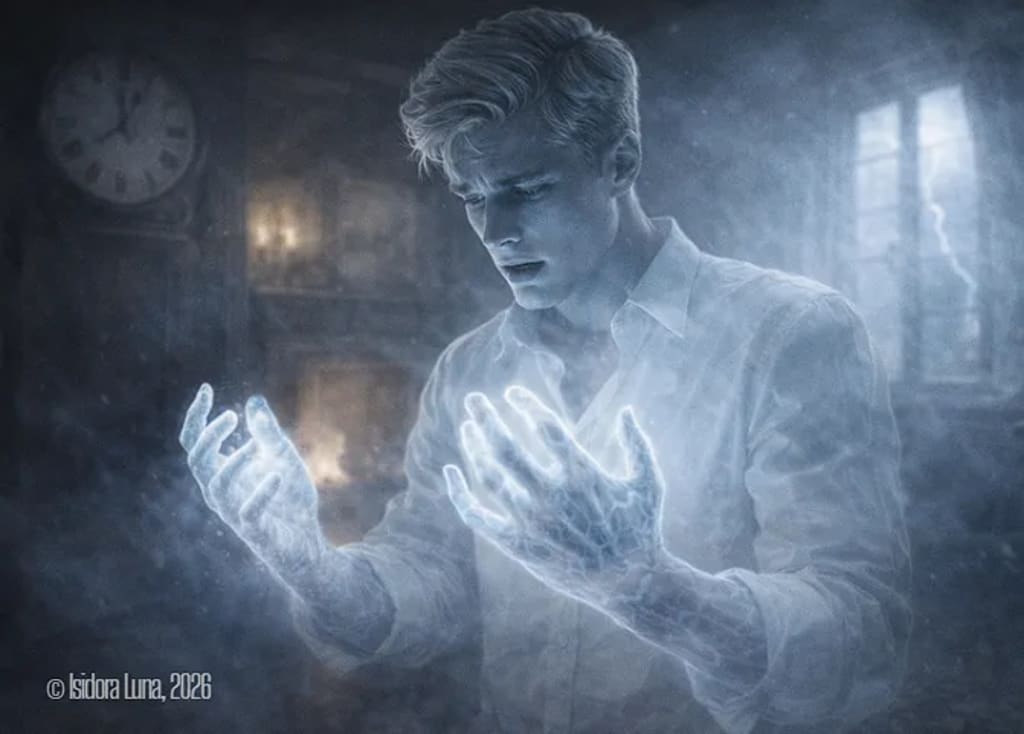
When the light dissipated, Klaus looked at his hands. They were becoming translucent.
— He’s killing us — he gasped.
Maria looked at hers and stifled a sob.
The books began to morph; titles twisted — History of the Global Reich unraveling into The Fall of Nazism. The portrait of the Führer distorted, the paint dripping like black blood upon the ashes of time.
Maria approached — already half-transparent — trembling like a reflection before breaking.
The fire extinguished with a hiss. The air smelled of ozone… and farewell.
Maria placed her hand on Klaus’s face, trembling.
— I love you — she said, crying — . That was real.
Klaus looked at her, understanding there was nothing that could be stopped.
— ... I love you too.
The world crumbled. Only the snow still floated, suspended in silence, timeless.
Maria looked at her hand. The ring was still there, glowing as it became translucent.
She smiled — through sobs — .
— Forgive me.
Maria lunged toward him.
Klaus held her tight.
Everything he’d ever wanted, dying in his arms.
Beneath the roar of time rewriting itself,
their lips sought each other for the last time.
Two footprints trembled on the earth,
one beside the other.
Three hearts fading as one…
And the pain fell asleep.
Only the echo of an eternal kiss remained.
About the Creator
Isidora Luna
Writter & Poet
Enjoyed the story? Support the Creator.
Subscribe for free to receive all their stories in your feed. You could also become a paid subscriber, letting them know you appreciate their work.
Comments
There are no comments for this story
Be the first to respond and start the conversation.