
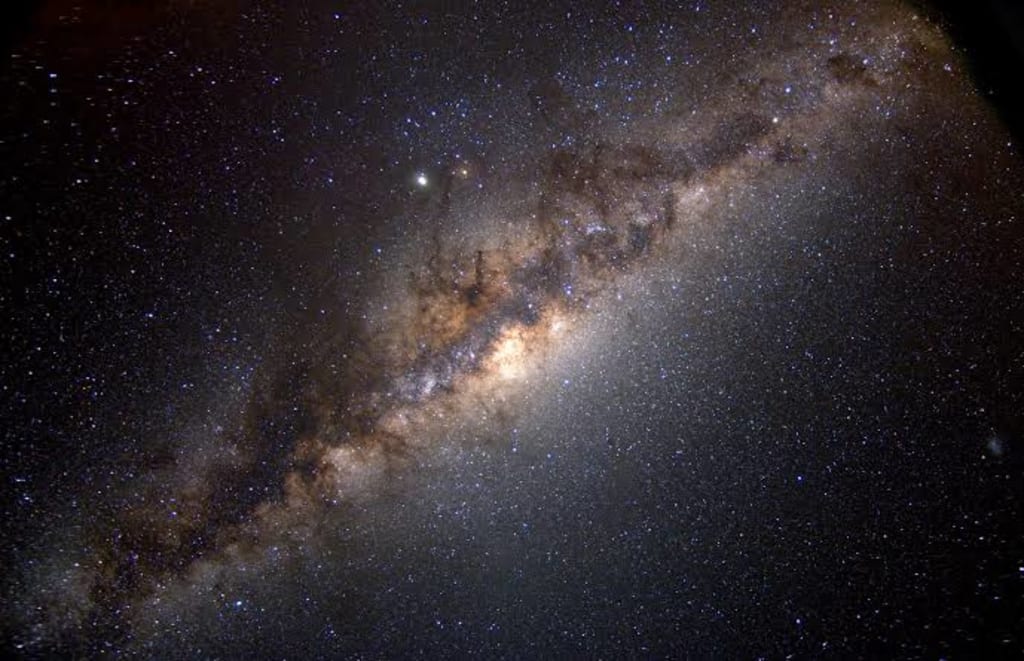
The Milky Way is a barred spiral galaxy, and it is the galaxy in which our solar system resides. It is a vast structure that contains billions of stars, as well as various other celestial objects. Here are some key facts about the Milky Way: 1. Size and Shape: The Milky Way has a diameter of about 100,000 light-years and a thickness of about 1,000 light-years. It has a disk-like structure with a bulge at the center and spiral arms extending outward. 2. Structure: The galaxy consists of multiple components. The central bulge is a dense region of stars and contains a supermassive black hole called Sagittarius A* at its center. Surrounding the bulge is a flat disk composed of stars, gas, and dust. The disk has spiral arms that wrap around it, and these arms are filled with young, bright stars, as well as gas and dust. 3. Stellar Population: The Milky Way is home to billions of stars. The exact number is difficult to determine, but estimates suggest there are anywhere between 100 billion to 400 billion stars in our galaxy. These stars have different ages, sizes, and compositions. 4. Solar System: Our solar system is located within the Milky Way, about 27,000 light-years away from the galactic center. The Sun is situated in one of the spiral arms known as the Orion Arm or Local Spur. It takes the solar system around 225-250 million years to complete one orbit around the galactic center. 5. Galactic Halo: Surrounding the disk of the Milky Way is a spherical region called the galactic halo. The halo contains globular clusters, which are dense clusters of old stars that orbit the galactic center. It also contains dark matter, an invisible substance that exerts gravitational pull on visible matter. 6. Interstellar Medium: The space between stars in the Milky Way is not empty but filled with gas and dust known as the interstellar medium (ISM). The ISM consists of various elements and compounds, including hydrogen, helium, and trace amounts of heavier elements. It is from this interstellar medium that new stars are born. 7. Star Formation: Stars form within dense clouds of gas and dust in the Milky Way. When regions of the ISM become sufficiently dense and gravitationally unstable, they collapse under their own gravity, forming protostars. These protostars go through a series of stages, eventually becoming main-sequence stars like our Sun. 8. Spiral Arms: The Milky Way has multiple spiral arms that wrap around its disk. The exact number and structure of these arms are still a topic of debate among astronomers. The two major arms are called the Perseus Arm and the Scutum-Centaurus Arm. The Sun is located within a smaller arm called the Orion Arm. 9. Galactic Center: At the center of the Milky Way lies the galactic bulge, a densely packed region of stars. Within the bulge, there is a supermassive black hole called Sagittarius A*. This black hole has a mass of about 4 million times that of the Sun and plays a crucial role in the dynamics of the galaxy. 10. Satellite Galaxies: The Milky Way has several smaller satellite galaxies that orbit around it. The largest and most well-known satellite is the Andromeda Galaxy (M31), which is similar in size and structure to the Milky Way. Other satellites include the Magellanic Clouds, the Triangulum Galaxy (M33), and various dwarf galaxies. 11. Dark Matter: Observations indicate that a significant portion of the Milky Way's mass comes from an invisible substance called dark matter. Dark matter does not interact with light and remains undetectable through conventional means. Its presence is inferred
About the Creator
Enjoyed the story? Support the Creator.
Subscribe for free to receive all their stories in your feed.
Comments
There are no comments for this story
Be the first to respond and start the conversation.