
Microbes discovered in "living fossils" provide information on the origins of sophisticated life.
A covert alliance emerges

Some of the earliest living things on Earth were created by microbes, yet most people wouldn't be aware of them. In shallow waters, they form silently and resemble ordinary, dark boulders. For billions of years, these stromatolite formations have shaped life on Earth.
These little societies were at work long before there were plants or animals. They contributed to the oxygenation of Earth's atmosphere. Scientists now believe that they may also help explain how life evolved from simple cells to the complex ones that are present in modern humans, animals, and plants.
A covert alliance emerges
Researchers have discovered something surprising deep within these living formations: two microscopic organisms cooperating in a way that suggests the origins of sophisticated life. It goes beyond simple cohabitation. This amount of cooperation has the potential to alter the trajectory of evolution.
This was not an easy discovery. Years of patient labour, close observation, and a little perseverance were required. However, the results that scientists eventually observed were worth the wait. Through microscopic tube-like structures, they discovered a kind of microbe that was physically attached to a bacterium. Through these links, the creatures were able to share vital resources and support one another's survival.
More than only a birthplace
Professor Brendan Burns, an evolutionary microbiologist at the University of New South Wales (UNSW Sydney), oversaw the study. The group concentrated on stromatolites that are still growing in Shark Bay, a Western Australian protected area.
According to Professor Burns, "stromatolites could be more than just a cradle of life where early microbial life flourished." "They could also explain the origins of complex life." The group discovered a hitherto unidentified microorganism. The ancestors of eukaryotes, the complex cells that comprise all visible life, are believed to be closely related to these species.
Easy yet effective collaboration
Scientists have long held the view that two simpler cells joined forces to generate sophisticated cells. It's possible that one cell swallowed the other, forming a long-lasting alliance rather than digesting it. Eventually, this connection led to the development of mitochondria, the cell's energy-producing organ.
Direct evidence of how this type of collaboration actually appeared in real life was what researchers were missing. Now the gap has begun to narrow. According to Professor Burns, "this could be a little model for how these kinds of partnerships started and ultimately formed eukaryotes."
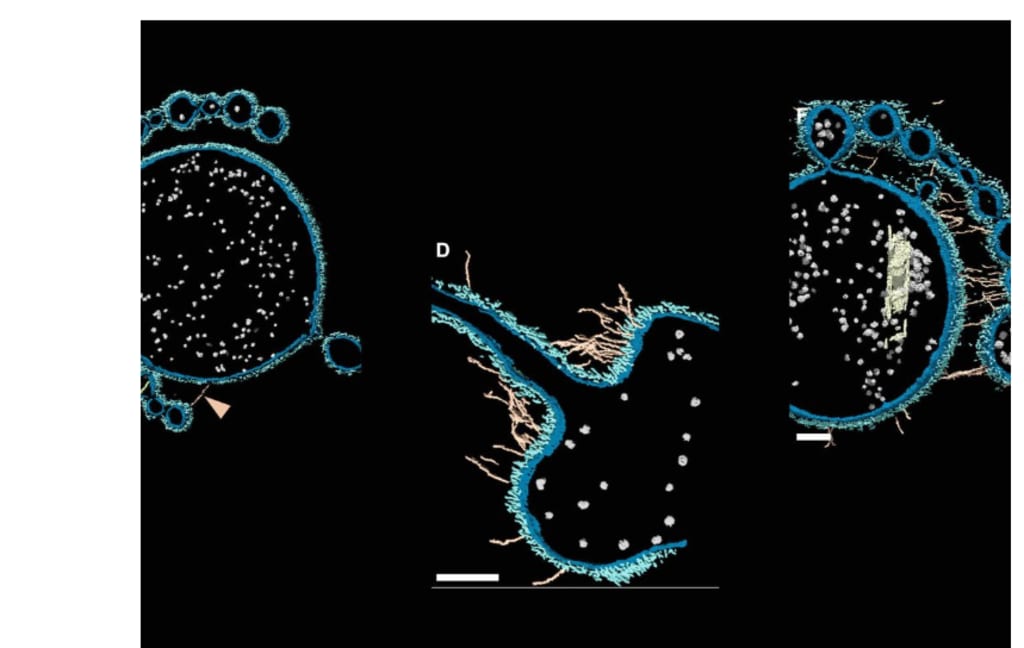
The two microbes are seen in the study's photos to be physically connected and exchanging nutrients like hydrogen and vitamins. Every organism created something that the others required. The system was straightforward but effective.
Trial and error for years
It took some time to get here. According to Professor Burns, "it took four or five years in the lab." "Optimising and chasing various shadows takes a lot of time." There was one particular difficulty. The Asgard archaea could not be grown by the researchers alone.
According to Professor Burns, "the reason we could never get these organisms into pure culture is probably because they always depend on other organisms to survive." That reliance could be crucial. It implies that collaboration benefits more than just these microorganisms. It might be necessary.
From simple microorganisms to complex life
Electron cryotomography, a potent imaging technique, was the breakthrough. This method produces intricate three-dimensional pictures at a minuscule scale—a millionth of a millimetre.
Scientists were able to observe the intricate relationships between the bacteria through this lens. They also noticed intricate tube networks that extended from the archaeon and little structures that resembled bubbles.
These characteristics might influence how the organisms exchange information and distribute resources. The University of Melbourne's Professor Debnath Ghosal emphasised the importance of the study.
According to Professor Ghosal, "this discovery brings us a few steps closer towards understanding how complex cells evolved from relatively simpler microbial life forms."
An in-depth examination of ancient biology
The investigation went beyond imaging. To further understand what's going on inside these bacteria, researchers also looked to sophisticated computation.
Professor Katharine A. Mitchie explained, "We used this to predict the structures of proteins in these microbes." "And that's exciting because we can begin to observe early forms of the cellular machinery that subsequently became essential to complex life."
These results imply that some of the fundamental components of contemporary cells were already developing billions of years ago, concealed behind these microscopic alliances.
Professor Iain Duggin of the University of Technology Sydney, a living link to the past, considered the wider picture. "It's as though we have gradually risen from the ocean floor,"
It's not only a poetic notion. It is directly related to the evidence. These microorganisms may be an early stage in the development of all complex life because they coexist in hostile settings and depend on one another.
Nerearchaeum marumarumayae is the name given to the recently found archaeon. The name, which means "ancient home," combines a phrase from the Malgana language with a reference to an ancient Greek sea god. The local Indigenous groups, whose ties to the land date back about 30,000 years, were closely consulted during the naming process.
Cooperation advanced life.
The study highlights a straightforward concept with significant ramifications. Isolation did not lead to progress in life. Through collaboration, it progressed.
This is exciting in part because it involves connection rather than just finding. Not only over a long period of time, but also during a period when human activities and climate change pose increasing dangers to these delicate ecosystems, according to Professor Burns.
"Those microbes serve as a reminder that our history can be profoundly impacted by even the smallest partners." The lesson seems obvious. Collaboration can influence the future in ways that will persist for billions of years, even on the smallest scale.
About the Creator
Enjoyed the story? Support the Creator.
Subscribe for free to receive all their stories in your feed.
Comments
There are no comments for this story
Be the first to respond and start the conversation.