
Lost and Found
A desperate escape from a suburban nightmare

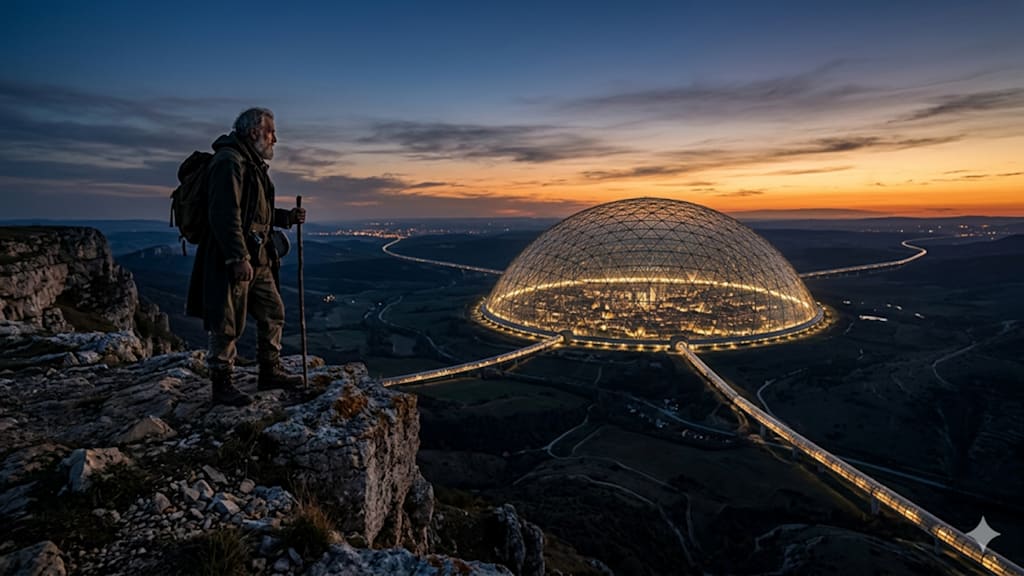
This story is an AI recreation of a recurring dream I had many years ago. I am not a writer so I asked AI to turn my original 1500 words I wrote down into a short story - I think it captured it very well. The Image is also generated by AI. I hope you enjoy the story - it certainly surfaces strong emotions for me as I relive the dream in my head.
***
The subdivision was quiet that morning, the kind of quiet that makes you stop and notice it. Mimi and I had only been married a short time, and everything still felt new - the house, the neighborhood, even the way the word home felt when I said it.
We were taking our time on a walk around the block, no particular reason, just the kind of thing you do when you're still getting used to a place. The house had a large picture window across the front, and from the right angle on the street you could see straight through to the mountain range sitting out on the horizon. We'd stop and look at it every time we passed, like we still couldn't believe it was ours.
That's when the siren went off.
At first neither of us moved. The siren was the kind you hear tested on the first Wednesday of the month, distant and routine. But this wasn't a Wednesday, and it didn't stop.
Within minutes the street was alive with noise. Military vehicles moved through the subdivision with a purpose that didn't leave much room for questions. Soldiers fanned out between the houses, organized and efficient, like they had done this before. Neighbors were being gathered in the street, some confused, some compliant, some trying to back away only to find there was nowhere to go. Each one, once contained, was administered something - a quick shot in the arm, no explanation given, no option to decline.
We watched from the corner of the yard, pressed close together, neither of us saying what we were both thinking. They were working their way toward us.
Mimi looked at me. I looked at her.
Run.
We didn't say it out loud. We didn't have to. We broke for the side of the house, heading for the back, heading for open ground, heading for the mountains sitting out there on the horizon that had looked so peaceful not twenty minutes ago.
We almost made it.
A soldier came around the corner of the house just as Mimi reached it. She was grabbed before she could turn. I stopped, every instinct pulling me back toward her.
"Run!" she yelled. "Go!"
I ran.
Every step away from her felt wrong, like running against a current. But her voice was still in my ears and my legs kept moving. I cleared the back of the subdivision and hit open ground, the mountain range ahead of me growing slowly larger with each stride.
I wasn't alone. Others had broken free in the chaos, scattered at first, then gradually pulling together the way people do when they realize the person next to them is running the same direction for the same reason. Nobody stopped to introduce themselves. We just ran.
When we finally put enough distance between us and the town to catch our breath, we slowed to a walk and started talking. It came out in fragments, everyone sharing the piece they had.
One man said he'd heard there was a breach - multiple military installations across the country hit at the same time. Another woman, still breathing hard, said she'd overheard a soldier on a radio mentioning tagging. Not vaccinating. Tagging.
Nobody knew what that meant exactly. Nobody wanted to think too hard about it.
The mountains were closer now, the tree line at their base dark and cool looking against the afternoon sun. We kept moving toward it, because it was the only direction that made any sense.
Behind us, the town was still making noise.
* * *
With night coming on faster than any of us had anticipated, the urgency shifted from running to surviving the dark. The temperature was already dropping and nobody had thought to grab so much as a jacket. We had left with nothing but the clothes on our backs and whatever happened to be in our pockets.
Someone spotted it first - a flat clear area about two thirds of the way up the mountainside, catching the last of the evening light. A plateau. From where we stood it looked wide enough to spread out on and the rock face behind it suggested shelter of some kind. It was a hard climb in fading light but nobody complained. Complaining felt like something that belonged to the morning we'd left behind.
When we pulled ourselves up onto the plateau the collective exhale said everything. It was better than it had looked from below. The flat area was generous, ringed on three sides by natural rock that would break the wind, and set into the mountain behind it was a cave - not deep, but deep enough. Dry inside, wide enough for all of us to get out of the elements.
From the edge of the plateau you could see the entire town spread out below, lights coming on in the dusk like nothing had happened. Like it was any other evening.
It wasn't any other evening. We all knew that. But for the moment we had high ground, a roof of sorts, and each other.
We made camp and nobody slept much that first night, each of us alone with whatever we'd left behind down there in those lights.
Morning came gray and cold and hungry. Whatever adrenaline had carried us through the previous day had long since burned off, replaced by the kind of practical reality that doesn't care about your circumstances. We needed food. We needed water. We needed to figure out what came next.
We split up without much debate, each person or small pair heading in a direction that felt promising. Nobody wandered back toward town. That was the one unspoken rule.
By midday the plateau looked like a different place. Those who had pushed further along the base of the mountain had found abandoned farms, gardens still producing, untended but generous. They came back with arms full - tomatoes, carrots, potatoes, a head of cabbage. Others had located a stream not far into the tree line, cold and clear, and had found blankets and pillows in an unlocked farmhouse along with soap and a few other small comforts that felt like luxuries now. A couple of the men came back quiet and purposeful, a brace of rabbits and two squirrels between them, already cleaned.
Nobody said much while we worked together to get a fire going and get food on it. But something had shifted. The night before we had been strangers thrown together by fear. Around that fire, with the smell of something cooking and the town still visible below us, we were becoming something else.
Not a family. Not yet. But something pointed in that direction.
We ate well that first night. It felt almost like defiance.
* * *
The days settled into a rhythm that none of us had planned but all of us needed. Morning brought chores - water, food, firewood, watching. Always watching. The town below never fully quieted and we took turns at the edge of the plateau with whatever we could find to see further, a pair of binoculars someone had grabbed on instinct, a spotting scope pulled from an abandoned hunting cabin two ridges over.
Weeks passed. The seasons began their slow turn.
Then the construction started.
At first it was just increased activity at the edges of town. Heavy equipment we couldn't quite identify, materials arriving in convoys that came in but never seemed to leave. We watched it the way you watch weather moving in from a distance, knowing something is coming, not yet knowing what.
Then the shape of it began to reveal itself.
They were building a dome.
Not a building, not a wall - a dome over the entire town. The scale of it was difficult to process at first. We would watch for hours and argue about what we were seeing, none of us wanting to be the first to say out loud what it obviously was. When we finally said it the word just hung there in the mountain air.
A dome.
They worked around the clock, lights blazing through the night, the sound of construction drifting up to us on the wind. It was relentless and it was fast, the kind of project that only happens when someone with enormous resources has decided that speed matters more than anything else.
Within a month the shape was unmistakable. A great curved structure arcing over everything we had known, sealing it off from the sky, from the mountains, from us. And as the dome neared completion something else began to take shape - tubes extending outward from the dome in multiple directions, reaching toward the horizon like spokes on a wheel.
We climbed down to get a closer look, careful, staying to the tree line and the shadows. The tubes were massive up close, large enough to walk through, constructed with the same dark purposeful materials as the dome itself. Through gaps in the outer shell we could make out a rail system running the length of each tube, two lanes, coming and going.
Transportation. Between domes. Which meant ours wasn't the only one.
We stood there at the tree line looking at each other and nobody said a word. We didn't need to. If there were other domes, this wasn't a local emergency. This wasn't a breach at a couple of facilities.
This was everything. All of it. Everywhere.
We climbed back up to the plateau as the sun went down and the dome below us glowed faintly from within, like a small captured sky.
* * *
Years have a way of blending into each other when the world you knew no longer exists. Seasons became our calendar. The group had thinned some over time, a few had gone back early on looking for family and never returned, others had drifted away in ones and twos over the years, headed somewhere else or nowhere in particular. Those of us who remained had become something close to family by necessity and by choice. We knew each other the way people only know each other when there is nowhere else to go and nothing left to pretend about.
But I never stopped watching the dome.
Every morning, coffee from whatever we had managed to source, and my eyes down the mountain. Looking for a seam, a gap, a moment of carelessness. Looking for a way in. Looking, if I was honest with myself, for her.
Mimi had been down there for years now. I had grown old on this mountain. My hair had gone long and gray, my beard the same, my hands rougher than they had ever been in the life I used to have. I wondered sometimes if she had changed as much as I had. I wondered if she still thought about me or if the years and whatever life had become inside that dome had softened the edges of the memory.
I wondered if I would recognize her.
I wondered if she would recognize me.
Then one morning, working my way along the base of the dome where a tube connected to the outer shell, I found it. A panel, slightly proud of its neighbors, the fasteners along one edge no longer flush. Years of thermal expansion and contraction had worked it loose, barely, just enough.
My heart was hammering before my brain had fully caught up.
I didn't touch it. Not yet. I stood there looking at it for a long moment, memorizing its exact location, then walked back to the tree line like nothing had happened.
That night around the fire I described what I had found. The reaction was immediate. Two of the group were on their feet before I had finished the sentence, already talking about tools, already thinking about the abandoned farm down the valley. By morning they were back with hammers, pry bars, and a come-along that someone had found hanging on a nail in the barn, dusty but sound.
We spent the day making a plan. Every angle, every contingency, every what-if we could think of. Then we waited for dark.
The walk down from the plateau that night felt different from every other walk I had made down that mountain. Lighter somehow, and heavier at the same time. The others felt it too. Nobody talked much. The dome glowed ahead of us in the darkness, and somewhere inside it, if the years had been kind, was my wife.
We reached the panel just after midnight.
Working in the dark, by feel as much as by sight, we set the come-along and started applying pressure. The panel groaned once, low and metallic, and we all froze. Nothing. We kept working. Pry bars found the edge, hammers tapped careful and quiet, and slowly, the way a door opens that has been stuck for a very long time, the panel began to give.
When it finally let go the sound seemed enormous in the night air. We held our breath and listened.
Silence.
From there the neighboring panels came more willingly, each one easier than the last, until the opening was wide enough. I looked at the others. They looked at me.
I went first.
Inside the tube the rail system hummed faintly with whatever energy fed it, a low vibration you felt more than heard. I crouched and moved carefully through the terminal area at the tube's end, scanning for any sign of movement, any camera, any sensor we hadn't accounted for. Nothing triggered. Nothing moved.
I leaned back to the opening and waved the others through.
One by one they came. When the last one was in we stood together in the dim interior light and looked out into the dome for the first time.
It was like stepping into another world.
Overhead railways crisscrossed the interior in graceful arcs, pods gliding silently along them carrying passengers to destinations we couldn't yet imagine. The buildings were enormous cubes, every one of them dark gray with a texture like weathered barn board, uniform and strange and oddly beautiful in their own severe way. Between them open common areas spread out, gathering places where people moved and talked and lived their lives under a sky that wasn't a sky.
We stood there with our mouths open like children.
Then we heard voices just around the corner.
* * *
We pressed against the wall and listened. Two voices, casual, unhurried, the kind of conversation people have when they have nowhere particular to be. We looked at each other and made a silent agreement. There was no going back through that panel and pretending we hadn't come this far.
We stepped around the corner.
Two residents stopped mid sentence. A man and a woman, older, well kept in the way that people are when life has been structured and predictable. They looked at us the way you look at something your brain can't immediately file anywhere. Their eyes moved across our weathered faces, our worn clothing, our long road written plainly on every inch of us.
The woman took a half step back. The man put his arm out instinctively in front of her.
"We're not here to cause any trouble," I said, and I meant it with everything I had.
The sound of my voice seemed to break whatever spell had frozen them. They exchanged a look, one of those looks that long familiarity produces, an entire conversation in a glance. Something passed between them and the fear in their faces shifted, not disappearing entirely but moving aside to make room for something else.
Curiosity.
"You're from outside," the man said. It wasn't a question.
"We are," I said. "We've been out there since the beginning. Since the day they built this."
The woman's hand went to her mouth. The man straightened slowly, processing it.
"All this time?" he said quietly. "You've been alive out there all this time?"
"All this time," I said.
They looked at each other again. Then the man turned back to me with a decision already made behind his eyes.
"Come with us," he said. "There are people you need to meet."
We followed them through the common area, staying close, keeping our heads down. The pods moved silently overhead and the residents of the dome went about their lives around us, and I was struck by how normal it all looked from the inside. People talking, children moving between buildings, the ordinary texture of daily life carried on beneath an artificial sky.
The two residents led us to a low building set slightly apart from the others, and through a plain door into a small meeting room. Around a table sat five older men, deep in conversation, papers spread between them. They looked up as we entered.
Our guide leaned down and spoke quietly into the ear of the man at the head of the table. The man listened without expression, then turned and looked at me with steady unhurried eyes that had seen a great deal and learned not to react quickly to any of it.
He studied me for a long moment.
Then a slow sound, somewhere between a breath and a word.
"Hmm."
He straightened in his chair and gestured toward the empty seats across the table.
"Come," he said. "Sit."
We sat. And I began to talk.
I told them everything. The morning of the sirens, the run, the mountain, the years of watching from the plateau above their dome while they lived their lives inside it. I told them about the farms and the hunting and the winters that almost broke us. I told them about the panel and the come-along and the walk down the mountain in the dark.
When I finished the room was quiet for a long moment.
"You've been living outside," the elder said slowly, like he was testing the weight of each word. "All of you. For all these years."
"Yes," I said.
He looked at the others around the table and something moved through the room that I couldn't quite name. Disbelief edging toward wonder.
"That should not be possible," he said carefully. "What they told us..." He paused, choosing his words. "We were told the air outside was toxic. That a catastrophe at multiple locations had made survival outside the domes impossible. That anyone who had not been tagged and brought inside in time was..." He stopped.
"Was gone," I finished for him.
"Yes," he said quietly.
I leaned forward.
"We are not gone," I said. "We are right here. And the air outside is clean. It always was."
The silence that followed was the kind that changes things.
After a moment the elder nodded slowly, as if something long held was finally being set down.
"We will need to have you examined," he said. "To confirm your health. You understand."
"We understand," I said. "But when that's done I need something from you."
He waited.
"I need to find my wife," I said. "She was taken the morning all of this started. She's been inside this dome for years and I need to find her."
The elder looked at me for a long moment, something shifting quietly behind his eyes.
"Tell me about her," he said.
* * *
I described her the way you describe someone who lives in every corner of your memory. Her eyes first, because that's what you remember when everything else fades. Then her voice, her laugh, the way she carried herself. I mentioned the tattoo, small and particular, the kind of detail that can't be mistaken. And I told them what she did, that she was a therapist, that she had a deep knowledge of alternative medicine and aromatherapy that she had spent years developing, that healing people was not just her profession but her nature.
The elders listened without interrupting. When I finished the man at the head of the table was quiet for a moment, and then something changed in his expression. A recognition, slow and certain, like a lamp coming on in a dark room.
He looked at the others around the table.
They were all looking back at him with the same expression.
"We know her," he said.
The words hit me like a physical thing. My hands found the edge of the table.
"She is known to us as a healer," he continued. "What you call therapy, what she practices with plants and scent and the kind of listening that most people are not capable of - here she is considered something rare. Something valuable." He paused. "She is well. She is respected. She has built a life on the far side of the dome."
I could not speak for a moment.
"Can you take me to her?" I finally managed.
"We can try," he said. "But understand - the far side of her neighborhood is one of the safest and most closely watched areas in the dome. Everyone knows everyone there. Strangers are noticed immediately. And the police carry scanners that detect untagged citizens." He looked at me steadily. "If a scanner finds you, you will not get a second chance."
"I understand," I said. "I've waited years. I can be careful for one more day."
He studied me for a long moment, then nodded once.
"We will help you," he said. "But we do this carefully. We do this smart."
The plan came together over the next few hours. Word was passed quietly through channels the elders trusted, reaching people in her neighborhood who could be counted on. Watchers would be positioned along our route, eyes on the police patrols, signals ready if anything moved the wrong way. Local residents would walk close around us during the busiest part of the afternoon, a moving crowd to confuse the scanners, bodies enough to bury our untagged signatures in the noise.
We would have one window. One chance.
We set out in the early afternoon, the elders having provided us with clothing that wouldn't announce us as outsiders from twenty yards away. Clean, plain, nothing remarkable. I had trimmed my beard as best I could with borrowed scissors, though the gray and the years were not so easily dealt with.
Moving through the dome was like walking through a dream I hadn't known I was having. The pods overhead, the great curved sky above the buildings, the sounds of ordinary life echoing off surfaces that had no business existing. I kept my eyes forward and my breathing steady and tried not to think about what a scanner alarm would sound like.
Our watchers were good. Twice a subtle signal reached us and we drifted naturally into a doorway or lingered at the edge of a common area while a police unit passed, scanners sweeping, finding nothing worth stopping for.
Then we were at the edge of her neighborhood.
It was quieter here, more settled, the buildings a little less uniform as if individuality had managed to assert itself in small ways over the years. Gardens in window boxes. A mural on one wall, soft colors and careful lines. People who smiled at neighbors by name.
And they knew us before we knew them.
Word travels faster than feet in a close community, and by the time we turned onto her street faces were appearing in doorways, people stepping out onto the common walk, a low murmur moving ahead of us like a bow wave.
An older woman stepped forward from the small gathering crowd, her eyes moving over me with an expression I couldn't quite read.
"Do you know Mimi?" she asked.
"She's my wife," I said.
The gasp that moved through the crowd was a single sound from many mouths. Then the questions started, overlapping, unstoppable - how long, really outside, all those years, how did you survive, what is it like out there.
I answered what I could but I was barely hearing them.
Because someone was pointing.
Her door was plain and well kept, a small pot of something green and fragrant beside it - of course there was, that was so entirely her that my chest ached with it. I walked to it through the parting crowd, my heart doing something it hadn't done in years, and I raised my hand and knocked.
The sound of footsteps inside.
A pause at the door, the particular hesitation of someone wondering who could be calling at this hour.
Then the door opened.
For a moment neither of us moved. The years collapsed. All of them, every hard cold morning on that mountain, every night watching the dome glow in the dark, every moment of doubt and grief and stubborn refusal to stop believing - all of it folded up and disappeared in the space between one breath and the next.
Her eyes found mine.
Mine found hers.
And every single thing we had ever been to each other came flooding back in an instant, unstoppable and enormous, and neither one of us could hold it.
We didn't try.
The tears came before the words, before anything, and we reached for each other the way people reach for something they were certain they had lost forever. The crowd behind us had gone quiet, and then someone started clapping, and someone else joined them, and the sound grew until it filled the whole street and bounced off the dome above us and rang out like something that had been waiting a very long time to be heard.
We didn't hear any of it.
We were already behind the door.
About the Creator
BLGardner
An old guy with some vivid, sometimes recurring dreams. I'm more a thinker and tinkerer but I do enjoy writing down my thoughts, dreams and daydreams. I hope you enjoy what's in my head!
Enjoyed the story? Support the Creator.
Subscribe for free to receive all their stories in your feed.
Comments
There are no comments for this story
Be the first to respond and start the conversation.