
Last Call Home
Can you change the past?

All night, Andrew had dreamt of his childhood home. The dream version wasn’t accurate, of course; there’d been more rooms than there should have been, or ever could have been, in the modest terrace house, and his bedroom window had offered views far more panoramic than the messy back gardens of the suburban enclave where he’d been born. But in every dream he’d felt safe and worry-free. It was as if the dream had been tucked around him like a soft blanket, cocooning him from reality and all the grief and misery that came with it.
But now he was fully awake. He wouldn’t go back to sleep. The morning jitters had started; the twitching legs; the overactive mind, racing with every negative possibility the day could hold, and his heart beating so loudly, the sound filled his head like someone pounding on a door.
He sighed and threw back the duvet, sitting on the side of the bed for a few seconds, waiting for the dizziness to pass, before heading to the kitchen.
He wondered why his old home had filled his dreams all night. He hadn’t really thought about it in years. He did a quick calculation in his head: he’d left when he was 18, moving to a squat in Camden Town, and now he was 63.
“Jesus,” he whispered, “Forty-five years.”
His parents had moved to Devon a few years after his departure. His mother was still there, although she was now in a care facility
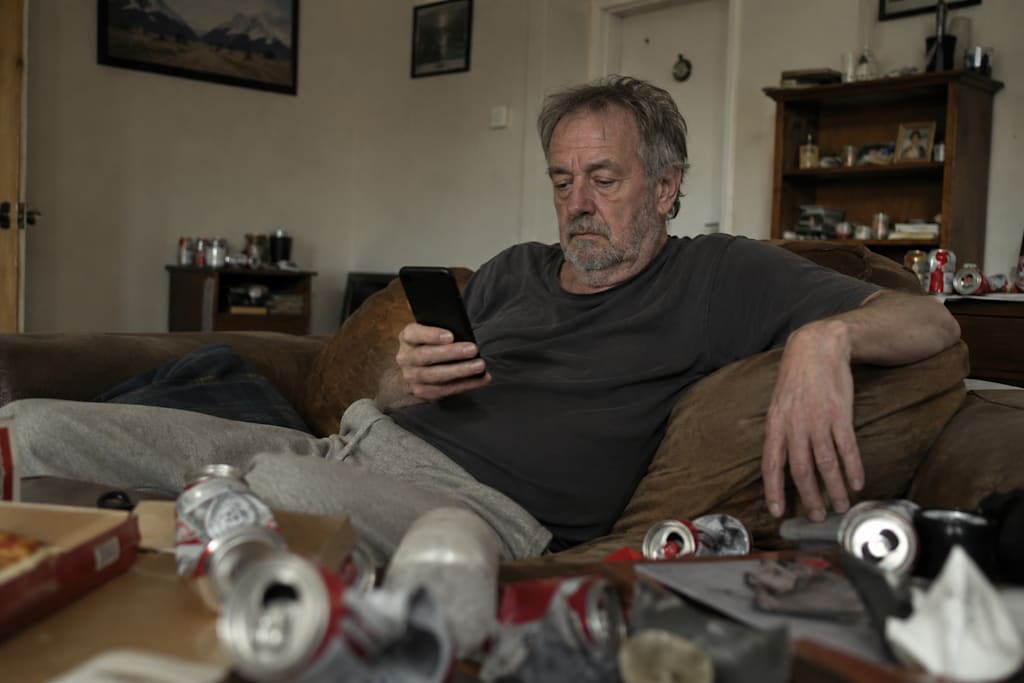
He sat on the sofa in his poky living-room, mug of coffee cradled in his hands.
“Ickrington 30391.”
That had been the phone number of his childhood home. Fancy him remembering that. But, of course, in those days, you didn’t just say ‘hello’ or ‘hia’ when you picked up the phone; you always said the number, so it was ingrained in his brain.
He searched the clutter of the living room for his mobile phone. It hadn’t been on the bedside table this morning, so he’d obviously left it here somewhere after his tenth can of lager. There it was, tucked between two sofa cushions, three crushed cans lying next to it.
He murmured the number to himself again. How weird would it be to call it now and know that he was making a phone ring in his old childhood home. It would be like making a connection after all these years.
He plucked his phone from between the cushions. It only had 14% battery, but it wasn’t like he was planning a long chat. The people who owned the house now probably didn’t even have a landline, and if they did, they may have changed the number.
He had to Google the dialling code for his old hometown, which wasn’t tattooed into his mind, as he’d never had to say it. Armed with all the digits he needed, Andrew stared at his mobile for a few seconds.
Do it, he encouraged himself. Just let it ring a couple of times. Imagine the sound carrying through the house, to each room. It will be like saying ‘hello’.
Andrew dialled the number.
He’d expected to be greeted with the ‘not in service’ automated message, but instead, he heard the dialling tone. He let it ring twice, picturing the hallways, the sitting room and dining room, his old bedroom, then went to end the call. Someone answered.
“Ickrington 30391, hello.’
Andrew made a dry croaking sound.
‘Hello?’ said the person on the other end of the crackling line.
It sounded like a boy, and the voice was familiar. And how unusual for a young person to actually say the phone number rather than just blurting out a one-word greeting. How unusual for a young person to even know what a landline was!
‘Who’s this?’ Andrew asked, wondering why he hadn’t already ended the call.
‘It’s Andrew, ‘ said the boy. ‘Who’s this?’
Andrew ended the call.
*
It was me, thought Andrew, staring into space and still clutching his phone.
Impossible as it was, he had just spoken to his younger self via a phone that probably hadn’t existed for forty-something years.
After around half an hour, Andrew stood on aching legs and went to the kitchen to make a mug of tea. He needed to do something normal. By the time his tea had brewed and he was back on the sofa, he’d stopped questioning the reality of the situation and started to consider the possibilities offered by a hotline to his, what, twelve, maybe thirteen, year-old self. The voice on the other end of the phone hadn’t broken completely, but it had had the texture of one that was getting close to puberty.
Andrew began to ponder where his life had started to go so badly wrong. Was there a terrible decision he could warn his younger self not to make, a situation to avoid at all costs, that would change where he was now — halfway down a steep downhill slide to complete self-destruction?
He’d need to be quick but assertive. Too much preamble and Andrew junior would hang up before he could issue any warning; but he also needed to sound genuine and authoritative so that the boy he’d been would take him seriously and remember the call when the time came to act on it.
The biggest bad decision he’d ever made had been Julie, his wife of five years. They’d met in college; Andrew had been studying motor mechanics, and Julie had been on a secretarial course. They’d both been sixteen when their eyes had locked across a crowded canteen. The collision of gazes had been brief, before Julie had pointedly looked away and whispered something to the friend sitting at the table next to her. Both girls had started giggling, which had irritated Andrew.
A few weeks later they’d met at a house party. Andrew couldn’t even remember whose party it had been. He hadn’t even planned to go, but his best mate of the time, Geoff, had convinced him it would be the best night of his life.
Julie had been in the front garden puffing on a cigarette when Andrew had slipped out of the house, planning to make an escape and head home.
‘You off?’ she’d asked through a cloud of smoke.
They’d gone back into the party together and ended up snogging for a solid two hours. They’d dated for a few weeks, but then Julie had dumped him for Trevor Brewer, a real sporty type. The way she’d finished with him so easily should have been a warning sign, but six years later when they’d met at a New Year’s Eve party at the Crown and Sceptre in Islington, they’d ended up dating again, and this time it had led to a marriage, with Alex his son following very shortly afterwards. Those whispering at the wedding that Julie was carrying a bit of extra weight around the middle weren’t wrong.
So, what would he tell his younger self if he made another call home? Never make eye contact with Julie Drinkwater; don’t snog Julie Drinkwater at a party when you’re sixteen; never date Julie Drinkwater and certainly don’t marry her. Just when you think life is okay, she’ll tell you she’s seeing Ron Bailey from work and that she’s leaving you and taking your five-year-old son with her.
Bitch! Thought Andrew.
But without Julie, there’d be no Alex, who Andrew still loved more than anyone in the world, even though they hadn’t spoken in three years. The rift had been totally Andrew’s doing. At his lowest ebb, following yet another toxic relationship breakdown, he’d turned up at Alex’s home asking to borrow money. Andrew had said it was to pay his heating bill, but Alex had known it was for booze. Andrew still felt sick at the memory of standing on Alex’s doorstep, swaying from side-to-side, slurring his pitiful words. Alex had told him to stay away until he’d sorted his life out. He didn’t want his kids to see their grandfather in this state.
So, if he couldn’t swerve the marriage to Julie, was there another significant decision that had led to his current situation? There’d been so many unhealthy relationships, most with fellow addicts, it was hard to pick.
Melanie had been the first serious relationship after Julie. He’d met her in The Queen’s Arms, which seemed to attract deadbeats like him. He and Melanie had got chatting at the bar, shared a few bottles of wine while slagging off their respective exes, before ending up at his studio flat for drunken sex.
That relationship had lasted about a year, before Melanie had left him for another pub regular, sending him into his first major downward spiral since the breakup with Julie. Should he warn his younger self to avoid that particular pub so that he and Melanie would never meet? Could she have been the trigger that made his toxic love affair with booze the default whenever he broke up with someone?
But then he wouldn’t meet Ben. Ben was one of the few regulars at The Queen’s Arms who drank in moderation. He was intelligent and thoughtful. He’d also been there for Andrew through all the lows of the past thirty-something years. Without Ben to pick him up and help him get sober for a few months at least, Andrew probably wouldn’t be here. They hadn’t spoken in a few weeks. Maybe he should call him today, suggest a healthy walk or something equally virtuous. Despite the empty beer cans, Andrew had been moderating his drinking to an extent for the past two months. Maybe today could be that day when he really started to change.
His thoughts returned to significant downfall decisions. Of course, there was the night he’d ended up in A&E after 24 hours of binge drinking and cocaine. He didn’t normally indulge in drugs, but that night — he’d been forty-three at the time — a stranger he’d latched onto for the evening had offered him a line and that had led to several more lines. The cocaine coupled with the copious amounts of booze had led to a minor heart attack. He’d woken up in a hospital bed on a drip with a nurse standing over him.
‘I could warn young me not to go out that night or to say no to class A drugs at all costs.’
But it was in the hospital that he’d met Jake, a young lad of 18 who was already halfway down his slippery slope. He’d been admitted to hospital with severe malnutrition and dehydration after two weeks of almost non-stop drinking. They’d spoken a lot over the days they were sharing the same ward. Andrew had asked Jake if he really wanted to end up like him.
Something had obviously got through to the lad, because the next time Andrew heard from him, he’d been clean for six months. ‘No offence, Mate,’ he’d said, ‘But seeing you in that state was the wake-up call I needed.’
Jake had gone on to have a family and hold down a job as a brickie. Last Andrew had heard, he was doing well. If he warned his younger self not to take cocaine that night, what would happen to Jake? Did he really want that on his conscience?
Andrew made himself another cup of tea. While the kettle was boiling, he cleared away the scattered cans. He stared for a moment at the half-empty bottle of Jameson's on the kitchen counter, then tipped the remainder of the amber liquid down the sink. It was a start.
He took the tea back through to the living room and sat staring at his phone. He took a deep breath and dialled.
‘Hello?’ The familiar voice caused tears to well.
‘Hello, Alex,’ said Andrew. ‘It’s Dad.’
About the Creator
Matthew Batham
My stories have been published in numerous magazines and on websites in both the UK and the US. My novels and short story collection, Terrifying Tales to Read on a Dark Night, are available on Amazon. I also love horror movies.
Enjoyed the story? Support the Creator.
Subscribe for free to receive all their stories in your feed. You could also become a paid subscriber, letting them know you appreciate their work.
Comments
There are no comments for this story
Be the first to respond and start the conversation.