
Last Call at St. Jude’s
Forgiveness at the End of the Line
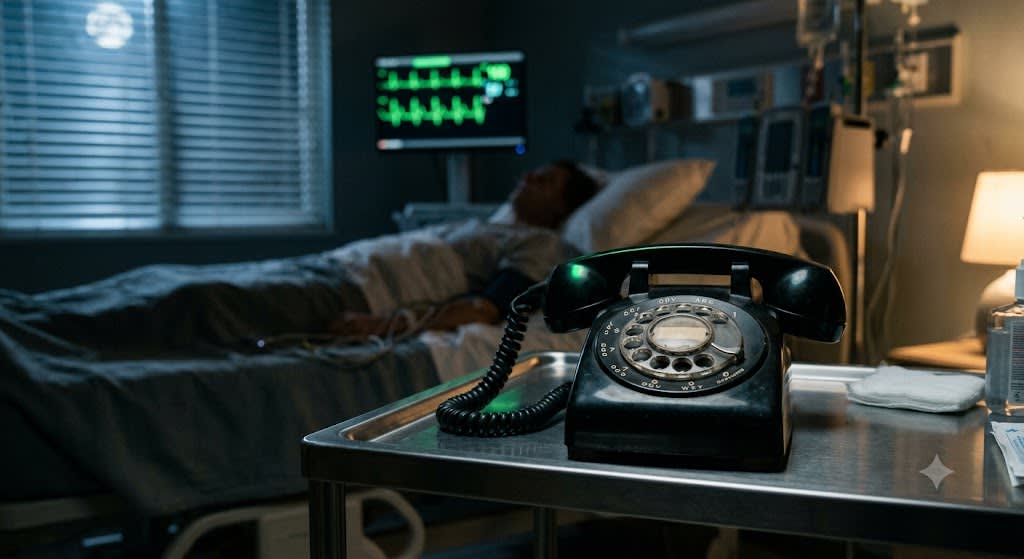
Three-fourteen in the morning is a heavy hour at St. Jude’s Hospice. It is the hour when the world outside is dead to the living, and the world inside hangs delicately by a thread.
Nora knew the sound of a fading thread. After twelve years on the night shift, she could hear it in the rhythm of a patient's breathing, in the sudden stillness of a restless sleeper, and in the quiet, metallic hum of the monitors shifting their tempo.
Tonight, the shifting tempo belonged to Arthur Vance in Room 4.
Dr. Evans stepped out of the room, letting the heavy wooden door click shut behind him. He looked at Nora, his eyes ringed with the permanent fatigue that came with their line of work, and gave a single, solemn nod.
"An hour," Dr. Evans murmured, sliding his stethoscope into his pocket. "Maybe two, if his heart decides to be stubborn. But his pressure is dropping fast."
"I'll get the cart," Nora said softly.
In palliative care, the phrase "last call" doesn't mean the bar is closing or a flight is boarding. It means exactly what it sounds like. It is a tradition at St. Jude’s, an unwritten protocol initiated only when the invisible sand in the hourglass has almost entirely run out.
Nora walked down the sterile, fluorescent-lit corridor to the supply closet. She bypassed the extra linens and the IV bags, reaching instead for a small, rolling metal cart. Sitting atop it was a heavy, antique black rotary telephone. It was plugged into a long, coiled extension cord that snaked along the baseboards of the ward.
It wasn't magical, but it was sacred. It was the designated lifeline to the outside world, reserved for the final words a person would ever speak.
Nora wheeled the cart into Room 4. The only illumination came from the amber glow of the streetlamp filtering through the blinds and the harsh, green light of the heart monitor.
Arthur lay propped against a mountain of pillows. He was eighty-two, his skin the color of old parchment, drawn tight over sharp cheekbones. His breathing was shallow, a ragged rattle at the back of his throat. But his eyes—pale blue and clear—flicked toward Nora as she parked the cart beside his bed.
"Is it time, Nora?" his voice was a dry whisper, like leaves scraping across concrete.
"It's time, Arthur," she replied gently, adjusting his blanket. "Your heart is getting tired. We’re going to make you as comfortable as possible."
Arthur looked at the heavy black telephone sitting on the metal cart. He knew what it was. Nora had explained it to him three days ago when he was admitted. One call, she had told him. To anyone, anywhere. We make sure it goes through.
"I don't know if I can," Arthur whispered, a tremor passing through his frail body.
"You don't have to," Nora said, pouring a small cup of water and swabbing his dry lips. "But it's the last call, Arthur. If there's something left unsaid, the clock is running out."
Arthur closed his eyes. Behind his eyelids, the ghosts of his pride were fighting a bitter war with his regrets. Fifteen years. He hadn't spoken to his son, Leo, in fifteen years. It had started over something infinitesimally small—a heated argument over the sale of the family hardware store after Arthur’s wife died. Words were weaponized. Doors were slammed. Silence had followed, calcifying into a wall so thick that neither man knew how to break it.
"What if he doesn't answer?" Arthur asked, a single tear escaping the corner of his eye and tracing the deep lines of his face. "It's three in the morning."
"People answer this phone," Nora said firmly. Over the years, she had witnessed the impossible phenomenon of the hospice line. Whether it was intuition, the jarring ring of a midnight call, or some universal tether connecting a dying soul to the living, they always answered.
"What if he hangs up?" Arthur’s chest heaved, his heart monitor beeping in a frantic, irregular rhythm. Panic was setting in—not of death, but of rejection on the threshold of it. "I was cruel, Nora. I was a cruel, stubborn old man. He has no reason to forgive me. It might be better to just... slip away. Let him remember the silence."
Nora leaned over the bed rails, bringing her face level with his. She didn't offer empty platitudes. She offered the candor he needed.
"If you don't pick up that receiver, Arthur, you guarantee the silence," Nora said, her voice a steady anchor in the room. "You are out of time for hesitation. You can let your pride take you into the dark, or you can spend your last ounce of breath trying to fix it. But you have to choose right now."
The heart monitor gave a long, concerning trill. Beep. Beep..... Beep. His pulse was fading.
Arthur looked at the ceiling, drawing in a jagged, painful breath. He had spent his entire life waiting for tomorrow to make things right. Tomorrow to apologize. Tomorrow to call.
There were no more tomorrows.
With a groan that seemed to echo from the hollows of his bones, Arthur lifted his right arm. It trembled violently, a frail branch caught in a gale. Nora quickly guided his hand to the cold, heavy bakelite receiver.
Arthur pulled it to his ear. With his left hand, fighting the lethargy pulling him toward sleep, he extended a single, arthritic index finger. He placed it in the rotary dial.
He didn't need to look up the number. It had been burned into his memory for a decade and a half.
Click-shhh-click. The mechanical whir of the rotary dial spinning back into place felt louder than thunder in the quiet room. Click-shhh-click. Click-shhh-click.
With every digit, Arthur’s breathing grew shallower. The effort was draining the last reserves of his battery. Nora watched the monitor, the green line flattening out, dipping precariously low. Hold on, she prayed silently. Just hold on.
He finished dialing. The phone rang.
One ring. Two.
Arthur’s eyes squeezed shut in agony. He’s not going to answer. I waited too long.
On the third ring, a sharp click echoed through the receiver, followed by the groggy, confused voice of a man in his forties.
"Hello?"
Arthur’s mouth opened, but only a dry rasp came out. The monitor beeped, a slow, mournful sound.
"Hello? Who is this?" Leo’s voice was laced with the sudden anxiety of a middle-of-the-night phone call.
"Leo," Arthur choked out. The word required everything he had left.
Silence hung on the line. A heavy, suffocating silence that stretched across state lines and fifteen years of bitter stubbornness.
"...Dad?" Leo’s voice cracked instantly, the sleep evaporating.
"I'm sorry," Arthur wept, his grip on the receiver slipping. Nora stepped in, placing her hand over his to hold the heavy plastic to his ear. "I'm so sorry, Leo. I was a fool. I am out of time, my boy. But I couldn't go without telling you... I love you."
The green line on the monitor fluttered, skipped a beat, and dropped.
From the receiver, Nora could hear the unmistakable sound of a grown man breaking down. "Dad. Dad, are you there? Don't go, please. It's okay. I forgive you. I love you too, Dad. I love you."
A profound peace washed over Arthur’s tortured face. The deep creases on his forehead smoothed out. The panicked tightness in his chest released. He let out one long, final exhale.
The heart monitor flatlined, emitting a steady, uninterrupted tone.
Arthur’s hand went limp. Nora gently took the receiver from his fingers. She lifted it to her own ear.
"Leo?" she said softly.
"Is he...?"
"He's gone," Nora replied. "But he heard you. He heard every word."
A ragged sob echoed through the line, but beneath the grief, there was the unmistakable lightness of closure. They stayed on the line for a moment together—two strangers connected by the quiet aftermath of a salvaged bond.
"Thank you," Leo finally whispered.
"Take care, Leo," Nora said, and gently placed the receiver back onto the cradle with a soft click.
She reached over and turned off the blaring alarm of the heart monitor. Silence returned to Room 4, but it was no longer a heavy, suffocating silence. It was the quiet of a settled debt.
Nora noted the time of death on the chart at the end of the bed: 3:28 AM. She pulled the sheet over Arthur’s shoulders, gave his cold hand a final, brief squeeze, and gripped the handle of the rolling metal cart.
As she wheeled the heavy, black telephone back into the fluorescent-lit hallway, Nora couldn't help but smile slightly. Sometimes, people missed their flights. Sometimes, the bar closed before they got their drink.
But tonight, the last call was answered.
About the Creator
Enjoyed the story? Support the Creator.
Subscribe for free to receive all their stories in your feed.
Comments
There are no comments for this story
Be the first to respond and start the conversation.