
Last Call
Based on a true story however some of the characters are fictionalized


“LAST CALL!” is the toughest call. It means the bar is closing and you have just enough time to get one more drink.
This forces you to do math with a brain now devoid of access to its hippocampus, the source of its good decision-making powers.
Will one more drink give me what I’m looking for, or will it guarantee I’m unfit to drive home immediately after?
I looked at the bottles glowing behind the bartender.
Bourbon. Vodka. Tequila. Gin.
Old friends.
If you have the kind of friends who help you hide a body and then testify against you.
Ten days ago, I would have raised my hand.
Tonight, I keep them wrapped around my seltzer and lime.
I had been out of rehab for approximately twenty-four hours.
I hadn’t gone because I thought I had a drinking problem. The State thought I had a drinking problem. Apparently, getting two DUIs in less than three years qualifies you for their loyalty program.
Their recommendation was simple:
Stop drinking.
Who are they to tell me what to do, and when did society hand over my autonomy without my express permission?
I had been drinking for decades. Why should I suddenly stop because a judge, several police officers, my family, and my attorney suggested it?
But the State had developed a compelling argument called the Green Roof Inn. Their smug term for the county jail. One night there was sufficient for me, and I’m never going back.
So I went to recovery.
I arrived convinced I was different from everyone there.
For starters, I wasn’t an addict.
Sure, I drank every day.
Sure, I occasionally drove afterward.
Sure, “occasionally” had resulted in two arrests.
But I could quit whenever I wanted.
I simply had never wanted to.
Then I met the other residents.
They looked terrifying.
Neck tattoos. Scars. Missing teeth. Men who looked like they had spent portions of their lives solving disagreements with tire irons while also trading “favors” for a speck of opioid dust.
Then, out of the corner of my eye, I saw a guy sitting quietly reading a Bible.
And it was a really nice Bible.
Across the room, a woman was reading one too.
This was not what I expected to see.
These people were supposed to be degenerates.
I was supposed to be the normal one.
Within a few days, I began to suspect I had misunderstood the casting.
Recovery consists of classes on multiple addiction-management-related subjects.
My first class was meditation.
The instructor looked like a hippie and a meth addict had a love child.
Then she told us her life story.
It turned out that was exactly how she came into existence.
She had survived addiction, abuse, violence, and enough misery to make my problems feel embarrassingly suburban.
“Breathe in for four,” she said.
I crossed my arms.
“Hold for two.”
Fine.
“Out for six.”
Whatever.
We did it again.
And again.
Then something happened.
My hands tingled.
My chest loosened.
A vibration moved through my body.
I opened one eye.
Nobody else seemed concerned.
What kind of black magic is this?
I kept breathing.
Afterward, she read us a poem she had written.
It wasn’t particularly good.
This somehow made it better.
She was going to perform it at a poetry slam.
She was willing to expose herself to strangers and show them her deepest inner monologue.
Très brave.
I hadn’t written anything meaningful in years.
I ran back to my room and grabbed the pink notebook they had given me at intake.
Pink was not my choice.
Neither was rehab.
Neither, for that matter, was having two young nurses inspect every portion of my naked body before admitting me.
Dignity was apparently contraband.
I started writing.
And then I couldn’t stop.
Stories.
Poems.
Jokes.
Observations.
Ideas that had been floating around in my head for twenty years but that I had apparently been drowning every evening.
The next class was about the nervous system.
I learned about the vagus nerve and how breathing could actually affect the body.
There was science behind the buzzing.
This delighted me because I preferred neuroscience to a séance.
The doctor teaching the class was condescending enough that I chuckled at the irony. Here was a recovering alcoholic who was going to teach me why I drink, yet his personality made me want one. His teaching style was definitely immersive, as he would be the only one to trigger my desire during my stay.
But the material fascinated me.
The science scienced.
The vagal system was a real thing. An electronic network of nerves that made up the superhighway inside our body from head to toe. It was the premise of Mary Shelley’s book Frankenstein. Mine was so triggered all the time that I had become my own version of Frankenstein’s monster.
Meditation and breathing told my vagus nerve that I could chill and nothing would get me. And after ten minutes, it would relax, and calm thinking and the body’s rhythms could flow unobstructed by the overriding sensations of fight, flight, or fawn.
Then came therapy.
The thing I always considered but never pursued. Everyone else’s problems seemed more urgent than my own mental maintenance.
My therapist was a young Black woman with exactly the right combination of kindness and intolerance for my bullshit.
I told her about my marriage.
My affair.
My drinking.
My anger.
My excuses.
She listened.
Then she performed an irritating maneuver therapists call “making you take responsibility.”
I explained all the reasons I had done what I did.
She explained that reasons were not absolution.
My choices were my responsibility, and I needed to start making intentional ones.
Somehow, this task of living intentionally felt heavier than the burdens of everyone else’s needs I’d spent a lifetime carrying.
She reminded me that self-care isn’t selfish. It’s putting the mask on yourself first so you can help others.
She also read my writing.
“You wrote all of this in the few days you’ve been here?” she asked.
“Yes.”
“That’s not normal.”
This is not typically what you want to hear from your therapist.
“I wrote short stories and poems in college, but they took me a lot longer, and they weren’t this good,” she added.
“Is there something wrong with me, Doc?”
“You might be a genius?”
Genius? Me? That felt generous. But she has the degree, so… maybe?
I had suspected I might be smart when I was still in school and could ace every test with little to no effort while only half paying attention. But few people, including my parents and teachers, had the self-confidence to substantiate it.
Either I talked too much in class when I was bored, or I participated in class discussions to excess. I had skimmed the entirety of Romeo and Juliet the night before, and I couldn’t resist correcting my teacher when he said Mercutio was Romeo’s cousin.
“Actually… Mercutio was his friend, and Benvolio was his blood relative.”
He asked me to leave the classroom.
Ironically, my brain was not often welcomed even in school.
So I tried turning it off.
But now my mind was filled with all these thoughts, and I no longer had my preferred means of quieting them. They started spilling out onto paper.
Within the confines of my forced hiatus, an inner voice emerged. One I hadn’t heard in some time.
I started paying attention to my thoughts instead of immediately trying to change the channel.
Then something stranger happened.
I stopped hearing the voices of all the critics in my life that I couldn’t do enough to satisfy.
Then I started liking the person I was. Even the scared and disappointed child who still existed inside me. The one who lacked the parental attention it deserved.
I would parent it from now on.
All of a sudden, the terrifying tattooed men weren’t terrifying.
Sometimes they were funny, and other times I watched them weep over the love of their life who left them without explaining why—though likely because of their self-destructive choices.
And the women weren’t disasters.
They were wounded and smart and infuriating and kind and sometimes terrifying, like when all of them synced up on their menstrual cycles at the same time.
That’s when it started feeling like high school again.
Everybody had a story.
Everybody had lost something.
Everybody had hurt somebody.
Everybody had been hurt.
Strip away the drugs and alcohol and tattoos and criminal records, and underneath all of it, we seemed to be variations of the same brilliantly creative, sensitive, frightened animal asking the same question:
Does anybody understand me?
For the first time in years, my answer was yes.
I understood them.
And they understood me.
Soon they started coming to me for advice.
That was unexpected.
My marriage was collapsing. My children had heard things about me that made me wonder whether I had failed them completely. I had spent years believing I was becoming useless.
But these people trusted me.
They called me positive.
They treated me like a leader.
One person even called me wise, which demonstrated how desperately this facility needed additional funding.
The days developed a rhythm.
Meditation.
Classes.
Therapy.
AA meetings.
Art.
Music.
Movies.
Food.
Drama.
So much food and so much drama.
I started to love our band of misfit toys.
And somewhere during those ten days, without realizing it, I stopped counting the hours until I could drink again.
I had already had my last call.
Graduation frightened me more than admission had.
Inside those walls, sobriety was easy.
There was no alcohol.
There were counselors everywhere.
There were meetings every day.
There was always someone ten feet away who understood exactly what it felt like to want to crawl out of your own brain.
Outside, there was all the rope I wanted to hang myself with.
Freedom had always been where I got into trouble.
Twenty-four hours after leaving, I decided to conduct an experiment.
It was an idiotic experiment.
I now possessed the delusional confidence of a man who had won recovery in ten days.
I walked into the bar where I had been drinking the night of my DUI.
I wanted to prove I could sit there without drinking.
Same stools.
Same bottles.
Same smell.
Same bartender.
Different me.
At least, that was the hypothesis.
I ordered something without alcohol and looked around.
That was when I saw the flyer.
COMEDY OPEN MIC — TONIGHT.
The day before leaving recovery, I had told another resident that I had always wanted to try stand-up.
“Then do it,” he’d said.
“I’m too old to start.”
He stared at me.
“It is never too late to begin,” he said.
“Maybe.”
And now, twenty-four hours later, I was standing in the exact bar where life most recently slapped me down, staring at an opportunity.
I told myself I would only watch.
Then I met the comics.
They heard I had just gotten out of rehab.
They heard I had gotten my DUI after leaving this very bar.
Their eyes lit up.
“You have to go up.”
“No.”
“You absolutely have to go up.”
“I don’t have jokes.”
“You have a story!”
Apparently, this counted.
They put my name on the list.
My heart started pounding.
This was a different nervous-system response.
I considered breathing.
I considered leaving.
I considered drinking.
Just one.
Take the edge off.
The old solution arrived so naturally that it frightened me.
For ten days, I had been protected from this moment.
Now nobody was stopping me.
No counselor.
No judge.
No breathalyzer.
No locked doors.
I could order a drink.
I could have one in my hand in thirty seconds.
Nobody would know.
“LAST CALL!”
The bartender stood beneath the glowing bottles.
For a moment, everything seemed to stop.
Last call.
I thought about the jail cell.
My daughter.
The pink notebook.
The breathing.
My therapist.
The tattooed kid reading his Bible.
The misfit toys.
All those people trying desperately to become somebody they could live with.
I had spent years thinking freedom meant nobody telling me what to do.
Maybe I had it backward.
Maybe freedom was being able to tell myself what to do.
The bartender looked at me.
“You want anything?”
I did.
“No.”
He nodded and moved on.
From across the room, someone shouted my name.
“You’re up!”
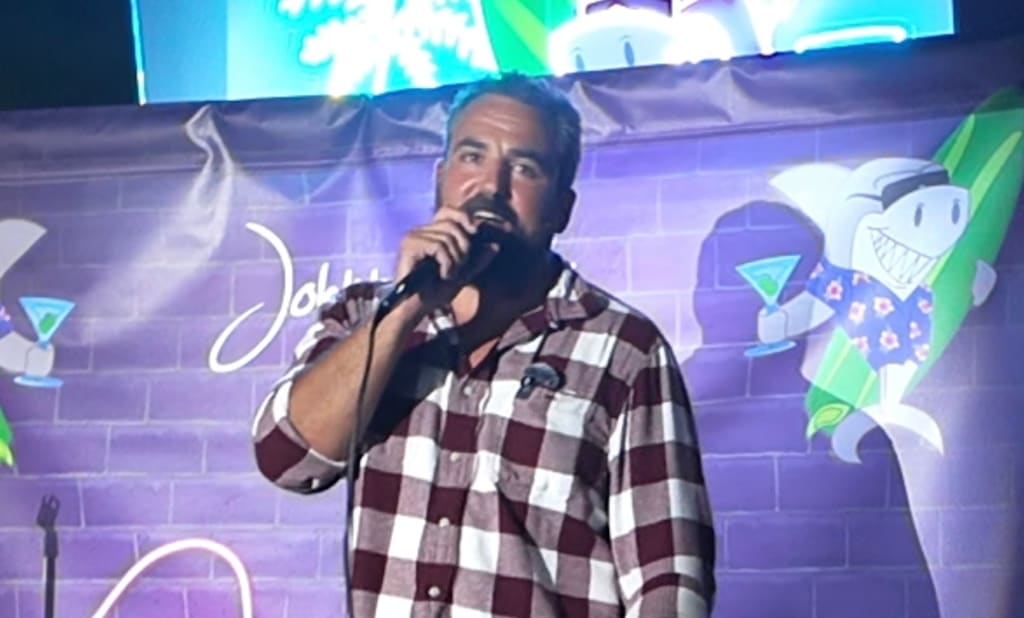
I walked toward the microphone.
My legs were shaking.
I grabbed the stand.
A dozen strangers stared at me.
I took a breath.
Four seconds in.
Hold for two.
Six seconds out.
My hands stopped shaking.
About the Creator
Jesse Lee
Jesse Lee is a comedian and writer that investigates ordinary experiences until they reveal extraordinary truths about being human.
socials:
Enjoyed the story? Support the Creator.
Subscribe for free to receive all their stories in your feed. You could also become a paid subscriber, letting them know you appreciate their work.
Comments
There are no comments for this story
Be the first to respond and start the conversation.