
Kindness of the Kokopelli
A little boy learns the benefits of being kind

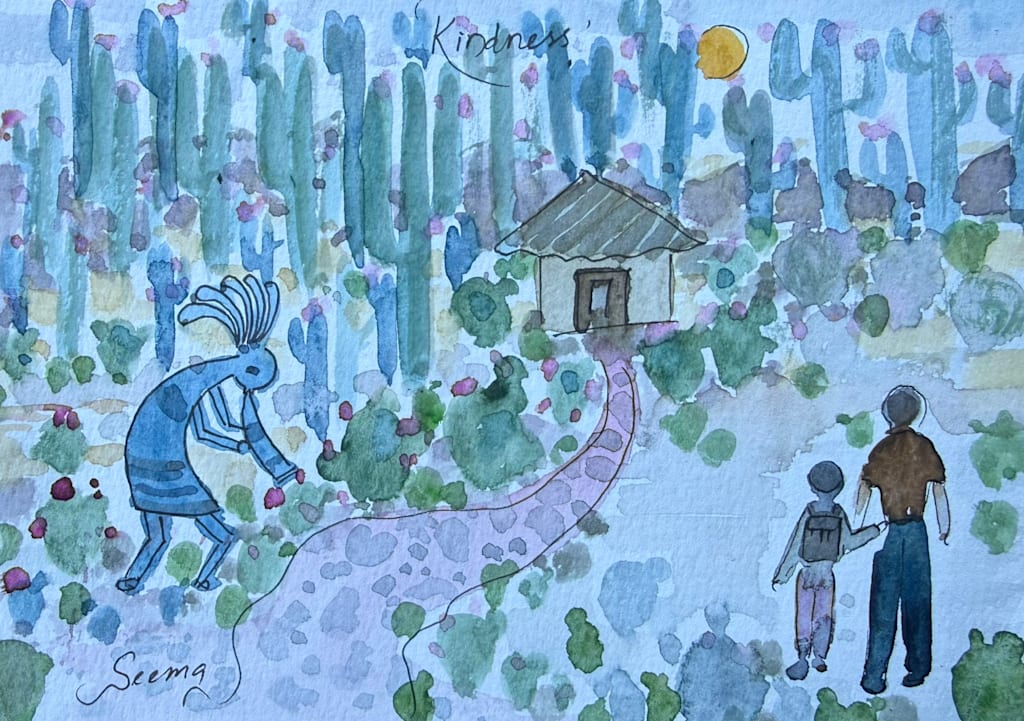
One hot day, a little boy and his father were hiking in the desert, not very far from their house.
They had brought a big water bottle, but they had run out of water. Desert makes one very thirsty. Each step in that hostile condition, dehydrates a person. The little boy was very thirsty, so they kept looking for some water. Hard to find in a desert. Only mirage, no drop of water.
Exhausted, and with hope, they followed the rocky trail, among the cacti. Suddenly, they spotted a little mud cottage. Hoping to find water there, they went near it. The cottage belonged to Kokopelli, a mythical figure and symbol of the Southwest.
“Could we please have some water?” they asked.
Kokopelli poured some water from his beautifully painted clay pot. The little boy drank it. The cool water refreshed him, and he wanted to thank Kokopelli for his kindness.
In his backpack, the boy had six granola bars made with oats, almonds, peanuts, chia seeds, pumpkin seeds, and chocolate chips. He gave two of them to the Kokopelli.
Kokopelli accepted them and took a bite. He usually ate acorn porridge, mesquite tortillas, prickly pears, saguaro fruits, and palo verde flowers. Very limited variety, and humble food that he forages from the desert. They quench his hunger but were not the tastiest food.
He had never tasted a granola bar before. It tasted so wonderful that he almost cried with happiness.
The little boy was touched by this display of emotion by Kokopelli. He learned that something he took for granted tasted like nectar to someone else.
He had four more granola bars in his backpack, so he saved two for himself and his father to eat on the trek back to their car. He gave the two other granola bars to Kokopelli.
Kokopelli accepted them happily.
He asked the father and son to sit on the mesquite branchess-covered ramada and rest a while. They talked about life in the desert and life in the city, like the country mouse and the city mouse. They learned about the lifestyle and struggles of each other.
They also talked about the little boy’s eczema. He had suffered from itchy, sore skin since he was very little. Doctors had diagnosed eczema and given him a variety of medicines, but it had not healed. The boy told that, sometimes the flare up and extreme itching made him cry in pain and affect his quality of life.
When Kokopelli heard about the boy’s suffering, he said he might have a solution. He brought out a little pot of salve from a ledge in his cottage. He said that he had made it by collecting the mucilage from a saguaro cactus, adding herbs and plant raisins. He uses it for sunburns.
“If you apply this to the sore places on your arms and legs at night, it may help. Try it. It's all plant materials,” Kokopelli said.
The boy and his father accepted the salve gratefully. They brought it home and used it on his limbs. Within a few weeks, the boy’s eczema had vanished.
The little boy had seen many times, how kindness gestures could lead to wonderful things. Now he saw it again. He painted a picture of Kokopelli and hung it beside his bed. It reminded him to keep being kind throughout his life.
Note: My son, 4, narrated the story as part of his transitional kindergarten (TK) homework. I elaborated it. The eczema therapy is hypothetical.
I hope, you loved this story of kindness.
Kokopelli is a hunchbacked musician deity of US Southwest. He symbolizes fertility and abundance.
About the Creator
Seema Patel
I am Seema. I contribute to PubMed, Blogger, Medium, LinkedIn, Substack, Amazon KDP, Vocal Media.
I write on nature, health, parenting, creativity, gardening, social issues.
My art shop: https://artsforhealinggifts.etsy.com
Enjoyed the story? Support the Creator.
Subscribe for free to receive all their stories in your feed. You could also become a paid subscriber, letting them know you appreciate their work.
Comments
There are no comments for this story
Be the first to respond and start the conversation.