
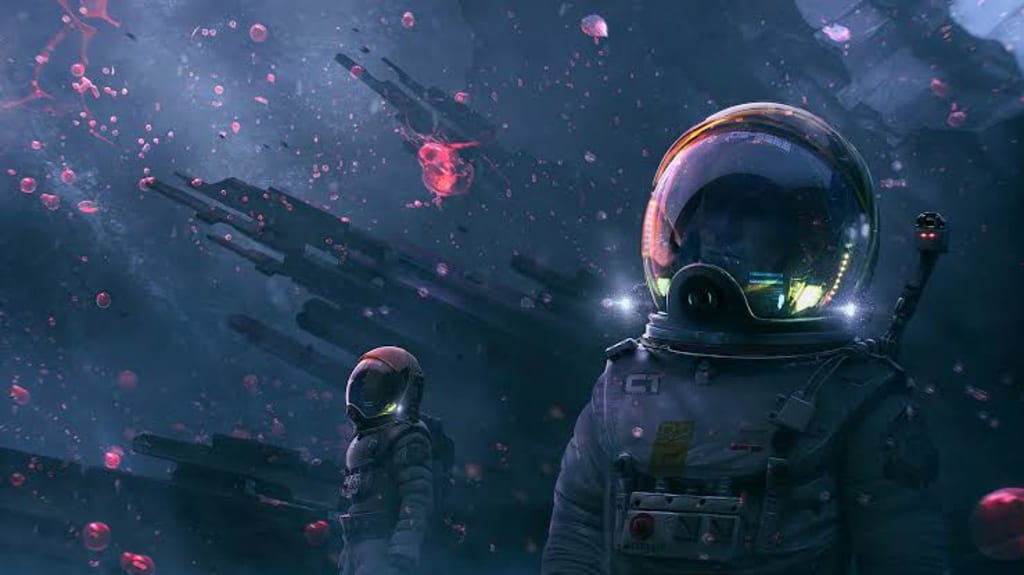
The concept of interstellar travel has always fascinated humans. The idea of exploring the vast and unknown depths of the universe, discovering new galaxies and potentially finding other forms of life has captured the imagination of many. Science fiction movies, books and TV shows have long portrayed interstellar travel as a common occurrence, with advanced technology and spacecrafts enabling humans to journey through space at incredible speeds. However, one movie that truly took this concept to a whole new level is Christopher Nolan's 2014 film, Interstellar.
The movie follows the journey of a group of astronauts who embark on a daring mission to find a new habitable planet for humanity as Earth is facing an impending crisis. The film not only captivated audiences with its stunning visual effects and intense plot, but it also sparked discussions about the possibility of interstellar travel in the future. Many wondered if what was shown in the movie was pure fiction or if it could actually become a reality. So let's dive into some of the hyped scenes from Interstellar and explore whether interstellar travel is just a myth or a potential future reality.
One of the most talked-about scenes from Interstellar is when the astronauts enter a wormhole, which allows them to travel through space at an incredible speed. Wormholes are theoretical shortcuts through space-time that connect two distant points in the universe. In the movie, the wormhole is created by an advanced alien civilization near Saturn, allowing the characters to travel millions of light-years away in just a matter of hours.
While wormholes have been a popular concept in science fiction for decades, their existence has yet to be proven in reality. However, recent studies have shown that they are theoretically possible within the laws of physics. In 2016, physicists at the University of Massachusetts Amherst created a mathematical model that suggests that wormholes could exist, but they would require huge amounts of negative energy to keep them open. This negative energy is something that we have not yet been able to harness, but with further advancements in technology and understanding of physics, it may be possible in the future.
Another notable scene from the movie is when the characters visit a planet that is orbiting a massive black hole. The planet, named Miller's Planet, has a gravitational pull so strong that it causes time to slow down significantly. This leads to one hour on the planet being equivalent to seven years on Earth. This concept of time dilation is not entirely fictional and has been proven by Einstein's theory of relativity.
In reality, the closer an object is to a black hole, the slower time moves for it. This effect has been observed in astronauts who have spent extended periods of time on the International Space Station, which orbits Earth at a relatively fast speed. Their clocks have been found to be slightly behind those on Earth due to this phenomenon. However, experiencing such extreme time dilation as shown in Interstellar would require getting incredibly close to a black hole, which is currently beyond our technological capabilities.
Furthermore, the movie also touches upon the concept of cryogenic freezing, where humans are put into a state of deep sleep for long periods of time during space travel. While this technology is still in its early stages and has only been used for short periods of time, there have been some advances in this field. In 2016, NASA successfully cryogenically froze and revived zebrafish embryos, proving that it is possible for certain organisms to survive this kind of freezing process.
Despite these advancements, cryogenic freezing for interstellar travel is still far-fetched at this point. The technology would need to be perfected and tested extensively before it could be used for human travel. Additionally, the physical and psychological effects of being in a state of deep sleep for extended periods are still unknown.
So, where does this leave us? While some of the concepts shown in Interstellar may not be entirely fictional, it is clear that we are still far from achieving interstellar travel. The technology and understanding of the laws of physics needed for such a feat are still in their early stages and require significant advancements. However, that does not mean that it is impossible.
Scientists and researchers around the world are constantly working towards understanding and unlocking the secrets of space travel. With continued advancements and breakthroughs, it is possible that one day we may be able to achieve interstellar travel. But for now, it remains a myth, a dream, and a source of inspiration for the future.
In conclusion, Interstellar has certainly raised the bar for what we consider possible in terms of space travel. It has sparked discussions and pushed us to think beyond our current limitations. While it may be some time before we can experience interstellar travel like in the movie, it serves as a reminder of our innate curiosity and determination to explore the unknown. So who knows, perhaps one day we will be able to embark on a journey through space just like the characters in Interstellar did. Until then, let's continue to dream and imagine what could be possible in the future.
About the Creator
Enjoyed the story? Support the Creator.
Subscribe for free to receive all their stories in your feed.
Comments
There are no comments for this story
Be the first to respond and start the conversation.