
I Was Dating Eight Boyfriends at Once—Then They Found Out About Each Other
What happens when the woman who’s been professionally impersonating your dead girlfriend turns out to have eight of you on retainer?
I was dating eight boyfriends at once.
They all treated me as a stand‑in.
I didn’t care.
As long as the money kept coming, every last one of them was my darling.
Then they found out about each other.
They lost their minds.
I am a master of time management.
Three months. Eight men. Not one of them had a clue the others existed. In fact, each was convinced he was my one and only—no, my only source of income. They all believed I was madly in love with them, and they were often deeply troubled by that belief. They warned me, again and again, to know my place, to not let my feelings get out of hand.
Joke’s on them. My feelings were for their money.
Boyfriend number one: Sebastian Grey. A hedge fund manager on Wall Street, thirty‑two, drove a black Aston Martin. His cufflinks cost more than my rent. Every time he got drunk, he’d cup my face, call me “Claire,” and bury his head in the curve of my shoulder and cry. Claire was his white moonlight, a high school sweetheart who died of cancer and left him a scarf she’d knitted. He kept it in a safe.
I was not Claire. My hair was dark brown; Claire was blonde. So he asked me to dye it. I did. Charged five thousand dollars. He paid without hesitation.
Boyfriend number two: Liam O’Connor. Partner at an architecture firm. Always had graphite dust on his fingers, mud from construction sites on his cuffs. He never got drunk in front of me, but at three in the morning, he’d text, asking if I could put on that dark green silk slip and send him a picture. The first time he asked, I did. He replied with a single word: “Eileen.” Later, I found a photo of the woman named Eileen in his iPad gallery, dark green slip, lying on her side on a sofa, eyes as indolent as a cat sunbathing in the afternoon. His ex‑fiancée. Three months before the wedding, she ran off with his younger brother. I stared at that photo for a long time. Then I bought five more dark green silk slips in different cuts. When Liam wired me money, he never asked what it was for.
Boyfriend number three: Dominic Chen. Neurosurgeon. Fingers long, steady, precise—as if opening a skull were handling a work of art. He liked to trace the ridge of my brow while I slept, or, more accurately, while I pretended to sleep. “Sophia,” he would whisper. Sophia was his patient, twenty‑three years old, with a cerebral aneurysm rupture; he had performed the surgery himself, but couldn’t save her. On the surgical record, the time of death fell on his birthday. He hadn’t celebrated a birthday since. With him, I learned to breathe slowly and even, to keep my eyelids perfectly still in the dark. It was hard; his fingertips were so light they tickled, like feathers. I wanted to laugh. I never did. A proper stand‑in doesn’t laugh at a time like that.
Boyfriend number four: Marcus Reed. Venture capitalist. Perpetually on the phone, perpetually saying “one more round.” He made me wear white blouses with black‑framed glasses, hair pinned up, speaking in bullet points backed by data. He couldn’t get over a teaching assistant from business school, a woman named Diane. Diane had turned down his proposal and married his roommate. Marcus still kept the papers she’d graded, with more red ink in the margins than original text.
Boyfriend number five: Alexander Walker. Retired fighter pilot, now an aviation safety consultant. Spoke very little, but before every flight, he’d send me a message, just three letters: SAFE. I later learned that was the call sign of his co‑pilot, killed in action. The co‑pilot’s name was Michael, hit by ground fire in Afghanistan, died right in front of Alexander. Alexander never mentioned Michael’s name, but he’d named his three cats Mike, Charlie, and Delta, the first three letters of the military alphabet. My job was to sit with him on nights he couldn’t sleep, paging through his flight logs until dawn.
Boyfriend number six: Benjamin Fisher. Independent film director, two films at Sundance. His white moonlight was the lead actress from his debut feature, a French actress named Lily. As soon as the film wrapped, she went back to Paris and married a gallery owner. Benjamin hadn’t made a feature since. When he was with me, he’d have me recite Lily’s line from the film over and over: “You think leaving is an action, but it’s really a direction.” I must have said it two hundred times. Each time, he’d fall silent for a long while, then say, “Thank you.” I’d say you’re welcome, and mentally note that my hourly rate has just gone up again.
Boyfriend number seven: Christopher Shaw. The gallery owner has a whole floor of exhibition space in Chelsea. He liked me in black turtlenecks, hair down, no makeup. His ex was named Madeleine, a sculptor. During an installation, a suspended piece collapsed and crushed her spine, leaving her paralyzed from the waist down. She didn’t die, but she refused to ever see him again. Every month, Christopher mailed her a check—actually mailed it, hand‑addressed. Once, he asked me to write the address for him. I did. He stared at it for a long time. “Your handwriting looks like hers,” he said. “I know,” I replied. What I didn’t say: I’d found a stack of Madeleine’s manuscripts in his study and spent two nights copying her script.
Boyfriend number eight: Nicholas Kane. Blue's bar owner. His fingers permanently carried the smell of cigarettes and the sweet sting of whiskey. He never mentioned any woman’s name, but every night after closing, he’d sit in the empty bar and play the same piece on the piano. I once arrived early and stood outside the door, listening to the whole thing. At the very last chord, his fingers would rest on the keys and not lift; they’d stay there so long I’d think he’d forgotten I was waiting outside. Later, I got the story from the bartender. He’d written that piece for a woman. When she left him, she said one thing: “Your song will never be finished, and I can’t wait for something that never ends.” Ten years later, he still hadn’t finished it.
Eight men. Eight histories of trauma. Eight women’s names, appearances, speech patterns, little gestures, signature phrases, favorite positions, and untouchable topics.
I stored all this information in an encrypted memo, each relationship’s dossier marked with a different emoji:
🖤 Claire. Blonde, knits, soft‑spoken, hates the cold, warm milk before bed. Scarf.
💚 Eileen. Dark green, silk, languid, with a tattoo on her right ankle, likes being told her collarbone is beautiful.
🤍 Sophia. Long hair, sleeps naked, cries at old movies, never mentions “artery” or “June.”
💙 Diane. White blouse, black‑rimmed glasses, academic tone, loves the word “structural.”
🧡 Michael’s call sign is SAFE. Flight jacket, insomnia at 3 AM, never ask “Are you okay?”
💜 Lily. French accent, loves New Wave films, must deliver English lines with a French inflection.
💛 Madeleine. Black turtleneck, no makeup, rounded handwriting, never mention “sculpture” or “exhibition.”
❤️ Untitled song. Blues, final chord never resolved, never ask its name.
Sometimes I thought, I’m not in eight relationships. I’m running a high‑end, bespoke emotional rental service. Exclusive clientele. Custom product. Made to order. Price negotiable.
The day it all fell apart was a Saturday.
Sebastian ran into Liam outside my apartment building. Liam was holding a bag of breakfast, a croissant, and black coffee, my standing order. Sebastian was holding a bouquet of white roses, Claire’s favorite.
They locked eyes for three seconds. Two men who moved in New York’s highest circles didn’t need to ask many questions.
“You’re here to see her?” Sebastian spoke first, his tone unnervingly calm.
Liam looked down at the breakfast bag in his hand and let out a short laugh. Not a happy laugh, but the laugh of a man who’s just realized he’s been played for three months and can’t decide whether to be furious or impressed by his own stupidity. “Claire?” Liam asked.
“Eileen?” Sebastian returned.
They didn’t go upstairs. They went to the café downstairs. Compared phones. Checked message histories, movement patterns, photo dates, and transaction records.
Two hours later, Marcus was added to a group chat. Three hours later, all eight were in it.
They were livid.
Not because of the money—none of these men would blink at a few tens of thousands a month. The sums they burned on yacht clubs and charity galas every year had two more zeros. What enraged them was this: the woman they’d been using as a stand‑in was also using them as stand‑ins. Every dollar transferred was a line of unspoken dialogue: I know you don’t love me. I know you’re using me to fill a hole. That’s fine. Just pay up.
Each of them had believed he possessed a humble, one‑sided, inevitably heartbroken admirer. A stand‑in he could “enjoy” without owing anything. Then they discovered—the stand‑in had eight of her own. The stand‑in was running her own operation. The stand‑in even had a fully developed project management system.
Sebastian got into my encrypted memo. He screenshotted it and sent it to the group.
🖤💚🤍💙🧡💜💛❤️
Eight hearts. Eight dossiers. Uniform formatting, comprehensive data, even monthly service ratings, and renewal reminders.
The group chat went dead silent for a full ten minutes. Alexander was the one who finally broke it, using the kind of clipped language you’d hear in cockpit communications.
“She used every single one of us. And every single one of us paid for it. Gentlemen—I believe we need to have a word with this young lady.”
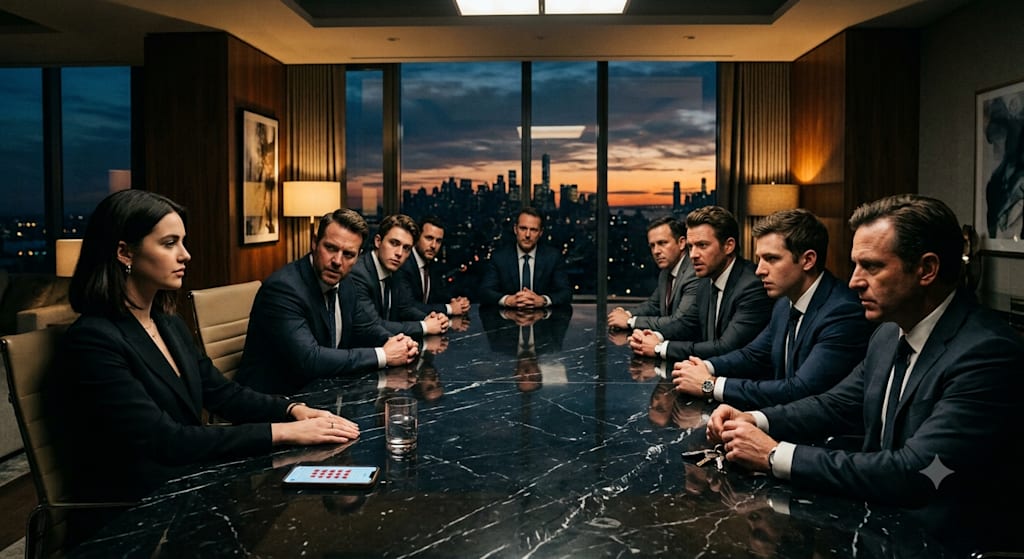
They summoned me to a penthouse suite at the Ritz‑Carlton on Fifth Avenue.
Alexander booked the room. A retired pilot, he preferred to look down from altitude. Eight men, a twelve‑seat conference table. I sat at one end; they ranged themselves along both sides. It felt like an arbitration hearing.
Sebastian tossed his Aston Martin keys onto the marble tabletop. The metal rang out sharply. “Explain yourself. Claire.”
“My name is Ava,” I said. “It’s always been, Ava.”
A muscle in his jaw jumped.
Liam leaned back in his chair, arms crossed, the corner of his mouth hooked in something between a smirk and a snarl. He was wearing a dark green shirt, the one I’d given him. He’d obviously put it on deliberately. “Ava,” he said, drawing my name out slowly, as if tasting it. “Do you know what I found when I traced your wire transfers?”
I said nothing.
“The money I sent you, you split into eight different accounts. Every account is named the same way: an initial, a dash, a string of numbers.” He flipped his phone around. The screen read: S.G‑0412, L.O‑0819, D.M‑1025, M.R‑0130, A.W‑0607, B.F‑1121, C.S‑0303, N.K‑0915. “Those numbers. They’re our birthdays. You even set up an auto‑transfer reminder on my account. The note said, ‘Liam renewal—do not forget dark green gift selection.’”
Dr. Dominic Chen hadn’t said a word since arriving. He sat quietly by the window, his long surgeon’s fingers interlaced over his knee, observing everything like a clinical case he’d never encountered before. Only after Liam finished reading out the account names did he speak.
“I’m curious about one thing.” His voice was flat, the tone he used in the OR when announcing the start of a craniotomy. “Was there ever a single moment—even one second—” he paused, “—where you forgot you were playing a role?”
Every gaze in the room fell on me.
These eight men. Combined net worth could buy half of Manhattan. They were accustomed to controlling, looking down, holding others in their grip. Yet here they sat, like eight schoolboys who’d just had their wallets stolen by the same pickpocket, fury laced with an emotion none of them would admit to. Not hurt. Curiosity. In their lives, women had either wanted to marry them, destroy them, or both at once. But never, never had anyone treated them as a project. A project with KPIs, risk assessments, and quarterly reviews.
“I never forgot,” I said.
Dominic nodded slightly, like a doctor confirming a diagnosis.
Sebastian couldn’t hold it in any longer. He stood, both hands planted on the table, leaning forward. At this distance, I could smell his cedar cologne, Claire’s favorite brand. I’d seen three backup bottles in his bathroom cabinet. “So the entire time, you never—not for one second—felt anything for me—” He choked. He couldn’t say the word. Because he’d never felt it for me either.
I looked at him. Thirty‑two years old, forty billion dollars under management, hundreds of make‑or‑break decisions every day. Right now, his face looked like a man who’d just discovered the chip he’d been holding for three months was hollow.
“Sebastian,” I said. “The first time you called me Claire was on our third date. You were drunk, your head buried in my shoulder, crying. I was wearing a black turtleneck, a color she never wore. My hair was still brown. You weren’t looking at me. You never were.”
The color drained from his face.
The room stayed quiet for a very long time.
Christopher finally broke the silence. He’d been typing notes on his phone from the corner. He looked up. “Just to confirm: you’re not planning to write us into your next screenplay, are you?”
I smiled. “No.”
“Good.” He pocketed his phone and turned to the others. “Gentlemen, I have a proposition.”
“Go on,” Alexander said, clipped as ever.
“Eight of us. Each conned for about three months. That’s two years total.” Christopher spread his hands. “Instead of taking her to court and letting the world know that the eight of us, wolves of Wall Street, were managed for ninety days by one woman with the same Excel spreadsheet—”
Marcus Reed, VC, spoke his first words since entering the room: “I’m in favor.”
“—Why don’t we change the game.”
Christopher looked me in the eye. “Ava, the fact that you kept eight relationships running seamlessly proves you have a rare skill. Anti‑stand‑in services, co‑founder and Chief Operating Officer. First seed round, everyone at this table, state your interest.”
I blinked. Then I scanned the eight men. Sebastian was frowning, but he didn’t say no. Liam’s fingers tapped the table, the set of his mouth shifting into something new. Dr. Dominic Chen showed the faintest hint of a smile—barely there, but there. Marcus was already running valuations in his head. Alexander’s expression was unreadable, but his eyes were bright. Benjamin was nodding. Christopher was waiting for my answer. Nicholas pulled a cigar from his pocket, didn’t light it, just held it between his teeth, and raised an eyebrow at me.
A realization hit me. For three months, I’d studied them, imitated their lost women, converted their wounds into my income. I thought I was the one pulling the strings. But at the same time, I’d become the only person in the world who had truly seen the most broken part of every single one of them. Claire’s scarf. Eileen’s slip. Sophia’s brow. Diane’s graded papers. Michael’s call sign. Lily’s line. Madeleine’s handwriting. The unfinished song. Those women had left, but these men had locked themselves in the morgue with the bodies. I was the one who’d sat in each of those morgues for ninety days, mapping every circuit, memorizing every vent.
“I have one condition,” I said.
“Name it,” came eight voices, almost in unison.
“I name the company.”
“Fine.”
“Exit Strategy.”
Christopher’s eyebrows shot up, and then he burst out laughing, the laugh of a man who’s just discovered the greatest third‑act reversal his film could ever have. “Deal.”
I stood, lifted my water glass, and raised it to them. “Well then, gentlemen—welcome to being my ninth through sixteenth clients.”
The corner of Sebastian’s mouth finally cracked. He picked up his glass and muttered something under his breath. I didn’t catch it, but I’m fairly certain it wasn’t Claire’s name.
They moved fast.
Christopher called a business lawyer he knew in Greenwich Village, and within three days, the company was registered. The name: Exit Strategy. Business category: Emotional Consulting and Trauma Recovery Services. The office was temporarily rented in an old building near Dominic’s hospital—originally a dental clinic. The previous tenant had left in a hurry, abandoning a pale green dental chair.
At our first official meeting, all nine of us were there. Eight ex‑boyfriends plus me.
Marcus handled the financial model. Alexander took charge of process management. Benjamin was responsible for all external copy and brand tone. Nicholas provided the beverages. Sebastian and Liam were still competing, always sitting at opposite corners, but when it came time to write checks, neither hesitated. Dominic rarely spoke, but he never missed a meeting. His stated reason was “clinical oversight.” I knew he just wanted to observe. A man who’d spent his life as a scalpel‑wielding god, suddenly finding out a woman had dissected him for three months; who wouldn’t want to see what the blade looked like?
In the first seed round, the eight of them put together 1.2 million dollars. Not much, but enough.
Our first client came through Marcus. Jack Horowitz, co‑founder of a Silicon Valley unicorn, cashed out at twenty‑seven, with a nine‑figure net worth. His first love had left him a week before he sold the company. No dramatic breakup, no third party—she just said, “I don’t fit into your future,” and moved back home to Savannah. For three years, Jack had tried everything to win her back. An email a day. A gift every week. He even bought an apartment across from her office and mailed her the key. She never responded.
“He doesn’t lack women,” Marcus said at the project kickoff meeting. “He lacks a way to get her back. Or—a way to stop wanting her back.”
“What he lacks,” I said, “is closure.”
Christopher’s eyes lit up. “And our company is called Exit Strategy.”
I picked up a marker and wrote three phrases on the whiteboard:
UNDERSTAND THE EXIT.
RECONSTRUCT THE EXIT.
OWN THE EXIT.
“What is the principle behind a stand‑in?” I turned to face them. “Why did you all hire me in the first place? Because I looked like someone? Not entirely. Liam, you had me wear that dark green slip because it made you feel Eileen was still in the room. Sebastian, you held me and called me Claire because I let you perform a goodbye you never got to perform. A stand‑in doesn’t replace the person. A stand‑in replaces the person’s departure. You can’t say goodbye to someone dead. You can’t tell a runaway fiancée, ‘I hate you.’ You can’t ask someone who simply stopped loving you, ‘Why?’ So you bought me. Now, we sell this service to Jack.”
Alexander looked up from his aviation logbook. “Execution plan.”
I turned to Dominic. “I need a psychological profile on Jack. Attachment style, stress responses, core fears—the full contour.” Dominic nodded.
“Then we need to find a woman,” I said, looking at Benjamin. “Casting. She needs clear similarities to Jack’s first love, but she can’t be too similar. Similar enough to trigger his pattern, not so similar that he’s immediately on guard. Hair, voice, speech rhythm, a few micro‑expressions—three key points are enough. The rest won’t rely on appearance. It’ll rely on the scene.”
Christopher was already typing furiously on his phone. The project was codenamed “Savannah.”
Three weeks of prep.
Dominic met with Jack twice under the guise of a “mental health consultant” and delivered a full profile: anxious attachment style, core fear of abandonment, and defense mechanism of hyper‑pursuit. The more he couldn’t have her, the more he chased. Marcus dug up all publicly available info on the first love. Christopher wrote the script, giving it an internal codename: “Reverse Pygmalion.” Benjamin found the actress, Naomi Hart, thirty‑one, an off‑Broadway performer specializing in immersive theater. Grey‑green eyes, a habit of leaving a half‑second pause at the end of her sentences, smiled by dipping her head first then lifting her face. About seventy percent resemblance to Jack’s first love. Enough to trigger, not enough to copy.
Naomi read the script and was silent for a long time. “This,” she said, tapping the words “Exit Strategy” on the cover page, “is the craziest thing I’ve ever seen.”
“Are you in?” I asked.
She raised those grey‑green eyes to meet mine. Then she smiled. Head down, then up. “I’m in.”
Execution day was a Thursday in April.
Marcus lured Jack to a private club in the Bay Area under the pretense of an “investor community exclusive dinner.” Jack arrived in a grey linen suit, his hair freshly cut, but the shadows under his eyes were dark and unmissable. Naomi stood by the floor‑to‑ceiling windows, holding a glass of sparkling water, her profile carved by the late afternoon light. Her hair was pinned up, revealing a pair of tiny pearl earrings, the exact same kind Jack’s first love had owned.
Jack’s hand paused when he saw those pearl earrings. A very brief pause. He didn’t say anything.
All evening, Naomi moved on the periphery of his vision according to the script: when he went to the buffet, she happened to switch plates; when he stepped onto the balcony for air, she was just there at the railing; when he spoke with others, her laughter drifted over from some direction, not too loud, not too close, just enough to trigger memory. Christopher monitored everything via earpiece from the next room. I sat in front of the surveillance screen, Dominic beside me, charting every micro‑expression Jack made.
“Phase two,” I said into the channel. “Naomi, you’re up.”
She got up, walked past Jack, and pretended to stumble on the rug. Wine splashed onto her wrist. Jack reflexively reached out and caught her. “Sorry,” she said, the rhythm of her voice exactly matching our pre‑recorded samples. “God, I’m so clumsy.”
Jack looked down at her. “It’s fine.” Then his gaze landed on the pearl earrings. This time, he didn’t look away. “Your earrings. They’re very distinctive.”
“My grandmother’s.”
“Mm.” He smiled, but it didn’t reach his eyes. “I used to know someone with a pair just like that.”
Naomi answered as scripted. She didn’t pry, didn’t probe. She just stood there, quiet. Quiet, the core trait of Jack’s first love.
The climax was arranged for the final set of the night. We had booked a private dock, a ten‑minute drive from the club. At the end of the dock was a small wooden sailboat. The name on its hull, the Katherine, had been temporarily painted on by us. Katherine was Jack’s first love’s middle name. Jack was coaxed to the dock by an “incidental passerby” guest. When he arrived, the guest vanished. Jack stood alone on the pier, facing the boat.
Naomi emerged from the stern. She didn’t speak. The sea wind tangled her hair. The pearl earrings caught the dim light.
“What…” Jack’s voice was hoarse. “What is this?”
Naomi took a step forward. “Jack. You sent over three hundred emails. You bought an apartment. You chased me for three years. But you never asked me one question.”
“What question?”
“You never asked if I was scared.”
Jack’s mouth opened, then closed. Then he bent over, not collapsing, but like a man whose central axis had just been pulled out. He buried his face in his hands. “What was she scared of?”
“That you couldn’t stop,” Naomi said. “That your future was too big, and she would become an antique collected inside it. That one day you wouldn’t need her anymore, but you’d never dare say it because she was your ‘first love.’ That she’d be slowly demagnetized by your success, reduced to a footnote on a résumé. So she left first.”
Jack didn’t look up. A wave slapped the pier piling, spraying a fine mist.
After a very long time, Jack lowered his hands. His eyes were red, but he wasn’t crying. “She could have told me. She could have told me all of this.”
“Did you ever give her the chance?”
He was silent again. Then he let out a short, sharp laugh, wiped the corner of his eye with his sleeve, and looked at Naomi, then at the name on the boat. “You’re not her.”
“No.”
“She would never talk to me like this. She always took the long way around, hoping I’d figure it out myself.”
Naomi smiled, a tiny expression, pressing her lower lip together, then releasing it quickly. Jack watched that gesture and took a deep breath. Then he said something that wasn’t in Christopher’s script.
“Thank you.”
He turned and walked off the pier. Three steps in, he stopped. “Will this boat still be here tomorrow?”
“Yes,” Naomi said.
“I want to come back. Alone.”
In the surveillance room, everyone exhaled at once. Christopher pulled off his headphones and leaned back in his chair, wearing the expression of a screenwriter who’s just watched an actor improvise the best line in the entire film.
“‘What was she scared of?’” he repeated. “Why didn’t we think of that line?”
Dominic closed his notebook, tone flat. “Because you’re not him.”
Sebastian sat in the corner, and hadn’t spoken all night. But his gaze wasn’t on the monitor. It was on me. “You switched channels twice during the op. The first time was when Naomi mentioned the grandmother’s earrings. You told her to add, ‘I actually haven’t worn them in a long time, don’t know why I put them on today.’ You came up with that yourself.”
“Yes.”
“From the look on his face when he saw the earrings, you diagnosed that what he needed wasn’t similarity. It was a coincidence.”
I nodded.
Sebastian was quiet for a moment. His eyes, which had shorted countless stocks, showed no sign of victory or defeat. “So you read all of us that clearly back then, too.”
It wasn’t a question. I didn’t answer. I didn’t need to.
After a beat, Liam grabbed the bottle of whiskey Nicholas had brought, unscrewed the cap, and poured nine glasses. He slid the first one to me. “Exit Strategy,” he said, raising his own. “First case delivered.”
Eight glasses lifted. The clink of glass in that cramped surveillance room had never sounded so crisp.
The second client came to us.
Margaret Davis, seventy‑one, retired opera singer, lived in a brownstone in Brooklyn Heights. She emailed us in all caps. Subject line: “I NEED A STAND‑IN, BUT NOT FOR A PERSON.”
Christopher forwarded the email to the group with a single comment: “Best headline of the year.”
We went to visit her. The house smelled of old sheet music and lemon furniture polish. The living room walls were covered with production stills from her career: La Traviata, Norma, and Tosca. In every frame, she wore a different costume, but the look in her eyes was always the same: the look of someone who knows she’s being watched by hundreds, but is singing to only one.
“My husband’s name was Lionel,” she said, pouring us tea in Royal Albert bone china cups, her hands perfectly steady. “Passed six years ago. Pancreatic cancer. I took care of him in this house for the last three months.” She gestured to a Steinway grand piano in the corner. “He used to play every day. Not for me—he was a pianist, I was a soprano, we never collaborated. He said a husband and wife working together was like cooking two dishes on the same stove. One always ruins the other. After he left, no one touched that piano for six years.”
“What would you like us to do for you?” I asked.
“I want to hear it ring out one more time,” she said. “But not just any sound. I want him to play.”
“So,” I said slowly, “you need a pianist. To play a piece in front of you. In your husband’s way. And then?”
Margaret looked me in the eye. Her irises were a very pale grey‑blue, like silk washed too many times. “Then I’ll sell it. This house. This piano. These photographs. I need a goodbye, but not a real one—the real one, I already attended. At the funeral home, with chrysanthemums and relatives whose names I can never remember. What I need is a goodbye I can perform.”
Alexander set down his logbook. “What were the specific characteristics of your husband’s playing style?”
Margaret smiled, her first real smile since we’d arrived. “He only sat on the front third of the bench. His left hand was always a fraction faster than his right. He believed the left hand is rhythm, the right hand is melody, and rhythm must always walk ahead of melody. When he played the final note, his fingers would rest on the keys. He never lifted them right away. I asked him why once. He said the resonance is part of the performance, and he didn’t want it to be alone.”
Nicholas spoke up. “I’ve got a house keyboardist at my bar. Ezra Fein. Juilliard grad. He can play Chopin, he can play Radiohead. His real gift is mimicry—any style, give him a week.”
“Can he mimic a pianist who’s been dead six years?” Margaret’s voice was calm.
“He can mimic anything,” Nicholas said. “Except himself. He never plays his own material.”
Project codename: Steinway. Two weeks of prep.
Ezra Fein was a man in his early thirties, painfully thin, his fingers so long they looked almost unnatural, like the forelegs of a spider. He wore round glasses and a flannel shirt faded to near white, missing two buttons on the cuff. He walked into our office, looked at the whiteboard, then looked at the nine of us.
“So you’re the people who turn human beings into scripts.”
“And you’re the man who never plays himself,” I returned.
The corner of his mouth twitched. “You want a pianist who’s been dead six years. What do you need from me?”
“Fingering habits, rhythmic idiosyncrasies, posture, depth of seat on the bench, duration of hand resting after the final note.” Dominic handed him a document. “This is a forty‑two‑item detail questionnaire filled out by Margaret Davis. She even noted the frequency with which Lionel’s fingernails clicked against the edge of the keys.”
Ezra flipped open the file. He stared at the first page for a very long time, long enough that Benjamin cleared his throat.
“You’ve met this lady?” Ezra asked.
“Yes.”
“Does she love him?”
“Yes.”
He closed the file, took off his glasses, and wiped the lenses on the hem of his shirt. “Then she doesn’t want a musician. She wants a ghost.”
He took the job.
During rehearsal, Ezra came every afternoon to the old dental clinic downstairs. We’d moved out the dental chair and brought in a Steinway Model B. Margaret provided a recording of Lionel, an old cassette tape, made the night of their twentieth wedding anniversary. He played Schumann’s Träumerei. At one spot, the left hand’s rhythm rushed ahead by half a beat, like a skipped heartbeat. Ezra listened to that tape at least twenty times a day.
“His left thumb had mild arthritis,” Ezra said on the third day. “Listen to the trill here. He’s borrowing force from his wrist instead of relying on the knuckle. A normal person wouldn’t play it like that.”
“Can you replicate it?”
“Yes. But I’ll need to make my wrist hurt first.”
Dominic wrapped Ezra’s right wrist with three layers of kinesiology tape, restricting movement, forcing him to compensate with his left. Ezra played scales for six hours. His fingertips went white, the back of his flannel shirt soaked through. In the middle, he stopped, looked at his taped‑up wrist, and let out a short laugh. “I’ve taken a lot of gigs in my life,” he said. “Never one that asked me to play worse.”
On the tenth day, Margaret came to inspect. She stood in the doorway of the old exam room, clutching her crocodile‑skin handbag, hair immaculate, coral lipstick. She didn’t sit down. She just stood at the threshold, watching Ezra play.
He played Träumerei. The left hand rushed half a beat. Final note, his fingers rested on the keys. He did not lift them.
Margaret said nothing. Her lips were slightly parted, knuckles white on her handbag. She stood there for three full minutes; the piece was only two and a half. The final thirty seconds were silence. His fingers still on the keys, the resonance bouncing off the pale green tiles.
Then she turned and walked out. I followed. Her back was straight, but her hands were trembling.
“Margaret—”
“You were right,” she said, her voice far steadier than her hands. “The habit of holding the fingers. He didn’t miss a single one.” She pressed a handkerchief to the corner of her eye. She didn’t cry. Just pressed. “Good. Friday. As planned.”
The evening of the service, Margaret insisted on being alone. The rest of us listened from the adjacent room. Ezra wore a dark blue cashmere cardigan, custom‑made to Margaret’s specifications. He sat on the front third of the bench.
He played Träumerei. Then Für Elise. Then, an impromptu piece Lionel had played on their wedding day at City Hall, Margaret said it had no name. That day, he’d been waiting for her outside the registry office, casually playing a few chords. The people behind him told him to hurry up. He said, wait, I’m not done yet.
Ezra finished it. On the final note, his fingers rested on the keys. Seven seconds.
Margaret Davis stood beside the piano, her right hand resting on the lacquered lid, as if on someone’s shoulder. She didn’t cry. She just said one thing, so softly it barely reached the monitoring equipment.
“Lionel. You can go now. I’ll take the resonance from here.”
In the surveillance room, after she spoke, there was a very long silence. On the monitor, Margaret stood up, walked to the piano bench, bent down, and gently kissed the top of Ezra’s head. Not a kiss between a man and a woman. Something older, the kiss you give someone who helped you lay down a part of your life you’d been carrying. Then she walked to the wall, picked up the phone, and dialed her real estate agent.
“When you take the listing photos, make sure that the piano is clearly visible,” she said. “It’s the youngest thing in this house. It’s only six years old.”
She hung up.
Alexander’s throat moved. He scribbled something in his logbook. Benjamin Fisher stared at the monitor, unfocused, fingers tapping his knee. He turned to me. “She just said, ‘I’ll take the resonance from here.’ That was his line. The pianist’s. ‘The resonance is part of the performance, I don’t want it to be alone.’ She knew he’d pause at the end. She spent six years waiting for someone to help her finish those seven seconds. And then she caught it herself.”
No one spoke.
In the corner, Sebastian sat in a swivel chair, hands clasped, thumbs pressed to his forehead. He stood and walked out without a word.
I found him on the rooftop. The wind was strong. He was flipping his Aston Martin keys over and over in his hand, like a coin. The city floated beneath him in the dusk, like a piece of iron cooling.
I stopped three steps away. “One day,” he said, without turning around, “would you do an Exit for me?”
“For Claire?”
He finally turned. The wind had mussed his hair. His eyes were slightly red, but his expression was hard. “Not for Claire. For me.”
I didn’t answer right away. In the distance, the Empire State Building’s lights had just come on, puncturing the deep blue sky. The wind had blown away most of Sebastian’s cedar scent, exposing the truer smell underneath, not cologne. Coffee alkaloids, ink, and too much sobriety.
“Ezra said he doesn’t play his own material,” I said. “Do you know why? Because the moment you play your own, you have to admit it’s real. All mimicry is rehearsal. The real thing has no rehearsal.”
He looked at me, and the key‑flipping motion stopped.
“So you decide, Sebastian. When you’re ready to play your own song—come find me.”
I turned toward the rooftop door.
“Ava.”
I stopped.
“That Ezra,” he paused. “Is he using the stand‑in theory to run from something, too?”
“We all are,” I said. “The only difference is some people pay, some write scripts, some play piano.”
“And you?”
The wind kicked up. My hair whipped across my face, like someone’s fingers tracing the ridge of my brow years ago, so light it tickled, I wanted to laugh. But I didn’t.
“I’m never the stand‑in,” I said. “I just manage the project.”
The door closed behind me. In the hallway, Dominic was leaning against the wall, holding the Steinway project’s closing file, a yellow sticky note paperclipped to the cover. He’d probably followed up here from the surveillance room.
“You’re very good at sending people off,” he said, his tone light. “Have you ever sent anyone off yourself?”
“What do you think?”
He looked at me for a moment. Those hands that had opened countless skulls hung quietly at his sides. “My professional instincts tell me the micro‑expressions you made just now, when you said ‘I’m never the stand‑in,’ were exactly the same as when you taught Naomi how to play Claire.”
The hallway light was a motion‑sensor. No one had moved in too long. It clicked off. In the darkness, his voice came through: “But you don’t need to give me an answer. You’re my business partner, not my patient.”
When the light clicked back on, he was already gone. The yellow sticky note had been stuck to my sleeve; I hadn’t even noticed him do it.
It read: After Sophia died, I never celebrated my birthday. But now I do. — Dominic
I stared at that note for fifteen seconds. Then I folded it and slipped it into a compartment of my wallet, alongside the encrypted memo with the eight emojis. Uncategorized.
That night, none of us went home.
It wasn’t planned. Just a silent, mutual understanding—after “Savannah” and “Steinway” had both closed back‑to‑back, no one really wanted to be alone. Marcus suggested a late‑night dumpling spot he knew near Chinatown. No one objected. Two in the morning, all nine of us crammed around a round table. One of the fluorescent lights overhead was dead, flickering. The owner looked us over, asked nothing, and set down two bamboo steamers of dumplings and a pot of jasmine tea.
Sebastian shrugged off his suit jacket and hung it over the back of his chair. His tie was loosened, and he’d taken off his cufflinks, setting them beside his chopsticks. It was the first time he’d ever removed them in front of us. I recognized them; Christmas last year, Claire’s mother had sent them to him. The late daughter’s initials were engraved inside. He’d worn them for a full year.
“Claire’s sister messaged me,” he said. He grabbed a dumpling, ate it without vinegar, and only spoke after chewing. “Claire’s last few weeks—she wasn’t in the hospital. She was at home. She was learning to knit a second scarf. The first one she made for me was too short, barely went around once. She wanted to make a longer one. Her mom threaded the needles for her every day. Nobody knew who that second scarf was for. Maybe even Claire didn’t know.”
He set his chopsticks down. “I didn’t know any of this before. I only knew the funeral. I only knew the scarf in the safe. I only knew the end.”
Liam poured a cup of jasmine tea from across the table and pushed it over to Sebastian. Between them now was just a plate of smashed cucumber and a dish of chili oil. The old diagonal distance was gone; now it was only a dish away. “You know now,” Liam said.
“Yeah.”
“So then what?”
Sebastian took off his glasses, wiped the lenses on his shirt cuff, and put them back on. The motion was very light, as light as Ezra’s fingers resting on the keys after the final note. “Then I thought—what if I finished that second scarf she was knitting?”
No one laughed. Not out of pity. Because everyone at that table understood exactly what those words meant. In Exit Strategy’s dictionary, that was called “closure.” Not waiting for someone else to finish it for you. Picking up the needles yourself. Claire had started Sebastian’s obsession with a scarf. Now, he would end it with the same scarf. Not waiting for her to return. Not finding another stand‑in. Him. Himself. Finishing that incomplete gesture with his own hands.
“Do you know how to knit?” Marcus asked. He was perfectly serious.
“No. But I can learn.”
Dominic pulled his notebook from his pocket, flipped to a fresh page, and wrote something down. He tore the page out and slid it across to Sebastian.
It read: Knitting class, Upper West Side. Recommended by a patient. She says the sound of knitting needles reminds her of the sound of surgical instruments clinking on a tray. Both sounds force you to focus.
Sebastian looked at that slip of paper for a long time. Then he folded it, tucked it into his shirt pocket alongside the screenshot of Claire’s sister’s message. “Project Number Three,” he said suddenly. “Our company’s third project. The first two were Exits for other people. This one is my own Exit. Codename: ‘The Second Scarf.’” He looked up at me. “Can we open the file?”
I looked around the table. Marcus was already on his phone checking his calendar. Alexander had drawn a basic knitting diagram in his logbook. Benjamin and Christopher were murmuring about narrative structure, debating whether a scarf Exit should be told linearly or in flashback. Nicholas said his mother had been a seamstress when she was young; he still had her old knitting needles at home. Liam didn’t say anything. He just nudged the vinegar dish closer to Sebastian’s side.
Dominic met my eyes. He gave a small nod. Not a doctor’s nod. A partner’s nod.
“Project approved,” I said. “On one condition.”
“What?”
“You’re not allowed to learn alone. One man knitting a scarf alone is an obsession. A group of people knitting a scarf together is a goodbye.”
Sebastian paused. Then he smiled. Not a bitter smile, not a self‑deprecating one. The smile of a man who has finally woken from a very long dream and realized the sun has been up for hours. “Deal.”
By the time we finished the dumplings, it was nearly dawn. We walked out into a Chinatown just starting to stir. A fishmonger was hosing down the sidewalk. The back door of a bakery leaked the sweet smell of egg tarts. A garbage truck was crawling up from the end of the street, its yellow lights spinning, looking both unnecessary and warm in the morning light.
I walked at the back, watching the eight men ahead of me. Sebastian still had his jacket slung over his arm, his cufflinks not put back on. Liam walked beside him, the two of them talking low, an occasional laugh between them. Christopher and Benjamin were gesturing, probably about a shot sequence for some script. Marcus was on the phone as he walked, likely explaining to an LP in Silicon Valley why this quarter’s returns included profits from an emotional recovery firm. Alexander was walking with his head down, studying his logbook. Dominic and Nicholas were side by side, the two quietest men naturally gravitating together.
I slowed my pace, watching their long shadows stretch in the morning light.
Three months ago, I was the woman managing eight stand‑in relationships with an encrypted memo and a string of emojis. I had kept everything perfectly compartmentalized: this one is a client, that one is a preference, this is a revenue channel. I never put myself into any of those relationships because the moment I did, the management system would glitch. But now I wasn’t so sure. Not unsure about the business direction. Unsure whether I was helping them or helping myself.
I took out my phone and opened that encrypted memo. The eight emojis were still there (🖤💚🤍💙🧡💜💛❤️), but the information beneath them was different now. I no longer needed a reminder of what kind of cashmere Sebastian liked, no longer needed a note about which song Liam hummed when he was drunk. Those things were seared into my memory now. No memo required.
I scrolled to the very bottom of the file. There was a new category there I’d never shown anyone. The label was 🔑. Inside was only one line:
Sebastian: the rooftop. Liam: The day he wore his dark green shirt inside out. Dominic: The sticky note on the cuff. Marcus: The first time he said, “I’m in favor.” Alexander: the landing order in his logbook. Benjamin: stealing the line. Christopher: Reverse Pygmalion. Nicholas: the last line of the ninth song.
I stared at that line for a very long time. Then I changed the label from 🔑 to 🖇️. A paperclip. A paperclip doesn’t hold things forever, but it has value. When you’re done, you can remove it. But it leaves a small mark.
At the intersection, Sebastian suddenly looked back. He’d probably noticed I’d fallen too far behind. The morning light hit his face; the spots where the engraved cufflinks had been were now just two ordinary shirt buttons. “Ava,” he called my name, not Claire. “Hurry up. Marcus says he’s buying breakfast.”
“I did not say that,” Marcus’s voice drifted from up ahead.
“You just did.”
“I said I’d buy if the next project was approved. The contract’s not signed yet.”
“The scarf project is approved.” Sebastian turned back to me and waved. The gesture was casual. Not a command, not an invitation. The wave of someone standing beside you, not opposite you.
I put my phone away and quickened my step. The nine of us turned the corner and vanished into the orange light of a Lower East Side morning.
That afternoon, a new email pinged into the company inbox. Sender: Ezra Fein. Subject: “I have a project for you guys.”
The body was just one paragraph:
After the old lady sold her piano, she sent me a check and a letter. The letter said: “Ezra, the reason you don’t play your own material is that you think your own material isn’t finished yet. Let me tell you a secret—nobody is finished. Claire never finished her second scarf. Lionel never finished his impromptu piece. That doesn’t mean they aren’t worth hearing. If you’re willing, I’d like you to play something of your own. Anything. I can help you make a record.”
I don’t know how to reply to this letter. But I’m guessing you do.
So my project isn’t for me. It’s for her. You decide the codename.
Christopher forwarded the email to the group with a single comment: “Our third project isn’t a scarf. It’s a third.”
Benjamin replied: “Fourth.”
Alexander replied: “Ezra plus Margaret. Same case. Fourth.”
Marcus replied: “Whatever number it is, price it first.”
Liam’s reply was just two words: “Opening now.”
I shut off my phone, picked up a marker, and wrote a new project code on the whiteboard opposite the pale green dental chair.
EXIT STRATEGY · CHAPTER 4
Codename: Reply
Then I opened the drawer, took out a yellow sticky note, and stuck it beside the whiteboard. It had only three words written on it.
EXIT. UNFINISHED. LAND.
I already had them memorized.
About the Creator
Jin
Writer of reamstories
https://reamstories.com/jin
Enjoyed the story? Support the Creator.
Subscribe for free to receive all their stories in your feed. You could also become a paid subscriber, letting them know you appreciate their work.
Comments
There are no comments for this story
Be the first to respond and start the conversation.