
How Two Immigrants Carried the Weight of America So Their Son Wouldn’t Have To
The Outsiders

When my father first saw San Francisco, he thought the city looked wounded.
Fog swallowed the harbor as factory smoke drifted over the waterfront like bruises across the sky. Ship horns groaned through the darkness. Men shouted in languages he did not recognize. Nothing felt stable. Even the buildings seemed temporary, as though the city itself had been assembled too quickly.
He stood on the deck of the cargo ship, gripping the railing with both hands, staring at a country he did not understand.
A sailor beside him spoke in Cantonese.
“You leave tonight?”
My father nodded.
The sailor lit a cigarette and looked toward the shoreline.
“America changes people,” he said. “Some survive it better than others do.”
At the time, my father assumed the man meant "success" or "failure." Years later, he realized his words carried a deeper meaning.
Near midnight, my father climbed down the rope ladder, carrying only extra clothes, a few dollars, and a faded photograph of his parents in Guangdong Province. Below him, black water slammed into the dock pilings. Above him, the cargo ship groaned like a living thing, preparing to leave him behind forever.
The moment his feet touched American soil, he was an outsider.
Not merely foreign, but out of place.
The city overwhelmed him immediately. English signs covered storefronts like secret codes. Cars moved too quickly. People walked with an urgency he could not interpret. He followed another Chinese laborer through narrow alleys into Chinatown, where dozens of immigrant workers crowded into cramped apartments, often shared with others, above restaurants and laundries.
For weeks, he barely slept. Every knock at the door sent panic through the room because immigration raids were common. Men whispered stories of deportations and of dishonest employers who withheld wages, knowing undocumented workers could not complain.
During the day, my father washed dishes in restaurant basements filled with steam, grease, and shouting cooks. Employers paid him a fraction of the legal wage because they knew fear made immigrants obedient. Outside Chinatown, conditions grew even harsher. Americans openly mocked his accent. Some stared at him as though he did not belong in their neighborhoods.
He quickly learned that America judged outsiders before understanding them.
At night, he studied English from newspapers left on buses.
“How are you?”
“Thank you very much.”
“Have a nice evening.”
He practiced constantly, but the language betrayed him anyway. The moment he spoke, people made assumptions. Employers treated his broken English as evidence of low intelligence. Customers treated him rudely, never waiting for him to finish his sentences.
What they never understood was that my father was intelligent enough to recognize exactly how they saw him.
That awareness exhausted him.
Years later, he finally obtained legal residency and a work permit, but legal status did not erase the distance between him and the society around him. He moved from dishwasher to waiter. Restaurants hired immigrants because they knew they were willing to work harder for less money. He carried trays through crowded dining rooms for endless hours while wealthy customers barely noticed him except when coffee arrived late.
He often worked double shifts to survive.
Meanwhile, my mother arrived from Puerto Rico, carrying her own confusion about mainland America. Though she was legally an American citizen, she quickly discovered that poor Puerto Rican women occupied a distinct outsider status. She spoke little English and found work cleaning office buildings after midnight, once the executives had gone home. Other jobs she held involved cleaning hotel rooms, changing sheets, and scrubbing bathrooms while guests avoided eye contact. Sometimes she worked overnight shifts cleaning hospital corridors that smelled of antiseptic and sickness.
She often returned home physically exhausted but emotionally tougher than anyone realized.
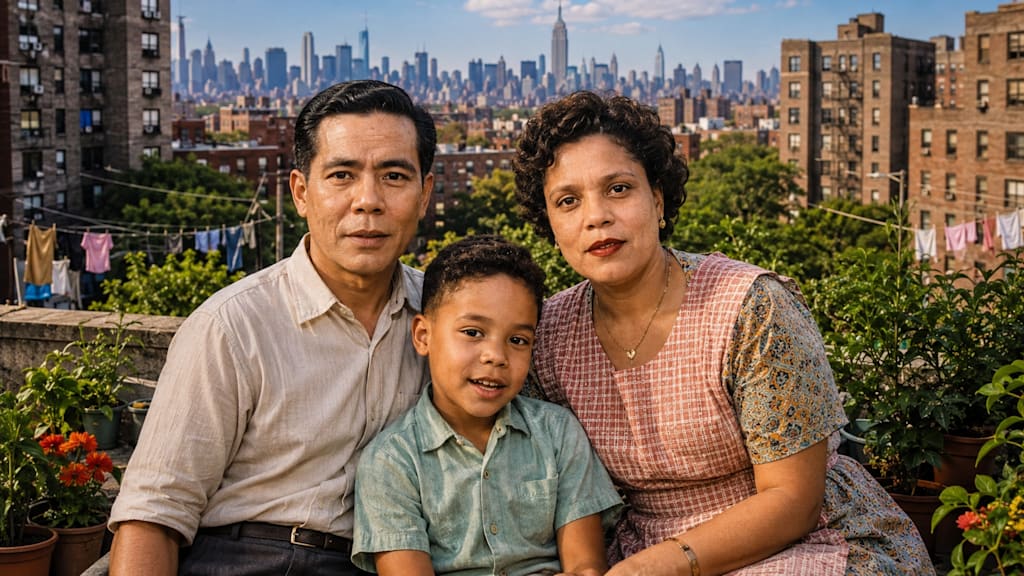
My parents created a life in low-income public housing, where poverty affected whole neighborhoods. Inside our apartment, they emphasized discipline and purpose. They prioritized education because they knew how fragile life was when society saw you as just disposable labor.
My father, in particular, feared that I would inherit his limitations.
“Learn English well,” he kept telling me in broken English. “People treat you differently.”
As a child, I misunderstood much of their struggle. I saw only exhaustion, strictness, and sacrifice. I did not yet grasp the psychological weight of spending decades in a society you could never fully decode.
America remained foreign to my father until the end.
He learned the language well enough to survive, but never well enough to feel fully comfortable. He understood customs intellectually, but never emotionally. Even after years in this country, there were moments when he still looked at the people around him as though trying to solve a puzzle that everyone else had mastered naturally.
The harder he worked, the more his body paid the price.
Resilience is often celebrated as if it were equally present in everyone, but it is not. Some people absorb suffering differently from others. Some adapt. Some endure quietly while damage accumulates beneath the surface.
My father carried stress like a man holding bricks to his chest year after year. Fear, exhaustion, discrimination, long hours, financial pressure, isolation — none of it ever truly left him. He learned to function while carrying it.
Until one day his body stopped cooperating.
He suffered a stroke and died at age forty-six.
I still remember how impossible that number felt. Forty-six was not old. Not even close. Yet his body had aged faster than his years, and decades of double shifts, poor sleep, relentless anxiety, and physical labor had exacted a toll.
My mother grieved him deeply, but she proved resilient in ways she herself probably never understood.
She continued forward.
She kept working. Kept surviving. Kept adapting to a world that had never fully welcomed her. Over time, her English improved, her confidence hardened, and her endurance became almost unbelievable. She outlived nearly everyone from those early immigrant years.
She passed away at ninety-four.
Sometimes I think about how differently two people can carry hardship, even when walking together through the same storm.
My father burned intensely and disappeared early on.
My mother bent but did not break.
Both entered America as outsiders, struggling to understand a society that often misunderstood them in return. Both sacrificed parts of themselves so their son could stand on more stable ground than they ever could.
And now, when I look back on their lives, I realize resilience is not a simple triumph story. It is uneven, complicated, and deeply human.
Some survive long enough to recover.
Others survive long enough to build a bridge for others to cross.
About the Creator
Anthony Chan
Chan Economics LLC, Public Speaker
Chief Global Economist & Public Speaker JPM Chase ('94-'19).
Senior Economist Barclays ('91-'94)
Economist, NY Federal Reserve ('89-'91)
Econ. Prof. (Univ. of Dayton, '86-'89)
Ph.D. Economics
Enjoyed the story? Support the Creator.
Subscribe for free to receive all their stories in your feed. You could also become a paid subscriber, letting them know you appreciate their work.
Comments
There are no comments for this story
Be the first to respond and start the conversation.