
House of Salt
A story about the cost of looking away

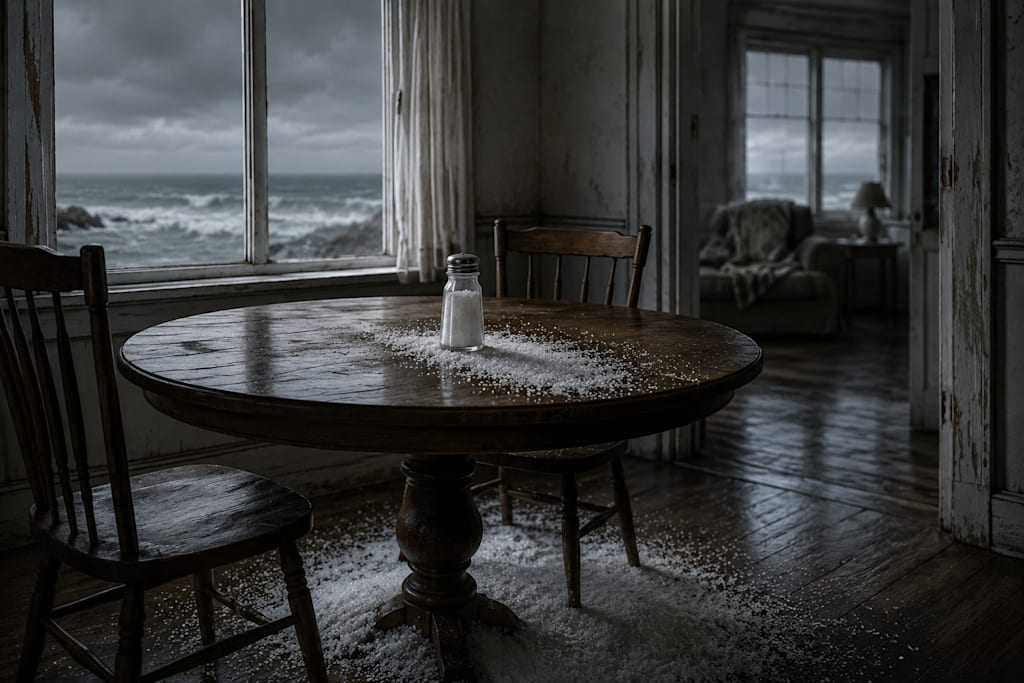
Martin took a second look at Sarah, squinting slightly this time, as he wasn’t quite sure what he was seeing. She looked thin, he thought, but not in the usual sense. She was still the same unassuming woman she’d always been, wholesome and clean in her dark blonde ponytail and soft grey sweater.
She was the same weight she’d been since they first met in college. But there appeared to be… less of her, somehow.
Sarah’s grey eyes stared out the window of their beach house at the crashing ocean waves. The way their color perfectly matched the murky skies above seemed eerie, Martin thought. It made her seem as if she was more there than here, and it gave him the shivers to think about it. The last time he was sick, he’d had a fever dream about her, a dream where she’d spontaneously faded into one of the wooden walls of their house, and something about the look on her face this morning as she absent-mindedly ate her cereal was reminding him of it.
“It looks like rain,” Sarah said, breaking the silence and abruptly jolting Martin out of his thoughts. “We weren’t supposed to get any today, but I suppose that’s just how it is around here now. Rain more often than not.”
Martin nodded as the silence filled the space between them once again. A gust of chilly ocean wind gently rattled the glass in the windows of the breakfast nook where they ate every morning, preparing to start their respective days, seemingly in answer to what Sarah had said.
She was right, though.
When they’d first moved here as a newly married couple, it had been for the abundance of sunshine glinting off of the then-placid ocean waters, even during much of the fall and winter. Now it seemed to be chilly, damp, and grey more often than not. And the wind howled now. Often. It had never been the type of wind to howl before.
Sometimes, when the skies grew very grey like they were right now, this wind almost sounded like it was crying, and it was downright unsettling.
With that, Sarah set her spoon down inside the now-empty cereal bowl before beginning to clear the breakfast dishes. And for a moment, Martin could have sworn he saw something strange – the clean, bone-white edge of the porcelain bowl through Sarah’s very fingers as she held it. But the illusion was only there for a moment, and then it was gone again as quickly as it came. After all, what could it have been but an illusion?
Sarah had always been a woman of few words – never the type to tell you what was really on her mind, even if you asked. Maybe she didn’t really know, Martin used to think, or perhaps she was simply the type of person who wanted to be read like a book.
He wished it were that easy – that he could simply open her, turn her pages, and read all the way to the end. Perhaps then he could begin to understand her.
Sarah had always been a volume, a puzzling history written in some ancient language nobody spoke anymore. But he used to like that about her, back when he’d first met her. Her stone-grey eyes, the mysterious smile that would flicker across her face when she’d look out over the ocean, lost in thought. He used to like how different she was from him.
He was present and social, the type of guy who was always happy to stop for a chat in town if he ran into someone he knew. He was solid, substantial, and reliable. If Sarah was a closed, foreign book that didn’t give up its secrets willingly, then Martin was the newspaper – factual, black-and-white, and filled with tangible everyday things from start to finish.
But facts can be boring and dry.
Sarah’s quiet mystery had added color to Martin’s life and given him something other than the minutiae of day-to-day life to think about. But she was a mystery he’d looked forward to solving one day. Like facts, mysteries can also be lackluster, especially once you come to the realization that you will never solve them. Old books you spend a long time reading and thinking about only to reach the end and realize the last hundred pages or so are missing altogether.
Sarah was like that to Martin now. A book without an ending, a problem without a solution. People like Martin could appreciate the unknowable in small doses. But ultimately, they needed solutions and conclusions, neat little endings that meet expectations and come gift-wrapped.
The day Martin told Sarah he was moving out was another grey one that came with the same choppy, steel ocean and rolling charcoal clouds overhead. She looked much the same as she always did – calm and collected, her cool grey eyes revealing little about how she had to have been feeling.
He’d leave her the house, he said. He’d bought it for her back when their relationship was still new and the sun shone on the water more often than the clouds rolled in.
It was her house more than it was his these days, anyway. He was hardly ever home anymore. He worked longer hours and preferred to come home late more often than not. He liked to be where people were, the air crackling with conversation about mundane, easy things Martin understood.
He told her all of these things, one after the other, her stony eyes studying him as he spoke. And he suddenly became painfully aware of just how much he’d been talking about himself.
“Can I ask you a question?” Sarah asked, her voice breaking ever so slightly. “Have you considered, even for a moment, how I might feel? What I might have needed that you weren’t giving?”
“Well, I’d just assumed you’d tell me if you wanted something,” Martin replied.
“Wanting and needing aren’t quite the same thing,” said Sarah. “Not the same thing at all.”
“Well, I can’t read your mind, Sarah,” snapped Martin. “I don’t have the energy. Or the time. Just thinking about trying makes me tired.”
“I never asked you to read my mind, Martin,” replied Sarah. “Just to listen now and then. I’d have hoped you’d know me better than that by now.”
“Does anyone really know you, Sarah?” Martin asked, running a frustrated hand through his salt-and-pepper hair.
“I guess maybe nobody really knows anyone,” Sarah said, shrugging in a defeated sort of way. “They only think they do. But all we really ever do is guess, and that doesn’t get anyone anywhere, does it?
“No, I suppose not,” said Martin, looking down at his feet.
And as he looked at his scuffed steel-toed work boots, he also happened to notice Sarah’s dainty white feet, bare as they always were when she spent time at home. And he was sure he saw it now – the familiar pattern of the weathered, grey floorboards underneath Sarah’s feet. Only he was seeing them through her feet somehow. Quite clearly.
“I’ll fade away without you, you know,” Sarah whispered tearfully. “Please don’t leave.”
Martin stared hard at Sarah’s faded feet with the solid wooden floor underneath them, and in that moment he wondered if what she was saying could be true in a literal sense. On some level, he even knew it, but he was tired of trying – tired of trying to solve the unsolvable mystery that was Sarah and learn the secret language of her thoughts.
“I have to,” he said, focusing intently on his own feet. He was afraid to meet her faded grey eyes for fear he’d see straight through them and out the back of her head, all the way to the wall behind her. “This isn’t what I want anymore. Maybe it never was.”
And with that, Martin walked out the door of the little beach house under the grey sky for the very last time.
Years later, Martin sat alone at a breakfast table of his own and thought of Sarah as he sprinkled the rubbery scrambled eggs on his plate with salt. No one knew where she’d gone after Martin had left, only that she’d disappeared, but Martin knew. Deep down in a distant corner of his heart he didn’t like to think about, he knew.
She’d told him in plain English right before he left – nothing figurative or mysterious about what she’d said at all, as it turned out. Martin wondered if maybe Sarah had been right, that all he’d ever had to do to understand her was listen. Perhaps she’d been a better communicator than he’d given her credit for.
But it hardly mattered now. Sarah was gone, faded away to nothing, just as she’d said. A quiet, grey-eyed woman who once lived by the great, grey sea under the dark, rolling skies but now didn’t live anywhere. And Martin regretted his decision, but it was too late now.
Some decisions couldn’t be undone, no matter how sorry one might be for them.
He stared at the white grains of salt in the shaker on the table. He thought of the story of Lot and his wife. The man who’d run from the crumbling city he once called home and the woman who couldn’t stop herself from looking back at the city’s destruction, even though she knew the consequences. He wondered what that must have been like, to collapse into a pile of salt because you couldn’t bear to let go of a life that meant something to you despite not being perfect. And then he realized he was beginning to understand all too well.
Some time later, when Martin hadn’t shown up for work, called his relatives, or kept plans he’d made with friends for weeks at a time, the authorities decided it was time to see what was what. But when the landlord let them in, Martin was nowhere to be found, although all his clothes and belongings were right where he left them.
In fact, everything was in its place, just as it should have been.
Except for an unexplainable quantity of gleaming white salt scattered across the dining room table and piled neatly on the floor underneath.
About the Creator
Shannon Hilson
Pro copywriter and storyteller chasing wonder and weirdness. Fiction, poetry, and occasional personal reflections live here.
✒️ Find me elsewhere via my Linktree
✒️ For business purposes and formal inquiries, please use my contact form
Enjoyed the story? Support the Creator.
Subscribe for free to receive all their stories in your feed. You could also become a paid subscriber, letting them know you appreciate their work.
Comments
There are no comments for this story
Be the first to respond and start the conversation.