
His Father Left Him a Shipyard — and a Fox Named Voss
When a young heir inherits a boardroom of wolves and a stopped chronometer, the hardest part isn’t the power — it’s learning to wind it.
Henry Hudson first held the brass seal at his father Robert's funeral. Carved on its underside was a three-masted barque—the ship that had brought the Hudsons their first load of timber out of Rotterdam a hundred and twenty years ago. The seal was cold, heavy as an unloaded gun. He turned it over in his palm, looked at it, then set it back down on the coffin lid. His mother wept beside him, but all he could hear was a voice inside his own skull: This thing does not belong in my hand.
He couldn't hold it. From day one.
Monday morning, the board met in the oak-panelled room on the third floor. Nine chairs, eight occupied, plus Henry himself. Conrad Voss, the professional manager, sat at the far end of the long table in a grey suit and gold-rimmed glasses, tapping one fingertip against the tabletop as he spoke, steady as a metronome.
"Overdue receivables on Dock Three have reached fourteen percent." Voss opened the leather-bound folder in front of him. "I recommend suspending the Nordic bulk-carrier orders and shifting capacity to the yacht-refit business."
Henry stared at the untouched black coffee beside Voss's hand and knew he ought to say something. He should have asked for the data source. He should have questioned the market size for yacht refits. He should have done anything a chairman was supposed to do. But his head was full of the ledgers he had found in his father's study the night before—columns of handwritten figures pressed into the paper with a ballpoint, numbers he couldn't read. Not that he couldn't read digits. He couldn't read how they bit into one another.
"Any comments from the board?" Henry asked, using his father's habitual tone.
Anton Müller, sitting third on the left—the Müller family held nineteen percent, and Henry had called him Uncle Anton as a boy—rested his cigar on the rim of the ashtray and looked at Henry with the expression of an older man watching a child shave for the first time. "Voss's proposal sounds reasonable. We'll defer to the professional."
There was no snarl of wolves. Something far worse: patience. All of them were patient, waiting for him to embarrass himself, or waiting for him to hand over the power himself. Henry didn't know which.
After the meeting, Voss lingered a step, sliding the folder towards Henry and a fountain pen with it. "Your signature is required. The notice to suspend the Nordic orders."
Henry picked up the pen. He noticed the red welt still pressed into the side of his right index finger from hauling funeral wreaths the day before. He signed. Only after the ink was dry did it hit him—he hadn't even asked Voss to pull up the breakdown of the overdue accounts.
The first crack split all the way to the ground that same night.
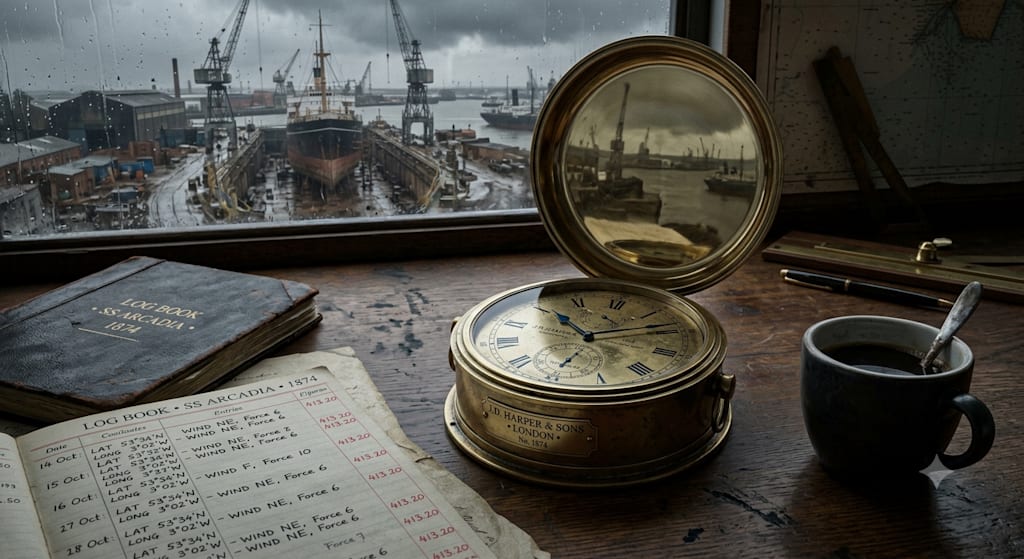
His mother called, her voice pitched low. "Voss had men move your father's ship's chronometer this afternoon." She meant the 1897 marine chronometer in its brass case, four generations in the Hudson family, the thing his father had wound first every morning. "He said the office needed reorganising. Taken away for safekeeping."
Henry stood at the edge of Dry Dock Five, phone pressed to his ear. Below him, the Baltic Princess lay open for a major refit; welding sparks fell into the water like broken stars. He wanted to say I'll get it back, but the words jammed in his throat and came out as, "I know, Mum." After he hung up, he stood there a long time, the sea wind snapping the hem of his jacket. He didn't realise he was biting his lip until he tasted blood.
It wasn't about the chronometer. It was Voss testing how far he could be pushed. And he had taken it.
Over the next three months, Voss planted every step straight into the jugular of the governance structure. First, for "decision-making efficiency," he changed monthly board meetings to quarterly. Then he recommended an independent external auditor—Helmut Fischer, partner at Fischer & Co., a silver-haired old man who spoke in slow, measured sentences and charged fees that made people blink. The board approved it unanimously. Henry voted yes because Uncle Anton had nudged him under the table with a boot.
Within Fischer's first week, the money trail on the Nordic orders was flagged. Not because of Henry—he didn't yet have the skill to create a problem. It was Voss. Confirmation letters went out to Stockholm and Oslo; the documents that returned showed that forty percent of the so-called overdue receivables were circular transfers through shell suppliers. The fox's tail had dragged a mark across the floor.
Late Friday afternoon, Fischer placed the report on Henry's desk. Not the boardroom table. Henry's desk, alone. The old man took off his spectacles, wiped them, and said, "Your father had me check Voss's travel expenses every year." He paused. "He only ever had me check. He never had me stop."
Henry stared at the figures circled in red ink, and in a lurch, everything fell into place. His father had kept Voss his entire career not because he trusted him, but because he needed a fox to stand between himself and the wolves on the board. And Fischer—the lock Fischer provided wasn't on Voss's hands. It was on Voss's boundary. His father had known how to use the three pieces: the board's greed checked each other, the manager's power was bound by the audit, and he himself stood in the middle, moving to the rhythm of that chronometer, winding when it needed winding, turning the hands when they needed turning.
But he had never taught Henry how to wind it.
That night, Henry went back to his father's study alone. On the desk still lay the last unfinished note, a ballpoint scrawl: Southampton project, keel delivery date—and then it stopped. He laid the audit report beside the note, then opened the drawer and took out the chronometer—the one Voss had moved, the one he had gone and retrieved himself that day. The clock had stopped. He opened the brass case, found the winding hole, fitted the key, and turned seventeen times. His fingers shook and ached, but he finished. The pendulum stirred—tentative, granular ticks at first, then steadied, finding its rhythm like a heartbeat picking itself back up.
He didn't turn on the light. He sat in his father's old leather chair and listened to the ship's clock running.
The next morning, Anton Müller met him at the shipyard gate. Old Müller had his cigar between his teeth. He looked at Henry's bloodshot eyes and chewed on a sentence for a long moment. "Your father, when he was twenty-three, mortgaged an old tug for a load of Swedish iron ore and nearly didn't make it back through a North Sea storm." He tapped his ash into the wind. "You don't have to start that way."
Henry didn't answer. He placed the thing he had clutched all night into Anton's hand—the brass key to the chronometer. "Keep this for me," he said. "Until I don't need anyone to kick me under the table."
Then he walked toward the office building. Voss's car was already in its space. The second audit team from Fischer's firm was checking in at the front desk. The March sea wind carried the smell of welding slag and tung oil.
Not being able to hold it is the rule. That's why the ones who designed the system never gambled on anyone being able to hold it.
About the Creator
Jin
Writer of reamstories
https://reamstories.com/jin
Enjoyed the story? Support the Creator.
Subscribe for free to receive all their stories in your feed. You could also become a paid subscriber, letting them know you appreciate their work.
Comments
There are no comments for this story
Be the first to respond and start the conversation.