
Her boyfriend disappeared. The hospital still refused to give her her baby's birth certificate.
A court in Liuzhou ordered the hospital to issue it. The case shows how a missing father can trap a newborn in paperwork.
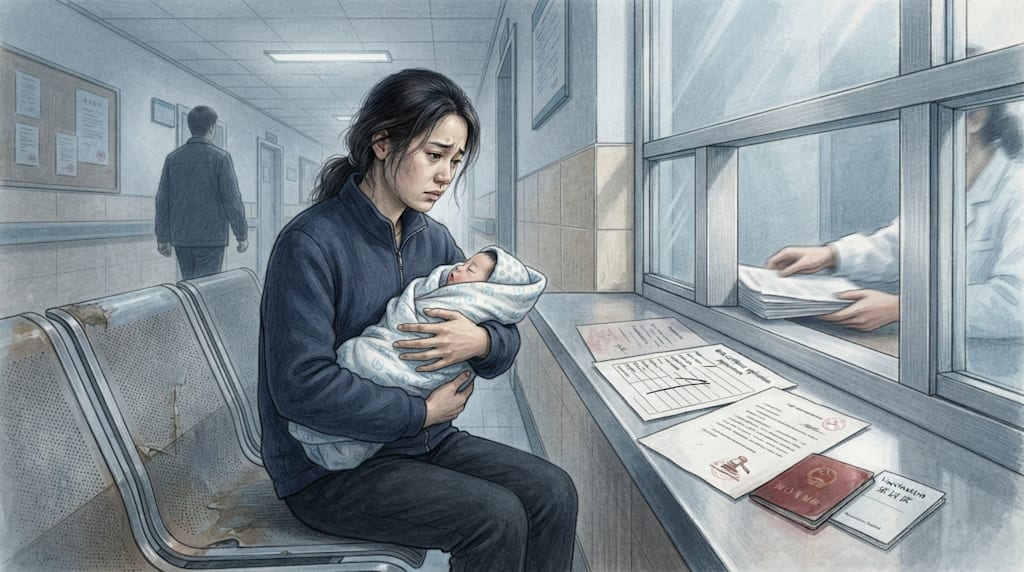
Father missing: where the birth certificate gets stuck
In February 2025, Ms. Zhang gave birth to a baby boy at a hospital in Liuzhou. When she filled out admission paperwork, she listed her boyfriend, Mr. Zhu, as the father. Mr. Zhu then disappeared. Ms. Zhang could not reach him by phone. He did not answer WeChat messages. She could not find him. She could not get his ID.
After the birth, Ms. Zhang applied for the birth medical certificate. She asked the hospital to put "/" in the father's field under the rule for "cannot provide information about the newborn's father." The hospital said no. Its reason: the prenatal and hospitalization records already listed Mr. Zhu. To change or delete that information, she needed proof. To keep it, Mr. Zhu had to come in person with his ID. Mr. Zhu was gone. Neither path worked. Without the certificate, the child's household registration and vaccinations stalled. In December 2025, Ms. Zhang applied again. The hospital refused again, saying she could not provide valid ID for the father. Ms. Zhang sued. The Liunan District People's Court heard the case as a failure to perform statutory duties. It ordered the hospital to issue the certificate.
Three procedures sit inside this case. People often mix them up. Separating them shows where Ms. Zhang got stuck.
Prenatal registration: a medical record, not a legal confirmation
During prenatal checkups and hospitalization, the hospital asks for the father's information. That information goes into the medical record. Its purpose is to record. The hospital does not check the man's ID. It does not run a paternity test. The pregnant woman declares the information. The hospital records it. Ms. Zhang wrote down Mr. Zhu. That act did not create a legal father-child relationship. Mr. Zhu never came to the hospital. He never signed. He was never verified. The record does not equal "the father's information has been confirmed."
Birth medical certificate: first issuance and change/deletion are two different procedures
The birth medical certificate is not an ordinary hospital certificate. A legally authorized healthcare institution issues it. It is used for household registration, nationality, medical insurance, vaccination, and school enrollment. Under China's birth certificate rules, if the mother "cannot provide information about the newborn's father," she can submit a written declaration signed by herself. The issuing institution then puts "/" in the father's field and issues the certificate. This procedure does not require a paternity test or the man's cooperation.
If the father's information is already registered on the birth certificate, changing or deleting it usually requires a paternity test. Once registered, it can trigger the man's right to know, parental rights, and child support obligations. It cannot be deleted casually.
Ms. Zhang's situation: she had filled in Mr. Zhu in the prenatal and hospitalization records. Mr. Zhu never came to verify anything. He never appeared when the birth certificate was issued. The hospital treated this "unilateral entry but unconfirmed" state as "father's information already registered." It told her to use the deletion procedure. Deletion requires a paternity test. The man had disappeared, so that was impossible. The hospital then said she could keep the information. Keeping it required Mr. Zhu to appear with his ID. That was also impossible. Both paths were blocked.
After trial, the court found that when Ms. Zhang applied for the certificate, her situation fell under "cannot provide information about the newborn's father," not "change or deletion." The hospital had classified it wrong.
Why the hospital's refusal does not hold up legally
When issuing a birth medical certificate, the hospital has only formal review power. It checks whether ID documents are valid and whether hospitalization and delivery records match the parents' information. The hospital has no authority to decide whether Mr. Zhu is the biological father. A paternity test requires both parties. The hospital cannot run one, and it should not try.
Mr. Zhu's name came from Ms. Zhang alone. He never came to the hospital. He never showed ID. He never signed. Based on the mother's unilateral entry, the man cannot be legally confirmed as the child's father. The court focused on this: the man had not verified the information, and the mother could not provide his valid ID. The case should be handled as "cannot provide information about the father."
The hospital pushed the consequences of "unable to verify" onto the mother and the newborn. The man was gone. A paternity test was impossible. The man could not appear. The child could not get the birth certificate. Household registration, insurance, and vaccination were affected. By refusing to issue the certificate because it could not verify, the hospital used the limits of formal review to block a citizen's statutory rights.
Basis for the court's judgment
Article 23 of the Maternal and Infant Health Care Law of the People's Republic of China says healthcare institutions must issue a uniformly produced birth medical certificate for newborns under State Council health department rules. For eligible citizens, medical institutions must issue the certificate. They cannot pick and choose whether to issue it or delay it.
Article 1071 of the Civil Code of the People's Republic of China says children born out of wedlock have the same rights as children born in wedlock. No organization or individual may harm or discriminate against them. The birth medical certificate is a prerequisite for making this equal right real. Without it, household registration is hard. Vaccination and school enrollment also become hard.
The Law of the People's Republic of China on the Protection of Minors sets out the principle of "the best interests of the minor." Officials handling matters involving minors must follow this principle. Emotional disputes between parents and the father's disappearance should not become reasons a child cannot obtain legal status.
The court's order that the hospital issue the certificate is a performance judgment. It confirms that the hospital had a statutory duty and refused to perform it without justified reason. The court put Ms. Zhang's case under "cannot provide information about the newborn's father" and ordered "/" in the father's field. If the man later appears and asserts his rights, paternity can be confirmed separately through a paternity test or litigation. The risk should not be shifted onto the newborn in advance.
Where is the institutional loophole?
Current rules lack clear guidance for an intermediate state. The mother filled in the man's information during prenatal checkups. The man later disappeared. The information can neither be retained nor deleted. The hospital will not process it, fearing the man may pursue responsibility later. The mother cannot get it processed because the man will not cooperate. The child falls through a gap in the rules.
Three fixes would prevent this.
First, unify the rules at the national level. Clarify that information the mother filled in alone, without the man's verification, does not formally confirm fatherhood when the birth certificate is first issued. If the mother submits a written declaration that she cannot provide the father's information, she should be allowed to put "/" in the father's field.
Second, create a "unilateral declaration plus later objection" mechanism. After the mother applies for a single-parent birth certificate, the man can later assert his rights. He can confirm the parent-child relationship through a paternity test and litigation. Then the father's information can be changed or added under the law. The child gets registered on time. The man's rights are not stripped away.
Third, hospitals should tell mothers clearly during prenatal checkups and hospitalization. They should explain the legal consequences of filling in the father's information. If the man does not cooperate, the birth certificate process may be affected. Let the parties choose with full knowledge instead of falling into a dead end later.
Practical advice for parties in similar situations
Be careful about filling in the father's information during prenatal checkups and hospitalization. If the man is unwilling to cooperate or the relationship is unstable, think early about whether to fill it in. If you decide not to, apply for a single-parent birth certificate under the "cannot provide information about the father" procedure.
After the man disappears, submit a written declaration as early as possible. State clearly that you cannot provide the father's information. Ask the hospital to put "/" in the father's field under the rules.
Keep evidence of the disappearance. Call records, WeChat records, text messages, and police receipts can show that the man cannot be contacted.
If the hospital refuses to process the application, ask for a written reason. It should state the legal basis and the conditions for processing.
File a complaint with the health commission, apply for administrative reconsideration, or file administrative litigation to require the hospital to perform its statutory duties.
For hospitals: distinguish "first issuance" from "change/deletion." Do not treat unverified information from the mother as legally confirmed father's information. Do not refuse a mother's unilateral application for a birth certificate because the man has not appeared. When a case is difficult, ask the higher competent department for instructions instead of pushing the problem onto the parties.
Ms. Zhang got the birth medical certificate. She went to the police station to register the child's household. The officer saw "/" in the father's field and entered it into the system. The child had a household registration. On the vaccination booklet, the father's field was also "/." Ms. Zhang put the booklet in her bag and took her son to get vaccinated.
About the Creator
Jin
Writer of reamstories
https://reamstories.com/jin
Enjoyed the story? Support the Creator.
Subscribe for free to receive all their stories in your feed. You could also become a paid subscriber, letting them know you appreciate their work.
Comments
There are no comments for this story
Be the first to respond and start the conversation.