
He Wrote Code to Save His Girlfriend. Then the Hospital Went Dark.
A programmer, a specialist appointment, and the 12,900 yuan that ended in prison.
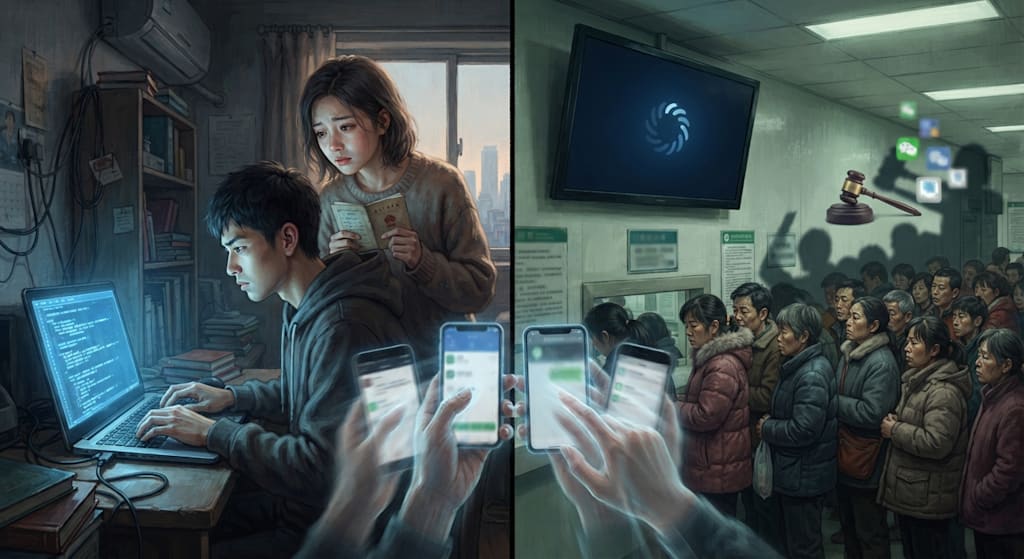
At 7 a.m. on July 5, 2024, the registration system of a hospital in Wuhan froze.
Not slow. Dead. The department list on the screen kept spinning. Pressing the appointment button did nothing. People in line began to curse. A security guard walked over. A technician ran into the server room. They did not know that at that moment, four people in four corners of the city had pressed “Start” at the same time.
Zhou Ming was one of them.
On his computer screen, lines of code were scrolling. Wang Lin stood behind him, clutching a medical record book. Her stomach was bad. She had been seeing specialists for half a year and had never once managed to book an appointment. Zhou Ming said, I’ll write you one. He wrote it for three days. When the program ran, it could click more than a thousand times a second. The fastest human hand could click six or seven times a second. When appointments were released, other people were still clicking. His program had already finished.
Wang Lin got one. The first time, the second time, the third time. She went every week. Acquaintances began to ask, How did you get the appointment? Wang Lin said, My boyfriend did it for me. The acquaintance said, Can you get me one? Wang Lin said, I’ll ask him.
Zhou Ming said, Sure.
At first they did not charge. Later, as more people came, Wang Lin said, Let’s charge a little. We can’t work for free. Zhou Ming said, Okay. Wang Lin took orders on WeChat. Zhou Ming operated the computer. One appointment, plus one hundred, two hundred, three hundred. Some people paid. Some did not. If they did not pay, Wang Lin did not press them. She was not cut out for business, but she knew how to talk. Zhou Ming did not know how to talk. He only knew how to write code.
On July 5, 2024, Zhou Ming took an order. At the same time, three other scalpers were also grabbing appointments. Four people, four computers, four programs, a thousand clicks per second each, all crashing into the hospital’s registration system. The system could not hold. It collapsed.
The hospital called the police. On August 8, Zhou Ming and Wang Lin were arrested. Investigators found that Zhou Ming had made 12,900 yuan in profit. In Wang Lin’s WeChat balance, the money had come in one transfer at a time. The largest was five hundred. The smallest was fifty.
On July 16, 2025, the court ruled. Zhou Ming was convicted of the crime of disrupting computer information systems and sentenced to twelve months in prison. Wang Lin was an accessory and was sentenced to ten months in prison, suspended for one year.
The charge: disrupting computer information systems
Article 286, paragraph 1, of the Criminal Law: Whoever, in violation of state regulations, deletes, modifies, adds to, or interferes with the functions of a computer information system, causing the computer information system to fail to operate normally, and the consequences are serious, shall be sentenced to fixed-term imprisonment of not more than five years or criminal detention.
Zhou Ming’s program did not delete data, modify code, or add modules. What it did was “interfere.” A thousand requests per second is not the speed of human clicking. The hospital’s registration system was designed for the operating frequency of human hands. Suddenly four machines poured in, each clicking at a thousand times the speed. System resources were exhausted, and normal users could not access it. That is “interference.”
“Serious consequences” has a standard. The judicial interpretation by the Supreme People’s Court and the Supreme People’s Procuratorate provides that illegal gains of 5,000 yuan or more, or economic losses of 10,000 yuan or more, constitute “serious consequences.” Zhou Ming made 12,900 yuan, more than twice the threshold.
The lawyer met Zhou Ming once in the visiting room. The lawyer took out two pieces of paper, one with “285” and one with “286.” The lawyer said, 285 is the crime of providing programs or tools for intruding into or illegally controlling computer information systems. 286 is the crime of disrupting computer information systems. What is the difference? 285 punishes the person who provides the tool. 286 punishes the person who uses the tool and causes consequences. You wrote the program, used the program, and caused the system to collapse. 286 is more accurate.
Zhou Ming asked, What if I wrote the program but only let others use it, and did not use it myself? The lawyer said, Then it might be 285. Zhou Ming did not ask again.
The other three scalpers were not co-defendants in the same joint crime
At 7 a.m. on July 5, 2024, Zhou Ming and three other people were grabbing appointments at the same time. The four had not discussed it, had no division of labor, and had no communication of criminal intent. They just happened to use the same method to do the same thing at the same time. In law, this is called “simultaneous offenders,” not “joint crime.”
Joint crime requires two or more people, a common criminal intent, and communication of criminal intent. Zhou Ming and Wang Lin had that. Wang Lin solicited clients, handled customers, and collected money. Zhou Ming operated the software, grabbed appointments, and sold them at a markup. Wang Lin replied on WeChat, “Can grab.” Zhou Ming pressed run at the computer. The two had a clear division of labor and cooperated with each other. So Zhou Ming and Wang Lin committed a joint crime.
Wang Lin was an accessory. Article 27 of the Criminal Law provides that an accessory shall be given a lighter or reduced punishment or be exempted from punishment. Wang Lin was responsible for auxiliary work. She did not write code. She did not operate the software. She only took orders and collected money. Zhou Ming was the principal offender. He wrote the code, operated the software, and caused the system to collapse. The court gave Zhou Ming a prison sentence and Wang Lin probation. The difference came from the division of labor.
12,900 yuan, one transfer at a time
In Zhou Ming’s computer there was a folder named “Registration.” Inside was a spreadsheet recording every order. Date, client name, hospital, department, specialist, amount. The largest was five hundred. The smallest was fifty. The last column was “Status,” some marked “Booked,” some marked “Not booked.” For those not booked, Wang Lin would refund the money.
12,900 yuan was the sum of those numbers. In Wang Lin’s WeChat balance, the money came in one transfer at a time. Sometimes in the morning, sometimes in the middle of the night. Her phone screen lit up with a WeChat notice: “Payment received.” She opened it, took a look, and went back to sleep. Zhou Ming did not know exactly how much money there was. He was only responsible for grabbing. Wang Lin knew, but she had never added it up. It was not until the police printed out the spreadsheet that she saw the number.
12,900 yuan is more than twice the threshold for criminal liability. If it had been only 5,000 yuan, the case might not have reached criminal prosecution. If it had been only 1,000 yuan, it might have been only an administrative penalty. But 12,900 yuan was enough.
Specialist appointment anxiety and the “medical escort” disguise
Zhou Ming and Wang Lin were not professional scalpers. They had jobs, lives, love. Zhou Ming wrote code to help his girlfriend. Wang Lin charged money because more and more acquaintances asked. They slid from “helping” into “business” without realizing it.
Professional scalpers are on the platforms. You go on Xianyu. Search “registration.” You cannot find it. Search “medical escort.” You can find a lot. Click in. Ask in the chat box, “Can you grab an appointment?” The other side replies instantly, “Yes.” The page says “medical escort,” but in fact it is “proxy booking.” The platform blocked the word “registration,” so the scalpers put on a new disguise.
Specialist appointments are hard to book because there are few good doctors and many patients. A specialist at a top-tier hospital sees only a few dozen patients a day. When appointments are released, they are gone in a second. An ordinary person holds a phone, clicks until their finger breaks, and still cannot beat a program. Zhou Ming’s program did a thousand clicks a second. A professional scalper’s program might be faster.
The hospital did have risk controls. Real-name registration, verification codes, rate limiting, waiting lists. But the arms race between risk controls and appointment-grabbing software has never stopped. After Zhou Ming was released from prison, he saw that the hospital’s registration page had added a slider verification. He laughed, and then he did not laugh. He knew the slider could also be cracked. It was just more expensive.
The code was not neutral
“Technology is neutral” is an easy thing to say. Technology itself has no good or evil, but the people who use it do. When Zhou Ming wrote the code, he never thought it would paralyze the system. He was thinking of getting Wang Lin an appointment. Later he was thinking of getting acquaintances an appointment. Later still he was thinking of charging a little money, because he could not work for free.
At every step, he felt it was nothing. Helping acquaintances for free was kindness. Charging acquaintances was payment for labor. Until the system collapsed, until the police came, until the judge pronounced sentence.
Code can run faster than a person, but it cannot outrun the law. The law does not punish love, but it punishes crossing the line in the name of love. Zhou Ming loved Wang Lin. That was not wrong. But he used technology to interfere with the normal operation of the hospital’s registration system. That was wrong. He loved her. That did not make the interference legal. He could write code. That did not make the system his to break.
The day of the verdict
When the judge read the verdict, Zhou Ming stood in the defendant’s dock. His fingers tapped under the table, once, once, once. As if typing on a keyboard. Wang Lin sat in the gallery, clutching the medical record book. The corner of the book was curled. She kept clutching it.
After the verdict, the bailiff led Zhou Ming away. Wang Lin stood up, wanted to say something, but could not. Zhou Ming turned and looked at her, and also said nothing.
Later, Wang Lin put stomach medicine into Zhou Ming’s bag. In Zhou Ming’s bag there was also an appointment slip from June 2024, a specialist appointment, gastroenterology. The slip was already wrinkled, but the words were still clear.
The day Zhou Ming was released, Wang Lin did not go to meet him. She was in line at the hospital, using her phone to book an appointment. Her finger tapped, once, once, very slowly. The department list on the screen spun. She pressed the appointment button. Nothing happened. She waited a while, then pressed again.
The appointment was released. She did not get it.
She put the phone in her pocket and looked up at the screen in the registration hall. The screen scrolled through department names, specialist names, remaining appointments. She looked for a long time.
Then she walked out of the hospital and bought a bottle of water by the roadside. She twisted it open and took a sip. Sunlight fell on her face. She narrowed her eyes.
Her phone rang. It was a message from Zhou Ming: “Any appointments today?”
She typed: “No.”
She thought for a moment, then typed another line: “Try again tomorrow.”
Send.
She put the phone away and kept walking.
About the Creator
Jin
Writer of reamstories
https://reamstories.com/jin
Enjoyed the story? Support the Creator.
Subscribe for free to receive all their stories in your feed. You could also become a paid subscriber, letting them know you appreciate their work.
Comments
There are no comments for this story
Be the first to respond and start the conversation.