
He Conned Women, Then Bought a $2 Ticket He Refused to Scratch.
The box wasn’t evidence. The box was a self-made prison where redemption is always one scratch away — and always untaken.
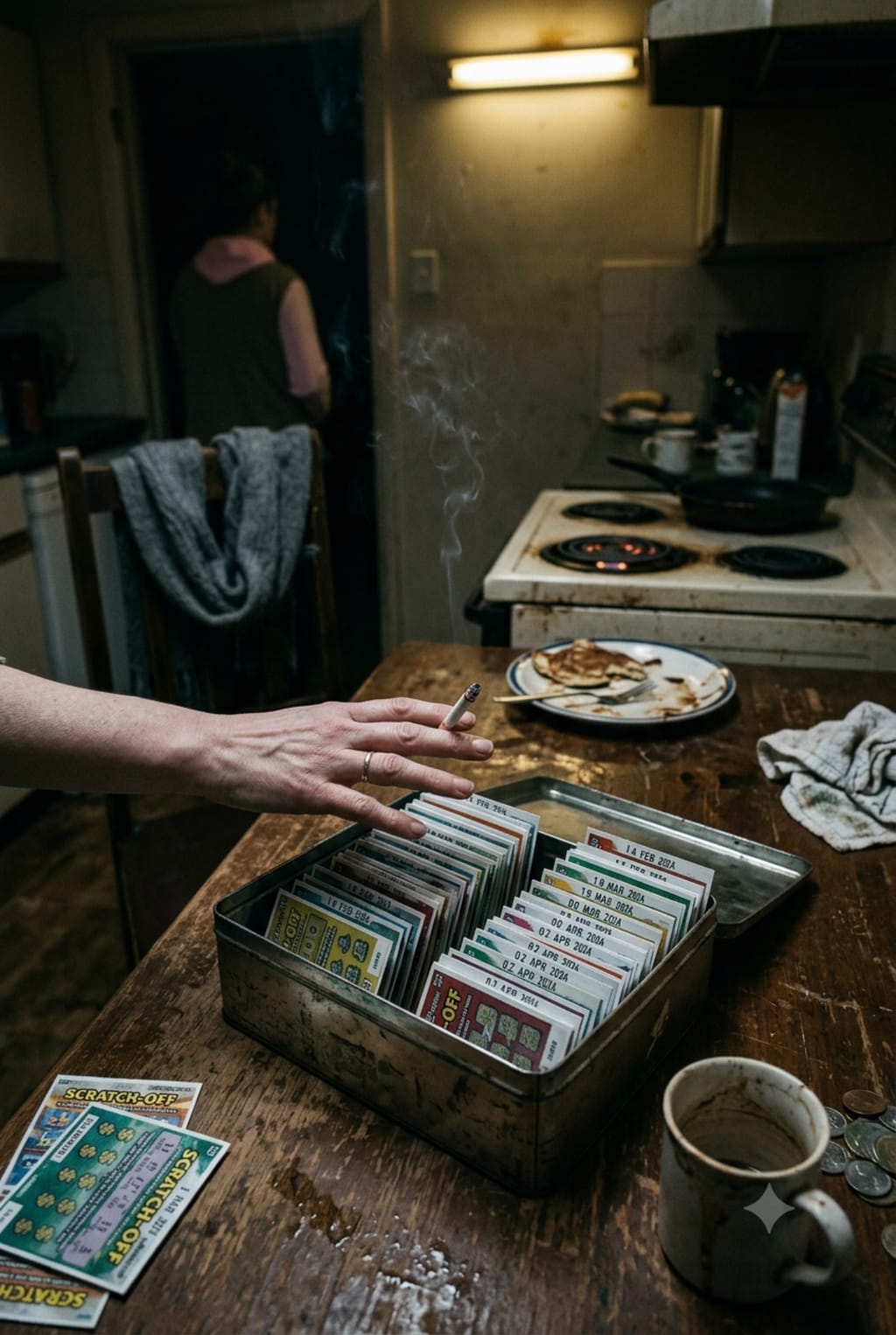
Leo has a tin box. What's inside isn't money.
He spent two years folding sheets in the laundry room of the Ritz‑Carlton downtown. He could tell a bespoke shirt from off‑the‑rack just by looking at the seams. Tony from housekeeping said he was the only server who'd check the stitching with his fingers. Leo didn't answer. He was soaking a wine‑stained cuff in soda water, the temperature held steady at forty degrees.
He didn't drink, but he knew which wine went with which dish, knew the exact shade of ash a properly rolled cigar should leave. He'd learned all of it from the trash, not by digging through it, but by watching. When he cleaned rooms, he noted what shopping bags the guests had thrown out. When he cleared tables in the dining room, he saw which plates came back unfinished.
He started at the hotel at twenty‑two. By twenty‑four, he'd worked his way to the front desk. At twenty‑five, he saved up his first real sum.
It didn't come from his paycheck.
The summer after high school graduation, a girl named Emily sent him eight hundred dollars—money she'd saved from her summer job.
Her name wasn't Emily. He found that out later. It was just her Instagram handle.
He took her to Denny's. She wore a pink T‑shirt, the collar a little stretched from washing. She kept tucking her hair behind her ear while she talked. He told her he was a college student back for the summer, studying finance at a state school. She asked what college was like. He said the workload was heavy, but you got used to it.
When the check came, he opened his wallet, flipped through it, and frowned.
"Card must be demagnetized."
Emily looked at the bill. A little over thirty dollars. She said no problem, she'd get it.
Outside the restaurant, he said wait here, I'll hit the ATM across the street and pay you back. She stood in the parking lot for forty minutes. He never came back.
He went to the 7‑Eleven next door.
A pack of Marlboro Golds, seven bucks. A scratch‑off ticket, two. He stood outside the 7‑Eleven, tore open the pack, and lit one. The first drag made him cough. On the second, he held it in. He put the pack in his pocket and walked three miles home. He didn't take the bus.
That scratch‑off never made it into the tin box.
He scratched it that same night. Nothing. He dropped it in the dumpster in the hotel's back alley. First thing he ever threw in that dumpster. Over the years, he threw in a lot more.
Leo could play poker without looking at his cards.
Not the kind where you feel the edges—he just remembered the order every card hit the muck. He lived in the hotel staff dorm for three years, went through two sets of roommates, and every single one of them lost money to him. He never won big, two hundred tops. Any more and people start to remember.
His teacher was an old‑timer named Sal, the shift lead who trained him when he first started. Old Sal said Leo had a pair of naturals—thin, pale hands with even knuckles, dealing cards like he was touching a woman's wrist. Leo didn't laugh. Old Sal taught him one thing: at the table, the most dangerous man isn't the one who knows how to play. It's the one who knows when to lose.
Leo learned to fold on the twelfth hand.
After every loss, he'd say the same thing: bad run. Then he'd push his cards in, stand up, and go pour himself a coffee.
He used that habit in other places.
In the autumn, he turned twenty‑six, and he was working part‑time at a riding club, feeding horses, when he met Grace.
She wasn't there to ride. She'd come with a friend. She stood outside the ring in flat shoes, watching. Her friend was inside on a chestnut warmblood, but the photos Grace took on her phone—every single one—didn't show the person on the horse. She was shooting the sand the hooves kicked up.
Leo brought a tray of carrots over to the chestnut.
She looked at him. "What's his name?"
"Reuben."
"Why Reuben?"
"Because he's got something in the middle." Leo snapped a carrot in half and offered it to the horse. "His sire's Rye. His dam's Corned Beef."
Grace laughed. When she laughed, her mouth went a little crooked.
She wasn't a beautiful woman. Her beauty took three looks to land. The next day, Leo still remembered the color of her shoes. Dark grey, suede, the toe scuffed down to show the lighter leather underneath.
They got together the old‑fashioned way—added each other on Facebook, messaged for a week, then he showed up at her shop and ordered a pancake.
She ran a tiny pancake place out in Brooklyn, a storefront so narrow two people could barely squeeze in. The menu was chalked on a blackboard on the wall, the corners smudged from being rewritten. She cooked alone, took the money alone, and washed the dishes alone.
Leo went four days in a row.
On the fifth day, Grace set the pancake down and said, "You're not here for the pancakes."
"Then what am I here for?"
"To settle up."
She pushed the money he'd paid over the past four days back across the table, a stack of small bills, tucked under the syrup bottle.
"You never use syrup," she said. "Every single plate, no syrup. But without it, they're too dry, so you always leave the edges."
"You pay attention."
"That's how I make a living." She draped her dishrag over her shoulder. "What do you do?"
Leo looked at the money. A little over a hundred. He pushed it back. "Guess."
Grace didn't guess. She sat down across from him, pulled a pack of cigarettes from her apron pocket, and held one out to him. He took it.
She lit it for him with a lighter from a gas station, the free kind with a repair shop's phone number printed on the side.
"I've seen your type before," she said. "Not a single word wasted. The way you're nice to people doesn't feel like real nice. More like something you practiced."
Leo tapped his ash into the pancake plate.
"Then why'd you light my cigarette?"
Grace thought about it. She stubbed out her own smoke and stood up.
"Because every time you eat here, you pick the onions out and line them up on the side of the plate. You don't eat onions. But you never said so."
She went back into the kitchen.
Leo sat at the table for a long time. The pancake went cold. The syrup set into a skin on the plate.
He took out his phone and snapped a photo.
He had an album on his phone named "Row 3 Section A," the kind of name that sounded like a parking garage marker. Thirty‑two photos inside. With the cold pancake, thirty‑three.
The first thirty‑two included: a girl's pink T‑shirt—just the shoulder, no face—a 7‑Eleven receipt, a bowl of soup he never finished, a shipping box, a pair of dark grey suede shoes.
He saved the photo and locked the screen.
Three months later, Leo moved out of the staff dorm.
Grace's pancake shop opened at six in the morning. He'd show up at five‑forty and push the rolling shutter up for her. The door was heavy. When you pushed it, it made a sound like bone scraping. The first time, he nearly crushed his hand. By the thirtieth day, he could do it one‑handed.
He stopped eating pancakes. He cooked his own pasta.
There was a hot plate in the kitchen. He'd boil spaghetti, crack an egg into it, and add no salt. Grace said even a dog wouldn't eat that. After he finished, he'd wash the bowl, wipe down the stove twice, fold the dishrag into a square, and leave it by the sink. The folding technique was the Ritz‑Carlton standard.
Once, Grace leaned against the kitchen doorframe and watched him wash a bowl for the length of an entire cigarette.
"You take four minutes on one bowl."
"You got a problem with that?"
"No." She stubbed her cigarette out in the sink. "I'm just counting. Twenty‑some years of washing bowls, twenty‑some years of folding dishrags. Trying to figure out what you're paying back."
The faucet was still running. Leo's hands stopped under the water.
A few seconds later, he kept washing. "Washing a bowl is washing a bowl," he said.
He never told her what he'd done.
Not that he didn't want to. It was that if he told her, he'd have to explain all over again who he was.
He never learned the name of the girl who waited for him outside Denny's. All he remembered was the pink T‑shirt. The collar stretched just enough to show a strap of a white bra underneath. When she talked, she didn't look at you; she looked at the ground. When she handed him the money, her hand moved fast, like she was afraid of embarrassing him.
He wasn't embarrassed.
He took her money and bought cigarettes and a scratch‑off. He finished the pack. The ticket was a dud. He slept fine that night.
After he threw that ticket away, he bought a second. A third. All scratch‑offs, all two dollars. Every time he conned a new woman, he bought one. He didn't know what he was hoping to win.
The scratch‑offs in the tin box weren't evidence.
The evidence he threw away. What he kept in the box were the ones he bought later. The ones he never scratched.
The first time Grace came into his room, she saw the tin box on his nightstand.
"What's this?"
"Junk."
She opened it. Inside were dozens of scratch‑off tickets, arranged by date in neat rows. The earliest one was from three years ago.
"Why do you have so many of these?"
Leo leaned back against the headboard. The fluorescent tube over the bed had a loose connection and kept flickering.
"Waiting till I win to scratch them."
"What are you waiting for?"
He didn't answer.
Outside on the street, a scrap collector pedaled past on a tricycle, shouting in Spanish about old appliances.
Grace closed the tin box.
"Leo," she said, "you're not that hard to figure out."
She didn't push it. That night she slept beside him, her back turned. Her back was thin. You could see her spine, knob after knob, like a row of cookie dough rounds that never made it into the oven.
At three in the morning, she rolled over. Her hand landed on his chest.
His heartbeat was slow and steady.
She talked in her sleep. What she said was: Onions don't cost extra. You can just say so.
Leo put his hand on top of hers.
Didn't move it. Just let it rest there.
She left on her own.
No confrontation, no fight. One afternoon she closed the pancake shop, locked the door, and taped a note to it: Family thing. Closed for three days.
She didn't open on the fourth.
On the fourth day, Leo got a package in the mail.
Inside the box was his razor, a grey scarf, and a note. The note had one line on it. People who don't eat onions can't eat pancakes, but you could have told me.
He didn't keep the note.
He burned it. In the hotel's back alley, he dropped it into that same dumpster and held a lighter to it. The flame lasted maybe ten seconds.
When it was out he crouched by the dumpster for a long time. There was a stray cat in the alley, grey, with a bad back leg. The right one was a little shorter than the rest. It walked past, stopped and looked at him, then kept going.
He went back to work.
He started noticing things he'd never seen before. The corner of the kitchen ceiling had a patch of mold shaped like Florida. In the staff changing room, a coat had hung on the hook so long the cuffs were worn glossy. These things had always been there. He'd only seen what he wanted to see.
That night he went back to that 7‑Eleven.
Not the same one. That one had been torn down years ago. A 7‑Eleven near Brooklyn, same storefront, same lights. He walked in and bought a pack of Marlboro Golds, seven bucks, and a scratch‑off ticket, two.
Outside, he tore the pack open. The first drag still made him cough. On the second, he held it in.
He put the scratch‑off in the tin box.
The box was full now. Ticket after ticket. None of them scratched.
He closed the lid. His fingers rested on it for a moment.
Outside, the scrap collector's voice came through again, the Spanish over the loudspeaker distorting like the batteries were dying.
The voice cut out mid‑word.
Leo stood up.
He opened the tin box and took out a scratch‑off from two years ago. Then one from last year. He laid them side by side on the table.
He didn't scratch them.
He just lined them up, the way you'd stack chips at a poker table. One by one, edges flush.
Then he put them back.
Closed the box. Turned off the light.
In the dark, the tin box gave off no shine.
About the Creator
Jin
Writer of reamstories
https://reamstories.com/jin
Enjoyed the story? Support the Creator.
Subscribe for free to receive all their stories in your feed. You could also become a paid subscriber, letting them know you appreciate their work.
Comments
There are no comments for this story
Be the first to respond and start the conversation.