
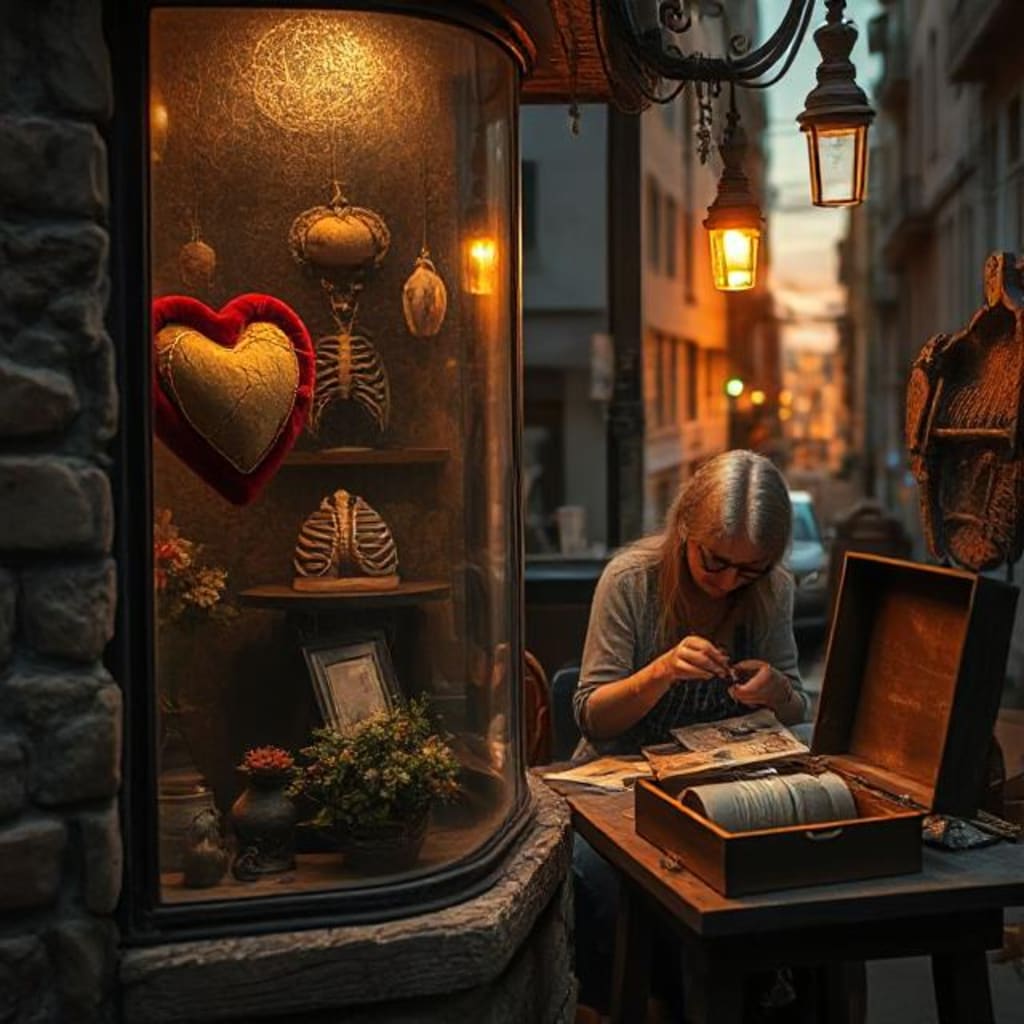
The small shop sat on a quiet block, between a tattoo parlor and a boarded-up bakery, as if it had sprouted there by chance. Its hand-painted sign said simply: “MEND.”
Most people walked past without a second look. No flashing neon lights, no glassy displays. Just a dusty glass case packed with strange and tenuous little things — porcelain hands, hearts sewn from velvet, cracked mirrors cambered like wings.
But Mara saw it.
Or maybe felt it.
She’d spent hours walking that cold Tuesday, a half-finished cup of coffee cradled in her hand as if it could keep her together. She wasn’t even sure which part of the city she had wandered into, but when she looked up and saw the shop, something in her shifted. Not healed. Not warmed. Just… moved.
The bell above the door jangled like a meek breath.
The inside smelled of lavender and aged wood. Silence, except for the quiet ticking of numerous clocks — none of them at the same time.
A man was repairing something delicate and poor behind the counter. His hands moved slowly, reverently, as though the object would talk back if he didn’t take his time.
Without looking up, he said, “Take your time.”
Mara wandered. She had not intended to, but her feet made her. Things strange and beautiful sat on every shelf. A sea-glass music box. A cracked bowl with gilt-tinged seams. Dolls with stitched mouths and poems stuffed into their sleeves.
She stopped at a glass case containing a human ribcage — painstakingly wired together, painted in soft pastels, stuffed with moss and tiny blooming flowers.
The tag said: Hearts grow differently.
She didn’t even notice she was crying until a tear dripped to the floor.
The man finally looked up.
His hair was silver but not old. His gaze offered no judgment, only spaciousness, as though he had seen so many forms of suffering that none could surprise him.
“You discovered something,” he told me softly.
Mara nodded. “I don’t know what.”
“That’s alright. Most of what we need finds us, before we understand it.”
She almost left then. But her hand — traitor that it was — crept into her coat and extracted the little box she’d walked around with for weeks.
It was metal. Scratched. Bent along one corner. Inside was a wrinkled letter she did not have the strength to reread, a silver ring with initials she could no longer say out loud, and a picture that had started to fade — two girls laughing on a rooftop in spring.
She placed it on the counter.
“I just don’t know what to do with it,” she said. Her voice was quieter than normal.
Man stared at it for a long time.
“I don’t throw things out,” he said. “I remake them.”
He opened the box. Intact, the letter felt like it would fall apart. He didn’t ask what it said. He didn’t need to.
“What do you want it to be?” he asked.
Mara swallowed hard. “Something I can carry. Without falling apart.”
He nodded as though it made perfect sense.
“Come back in three days.”
When she came back, the sign in the window was different.
Now it said: “Handmade for the Broken.”
He was already waiting for her, and the box was set on the counter.
Except that it was no longer a box.
It was a pendant. About the size of her thumb. The image had been painstakingly transferred into the surface — faded, but whole. The ring had been bent into the loop at the top. And the letter? It had been rolled up into the tiniest scroll and sealed inside the pendant’s hollow core, only to be glimpsed through a tiny slit on the side. Like a secret, always near.
She touched it as if it would disappear.
“I don’t know what to say,” she said in a whisper.
“You don’t need to say anything,” he said. “It was yours all along. I did this and helped you look at it differently.”
She wore it daily from that day on.
It didn’t fix her. Nothing ever really does. But it reminded her — compassionately — that being broken didn’t mean you were worthless. That healing wasn’t about being what she got to be—it’s about being what she had to be.
Gradually, she began to laugh again. Cook again. Walk in the sun and not turn away.
Months later, on a gentle rainy evening, she went back into the store. She brought a friend this time, a quiet boy with a limp and a camera full of pictures he couldn’t bear to look at anymore.
And when she swung open the door and heard that soft bell, Mara smiled.
This time, it was his turn to say:
“Take your time.”
About the Creator
Enjoyed the story? Support the Creator.
Subscribe for free to receive all their stories in your feed.
Comments
There are no comments for this story
Be the first to respond and start the conversation.