

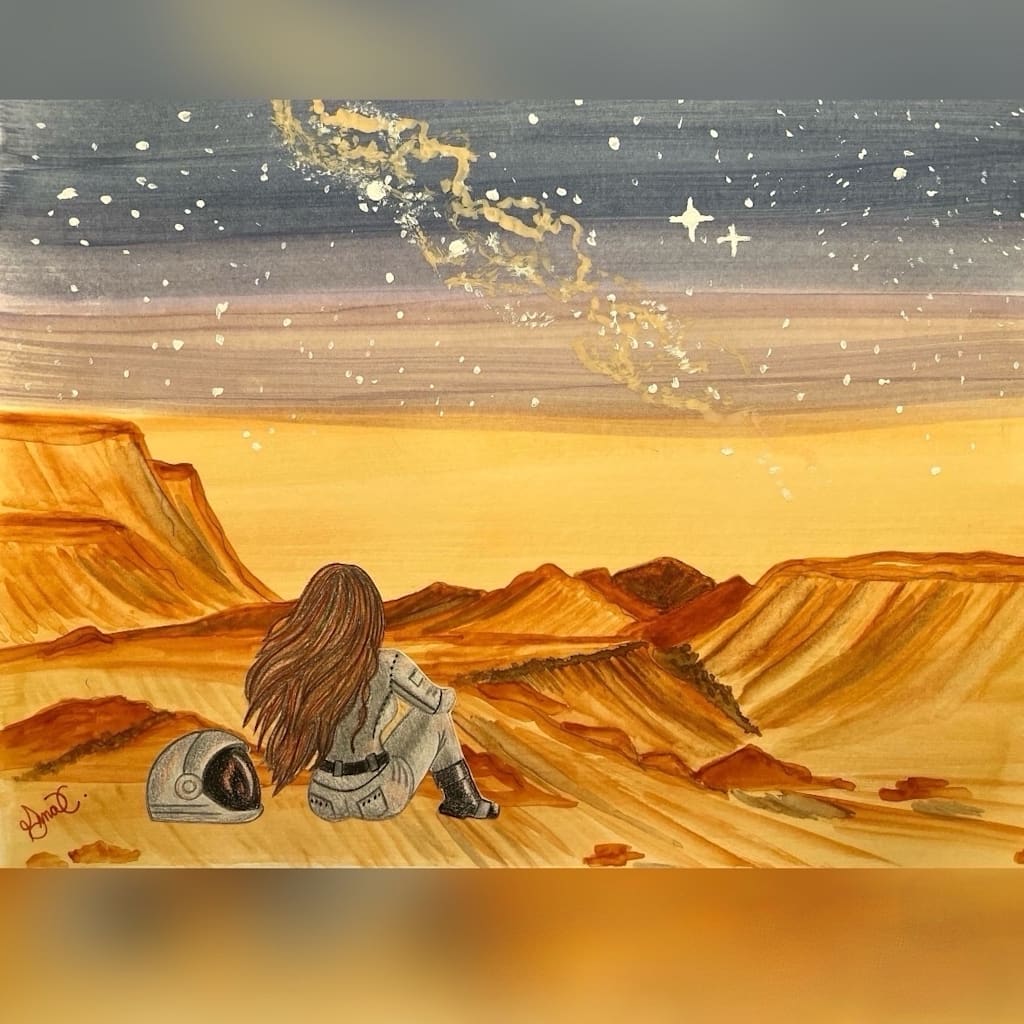
Two bright orbs glitter on the skyline, and you can’t help but think of her. She’s always the most visible during the winter season, when the mother planet and her small moon directly oppose the sun. It’s then when your two worlds are in closest proximity to one another.
You take your eyes off her only long enough to glance back at the bubbles—a constellation of tiny dew drops strewn across the red, barren desert. You can’t be certain if anyone has noticed you’re missing. You pray they forget all about you. You plead to God they don’t discover what you’re up to out here.
You’re still searching for movement when a small twinge skims across your scalp. You grimace, bracing for the voice that follows. A half-breath later, your neural augmentation needles your temple again.
Bzzzt.
Advisory: Boundary violation. Twenty-eighth warning.
Return to the greenhouse immediately.
Remember. Mars means hope.
You reorient, then ignore it. The voice has become far more integrated into your thoughts than it was only weeks ago. Though thirty percent of your native cognition is now artificial, you are still a visual being. Seventy percent of you is still unengineered—still human.
So you tell it to shut the fuck up.
“Override,” you mutter. “She needs me.”
The alarm falls silent for the twenty-eighth time.
You return your gaze to where she glows on the horizon. Northeast, you think. Altitude: twenty-three degrees, exactly. Just where I imagined you’d be, sweet pea.
You pull out your worn, dust-laden notepad and jot down her coordinates. Some small measure of relief settles into your bones. Keeping sight of her this way is how you’ve managed to convince yourself you are still her mother.
You just wish you had something of her you could touch.
You sigh, watching your breath fog the polycarbonate of your visor. It’s only a matter of months before her Starship arrives. Soon, you’ll have her in your arms again.
Her.
You pocket your notepad, then brush the fingers of your smart gloves across the regolith. You’ve been out here for hours, kneeled on the rust-colored surface. Imagining what her face might now look like, you close your eyes. You feel you could sculpt her from air at this point—though there’s still not enough of that here beyond the bubbles.
Yet.
You contemplate the red world before you. It’s been six years since you’ve created something. You can still feel her newborn skin cradled against your heaving, damp chest. The parts of your brain that remember how to love cling to the sweet scent of her scalp.
Will the pediatric memory implant work? you wonder. Will she remember me?
Back on the blue and green planet, she’s already in first grade. You’ve missed so much of her life at this point: her first smile, her first steps, her first day of school.
“Mars means hope,” Everard Markes had assured you. You loathed the way it sounded, the earnestness on his face as he said it—the spectacle of a plutocrat dabbling in amateur poetry. You’d spent the better part of your years in research avoiding men like him—men with money, with messiah complexes. You never followed the busywork of billionaires much until one bought his way into the government.
You stared at him, still trembling in the aftermath of her birth. How had he gotten into your room? You didn’t remember authorizing any visitors. The labor and delivery droids tried to pry her away from you, bringing your skin-to-skin contact to an abrupt end. You couldn’t understand why they’d been programmed this way. Was this his doing?
Her birth was the 74th that had occurred on a worldwide scale that year. She was a miracle. You were a miracle. The truth suddenly lay bare before you—he wanted to be a miracle, too.
You pulled her small body closer, batting the metallic claws away from the both of you like a lioness.
“Tell me how it means ‘hope’ if I have to leave her behind,” you snarled.
Markes only regarded you. The texture of his skin was like raw poultry under the hospital’s harsh lighting.
“Join us, Moira. Help us grow a better, safer world for her. For all of our children. Your skills are needed on the settlement mission.”
He was referring to your work as an astrobotanist with UC Berkeley—to your award-winning thesis and your leading role with the Mars Desert Research Station in Utah.
You scoffed, then told him to go to hell. The world had turned to shit, sure, and you feared for her future, of course—but there were plenty of other esteemed plant pathologists who would jump at the opportunity. There were specialists whose children were grown, who wouldn’t need to leave infants in the care of nanny-bots. There was no way you could ever abandon her.
“There’s no way I could ever abandon you,” you whisper, staring up at the stars. You’re still kneeling in the midst of this bleak, austere planet that will soon be her home. Drawing a breath, you center yourself once again on the sensation of the regolith pulsing through your gloves, your fingers beginning to sculpt soft crescents. The misplaced energy between her and you must be expressed, you’ve decided. You just haven’t figured out how.
Pressing deeper into the dust, you repeat to her: “There’s no way I could ever abandon you.”
Speaking to her from such a distance like this, your voice is a goldfish. It swims around in your space helmet, penned in. It seems pointless.
Then again, there’s a part of you that believes specks of your words can break space barriers. A sliver of you subscribes to the thought she can hear you.
But you’re no longer certain from where that sliver derived.
It doesn’t matter, you remind yourself. Speak words.
Every sound, every syllable, every fragment of speech is being stored by the quantum computing microchip on your right temple. From there, they’ll be transferred to her pediatric memory implant. The memory implants are how Markes promises the time you’ve lost with her will be worth it.
“She’ll have no memory of growing up without you,” he had said. “Speak to her. The device will interpret a mutually shared past from which it will train your memory centers. The hippocampus is moldable, Moira. Mars means hope.”
The hippocampus is moldable, Moira. His words lace through the part of your mind that still dares to question. To doubt. To resist. Words, words, words—words that entreat the mother in you. Words you want desperately to believe.
So, you speak to her.
“Mars means hope” has become the motto here. For the most part, it’s a blessing. Falling into the abyss of pessimism—of succumbing to the fear your children won’t know you when they arrive—would threaten the mission. The better, safer world you’ve all surrendered so much to build would be worthless.
So, you speak to her.
“There’s no way I could ever abandon you,” you repeat, “Mommy loves you—I’ve always loved you. You’ll be safe with me, just as you’ve always been. I’ve always been a part of your life.”
You say the words, you speak to her. You speak to her, you say the words.
But there’s nothing tangible for you to cling to while you rehearse them. You feel you could write your story more fully into existence if you had something holdable. Something soft. To recreate a childhood for her—one that’s warm and loving—you need something beautiful.
What could possibly be allowed to be beautiful here? you wonder.
You take up a small clump of regolith and squeeze it in your palm. You study it, wishing the answer would come to you. Some fragments crumble away to the ground. Some stay in the nest of your smart glove, waiting.
“Come on,” you say to your hands, “do what I brought you here for.”
When they do nothing, a wild longing thrums against your ribs. For the past four nights, you’ve come out here in secret to dream of her. To give the thought of her substance. You’ve come out here despite the risk.
You glance again at the bubbles. At those glistening terrariums of life—the seeds, you’re promised, of your children’s civilization.
“What business beyond the greenhouse do you have out here?” they’d surely demand.
Then again—no. They would not be so curious.
“You’ve violated the colony’s code of ordinances.”
That would be it. That is all they would concern themselves with.
Is my being here violating my role as a mother? you begin to hear yourself wonder. The thought gnaws at the edges of you no sooner than the twinge, all too familiar with its trajectory, crawls along your skull.
Bzzzt.
Advisory—
“Override,” you say, giving your visor a hard knock with your fist. “Damn you, get out of my thoughts!”
But it will not be silenced this time.
Go no further. Return to the greenhouse. Your assigned role is overseeing the settlement’s food and oxygen source.
Remember. Mars means hope.
“No!” you snap. Your pulse wars against the needling—refusing the decree that your life is now harvesting carrots and sweet potatoes 140 million miles away from her.
“No—I won’t. Something else must be cultivated here.”
The words spill from your mouth, small but immune. A bud of some caged, locked away part of you that refuses to be relinquished, taking root.
Your eyes fall once again to your gloves. Removing them outside the bubbles is dangerous, you know. The low atmospheric pressure of Mars could cause frostbite. Even death.
But you yearn to immerse yourself into this esurient energy. You can’t resist the thought that something extraordinary might blossom here—that you could fill this desolate world with something more than just dust.
Because she is deserving of so much more than survival.
She is deserving of beauty.
Your longing overcomes your better judgement. Grabbing the wrist of your right glove, you gather your resolve. You then pull the protective barrier from your skin. The cold finds your bones at once. You wince before burying your flesh into the planet.
There’s an immediate surge through your veins just as the slow creep returns.
Hazard: Unprotected dermal contact. First warning.
Do not touch—cease exposure immediately.
Remember. Mars means hope.
“No—override!”
It takes a moment, but you manage to steady your heartbeat. Or perhaps it is the regolith that eases you. The energy derived from its perchlorate salts is palpable. Electrifying. Almost animate. Absorbing it, a smile widens across your cheekbones. It feels like sand after the waves.
You begin to drift. Nostalgia is an ocean that swells and ebbs over your senses. You sink into the memory of digging for sand crabs—of tickling life scattering from your grasp.
“You and I are on the beach,” you say. You pray that somewhere on a swing in the sunset, she’s being filled with images of the two of you on the shoreline. You’re both laughing and jumping in the waves. You’re building great, tall sandcastles. You’re together.
“Do you see it, sweet girl?” you ask her, “Can you imagine our story?”
You watch as her dimples—the ones you’ve always imagined she has, the same ones that dent your own cheeks, as they once did those of your grandmother—blossom along with her luminous smile.
A tear slips toward your chin. Words seem artificial—too hollow to render all you envision. They still aren't enough. How can you convey this love that you have for her?
The atmosphere narrows around the dust in your glove-free hand. God, the particles of nontronite and saponite—they have so much potential out here in the open. You’ve worked with the regolith plenty as a botanist, sure, but you’re used to handling it in the greenhouse. There, it’s been irradiated. Tamed. In their wild state, these minerals have promise. C’mon, what can you make here?
For six years, you’ve worked tirelessly to become one with this world. You all have. After 72 months of struggling to survive, your team has done it: you’ve established a sustainable way of life on the red planet. Food, water, oxygen, and shelter have all been streamlined. The Martian Society operates like a flawless machine. The year is now 2052. Mars is now ready for your children.
For her.
But you’re not quite comprehending how you’ll welcome your children here. How this place will ever be enough for her. Now that you’re no longer fueled by the fight to keep yourselves alive, something remains wanting. Insistent. But what?
I know what, you think to yourself, I know exactly what.
You must plant a new type of garden. And you must do it for her.
You can’t be the only one that feels this way. But you’d be a fool to believe anyone would join you in this quiet rebellion. Markes makes it clear that practicality is to be prioritized in the colony—that creativity is a distraction.
“Mars is too dangerous for artistic diversions,” he reminds you. His words are now integrated into your morning routine. They swirl into your coffee and follow you to your workstations. “We must always stay disciplined.”
He allows you words, of course. The words you speak into the stars for your children—the ones he assures will fill the gaps in their memories, will soothe your parental unrest, as he calls it. The ones that are being stored by the microchips on your temples.
And in the beginning, those words were almost enough. Your spirits feasted on them. Your souls were fueled by the promise of their arrival—by the belief this was all for them.
For her.
For her.
But now that you’ve built her this habitat to survive you, you wonder: what will be left for her to love? To remember?
What will she live for?
There must be something more.
Your limbs still, your impossible ache for her pressing outward.
Words.
Words.
Words.
You shake the voice inside of you away. “No!”
You will not let anyone dictate the way you express your love for her. You will not allow anyone to decide how it manifests within the universe.
You’re lost in thought when the thirty percent of you—altered, synthetic, algorithmic—moles back into whatever genuine part of you remains.
Advisory: Maternal unrest. First warning.
Do not think. Speak words.
Remember. Mars means hope.
“Shut up!”
You bury your hand deeper in the regolith. “Words aren’t enough,” you say to her.
You say it. You say it. You say it—
You say it despite not being able to tell whether you’re rebelling or obeying. The words feel natural. Unartificial.
They feel right.
“Words aren’t enough because you’re only six, and you won’t understand everything I have to say when you get here. Words aren’t enough because you’re too young to know the sacrifices I’ve made, even though they’ve all been for you. Words aren’t enough because I don’t have anything of us you can see, sweet girl. For you, I must do more.”
I must do more, you think. You imagine two hands reaching into the depths of you. There, the answer awaits.
Think, Moira.
For the last four nights, you’ve dreamt about sculpting something beautiful. You’ve felt your hands leading a renaissance. But the vision’s been fragmented.
What is it?
You can’t take it. The glove on your left hand goes flying to the ground. You immerse your bare hands—the same hands you’ve used to sprout green, leafy life from a barren, red planet—into the unaltered soil. Your skin tingles, becoming one with the regolith. The soil’s been waiting for you. It’s always been waiting for you.
And finally, your hands begin to work—to create something magnificent. As if guided by your bond, they mold the sediment back and forth, making soft, delicate movements. They coax. They craft. They interpret. They give shape to your love for her.
“Where’s Moira?” a voice chirps over the relay system.
Your nerves light on fire. You don’t have much time.
You work quickly, first sculpting your hearts—then your arms—from regolith. Pieces of static pop from the radio, but you do not surrender. You only work faster. Every piece of you is now present.
Advisory: Artifi—
The voice catches itself at the word almost said.
You pause, waiting for the needling. For the slow, sprawling creep.
Nothing comes.
There is only a crackle. Then a sputter.
Speak words. Speak words.
“Artistic diversion,” you correct it.
You think it. You say it.
Remember. Mars means hope.
You flinch, unable to decipher the distortion.
Unable to decipher anything other than love.
With a wild flutter at your core, you return to your hands.
You watch, almost as if in a dream, as they move to your necks and your faces. You contour your dimples, then hers. Each fragment of the both of you is connected, becoming corporeal, becoming touchable, becoming whole. You carve your hands—every crescent and crevice of them—embracing her across constellations. Across never-were memories. Across the branching and blurring of neurological realms.
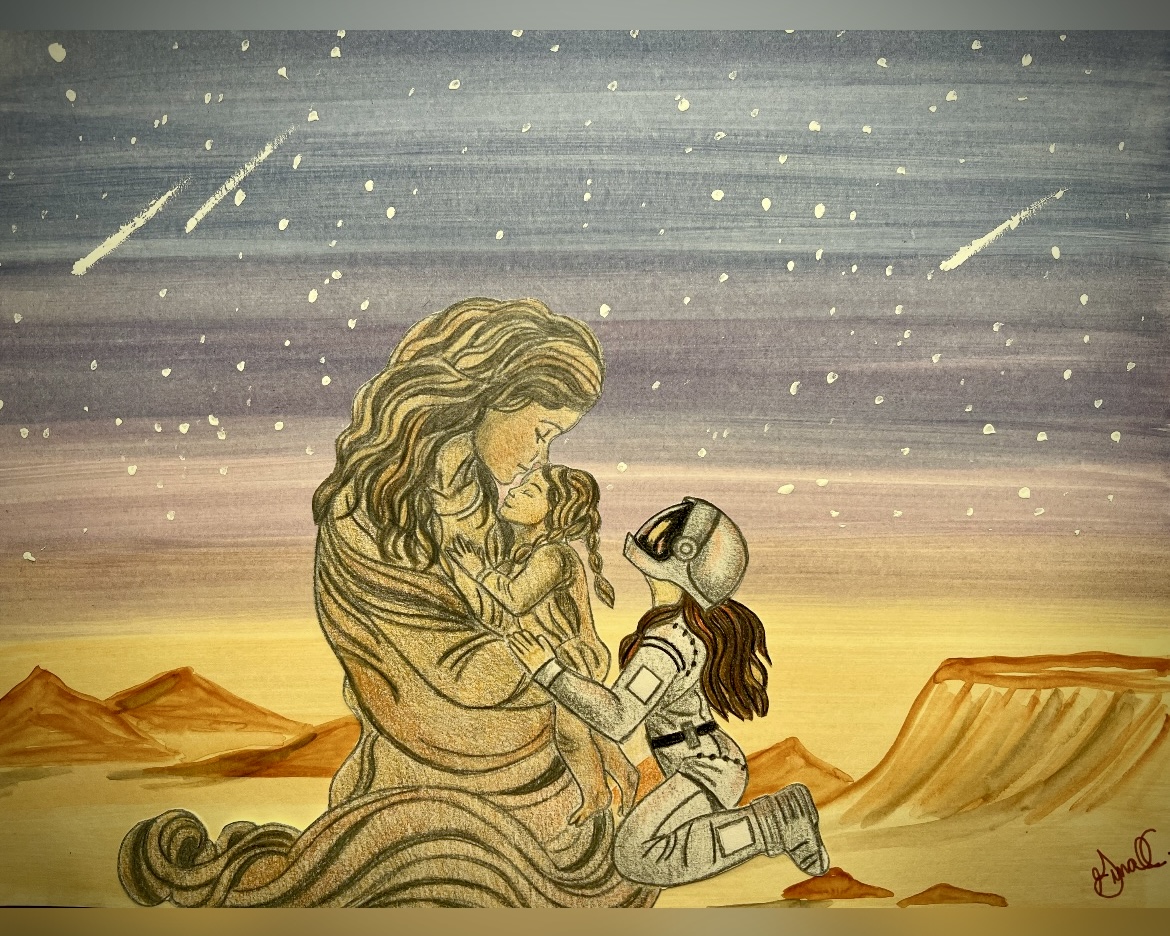
She’s snuggled into your chest. She’s safe and protected. Your chin rests on her small forehead. You plant kisses there—and there, from regolith, they bloom into a garden that makes up for the time.
“Mars means hope,” you whisper to her.
Beholding your creation, you feel you might finally believe that it’s true.
About the Creator
Gina C.
Novelist | Architect of Worlds
🖋️Literary • Speculative • Romantic Fiction
Sowing stories rooted in culture, myth, love & unapologetic womanhood.
Busy writing my fantasy books! 🐚🧚♀️🐉✨
🌱Debuting soon as Gina C. Vittoria :)
Enjoyed the story? Support the Creator.
Subscribe for free to receive all their stories in your feed. You could also become a paid subscriber, letting them know you appreciate their work.
Comments
There are no comments for this story
Be the first to respond and start the conversation.